Imagine standing beside a road as a car passes at 60 km/h. If another car follows behind at 80 km/h, it gains on the first car at 20 km/h. This feels completely natural because velocities usually add and subtract according to common sense.
Now consider something far stranger.
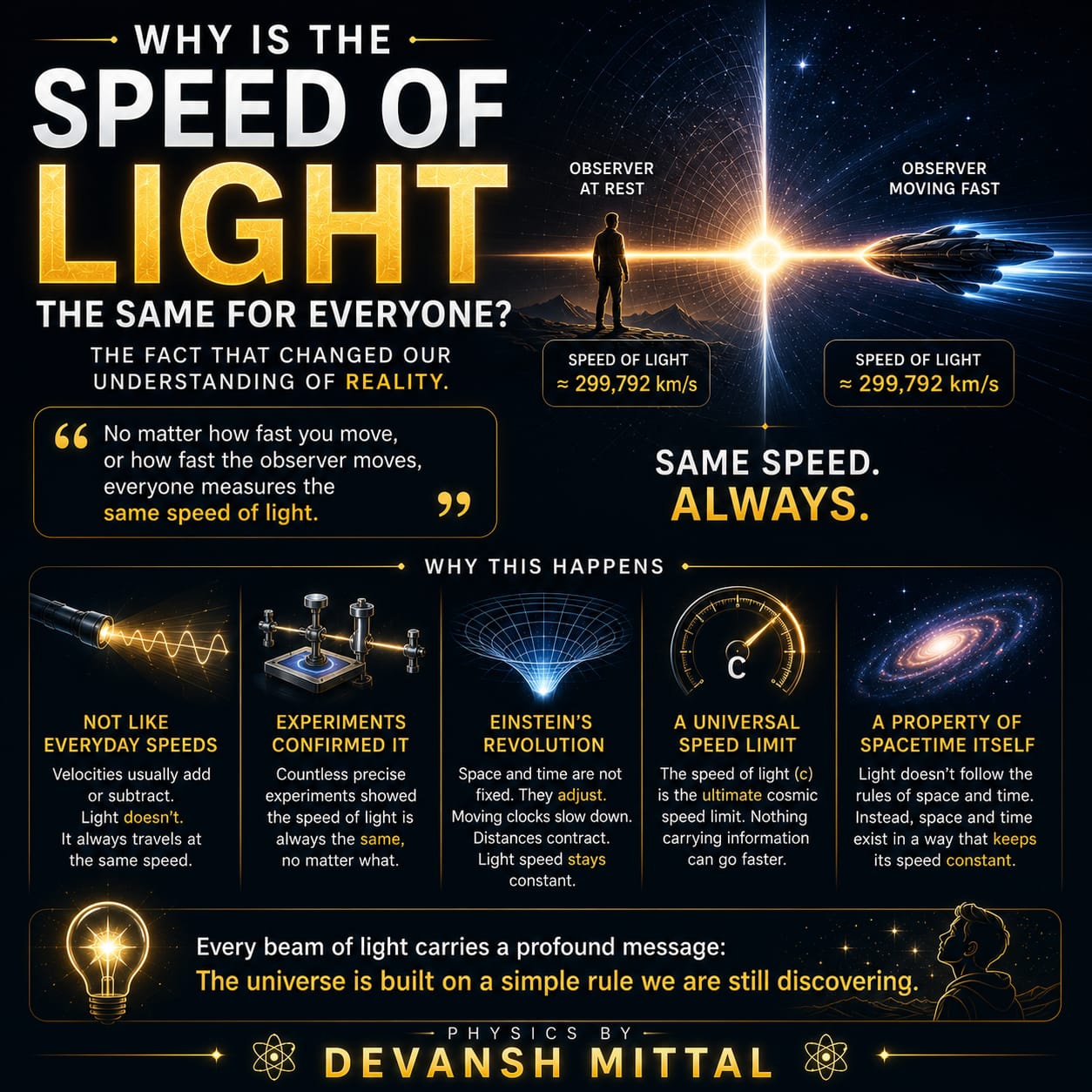
Suppose you switch on a flashlight while standing still. You measure the light leaving the flashlight and find that it travels at about 300,000 kilometers per second. So far, nothing seems surprising.
But what if you switch on the same flashlight while traveling in a spaceship at an enormous speed? Common sense suggests that the light should move faster when measured by an outside observer. Yet nature refuses to cooperate.
No matter how fast you move, and no matter how fast the observer moves, everyone measures exactly the same speed of light.
This is not a theory. It is an experimental fact.
And it may be one of the strangest facts in the entire universe.
The Experiment That Shocked Physics
In the late nineteenth century, scientists expected light to behave like sound. If you run toward a sound source, the sound seems different. If you move away, it changes again. Surely light should behave similarly.
To test this idea, physicists performed increasingly precise experiments. To their astonishment, the speed of light remained unchanged.
Every measurement pointed to the same conclusion: light does not obey our everyday intuition about motion.
The result was so shocking that it forced physicists to rethink the nature of space and time themselves.
Einstein’s Radical Insight
In 1905, Einstein proposed a bold solution.
Perhaps the speed of light is not changing.
Perhaps space and time are.
This idea sounds absurd at first. We think of space as a fixed stage and time as a universal clock. Einstein suggested that both are flexible and can adjust themselves so that the speed of light remains the same for all observers.
The consequences were extraordinary.
Moving clocks run more slowly. Distances can contract. Two observers moving relative to one another may disagree about the timing of events.
Yet through all these changes, the speed of light remains constant.
A Universal Speed Limit
The speed of light is more than the speed at which light travels. It appears to be a fundamental speed limit built into the structure of reality.
Nothing carrying information can travel faster.
Just as every mountain has a highest peak, the universe appears to have a maximum speed.
Light travels at that limit.
The Deeper Mystery
Perhaps the most beautiful way to think about it is this: the speed of light is not merely a property of light. It is a property of spacetime itself.
Light does not obey the rules of space and time.
Instead, space and time arrange themselves around this fundamental cosmic rule.
The Next Time You Switch On a Light
The next time you turn on a flashlight or see sunlight streaming through a window, remember that you are witnessing something profoundly mysterious.
The light reaching your eyes is traveling at exactly the same speed for every observer in the universe, regardless of how they are moving.
This simple fact shattered centuries of intuition, transformed our understanding of reality, and revealed that space and time are far stranger than anyone had imagined.
Sometimes the greatest mysteries are not hidden in distant galaxies or black holes.
Sometimes they arrive every morning with the sunlight.
Every morning, the Sun rises. You remember what you ate yesterday, the conversation you had a few hours ago, and perhaps even moments from your childhood decades in the past. Yet hidden within these ordinary experiences is something profoundly mysterious: you have never remembered tomorrow. Not once.
At first glance, this seems so obvious that it hardly deserves attention. But from the perspective of physics, it is astonishing. Why should the past be accessible to memory while the future remains completely hidden? Why do we experience time as flowing in one direction? This simple question leads us to one of the deepest puzzles in modern science.
The Universe Has a Secret
Imagine watching a movie of two planets orbiting each other in space. Now play the movie backward. Surprisingly, the reversed motion still looks perfectly plausible. The same is true for two billiard balls colliding on a table or an electron moving through space. In most cases, the fundamental equations of physics work equally well whether time moves forward or backward.
This is one of the most surprising discoveries in science. At the microscopic level, nature appears almost indifferent to the direction of time. The laws themselves make very little distinction between past and future.
Yet our everyday experience is built entirely around that distinction. We remember the past but not the future. We can influence tomorrow but not yesterday. Physics seems almost time-symmetric, while human experience is overwhelmingly time-directed. Somewhere between microscopic laws and everyday life, something remarkable happens.
The Movie That Feels Wrong
Consider a glass falling from a table and shattering on the floor. Everyone immediately recognizes this as a normal event. Now imagine watching the same video in reverse. The scattered fragments suddenly leap together, assemble themselves into a perfect glass, and jump neatly back onto the table.
Nothing about the fundamental laws governing the atoms explicitly forbids such a process. Yet we instinctively know it never happens. The reversed movie feels absurd because it violates one of the most important statistical tendencies in nature.
The key to understanding this tendency is entropy.
The Tyranny of Probability
Entropy is often described as a measure of disorder, but a more accurate description is that it measures how many microscopic arrangements correspond to a particular macroscopic state.
An intact glass sitting on a table can exist in only a relatively small number of microscopic configurations. A shattered glass, however, can exist in an unimaginably larger number of configurations. There are vastly more ways for the pieces to be scattered than for them to be perfectly assembled.
As a result, nature overwhelmingly tends to move toward states that can be realized in more ways. This is not because nature has goals or intentions. It is simply a matter of probability. The shattered-glass state wins the statistical lottery by an enormous margin.
A Universe That Constantly Hides Information
Imagine placing a drop of ink into a glass of water. Initially, the ink occupies a tiny region. Over time, it spreads throughout the entire glass until it becomes uniformly mixed.
What happened to the information about the ink’s original location? Surprisingly, it was not destroyed. Instead, it became distributed among countless water molecules in extraordinarily complex ways. In principle, the information still exists. In practice, it has become effectively impossible to recover.
The universe rarely destroys information outright. More often, it disperses it so thoroughly that reconstruction becomes hopelessly difficult. The past has not vanished; it has simply been hidden.
Why Memory Points Only One Way
This brings us to the deepest part of the story. The reason you remember the past may be intimately connected to entropy itself.
A memory is not an abstract object. It is a physical record stored in matter. When your brain forms a memory, neurons modify their connections, energy is consumed, heat is generated, and entropy increases. Every memory is a physical trace left behind by an event.
This explains why memories point only toward the past. Yesterday physically interacted with your brain and left records behind. Tomorrow has not yet done so. No interaction has occurred, no trace exists, and therefore no memory can exist.
In this sense, memories are fossils of irreversible physical processes. Every remembered experience is evidence that entropy has already increased.
The Arrow Hidden in Every Photograph
The same idea extends far beyond human memory. Every photograph records a moment from the past because light from an event reached a camera and altered physical matter inside it. The event created the record; the record did not create the event.
This asymmetry appears everywhere. Footprints reveal where someone has been. Smoke reveals that a fire occurred. Fossils reveal organisms that once lived. Memories reveal experiences that already happened. Every piece of evidence in the universe points backward in time.
The arrow of time is written into the very concept of a record.
The Greatest Mystery of All
At this point, it may seem that the problem has been solved. Entropy increases, and therefore time appears to move forward.
But this answer immediately raises an even deeper question: why was entropy lower in the past?
Entropy can only increase if it starts from a relatively low value. Modern cosmology tells us that the early universe, shortly after the Big Bang, existed in an extraordinarily low-entropy state. Not merely low, but astonishingly low.
This fact may be the ultimate source of the arrow of time. Every broken egg, every memory, every aging face, every historical event, and every civilization may ultimately trace its existence to this remarkable initial condition of the cosmos.
We Live Inside a Cosmic Avalanche
A useful analogy is a mountain covered with snow. The early universe was like a snowpack balanced high on a slope. Once the process begins, the snow naturally moves downward. The avalanche unfolds.
Similarly, the universe has been evolving from its extraordinarily special low-entropy beginning toward states of higher entropy. Along the way, stars formed, galaxies emerged, planets developed, life appeared, and conscious beings began creating memories.
The arrow of time is not something separate from these processes. It is the unfolding of the entire cosmic story.
The Final Surprise
Perhaps the most astonishing possibility is that the flow of time itself may not be a fundamental feature of reality. The microscopic laws of physics are largely indifferent to past and future. What we experience as the passage of time may emerge from statistics, information, and the extraordinarily special conditions present at the birth of the universe.
In other words, the future may not be hidden because physics forbids us from seeing it. It may be hidden because the universe began in a state so extraordinarily improbable that everything we call history has been the gradual unfolding of that initial condition.
Every memory you possess is therefore more than a record of your personal past. It is also a clue to one of the deepest mysteries in science. The simple fact that you remember yesterday but not tomorrow may ultimately be telling us something profound about the origin of the universe itself.
Between you and your phone, between Earth and the Moon, and even between galaxies, there appears to be nothing at all.
We call it “empty space.”
But modern physics has uncovered a remarkable truth:
Empty space may be one of the most active things in the universe.
In fact, what we casually call “nothing” is not really nothing.
It is something far stranger.
A Lesson from a Coffee Cup
Imagine placing a coffee cup on a table.
You might think the cup is made of solid matter and the air around it is empty.
Surprisingly, the cup itself is mostly empty space.
If every atom inside the cup were enlarged so that its nucleus became the size of a marble, the electrons would orbit hundreds of meters away. Almost all of the cup’s volume would be empty.
So even “solid” objects are largely made of emptiness.
But then another question appears:
What exactly fills the space between those atoms?
The Vacuum That Refuses to Stay Quiet
According to classical physics, a vacuum is simply a region with nothing inside it.
Quantum physics shattered this picture.
In the quantum world, space behaves more like a restless ocean than a silent void.
Even when all particles are removed, invisible quantum fields remain.
These fields constantly fluctuate.
Tiny particle-antiparticle pairs briefly appear and disappear.
Physicists call these events “quantum fluctuations.”
The vacuum is therefore not empty. It is alive with activity that normally remains hidden from our senses.
Nothing Can Push
This sounds impossible.
How can “nothing” exert a force?
Yet experiments show exactly that.
When two extremely smooth metal plates are placed incredibly close together in a vacuum, they experience a tiny attraction.
This phenomenon, known as the
Casimir Effect
arises because quantum fluctuations in empty space are altered between the plates.
The force has been measured experimentally.
In other words, “empty” space can physically push and pull objects.
Space Is Not a Stage—It Is an Actor
Many people imagine space as a passive background where cosmic events unfold.
Modern physics tells a different story.
Space bends around stars and planets.
That bending is what we perceive as gravity.
According to General Relativity, Earth is not being pulled through space by an invisible force. Instead, Earth moves through curved spacetime created by the Sun.
Space itself participates in the drama of the universe.
It is not merely the stage.
It is one of the actors.
The Biggest Mystery in the Cosmos
The story becomes even stranger.
Astronomers have discovered that the expansion of the universe is speeding up.
Something appears to be pushing galaxies apart faster and faster.
One possible explanation is that empty space itself contains energy.
This mysterious phenomenon is known as
Dark Energy.
Today, dark energy is thought to make up most of the cosmic energy budget.
Think about that for a moment.
The dominant ingredient of the universe may be hidden within what we call “empty” space.
What Does “Nothing” Really Mean?
The deeper physicists investigate reality, the more difficult it becomes to define nothingness.
A truly empty universe may not even be possible.
Even the vacuum possesses structure, energy, fluctuations, and physical consequences.
What appears to be a featureless void is actually a dynamic fabric woven into the workings of nature itself.
The Next Time You Look at the Sky…
On a clear night, look up at the dark space between the stars.
It may seem like the emptiest place imaginable.
Yet that darkness is not a barren void.
It is a restless quantum arena, a flexible geometric fabric, and perhaps the reservoir of the mysterious energy driving the expansion of the cosmos.
The greatest surprise of modern physics is not that the universe contains extraordinary things.
It is that what appears to be nothing may be one of the most extraordinary things of all.
We usually think gravity pulls only on things that have mass.
A falling apple has mass. A planet has mass. You have mass.
But light has no mass.
So why does light bend near a black hole?
This question confused scientists for centuries — until Einstein completely changed our understanding of gravity.
Gravity Is Not Really a Force
According to Isaac Newton, gravity is a force between masses.
But Einstein introduced a much deeper idea.
He said gravity is actually the bending of space and time itself.
Imagine placing a heavy bowling ball on a stretched rubber sheet. The sheet bends around the ball. If you roll a marble nearby, the marble curves toward the bowling ball — not because the ball is “pulling” it directly, but because the surface itself is curved.
Einstein proposed that space behaves in a similar way.
Massive objects bend the fabric of spacetime around them.
Light Always Travels Straight — But Space Is Curved
This is the key idea students often miss:
Light always tries to move in the straightest possible path.
But if space itself is curved, then the “straight path” also becomes curved.
Imagine walking straight on the curved surface of Earth. Even though you feel you are moving straight, your path curves around the planet.
Similarly, near a black hole, spacetime becomes extremely curved. So light follows that curvature.
As a result, light bends.
Why Black Holes Bend Light So Strongly
A black hole contains an enormous amount of mass compressed into an incredibly tiny region.
This creates extreme spacetime curvature.
Near the black hole, the bending becomes so intense that light can:
curve around the black hole,
orbit it temporarily,
or even become trapped forever.
The boundary beyond which light cannot escape is called the event horizon.
Once light crosses this boundary, escaping becomes impossible.
That is why black holes appear black.
We Have Actually Observed This
This is not just theory.
Scientists have observed stars appearing in shifted positions because their light bends around massive objects. This phenomenon is called gravitational lensing.
Sometimes a distant galaxy even appears stretched into rings or arcs because its light bends around another massive galaxy lying in front of it.
Einstein predicted this long before telescopes could observe it.
Later, experiments proved him correct.
The Deep Idea
Black holes do not “grab” light like a vacuum cleaner.
Instead, they bend spacetime so dramatically that every possible path light can take curves inward.
In other words:
Black holes bend light because they bend spacetime itself.
Why Electricity Travels Almost at the Speed of Light
The Surprising Truth About Electric Fields and Electromagnetic Waves
When you switch on a light bulb, it glows almost instantly.
When you press the power button on your computer, electrical signals race through billions of circuits in a tiny fraction of a second.
But here is the surprising part:
The electrons inside the wire actually move very slowly.
In many household wires, electrons drift at only a few millimeters per second — slower than a crawling ant.
So how can electricity seem to travel almost at the speed of light?
The answer reveals one of the deepest ideas in Physics:
Electricity is not mainly about electrons traveling rapidly through wires. It is about electric fields and electromagnetic disturbances propagating through space.
The Common Misconception
Most students imagine electricity like water flowing through a pipe:
electrons are like water molecules,
the wire is the pipe,
and electricity means electrons rushing rapidly from one end to another.
This picture is only partly correct.
The electrons themselves move slowly.
What moves rapidly is the electromagnetic signal.
Drift Velocity: The Slow Motion of Electrons
Metal wires already contain countless free electrons even before the circuit is switched on.
When a battery is connected, these electrons begin drifting in one direction. This average motion is called drift velocity.
Surprisingly, this drift velocity is extremely small.
An individual electron may take minutes or even hours to move a short distance through a wire.
Yet the bulb glows almost instantly.
Clearly, something else must be happening.
A Simple Analogy
Imagine a long pipe completely filled with tightly packed balls.
If you push one ball at one end, the ball at the opposite end moves almost immediately.
But the same ball did not travel across the pipe. Instead, the disturbance traveled rapidly through the system.
Electricity behaves similarly.
The electrons already exist throughout the wire. When an electric field is established, electrons everywhere begin responding almost simultaneously.
The Real Hero: The Electric Field
The moment you connect a battery, an electric field is created inside and around the wire.
An electric field exerts force on charges and pushes electrons throughout the circuit.
The important point is this:
The electric field propagates extremely rapidly — close to the speed of light.
So the fast behavior of electricity is mainly due to the rapid propagation of the electric field, not because electrons themselves are moving extremely fast.
Electricity Is a Field Phenomenon
This is one of the great conceptual shifts in modern Physics.
Electricity is not merely the motion of particles.
It is fundamentally a phenomenon of fields.
Electric and magnetic fields carry:
energy,
momentum,
and information.
The electrons simply respond locally to these fields.
Electromagnetic Waves and Maxwell
A changing electric field creates a magnetic field.
A changing magnetic field creates an electric field.
This beautiful interplay allows electromagnetic disturbances to propagate through space as electromagnetic waves.
This revolutionary idea was discovered by James Clerk Maxwell.
Maxwell realized that light itself is an electromagnetic wave.
That means:
radio waves,
microwaves,
visible light,
X-rays,
are all forms of the same electromagnetic phenomenon.
Electrical signals in wires are deeply connected to this same physics.
Real-World Examples
Switching On a Light
When you press a switch:
the electric field spreads rapidly through the circuit,
electrons everywhere begin responding,
the bulb glows almost instantly.
The electrons inside the bulb do not come all the way from the battery.
Internet and Communication
Modern communication depends on fast electromagnetic propagation through:
cables,
fiber optics,
antennas,
and satellites.
Without electromagnetic waves, the modern digital world would not exist.
Final Takeaway
The next time you switch on a light, remember:
the electrons themselves move slowly,
but the electric field spreads through the circuit extremely rapidly,
carrying energy and information almost at the speed of light.
Electricity is not merely the movement of electrons.
It is the dance of electromagnetic fields across space.
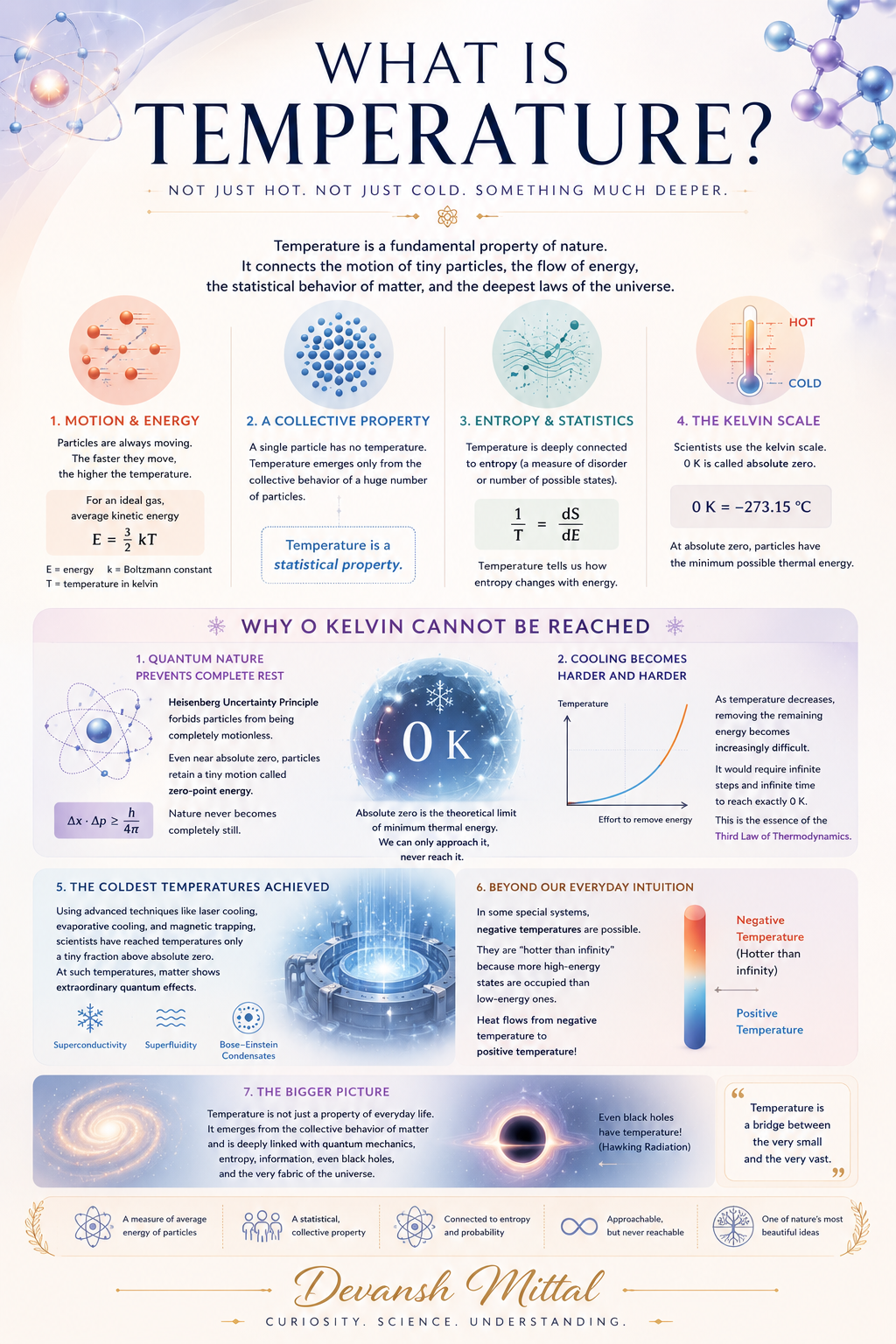
Temperature is something we experience every day. We say that tea is hot, ice is cold, and the weather is warm or cool. But in physics, temperature is much deeper than just the feeling of “hotness” or “coldness.”
Modern science tells us that temperature is related to the motion and energy of tiny particles such as atoms and molecules.
Temperature and Particle Motion
All matter is made of particles that are always moving.
In hot objects, particles move faster.
In cold objects, particles move slower.
For an ideal gas, the average kinetic energy of particles is:
E = (3/2) × k × T
where:
E = average kinetic energy
k = Boltzmann constant
T = temperature in kelvin
This means temperature is connected to the average energy of random particle motion.
Temperature Is a Collective Property
A single molecule does not have a temperature.
Temperature appears only when a very large number of particles are considered together.
So, temperature is a “collective” or “statistical” property of matter.
Temperature and Entropy
Modern physics also connects temperature with a very important idea called entropy.
Entropy measures the amount of disorder or the number of possible microscopic arrangements inside a system.
Higher temperature generally means particles can arrange themselves in more possible ways.
Lower temperature means fewer possible arrangements.
The deep thermodynamic relation is:
1/T = dS/dE
where:
T = temperature
S = entropy
E = energy
This equation shows that temperature is deeply connected to how energy and disorder are related in Nature.
The Kelvin Scale and Absolute Zero
Scientists use the kelvin scale for temperature.
0 K is called absolute zero.
0 K = −273.15°C
At absolute zero, particles have the minimum possible thermal energy.
Why Zero Kelvin Cannot Be Reached
According to modern physics, reaching exactly 0 K is impossible.
There are two major reasons.
1. Heisenberg’s Uncertainty Principle
Quantum mechanics tells us that particles can never become perfectly motionless.
According to the Heisenberg Uncertainty Principle:
Δx × Δp ≥ h/(4π)
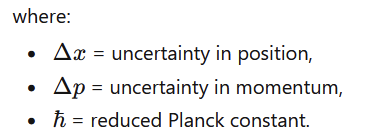
where:
Δx = uncertainty in position
Δp = uncertainty in momentum
h = Planck’s constant
This means we cannot know both the exact position and exact momentum of a particle at the same time.
If a particle became completely motionless at 0 K, its momentum would become exactly zero, which would violate quantum mechanics.
Therefore, even near absolute zero, particles still possess a tiny unavoidable motion called:
Zero-point energy
So Nature never becomes completely still.
2. Cooling Becomes Harder and Harder
As temperature decreases:
particles lose energy,
but removing the remaining energy becomes increasingly difficult.
Scientists can get extremely close to 0 K, but they can never reach it exactly.
This idea is part of the Third Law of Thermodynamics.
The Coldest Temperatures Ever Created
Using advanced techniques like laser cooling, scientists have cooled matter to temperatures only a tiny fraction above absolute zero.
At such temperatures, strange quantum effects appear, including:
superconductivity,
superfluidity,
Bose–Einstein condensates.
These states help scientists study the quantum world.
Modern Understanding of Temperature
Today, physicists understand temperature as:
a measure of the average energy of particles,
a statistical property of many particles together,
a quantity deeply connected with entropy,
and a concept linked with quantum mechanics.
Temperature is therefore not just about “hot” and “cold.” It is one of the fundamental ideas that helps us understand the microscopic behavior of matter and the deeper laws of the universe.
Temperature is one of the most familiar quantities in physics, yet its true meaning is remarkably profound.
At the microscopic level, temperature measures the average random kinetic energy of particles in a system. In simpler terms:
The faster the particles move randomly, the higher the temperature.
In gases, particles move freely in all directions. In solids, atoms vibrate about fixed positions. As thermal motion increases, temperature rises.
Thus, temperature is fundamentally connected to microscopic motion.
What Happens When Temperature Decreases?
When a body cools:
particle motion decreases,
vibrations become weaker,
and the average kinetic energy reduces.
This naturally leads to an important question:
Can particle motion become completely zero?
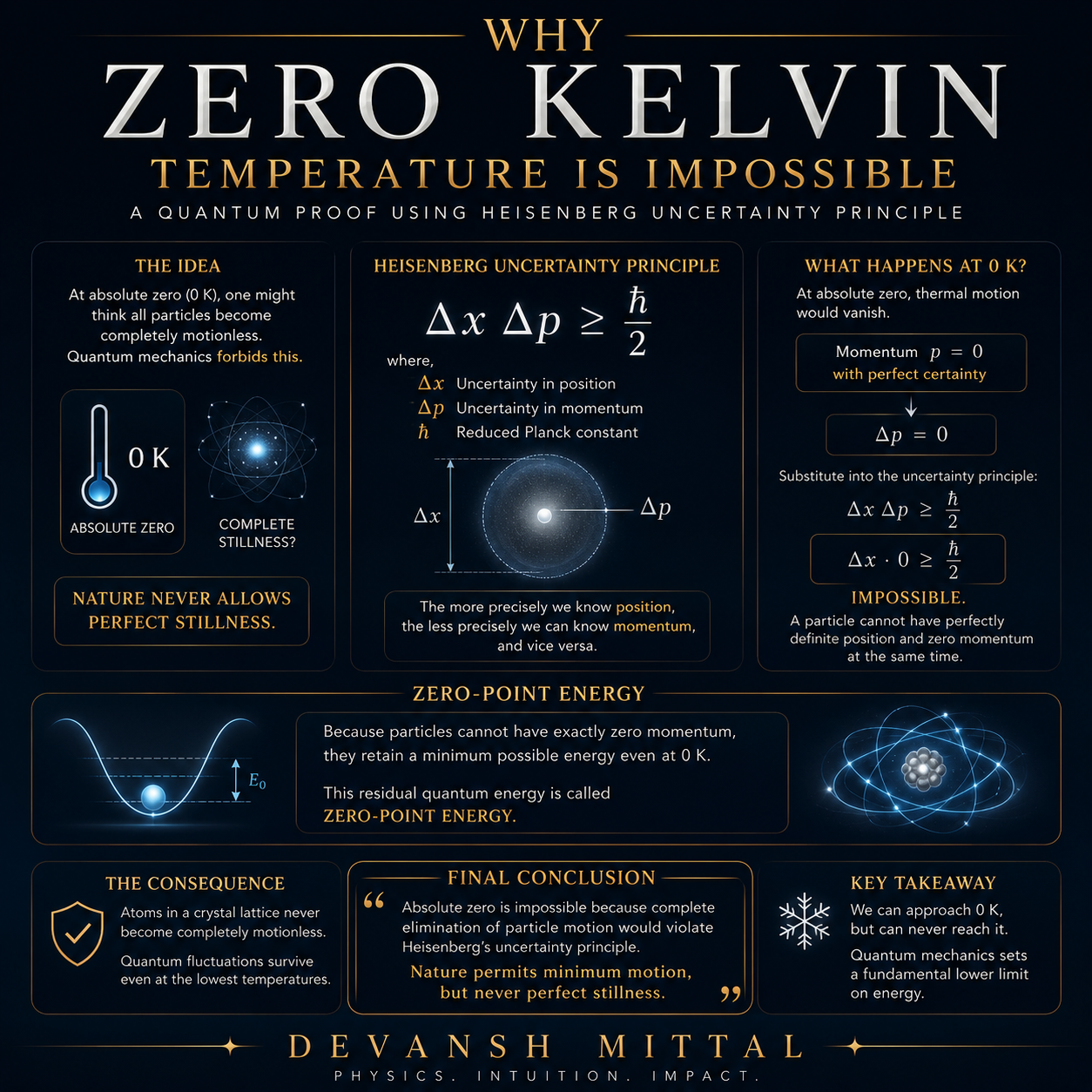
If that were possible, the system would reach the lowest possible temperature: 0 K, called absolute zero.
Classically, one might imagine that at 0 K all particles become perfectly motionless.
Quantum mechanics, however, forbids this possibility.
Heisenberg’s Uncertainty Principle
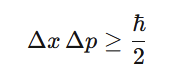
One of the foundational principles of quantum mechanics is Heisenberg’s uncertainty principle:
This principle states that a particle cannot simultaneously possess:
perfectly definite position,
and perfectly definite momentum.
This is not a limitation of measurement instruments. It is a fundamental law of nature.
Why Absolute Zero Is Impossible
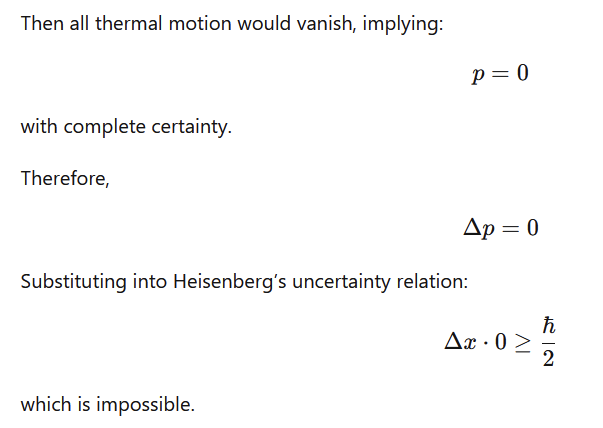
Suppose a particle inside a solid reaches absolute zero.
Hence a particle cannot simultaneously have:
zero momentum,
and a definite position inside matter.
Some residual momentum uncertainty must always remain.
As a result, particles retain a minimum unavoidable motion even at extremely low temperatures.
This residual energy is called zero-point energy.
Zero-Point Energy
Even near 0 K:
atoms in a crystal continue to vibrate slightly,
electrons retain quantum motion,
and complete stillness never occurs.
Nature permits minimum motion, but never perfect stillness.
Thus:
Absolute zero can be approached indefinitely, but never perfectly reached.
Final Conclusion
Temperature is a measure of microscopic random motion. As temperature decreases, this motion reduces, but quantum mechanics prevents it from becoming exactly zero.
Heisenberg’s uncertainty principle ensures that particles can never possess both perfectly definite position and zero momentum simultaneously.
Therefore:
0 K is Fundamentally Unattainable.
Absolute zero is not merely technologically difficult — it is forbidden by the quantum structure of nature itself.
Why Pressure in a Fluid Acts Equally in All Directions
One of the most fundamental results in fluid mechanics is:
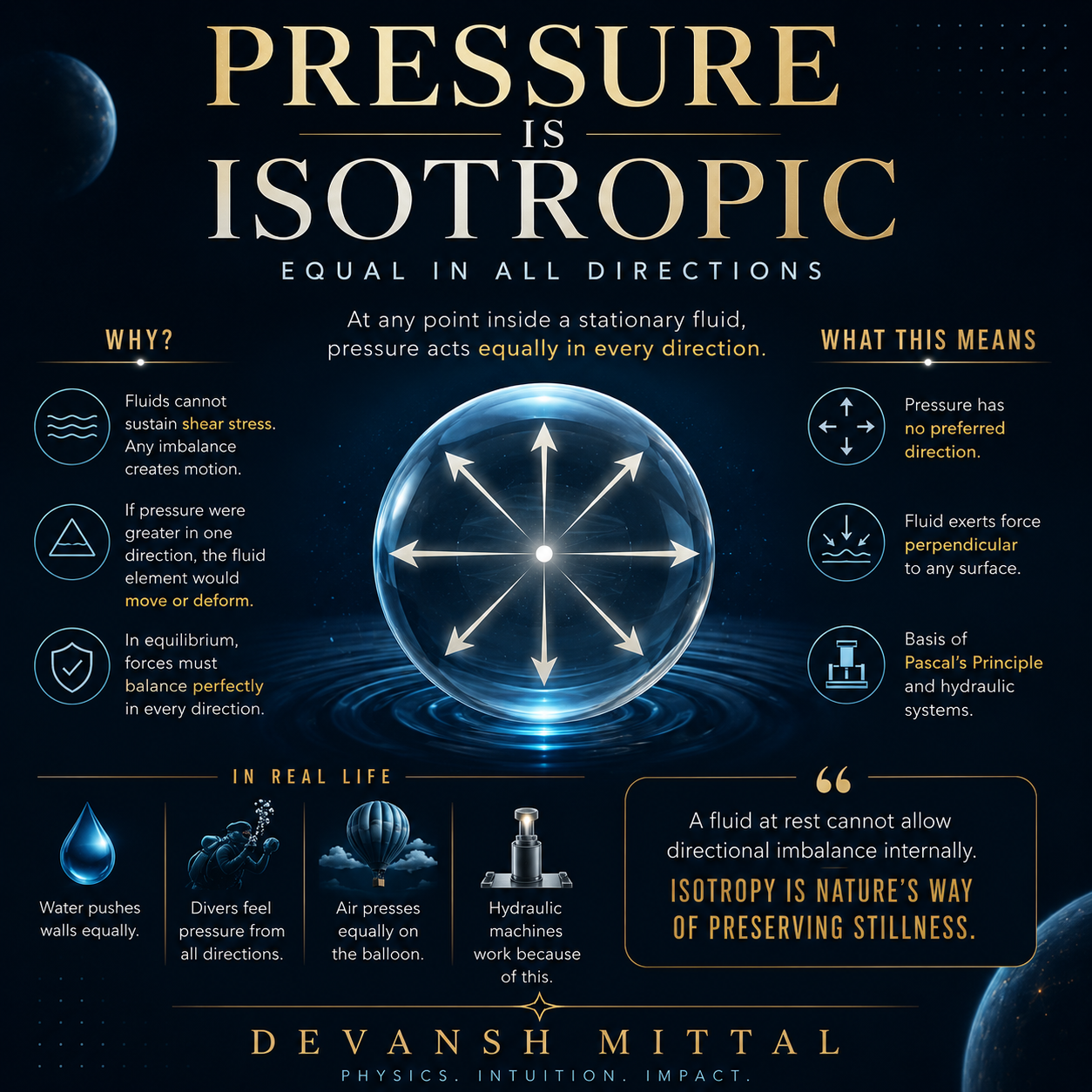
At a given point inside a stationary fluid, pressure acts equally in all directions.
This property is called the isotropy of pressure.
At first glance, the statement appears intuitive. Yet it emerges from a deep physical requirement: a fluid at rest cannot sustain shear stress.
The Core Physical Idea
Unlike solids, fluids cannot resist continuous tangential deformation. If unequal directional stresses existed at a point inside a stationary fluid, the fluid element would experience a net turning or shearing effect.
The element would then deform and begin to flow.
But a stationary fluid, by definition, is in equilibrium.
Therefore:
No directional imbalance can exist inside a fluid at rest.
Pressure must therefore act equally in every direction.
The Conceptual Proof
Consider an extremely small fluid element inside a liquid at rest.
Suppose pressure along one direction were greater than pressure along another direction.
The larger pressure would produce a greater force on one face of the element, generating an unbalanced shear tendency. Since fluids cannot sustain shear stress in static equilibrium, motion would immediately begin.
This contradicts the assumption that the fluid is stationary.
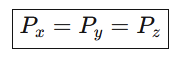
Hence the only possible equilibrium condition is:
Thus, pressure at a point in a static fluid is isotropic.
An Important Consequence
Because pressure has no preferred direction:
fluids exert force perpendicular to surfaces,
Pascal’s law becomes possible,
and hydraulic systems function efficiently.
From ocean depths to hydraulic lifts, isotropic pressure governs the behavior of fluids everywhere.
Final Conclusion
Pressure in a stationary fluid is isotropic because any directional inequality in pressure would create shear forces and destroy equilibrium. Nature preserves stillness inside fluids by ensuring perfect directional balance.





 The Intuitive Physicist