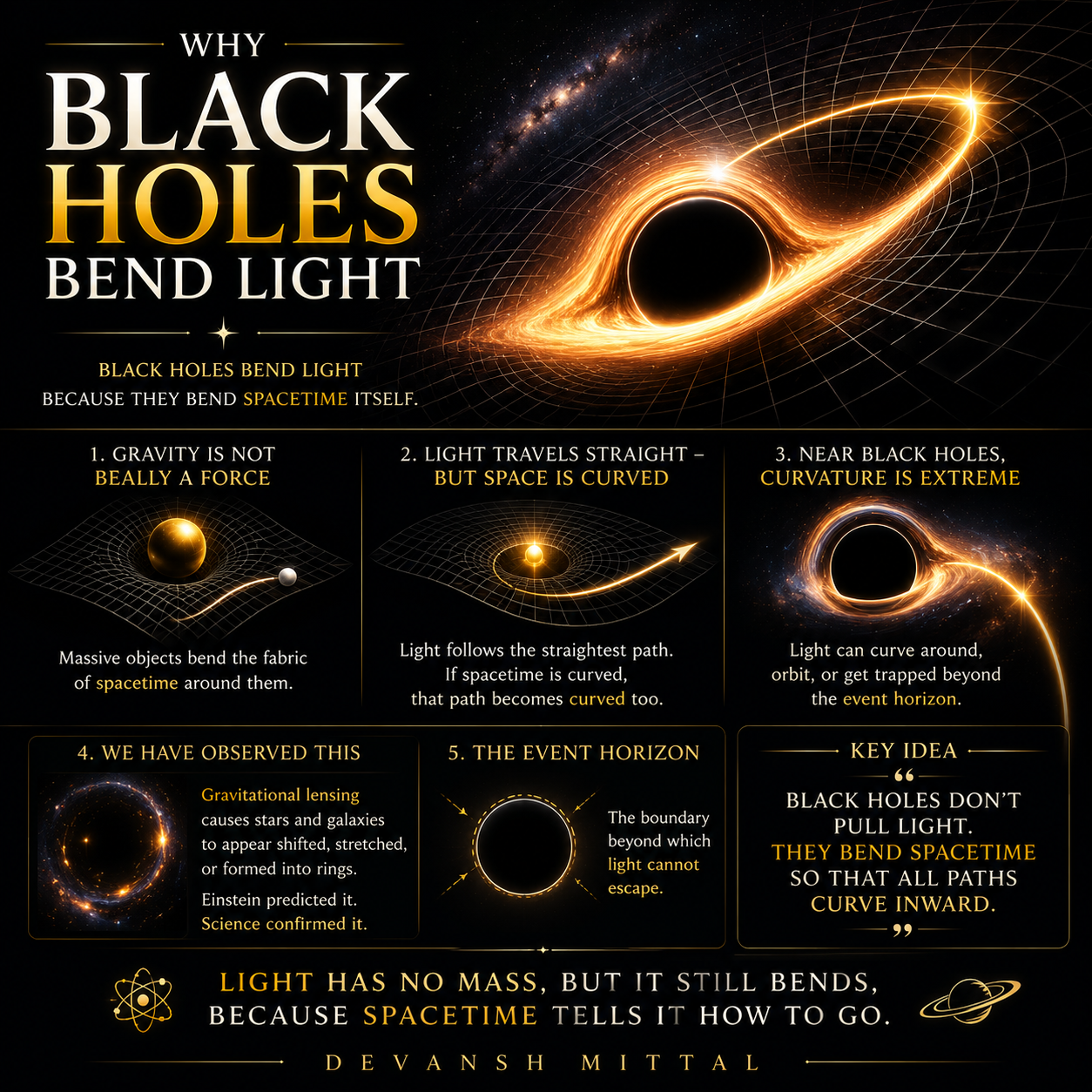
Why Black Holes Bend Light
The Strange Prediction of Gravity
We usually think gravity pulls only on things that have mass.
A falling apple has mass.
A planet has mass.
You have mass.
But light has no mass.
So why does light bend near a black hole?
This question confused scientists for centuries — until Einstein completely changed our understanding of gravity.
Gravity Is Not Really a Force
According to Isaac Newton, gravity is a force between masses.
But Einstein introduced a much deeper idea.
He said gravity is actually the bending of space and time itself.
Imagine placing a heavy bowling ball on a stretched rubber sheet. The sheet bends around the ball. If you roll a marble nearby, the marble curves toward the bowling ball — not because the ball is “pulling” it directly, but because the surface itself is curved.
Einstein proposed that space behaves in a similar way.
Massive objects bend the fabric of spacetime around them.
Light Always Travels Straight — But Space Is Curved
This is the key idea students often miss:
Light always tries to move in the straightest possible path.
But if space itself is curved, then the “straight path” also becomes curved.
Imagine walking straight on the curved surface of Earth. Even though you feel you are moving straight, your path curves around the planet.
Similarly, near a black hole, spacetime becomes extremely curved. So light follows that curvature.
As a result, light bends.
Why Black Holes Bend Light So Strongly
A black hole contains an enormous amount of mass compressed into an incredibly tiny region.
This creates extreme spacetime curvature.
Near the black hole, the bending becomes so intense that light can:
- curve around the black hole,
- orbit it temporarily,
- or even become trapped forever.
The boundary beyond which light cannot escape is called the event horizon.
Once light crosses this boundary, escaping becomes impossible.
That is why black holes appear black.
We Have Actually Observed This
This is not just theory.
Scientists have observed stars appearing in shifted positions because their light bends around massive objects. This phenomenon is called gravitational lensing.
Sometimes a distant galaxy even appears stretched into rings or arcs because its light bends around another massive galaxy lying in front of it.
Einstein predicted this long before telescopes could observe it.
Later, experiments proved him correct.
The Deep Idea
Black holes do not “grab” light like a vacuum cleaner.
Instead, they bend spacetime so dramatically that every possible path light can take curves inward.
In other words:
Black holes bend light because they bend spacetime itself.
 The Intuitive Physicist