What If Time Is Not the Same Everywhere?
Most of us grow up believing that time is universal. A second is a second, a minute is a minute, and a clock in your room, a clock on a mountain, and a clock in space should all tick at exactly the same rate. It feels obvious. In fact, it feels difficult to imagine reality behaving any other way.
Yet one of the most astonishing discoveries in the history of science revealed something deeply counterintuitive: gravity can slow down time itself. Not just in science fiction, not just near black holes, and not just somewhere far away in the universe. This phenomenon is happening right now, all around us on Earth, and modern technology depends on it every day.
The Experiment That Changes Everything
Imagine that you have two perfectly accurate clocks. You leave one on Earth and place the other aboard a spacecraft. After some time, the spacecraft returns and you compare the clocks. Common sense suggests that they should agree perfectly. After all, time is time.
But nature has a surprise waiting. The clocks show different times. One clock has actually experienced more time than the other. This is not because one of the clocks malfunctioned or lost accuracy. It is because time itself flowed differently for them. What sounds like science fiction is actually a real and experimentally verified consequence of modern physics.
Why This Sounds Impossible
Our everyday experience teaches us that time is constant. Whether you are drinking tea, riding a bicycle, studying physics, or watching a movie, time appears to move forward at the same steady pace. Gravity, meanwhile, seems completely unrelated. Gravity makes apples fall, keeps planets in orbit, and pulls us toward the ground. Why should it have anything to do with clocks? Why should it affect the passage of time?
This is where our intuition begins to fail. The universe is under no obligation to behave according to our everyday expectations.
Einstein’s Revolutionary Insight
In 1915, Albert Einstein introduced the theory of General Relativity, forever changing our understanding of gravity. Before Einstein, gravity was viewed as a force acting between objects. Einstein proposed something far more profound: massive objects such as planets, stars, and galaxies change the very structure of spacetime itself.
A useful analogy is to imagine placing a heavy bowling ball on a stretched rubber sheet. The sheet bends around the ball. If a smaller ball is placed nearby, it rolls toward the bowling ball because the surface is curved. Although spacetime is not literally a rubber sheet, the analogy captures the essential idea: mass tells spacetime how to curve, and curved spacetime tells matter how to move.
What makes this idea truly extraordinary is that the curvature affects not only space but also time.
The Deeper You Are in Gravity, the Slower Time Flows
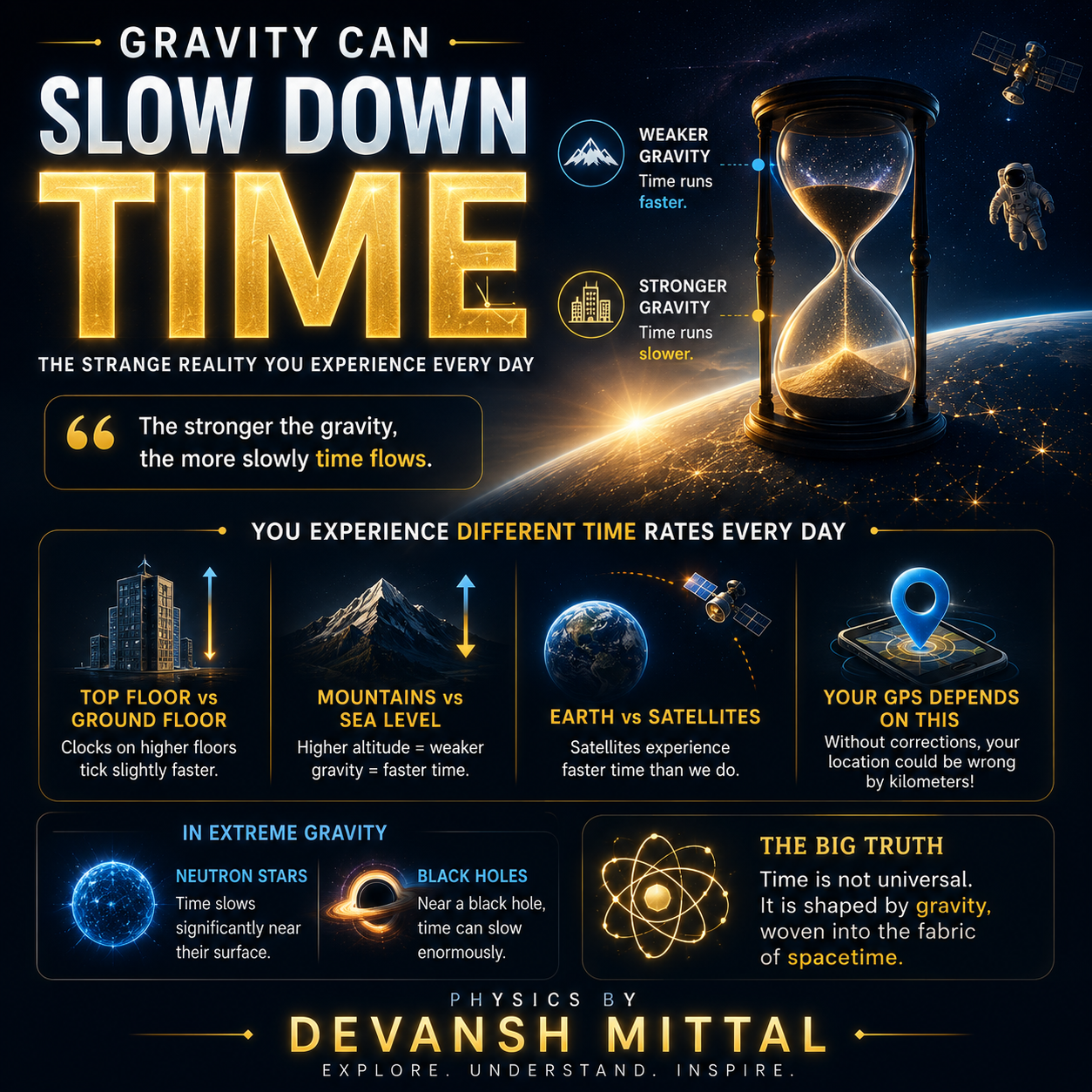
According to General Relativity, a clock located closer to a massive object ticks more slowly than a clock farther away. The stronger the gravitational field, the greater this effect becomes. Physicists call this phenomenon gravitational time dilation.
Consider two identical twins. One spends their life at sea level while the other lives on a high mountain. Because gravity is slightly weaker at higher altitudes, the mountain twin’s clock ticks a little faster. Over a lifetime, the twin on the mountain will age slightly more than the twin at sea level. The difference is extremely small, but it is real and measurable with modern instruments.
You Are Already Living in Different Time Zones of Gravity
Gravitational time dilation is not limited to exotic objects such as neutron stars or black holes. It exists everywhere. Time passes very slightly more slowly on the ground floor of a skyscraper than on the top floor. People living at high altitudes experience slightly faster time than people at sea level. Astronauts aboard satellites and spacecraft experience different rates of time compared with people on Earth.
The differences are tiny, but they reveal something profound: the universe does not provide a single universal clock. Every location experiences its own flow of time.
The Technology in Your Pocket Depends on This
Perhaps the most surprising part of the story is that gravitational time dilation is not merely a theoretical curiosity. The GPS system in your smartphone depends on it.
GPS satellites orbit thousands of kilometers above Earth, where gravity is weaker than it is on the surface. As a result, the clocks aboard those satellites tick slightly faster than clocks on the ground. If scientists and engineers ignored this effect, GPS errors would accumulate rapidly, causing navigation systems to drift by several kilometers each day.
Every time you navigate to a destination, track a package, locate a nearby restaurant, or call a ride-sharing service, you are relying on technology that corrects for the fact that gravity changes the rate at which time passes. Einstein’s century-old theory is quietly working inside your smartphone every moment.
The Universe’s Most Extreme Clocks
The effect becomes dramatically larger near extremely massive objects. A neutron star, for example, packs more mass than the Sun into an object roughly the size of a city. Its gravitational field is so intense that time noticeably slows near its surface.
Black holes take this phenomenon to the extreme. Near a black hole, gravity becomes so powerful that time can slow enormously compared with distant observers. Someone far away watching a clock near a black hole would see it ticking more and more slowly. To that observer, time itself could appear to be almost frozen.
At this point, the universe begins to feel less like a collection of objects moving through space and more like a vast landscape where time itself flows at different speeds in different places.
A New Way to Think About Time
We often imagine time as a universal river flowing uniformly throughout the cosmos. Modern physics paints a far stranger and more beautiful picture. Time is woven into the fabric of spacetime, and its flow depends on gravity and motion. Different observers can genuinely experience different amounts of time, not because of faulty measurements or optical illusions, but because reality itself is structured that way.
This realization forces us to rethink one of our deepest assumptions about the universe.
The Most Beautiful Lesson
Perhaps the most beautiful lesson is not simply that gravity slows time. It is that the universe is far deeper, stranger, and more elegant than our everyday intuition suggests. The same force that keeps your feet on the ground also influences the passage of time. The same theory that explains black holes helps your phone determine its location. And the same universe that appears ordinary during a morning walk hides profound mysteries beneath every step.
The next time you glance at a clock, remember that time is not as universal as it seems. The stronger the gravity around you, the more slowly time flows. Right now, at this very moment, gravity is quietly shaping the passage of time itself.
 The Intuitive Physicist