The Falling Cat That Defied Common Sense
Imagine holding a cat upside down and gently releasing it.
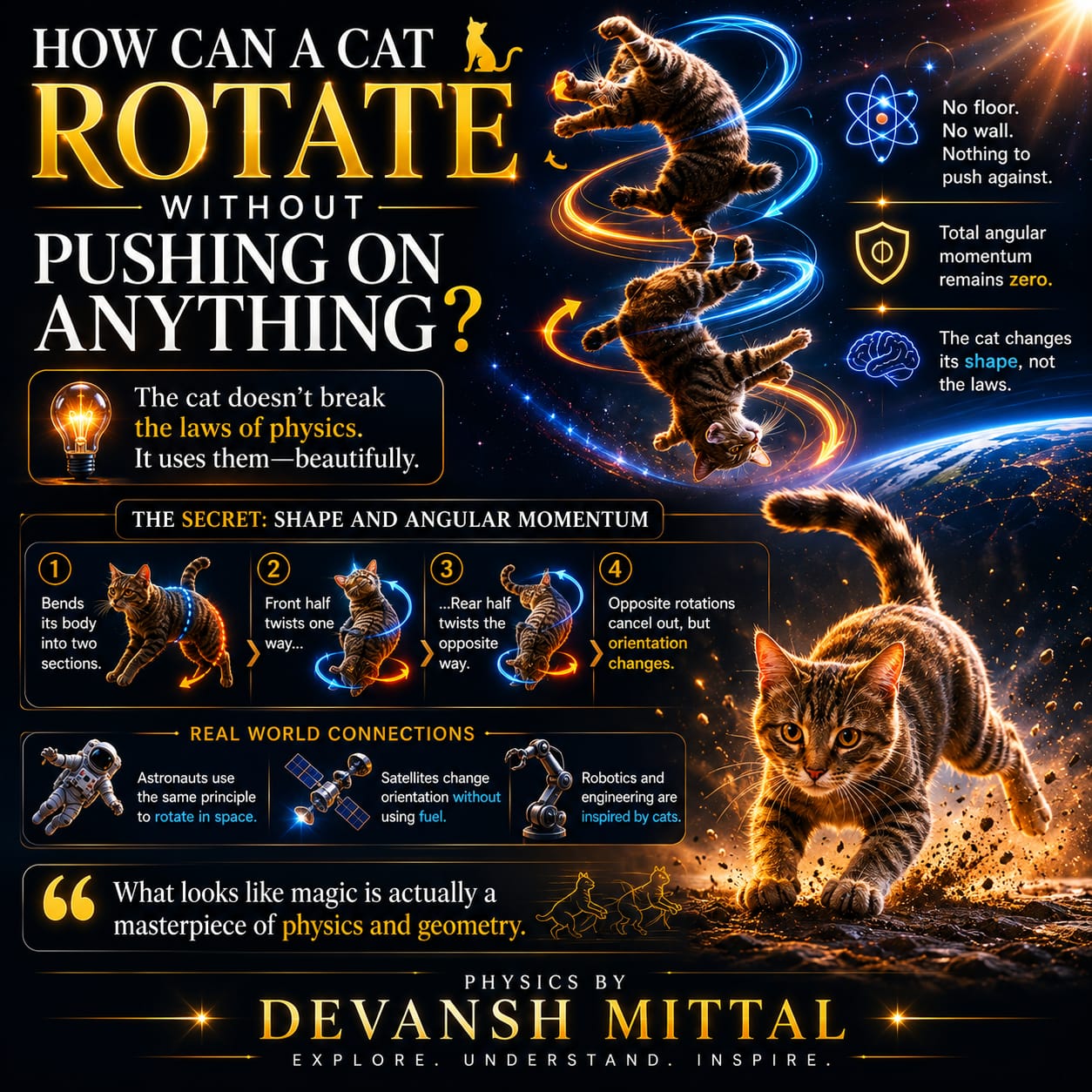
For a brief moment, the cat is falling through the air. There is no floor beneath it, no wall beside it, and nothing obvious for it to push against.
Yet something remarkable happens.
The cat twists its body, rotates in midair, and lands gracefully on its feet.
Most people accept this as a charming feline talent. Physicists, however, see something much deeper.
The falling cat appears to be violating one of the most important laws in physics.
How can something rotate if nothing is making it rotate?
The Puzzle
Suppose an astronaut is floating alone in deep space, far from any planets, stars, or spacecraft. If the astronaut is initially not spinning, can they suddenly start spinning without pushing on anything?
The answer is no.
According to the conservation of angular momentum, an isolated object cannot spontaneously begin rotating. Angular momentum is one of nature’s most fundamental conserved quantities.
This makes the cat’s behavior seem impossible.
If the cat starts falling without any overall rotation, how can it end up turning around?
For decades, this question fascinated some of the world’s greatest physicists.
The Secret Is Shape
The answer lies in a subtle distinction that our intuition often misses.
The cat does not create angular momentum out of nowhere. Instead, it changes the shape of its body.
A falling cat first bends its body into two sections. It pulls in its front legs while extending its rear legs. Then it twists the front half of its body in one direction and the rear half in the opposite direction.
Because the front and rear parts have different distributions of mass, they rotate by different amounts. The opposite rotations cancel in terms of total angular momentum, but they do not cancel in terms of orientation.
By repeating this process, the cat gradually changes its overall orientation while keeping its total angular momentum equal to zero.
The cat rotates without ever violating the laws of physics.
A Surprising Analogy
Imagine sitting on a swivel chair holding two heavy dumbbells. By moving your arms inward and outward, you can change how fast you spin without anyone pushing you.
The cat performs a far more sophisticated version of this idea. It uses the flexibility of its body to rearrange its mass in a carefully coordinated sequence.
What appears to be magic is actually a brilliant exploitation of geometry and conservation laws.
Why Physicists Love This Problem
The falling-cat problem is much more than an amusing curiosity.
The same principles appear in spacecraft control, robotics, biomechanics, and even advanced areas of mathematics. Engineers designing satellites often use ideas inspired by the cat’s maneuver to change orientation without expelling fuel.
A household pet inadvertently demonstrates concepts that connect everyday life to cutting-edge science.
The Most Beautiful Lesson
The next time you watch a cat land effortlessly on its feet, remember that you are witnessing a masterpiece of physics.
The cat is not breaking the laws of nature. It is obeying them with extraordinary elegance.
Perhaps that is one of the deepest lessons science teaches us. The universe often appears mysterious not because its laws are violated, but because those laws are far more subtle and beautiful than our intuition expects.
Sometimes, one of the most profound demonstrations of physics is not found in a laboratory or an observatory.
Sometimes, it is found in a falling cat.
 The Intuitive Physicist