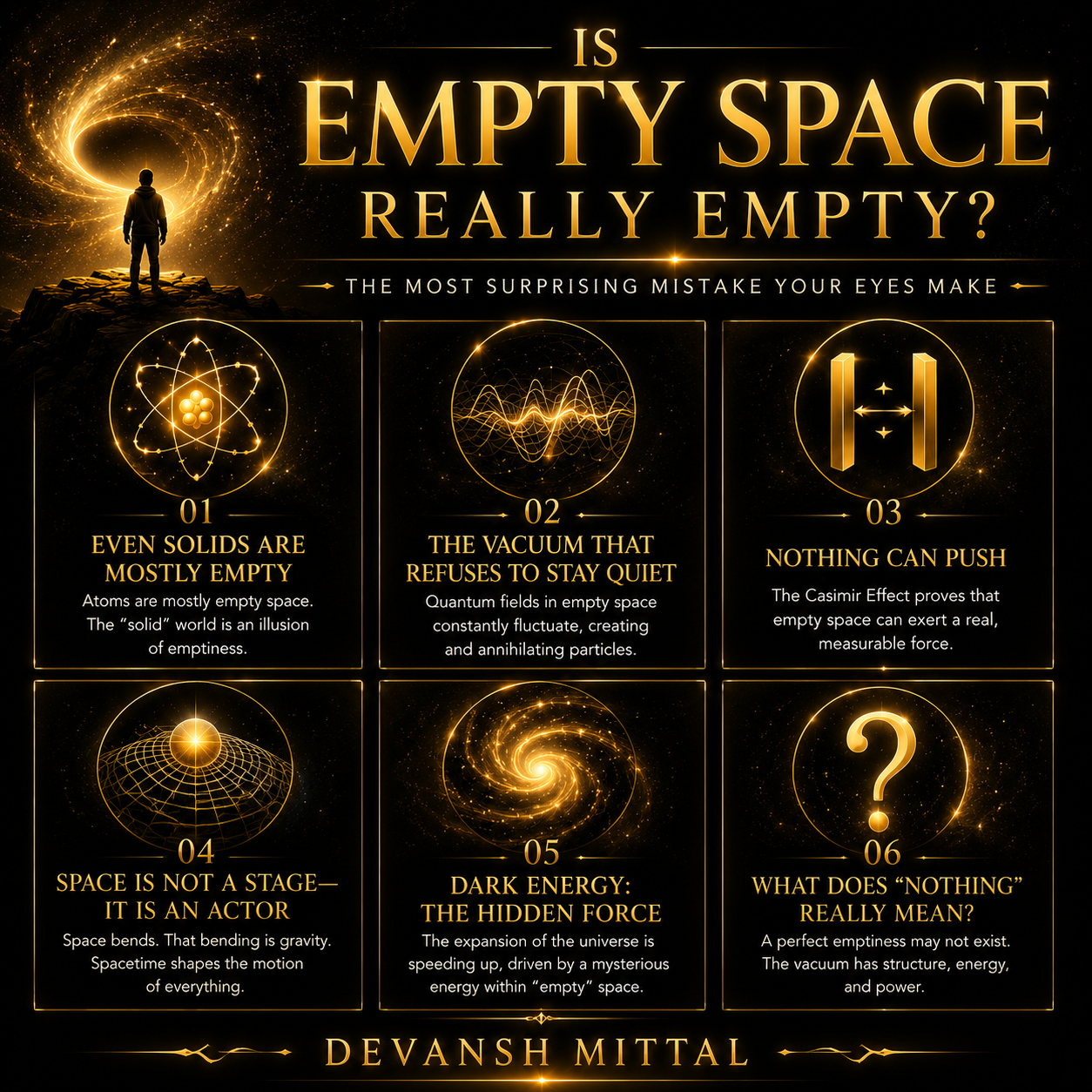
The Most Surprising Mistake Your Eyes Make
Look around you.
Between you and your phone, between Earth and the Moon, and even between galaxies, there appears to be nothing at all.
We call it “empty space.”
But modern physics has uncovered a remarkable truth:
Empty space may be one of the most active things in the universe.
In fact, what we casually call “nothing” is not really nothing.
It is something far stranger.
A Lesson from a Coffee Cup
Imagine placing a coffee cup on a table.
You might think the cup is made of solid matter and the air around it is empty.
Surprisingly, the cup itself is mostly empty space.
If every atom inside the cup were enlarged so that its nucleus became the size of a marble, the electrons would orbit hundreds of meters away. Almost all of the cup’s volume would be empty.
So even “solid” objects are largely made of emptiness.
But then another question appears:
What exactly fills the space between those atoms?
The Vacuum That Refuses to Stay Quiet
According to classical physics, a vacuum is simply a region with nothing inside it.
Quantum physics shattered this picture.
In the quantum world, space behaves more like a restless ocean than a silent void.
Even when all particles are removed, invisible quantum fields remain.
These fields constantly fluctuate.
Tiny particle-antiparticle pairs briefly appear and disappear.
Physicists call these events “quantum fluctuations.”
The vacuum is therefore not empty. It is alive with activity that normally remains hidden from our senses.
Nothing Can Push
This sounds impossible.
How can “nothing” exert a force?
Yet experiments show exactly that.
When two extremely smooth metal plates are placed incredibly close together in a vacuum, they experience a tiny attraction.
This phenomenon, known as the
Casimir Effect
arises because quantum fluctuations in empty space are altered between the plates.
The force has been measured experimentally.
In other words, “empty” space can physically push and pull objects.
Space Is Not a Stage—It Is an Actor
Many people imagine space as a passive background where cosmic events unfold.
Modern physics tells a different story.
Space bends around stars and planets.
That bending is what we perceive as gravity.
According to General Relativity, Earth is not being pulled through space by an invisible force. Instead, Earth moves through curved spacetime created by the Sun.
Space itself participates in the drama of the universe.
It is not merely the stage.
It is one of the actors.
The Biggest Mystery in the Cosmos
The story becomes even stranger.
Astronomers have discovered that the expansion of the universe is speeding up.
Something appears to be pushing galaxies apart faster and faster.
One possible explanation is that empty space itself contains energy.
This mysterious phenomenon is known as
Dark Energy.
Today, dark energy is thought to make up most of the cosmic energy budget.
Think about that for a moment.
The dominant ingredient of the universe may be hidden within what we call “empty” space.
What Does “Nothing” Really Mean?
The deeper physicists investigate reality, the more difficult it becomes to define nothingness.
A truly empty universe may not even be possible.
Even the vacuum possesses structure, energy, fluctuations, and physical consequences.
What appears to be a featureless void is actually a dynamic fabric woven into the workings of nature itself.
The Next Time You Look at the Sky…
On a clear night, look up at the dark space between the stars.
It may seem like the emptiest place imaginable.
Yet that darkness is not a barren void.
It is a restless quantum arena, a flexible geometric fabric, and perhaps the reservoir of the mysterious energy driving the expansion of the cosmos.
The greatest surprise of modern physics is not that the universe contains extraordinary things.
It is that what appears to be nothing may be one of the most extraordinary things of all.
 The Intuitive Physicist