Tag Archives: IIT

When the Straight Line Is Not the Fastest Path

Standard

When the Straight Line Is Not the Fastest Path

A Beautiful Idea from Physics

We often hear the statement:

“The shortest distance between two points is a straight line.”

In geometry, this is absolutely correct.

But physics teaches us something deeper:

The shortest path is not always the fastest path.

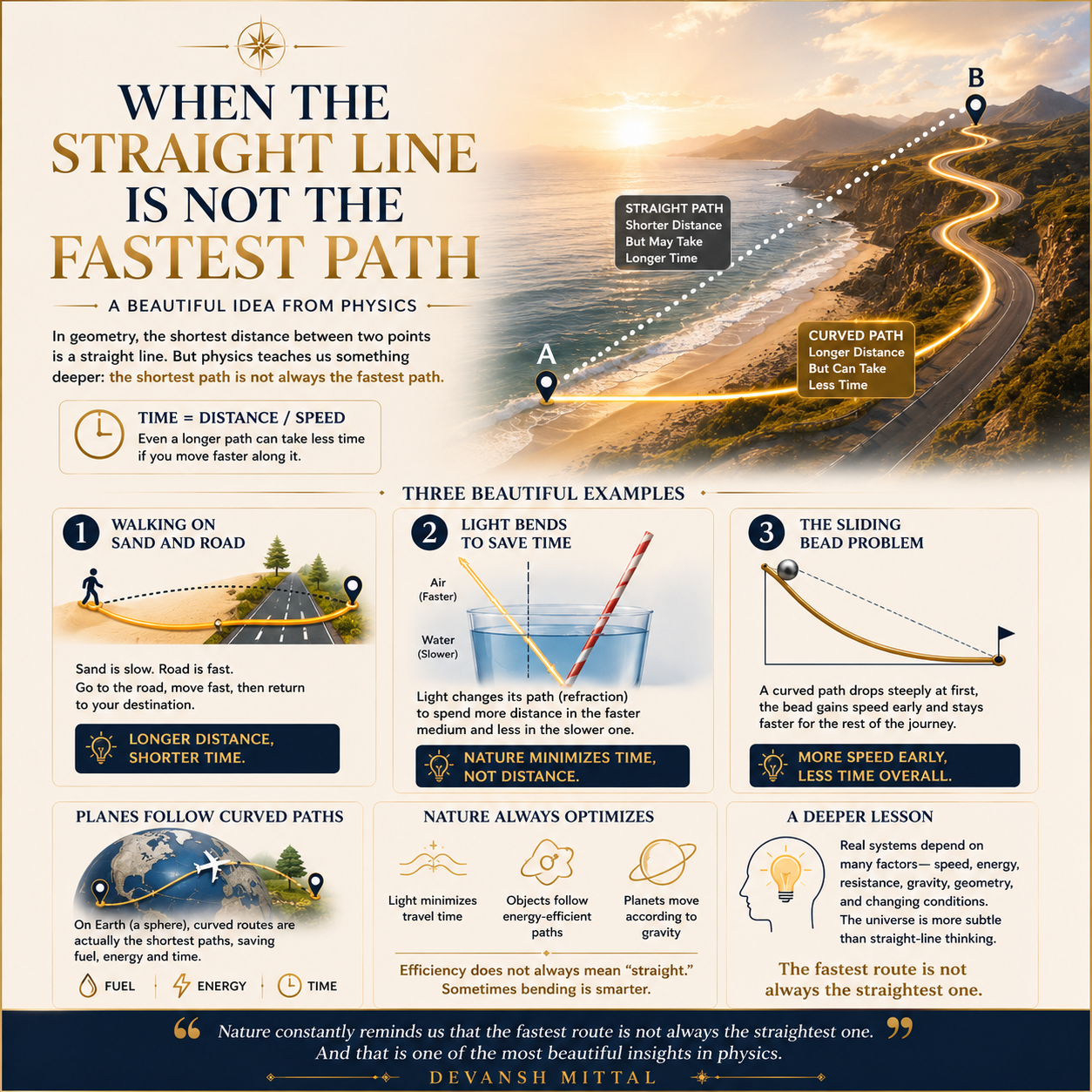
Sometimes a slightly longer curved path can take less time than a straight-line path.

At first this sounds impossible, but Nature gives many beautiful examples of this idea.


Distance and Time Are Not the Same Thing

Suppose you want to travel from one place to another.

Your travel time depends on two things:

  • the distance traveled,
  • and your speed during the journey.

Mathematically:

Time = Distance / Speed

This means that even if a path is longer, it can still take less time if you move faster along it.

This simple idea is the key to understanding the entire article.


Example 1: Walking on Sand and Road

Imagine you are standing on a beach.

  • Walking on sand is slow.
  • Walking on a road is much faster.

Now suppose your destination lies far away along the beach.

Should you walk directly toward it in a straight line through sand?

Not always.

A faster strategy may be:

  • first move toward the road,
  • travel quickly along the road,
  • then return toward the destination.

Even though the total distance becomes larger, the total time can become smaller because most of the motion happens on the faster surface.

So:

Shortest distance ≠ shortest time.


Example 2: Light Does Not Always Travel in Straight Lines

Light usually travels in straight lines in air.

But when light enters water or glass, it bends.

This phenomenon is called:

Refraction

Why does light bend?

Because light travels slower in water than in air.

To save time, light changes its path so that it spends more distance in the faster medium.

This is why a straw placed in water appears bent.

Nature is not trying to minimize distance.
Nature is trying to minimize time.


Example 3: The Sliding Bead Problem

This is one of the most famous problems in physics.

Imagine a bead sliding under gravity from one point to another.

Which path will take the least time?

Most people naturally think:

“A straight line.”

But surprisingly, this is wrong.

A curved path can actually be faster.

Why?

Because the curved path drops steeply at first, allowing the bead to gain speed quickly due to gravity.

After gaining large speed early, the bead continues moving rapidly for the rest of the journey.

So although the curved path is longer, the higher speed makes the total time smaller.

This is one of the most beautiful ideas in physics.


Why Curved Paths Can Be Faster

There are two competing effects:

Straight Path

  • shorter distance,
  • but slower speed gain.

Curved Path

  • longer distance,
  • but faster speed gain.

Sometimes the increase in speed is more important than the extra distance.

That is why the curved path wins.


Airplanes Also Follow Curved Paths

When airplanes travel long distances on Earth, their routes often appear curved on maps.

But Earth is spherical, not flat.

The curved-looking route is actually the shortest path on a sphere.

This path helps save:

  • fuel,
  • energy,
  • and travel time.

Again, Nature and engineering often prefer optimal paths rather than visually straight ones.


Nature Always Tries to Optimize

Many laws of physics are based on optimization principles.

For example:

  • light tries to minimize travel time,
  • objects move in ways that reduce energy,
  • planets follow paths determined by gravity.

Physics repeatedly shows that Nature is extremely efficient.

But efficiency does not always mean “straight.”

Sometimes:

  • bending is faster,
  • curved motion is smarter,
  • and indirect paths become optimal.

A Deeper Lesson

This idea teaches us something important beyond physics.

Our intuition often focuses only on distance.

But in real systems, many factors matter:

  • speed,
  • energy,
  • resistance,
  • gravity,
  • geometry,
  • and changing conditions.

The universe is more intelligent and subtle than simple straight-line thinking.


Final Thoughts

The statement:

“The shortest distance between two points is a straight line”

is true in geometry.

But physics asks a deeper question:

“What path takes the least time?”

And the answer is often very different.

Light bends.
Objects curve.
Airplanes follow arcs.
Sliding beads move faster on curved tracks.

Nature constantly reminds us that the fastest route is not always the straightest one.

And that is one of the most beautiful insights in physics.

The Mindset Behind IIT JEE Advanced AIR 56, IJSO Gold, and World Rank 10 in SIN: Vasu Vijay’s Extraordinary Journey

Standard

Very few academic journeys reflect excellence across so many of the world’s most prestigious examinations and Olympiads at such a young age. From securing an extraordinary AIR 56 in IIT-JEE Advanced, to winning a Gold Medal with International Rank 8 at the International Junior Science Olympiad (IJSO) 2022 in Bogotá, Colombia, to achieving International Rank 10 along with Distinction in the prestigious Sir Isaac Newton (SIN) Exam conducted by the University of Waterloo, Vasu Vijay’s accomplishments stand as a remarkable testament to intellectual depth, discipline, and conceptual mastery.

What makes his story especially meaningful to me, however, is not merely the scale of these achievements, but the transformation behind them.

As Vasu himself shares in this testimonial, there was a time when Physics felt difficult and unintuitive to him. Over the years, through a learning approach centered around intuition, conceptual understanding, analytical thinking, and scientific imagination, he gradually developed not only mastery over the subject, but also a genuine love for it.

His words beautifully reflect a philosophy I have always believed in deeply — that true excellence in Physics does not emerge from memorizing formulas or mechanically solving thousands of problems, but from learning how to think clearly, understand concepts fundamentally, and approach challenges with calmness and intelligence.

One of the most touching parts of Vasu’s testimonial is his gratitude toward the way he was taught to approach both Physics and examinations themselves — not with fear or pressure, but with curiosity, strategy, and confidence. To know that this mindset contributed meaningfully to his Olympiad journey, his international success, and his IIT-JEE performance is profoundly fulfilling as a teacher.

Vasu’s journey is not merely a story of ranks and medals. It is a story of transformation — from confusion to clarity, from hesitation to confidence, and from learning formulas to truly understanding the beauty of Physics.

I feel immensely proud to have been part of his journey and deeply grateful for the sincerity and warmth with which he has expressed his appreciation.


Respected Devansh Sir,

I remember that at the beginning of Class 9, Physics was the subject I struggled with the most. Even the basic concepts often felt unclear to me, and I never really enjoyed studying the subject. However, the way you taught Physics completely changed how I viewed it. Your emphasis on intuition and conceptual understanding helped me develop genuine interest in the subject.

What impacted me the most was that your teaching was never limited to memorizing formulas or blindly applying methods. Instead, you always encouraged us to understand the idea behind every concept and every question. Because of this, whenever I now encounter a Physics problem, my first instinct is to understand the concept deeply before attempting to solve it. The questions discussed in class were themselves more than sufficient to develop a strong understanding, without the need to solve hundreds of questions from multiple books.

Apart from academics, your guidance regarding examination pressure and mindset also helped me immensely. I still remember your idea of treating an exam like a puzzle, where the objective is to optimize marks, calmly and intelligently. That approach proved to be extremely effective for me and positively influenced my performance in every major examination thereafter.

This way of learning and approaching Physics helped me throughout my entire Junior Science Olympiad journey, from NSEJS and INJSO to the OCSC selection camp at HBCSE, eventually culminating in a Gold Medal and an International Rank 8 in IJSO 2022 held in Bogotá, Colombia. The same approach and mindset later continued to help me in other examinations as well, including JEE Advanced, where I secured AIR 56, and the Sir Isaac Newton (SIN) Exam, where I secured an International Rank 10 along with a Distinction.

I will always remain grateful to you not just for teaching Physics so beautifully, but also for changing the way I approach learning and problem solving as a whole. Thank you for making Physics so intuitive and enjoyable for me!

Vasu Vijay

Carnot Engine: Proof of Carnot Theorem…

Standard

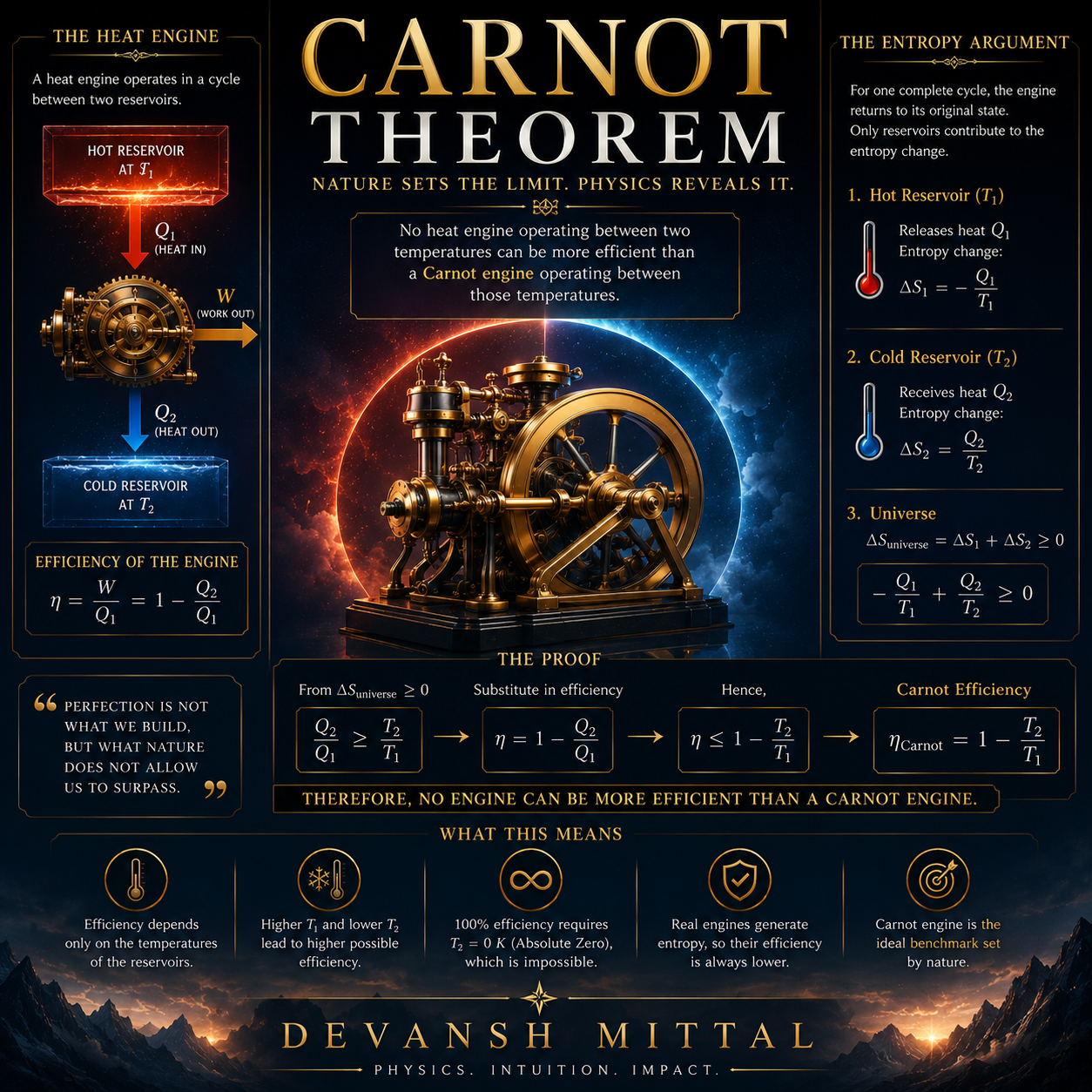
“It is impossible for any heat engine to be more efficient than a Carnot engine when operating between two given temperatures”.

The Carnot engine is a conceptual engine that achieves the most efficient conversion of heat to work permitted by Kelvin’s statement. In general, efficiency is defined as the ratio of work out to heat in:

For a Carnot engine, the efficiency is found in terms of the temperature of the reservoirs the engine operates between:

Carnot’s Theorem

It is impossible for any heat engine to be more efficient than a Carnot engine when operating between two given temperatures:

Consider a heat engine drawing heat Q1 from a heat reservoir at temperature T1​, delivering work W and dumping heat Q2​ into a heat sink at temperature T2.

The heat engine operates in cycles, that is, it takes in heat Q1, does work W, dumps heat Q2, and in the end returns back to its original unchanged state.

Consider the net change in entropy ΔS of the universe:

The heat reservoir releases a heat Q1 at a constant temperature T1. Thus the change in its entropy is

The heat sink accepts heat Q2 at a constant temperature T2. Thus the change in its entropy is

Thus the net change in entropy of the universe is

Using the second law of thermodynamics, ΔS≥0, which implies

Since the left-hand side represents the efficiency of the given heat engine (η) and the right-hand side is the efficiency of a Carnot engine,

Hence proved!