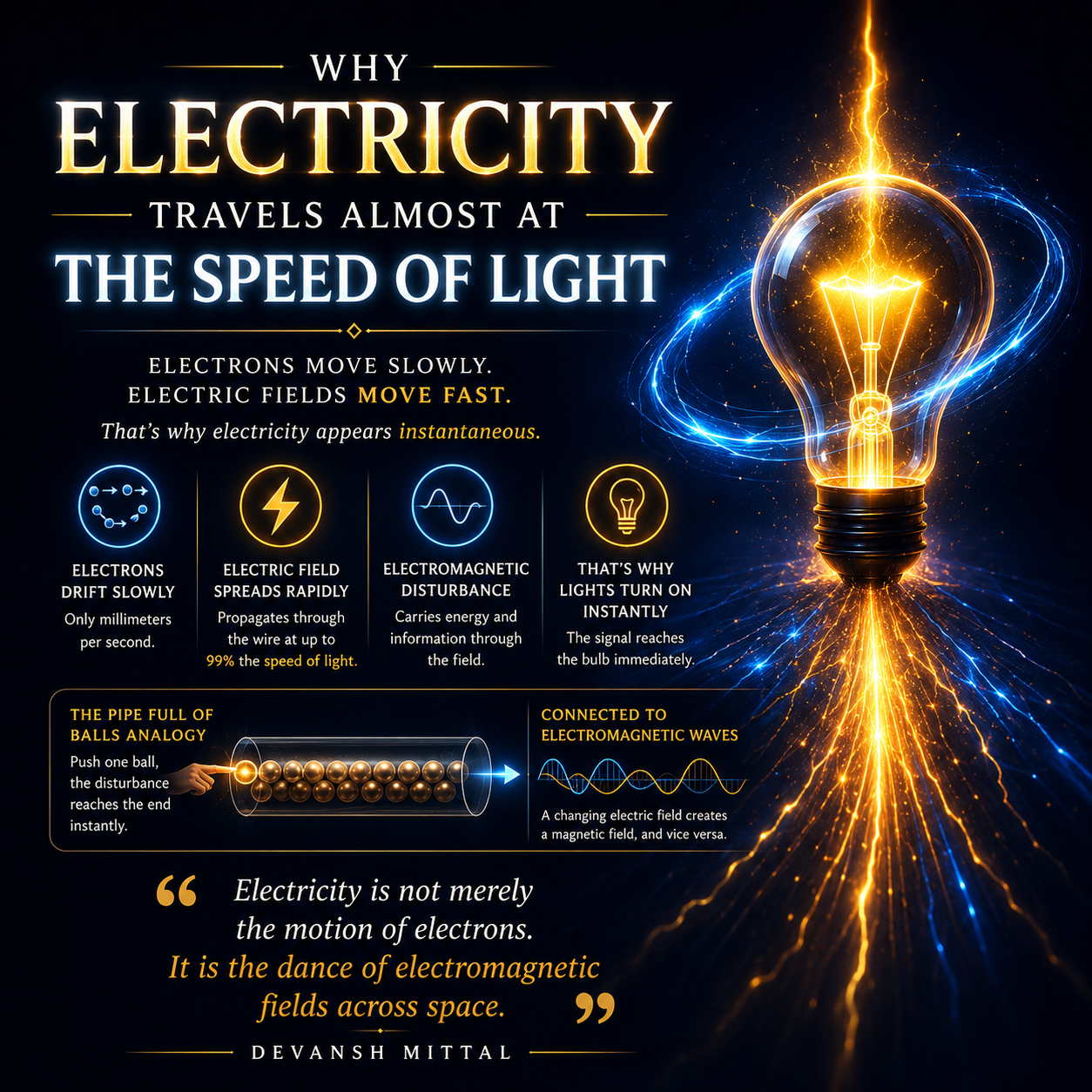
Why Electricity Travels Almost at the Speed of Light
The Surprising Truth About Electric Fields and Electromagnetic Waves
When you switch on a light bulb, it glows almost instantly.
When you press the power button on your computer, electrical signals race through billions of circuits in a tiny fraction of a second.
But here is the surprising part:
The electrons inside the wire actually move very slowly.
In many household wires, electrons drift at only a few millimeters per second — slower than a crawling ant.
So how can electricity seem to travel almost at the speed of light?
The answer reveals one of the deepest ideas in Physics:
Electricity is not mainly about electrons traveling rapidly through wires. It is about electric fields and electromagnetic disturbances propagating through space.
The Common Misconception
Most students imagine electricity like water flowing through a pipe:
- electrons are like water molecules,
- the wire is the pipe,
- and electricity means electrons rushing rapidly from one end to another.
This picture is only partly correct.
The electrons themselves move slowly.
What moves rapidly is the electromagnetic signal.
Drift Velocity: The Slow Motion of Electrons
Metal wires already contain countless free electrons even before the circuit is switched on.
When a battery is connected, these electrons begin drifting in one direction. This average motion is called drift velocity.
Surprisingly, this drift velocity is extremely small.
An individual electron may take minutes or even hours to move a short distance through a wire.
Yet the bulb glows almost instantly.
Clearly, something else must be happening.
A Simple Analogy
Imagine a long pipe completely filled with tightly packed balls.
If you push one ball at one end, the ball at the opposite end moves almost immediately.
But the same ball did not travel across the pipe. Instead, the disturbance traveled rapidly through the system.
Electricity behaves similarly.
The electrons already exist throughout the wire. When an electric field is established, electrons everywhere begin responding almost simultaneously.
The Real Hero: The Electric Field
The moment you connect a battery, an electric field is created inside and around the wire.
An electric field exerts force on charges and pushes electrons throughout the circuit.
The important point is this:
The electric field propagates extremely rapidly — close to the speed of light.
So the fast behavior of electricity is mainly due to the rapid propagation of the electric field, not because electrons themselves are moving extremely fast.
Electricity Is a Field Phenomenon
This is one of the great conceptual shifts in modern Physics.
Electricity is not merely the motion of particles.
It is fundamentally a phenomenon of fields.
Electric and magnetic fields carry:
- energy,
- momentum,
- and information.
The electrons simply respond locally to these fields.
Electromagnetic Waves and Maxwell
A changing electric field creates a magnetic field.
A changing magnetic field creates an electric field.
This beautiful interplay allows electromagnetic disturbances to propagate through space as electromagnetic waves.
This revolutionary idea was discovered by James Clerk Maxwell.
Maxwell realized that light itself is an electromagnetic wave.
That means:
- radio waves,
- microwaves,
- visible light,
- X-rays,
are all forms of the same electromagnetic phenomenon.
Electrical signals in wires are deeply connected to this same physics.
Real-World Examples
Switching On a Light
When you press a switch:
- the electric field spreads rapidly through the circuit,
- electrons everywhere begin responding,
- the bulb glows almost instantly.
The electrons inside the bulb do not come all the way from the battery.
Internet and Communication
Modern communication depends on fast electromagnetic propagation through:
- cables,
- fiber optics,
- antennas,
- and satellites.
Without electromagnetic waves, the modern digital world would not exist.
Final Takeaway
The next time you switch on a light, remember:
- the electrons themselves move slowly,
- but the electric field spreads through the circuit extremely rapidly,
- carrying energy and information almost at the speed of light.
Electricity is not merely the movement of electrons.
It is the dance of electromagnetic fields across space.
 The Intuitive Physicist