Tag Archives: quantum-mechanics

Why Is the Speed of Light the Same for Everyone?

Standard

The Fact That Shouldn’t Be True

Imagine standing beside a road as a car passes at 60 km/h. If another car follows behind at 80 km/h, it gains on the first car at 20 km/h. This feels completely natural because velocities usually add and subtract according to common sense.

Now consider something far stranger.

Suppose you switch on a flashlight while standing still. You measure the light leaving the flashlight and find that it travels at about 300,000 kilometers per second. So far, nothing seems surprising.

But what if you switch on the same flashlight while traveling in a spaceship at an enormous speed? Common sense suggests that the light should move faster when measured by an outside observer. Yet nature refuses to cooperate.

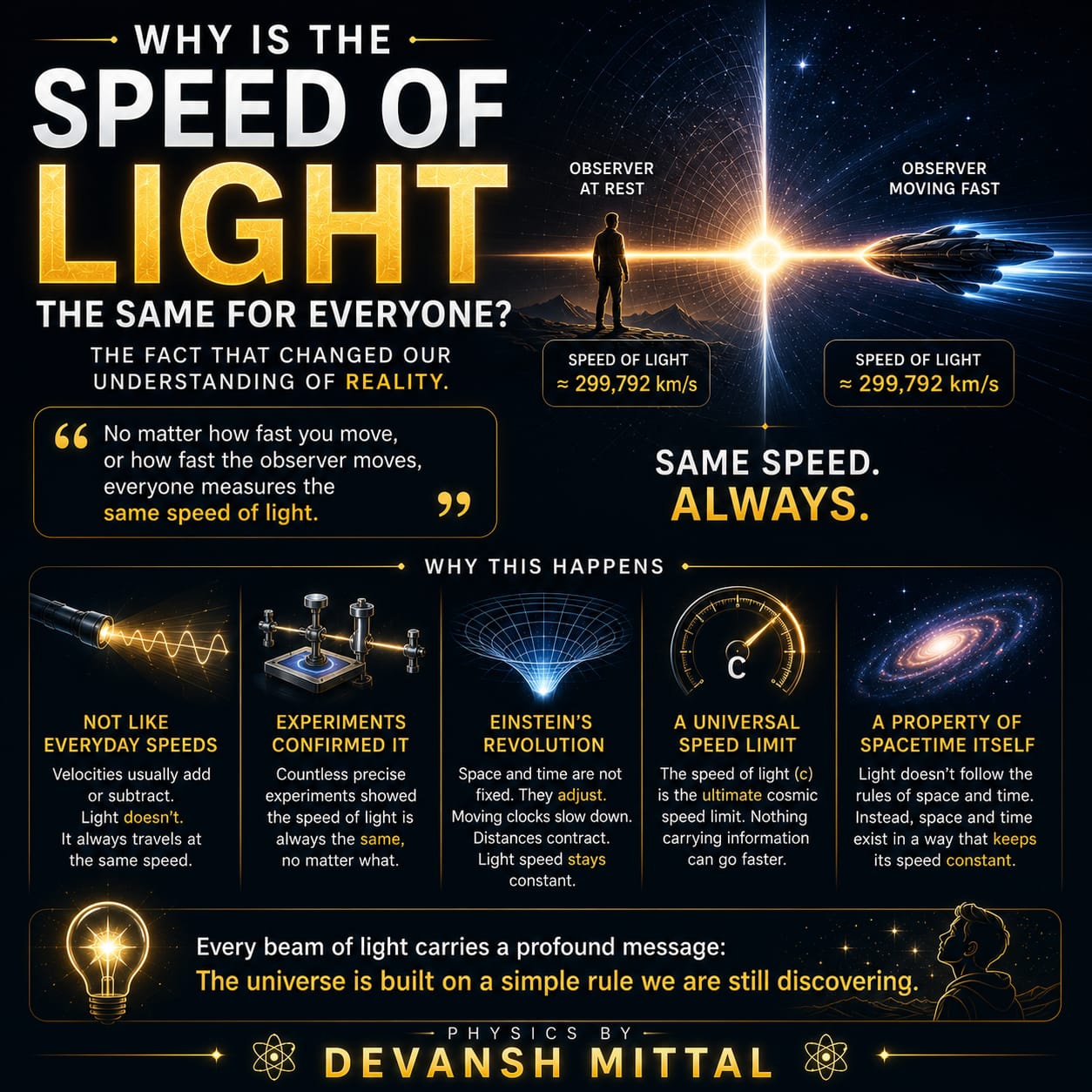
No matter how fast you move, and no matter how fast the observer moves, everyone measures exactly the same speed of light.

This is not a theory. It is an experimental fact.

And it may be one of the strangest facts in the entire universe.

The Experiment That Shocked Physics

In the late nineteenth century, scientists expected light to behave like sound. If you run toward a sound source, the sound seems different. If you move away, it changes again. Surely light should behave similarly.

To test this idea, physicists performed increasingly precise experiments. To their astonishment, the speed of light remained unchanged.

Every measurement pointed to the same conclusion: light does not obey our everyday intuition about motion.

The result was so shocking that it forced physicists to rethink the nature of space and time themselves.

Einstein’s Radical Insight

In 1905, Einstein proposed a bold solution.

Perhaps the speed of light is not changing.

Perhaps space and time are.

This idea sounds absurd at first. We think of space as a fixed stage and time as a universal clock. Einstein suggested that both are flexible and can adjust themselves so that the speed of light remains the same for all observers.

The consequences were extraordinary.

Moving clocks run more slowly. Distances can contract. Two observers moving relative to one another may disagree about the timing of events.

Yet through all these changes, the speed of light remains constant.

A Universal Speed Limit

The speed of light is more than the speed at which light travels. It appears to be a fundamental speed limit built into the structure of reality.

Nothing carrying information can travel faster.

Just as every mountain has a highest peak, the universe appears to have a maximum speed.

Light travels at that limit.

The Deeper Mystery

Perhaps the most beautiful way to think about it is this: the speed of light is not merely a property of light. It is a property of spacetime itself.

Light does not obey the rules of space and time.

Instead, space and time arrange themselves around this fundamental cosmic rule.

The Next Time You Switch On a Light

The next time you turn on a flashlight or see sunlight streaming through a window, remember that you are witnessing something profoundly mysterious.

The light reaching your eyes is traveling at exactly the same speed for every observer in the universe, regardless of how they are moving.

This simple fact shattered centuries of intuition, transformed our understanding of reality, and revealed that space and time are far stranger than anyone had imagined.

Sometimes the greatest mysteries are not hidden in distant galaxies or black holes.

Sometimes they arrive every morning with the sunlight.
We Cannot Prove the Laws of Physics!

Standard

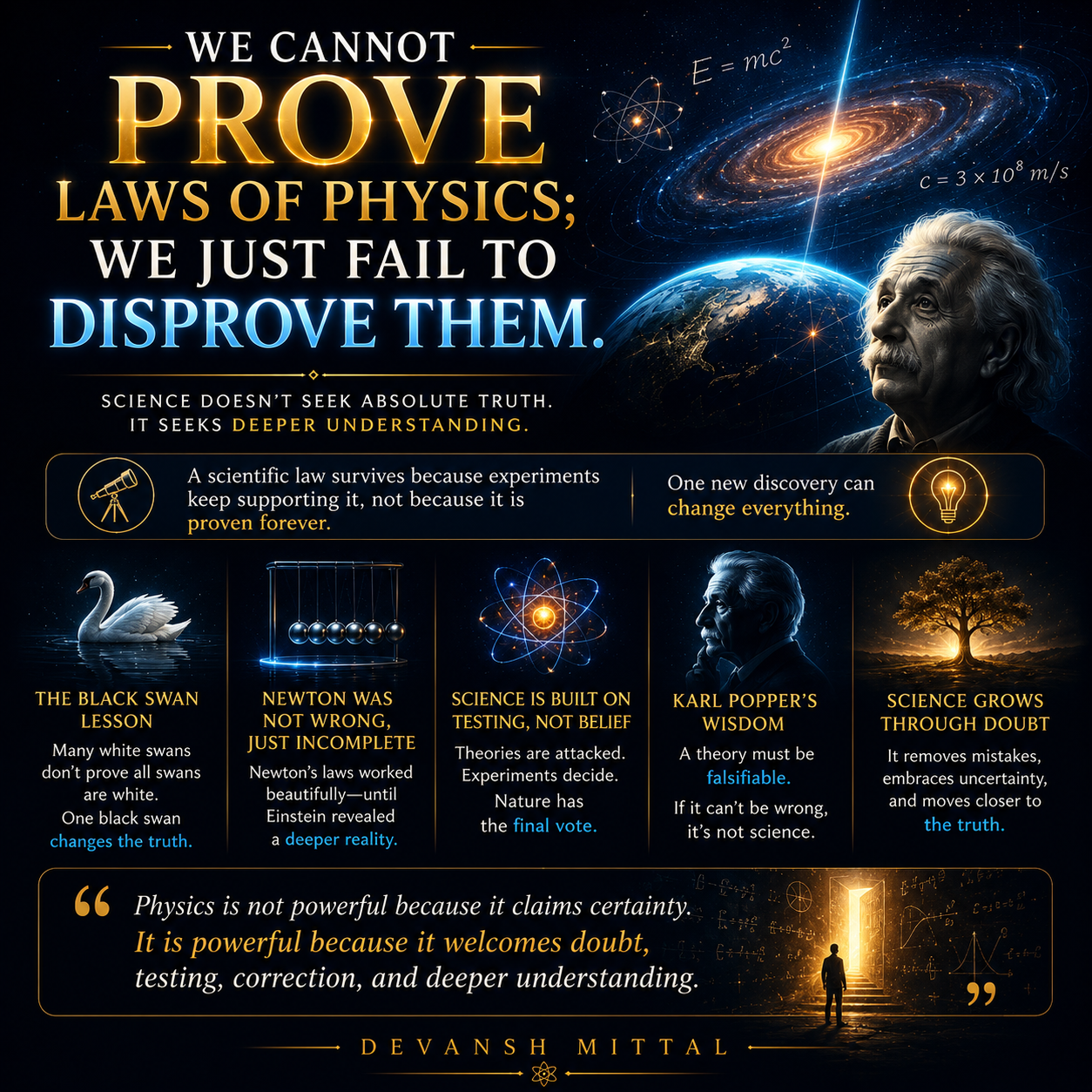
We Cannot Prove Laws of Physics; We Just Fail to Disprove Them

Most students grow up believing that the laws of physics are absolute truths.

We are taught that:

  • Newton’s laws are true,
  • gravity is true,
  • conservation of energy is true,
  • and the speed of light is constant.

But modern science reveals something far deeper and more humbling:

Physics does not truly “prove” its laws.

Instead, physics keeps testing them again and again — and so far, we have simply failed to disprove them.

This idea is one of the most profound insights in science.


Why This Idea Feels Strange

In mathematics, things can be proven permanently.

For example:

2 + 2 = 4

Once proven logically, it remains true forever within mathematics.

But physics is different.

Physics studies the real universe, and the universe must be observed experimentally.

No matter how many times an experiment succeeds, there is always a possibility — however tiny — that a future experiment may reveal something new.

This means:

No physical law is beyond questioning.

And that is exactly what makes science powerful.


Science Is Built on Testing, Not Blind Belief

A scientific law survives because it repeatedly passes experimental tests.

But passing tests is not the same as being “absolutely proven.”

Imagine this situation:

Suppose someone says:

“All swans are white.”

You observe:

  • 10 white swans,
  • 100 white swans,
  • 10,000 white swans.

Does this prove that all swans are white?

No.

Because finding just one black swan destroys the claim completely.

Physics works in a very similar way.

A law may survive millions of successful experiments, but a single contradictory observation can force scientists to rethink the theory.


Newton’s Laws Once Seemed Perfect

For centuries, Newton’s laws explained:

  • falling apples,
  • planetary motion,
  • cannonballs,
  • machines,
  • and motion on Earth.

People thought Newton had discovered the final laws of Nature.

Then Einstein arrived.

Einstein showed that Newton’s laws are not exactly correct at:

  • extremely high speeds,
  • very strong gravity,
  • and cosmic scales.

Newton was not “wrong” in ordinary situations.

But Newton’s laws were incomplete.

This is one of the greatest lessons in science:

Even the most successful theories can later become approximations of deeper truths.


The Speed of Light and Modern Physics

Today, Einstein’s relativity has passed enormous numbers of experiments.

GPS satellites work correctly only because relativistic corrections are included.

Modern particle accelerators confirm relativity repeatedly.

Yet scientists still do not claim that relativity is “perfectly proven forever.”

Why?

Because future discoveries may reveal an even deeper theory.

In fact, physicists are actively searching for theories beyond Einstein’s relativity.

Science always remains open to correction.


Why Science Is Different from Belief Systems

In many belief systems, questioning is discouraged.

But in science, questioning is essential.

A scientific theory becomes stronger precisely because scientists constantly try to break it.

Physicists do not worship theories.

They attack them with experiments.

A theory survives only if Nature refuses to disprove it.

This creates an extraordinary system of self-correction.


The Philosophy of Karl Popper

One of the most influential philosophers of science, Karl Popper, explained this beautifully.

According to Popper:

A scientific theory must be falsifiable.

This means the theory must make predictions that could, in principle, be proven wrong.

For example:

“This pen will fall downward if released.”

This is scientific because it can be tested.

But if someone makes a claim that can never be tested or disproven, it does not belong to science.

Science progresses because theories are vulnerable to failure.


Why This Makes Science Powerful

At first, this idea may sound weak.

If science cannot “prove” laws permanently, does that make science uncertain?

Actually, the opposite is true.

Science becomes powerful precisely because it allows correction.

Imagine two systems:

System 1:

  • never changes,
  • never questions itself.

System 2:

  • constantly tests itself,
  • removes mistakes,
  • improves continuously.

Which system becomes more reliable over time?

Obviously, the second one.

Science advances because it accepts the possibility of being wrong.

That intellectual honesty is one of humanity’s greatest achievements.


Real-World Examples

Example 1: Newton vs Einstein

Newton’s gravity worked extremely well for centuries.

But tiny errors in Mercury’s orbit could not be explained completely.

Einstein’s General Relativity explained those discrepancies beautifully.

The old theory survived for a long time — until better measurements exposed its limitations.


Example 2: Classical Physics vs Quantum Mechanics

Classical physics once seemed complete.

Then scientists discovered:

  • atoms,
  • electrons,
  • quantum effects,
  • wave-particle duality.

The old theories failed at microscopic scales.

Quantum mechanics emerged as a deeper framework.

Again, science corrected itself.


Example 3: Medical Science

Even medicine evolves this way.

Treatments once considered correct are sometimes abandoned after better evidence appears.

Science does not hide mistakes.

Science improves by discovering them.


A Deep Lesson About Truth

Science teaches us humility.

The universe is enormously complex.

Our theories are not perfect copies of reality.

They are models that approximate reality increasingly well.

Some models are extraordinarily successful.

But science never claims absolute finality.

This mindset is one of the reasons science progresses so rapidly.


The Beauty of Scientific Thinking

The statement:

“We cannot prove laws of physics; we just fail to disprove them.”

may initially sound unsettling.

But it actually captures the beauty of science.

Science is not a collection of unquestionable truths.

Science is a living process of exploration.

Every experiment is a question asked to Nature.

And Nature always has the final vote.


Final Thoughts

Physics is not powerful because it claims certainty.

Physics is powerful because it welcomes doubt, testing, correction, and deeper understanding.

Every law of physics survives only because:

  • experiments continue to support it,
  • observations continue to agree with it,
  • and Nature has not yet disproved it.

That is not weakness.

That is intellectual courage.

And perhaps this is the deepest lesson science teaches humanity:

True knowledge does not fear questioning.

It grows because of it.

— Devansh Mittal

Why Electricity Travels Almost At the Speed of Light, even though Electrons Drift Very Slowly in Wires?

Standard

Why Electricity Travels Almost at the Speed of Light

The Surprising Truth About Electric Fields and Electromagnetic Waves

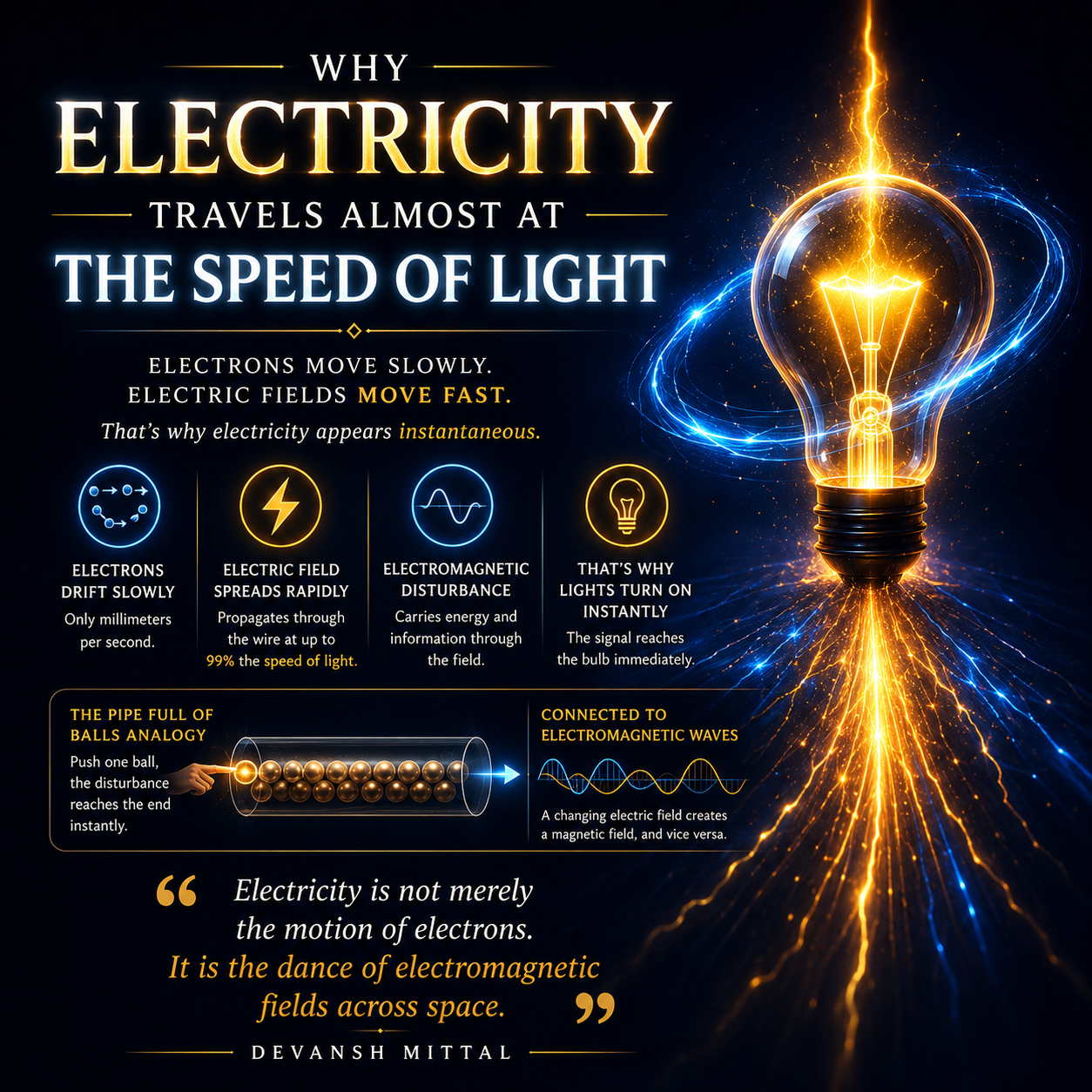
When you switch on a light bulb, it glows almost instantly.

When you press the power button on your computer, electrical signals race through billions of circuits in a tiny fraction of a second.

But here is the surprising part:

The electrons inside the wire actually move very slowly.

In many household wires, electrons drift at only a few millimeters per second — slower than a crawling ant.

So how can electricity seem to travel almost at the speed of light?

The answer reveals one of the deepest ideas in Physics:

Electricity is not mainly about electrons traveling rapidly through wires. It is about electric fields and electromagnetic disturbances propagating through space.


The Common Misconception

Most students imagine electricity like water flowing through a pipe:

  • electrons are like water molecules,
  • the wire is the pipe,
  • and electricity means electrons rushing rapidly from one end to another.

This picture is only partly correct.

The electrons themselves move slowly.

What moves rapidly is the electromagnetic signal.


Drift Velocity: The Slow Motion of Electrons

Metal wires already contain countless free electrons even before the circuit is switched on.

When a battery is connected, these electrons begin drifting in one direction. This average motion is called drift velocity.

Surprisingly, this drift velocity is extremely small.

An individual electron may take minutes or even hours to move a short distance through a wire.

Yet the bulb glows almost instantly.

Clearly, something else must be happening.


A Simple Analogy

Imagine a long pipe completely filled with tightly packed balls.

If you push one ball at one end, the ball at the opposite end moves almost immediately.

But the same ball did not travel across the pipe. Instead, the disturbance traveled rapidly through the system.

Electricity behaves similarly.

The electrons already exist throughout the wire. When an electric field is established, electrons everywhere begin responding almost simultaneously.


The Real Hero: The Electric Field

The moment you connect a battery, an electric field is created inside and around the wire.

An electric field exerts force on charges and pushes electrons throughout the circuit.

The important point is this:

The electric field propagates extremely rapidly — close to the speed of light.

So the fast behavior of electricity is mainly due to the rapid propagation of the electric field, not because electrons themselves are moving extremely fast.


Electricity Is a Field Phenomenon

This is one of the great conceptual shifts in modern Physics.

Electricity is not merely the motion of particles.

It is fundamentally a phenomenon of fields.

Electric and magnetic fields carry:

  • energy,
  • momentum,
  • and information.

The electrons simply respond locally to these fields.


Electromagnetic Waves and Maxwell

A changing electric field creates a magnetic field.

A changing magnetic field creates an electric field.

This beautiful interplay allows electromagnetic disturbances to propagate through space as electromagnetic waves.

This revolutionary idea was discovered by James Clerk Maxwell.

Maxwell realized that light itself is an electromagnetic wave.

That means:

  • radio waves,
  • microwaves,
  • visible light,
  • X-rays,

are all forms of the same electromagnetic phenomenon.

Electrical signals in wires are deeply connected to this same physics.


Real-World Examples

Switching On a Light

When you press a switch:

  • the electric field spreads rapidly through the circuit,
  • electrons everywhere begin responding,
  • the bulb glows almost instantly.

The electrons inside the bulb do not come all the way from the battery.


Internet and Communication

Modern communication depends on fast electromagnetic propagation through:

  • cables,
  • fiber optics,
  • antennas,
  • and satellites.

Without electromagnetic waves, the modern digital world would not exist.


Final Takeaway

The next time you switch on a light, remember:

  • the electrons themselves move slowly,
  • but the electric field spreads through the circuit extremely rapidly,
  • carrying energy and information almost at the speed of light.

Electricity is not merely the movement of electrons.

It is the dance of electromagnetic fields across space.

Why Time Slows Down at High Speeds?

Standard

Why Time Slows Down at High Speeds

Imagine traveling in a spaceship moving close to the speed of light. Inside the spaceship, everything would feel completely normal. Your heartbeat, thoughts, and even your watch would work exactly as usual.

But for someone watching from Earth, something strange would happen:

Your clock would appear to run slower.

This phenomenon is called time dilation, and it is one of the most fascinating predictions of Albert Einstein’s Special Theory of Relativity.


The Big Problem Einstein Solved

Before Einstein, scientists believed that time was absolute. They thought time flowed at the same rate for everyone everywhere in the universe.

But experiments with light created a huge problem.

Scientists discovered that the speed of light is always constant:

c ≈ 3 × 10⁸ m/s

Normally, speeds add together. For example, if you throw a ball forward inside a moving train, a person standing outside sees the ball moving faster than you do.

But light behaves differently.

Even if you move toward a beam of light at extremely high speed, you still measure light traveling at exactly the same speed.

Einstein realized that if the speed of light never changes, then space and time themselves must change.


Understanding Time Dilation Intuitively

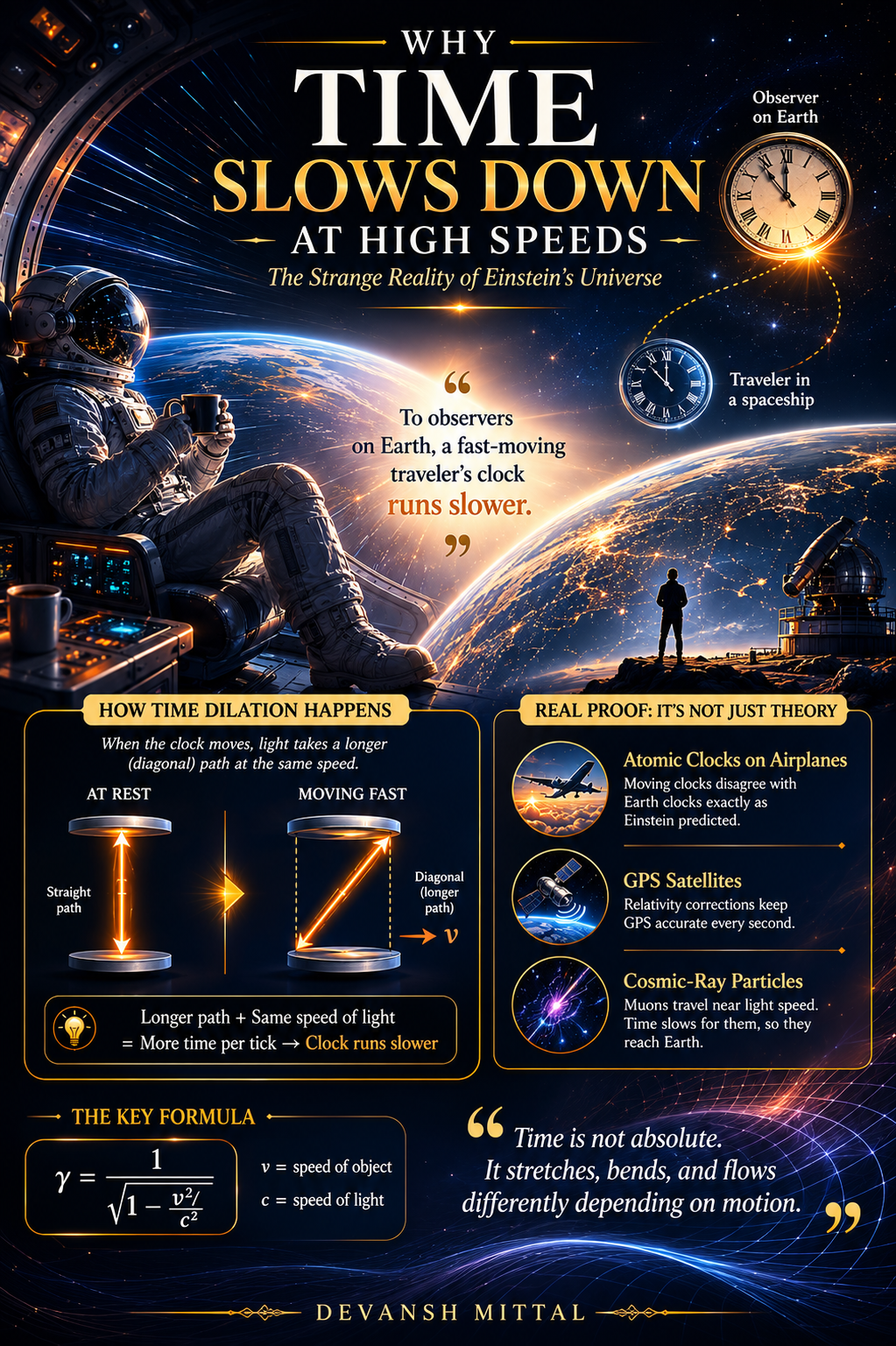
To understand this idea, imagine a special clock made using light.

Suppose light bounces between two mirrors. Every bounce acts like one “tick” of the clock.

When the clock is at rest, the light moves straight up and down.

But if the clock moves sideways at very high speed, the light must travel diagonally to keep up with the moving clock.

The important point is:

  • The diagonal path is longer.
  • The speed of light cannot change.

So the light takes more time to complete one tick.

As a result, the moving clock runs slower.

This is the basic reason why time slows down at high speeds.


Space and Time Are Connected

Einstein showed that space and time are not separate things. They are connected together in something called spacetime.

The faster an object moves through space, the slower it moves through time.

At everyday speeds, this effect is extremely tiny, so we do not notice it. But near the speed of light, the effect becomes very large.

The mathematical expression for time dilation is:

Δt = γΔt₀

where

γ = 1 / √(1 − v²/c²)

As the speed v gets closer to the speed of light c, the value of γ increases greatly, meaning time slows down more and more.


The Twin Paradox

One famous example of time dilation is the Twin Paradox.

Imagine two twins:

  • One stays on Earth.
  • The other travels in a fast spaceship and later returns.

When they meet again, the traveling twin is younger.

Why?

Because less time passed for the twin moving at very high speed.

This may sound unbelievable, but it is a real prediction of physics.


Is Time Dilation Real?

Yes. Time dilation has been experimentally confirmed many times.

1. Atomic Clocks

Scientists placed highly accurate atomic clocks on airplanes. After the flights, the moving clocks showed slightly less time than clocks on Earth — exactly as Einstein predicted.

2. GPS Satellites

GPS satellites move very fast around Earth. Their clocks run differently because of relativity.

If scientists ignored time dilation, GPS systems would quickly become inaccurate.

3. Fast-Moving Particles

Particles called muons are created high in Earth’s atmosphere. They should decay before reaching the ground, but because they move near the speed of light, time slows down for them, allowing many to survive longer.


Why Nothing Can Travel Faster Than Light

As an object moves faster and faster, slowing time requires more and more energy.

Reaching the speed of light would require infinite energy, which is impossible.

That is why no object with mass can reach or exceed the speed of light.


Final Thoughts

Time dilation teaches us something extraordinary:

Time is not the same for everyone.

It depends on motion.

At normal speeds, the effect is tiny. But near the speed of light, time itself slows down dramatically.

Einstein’s theory completely changed our understanding of the universe. Today, relativity is not just a scientific idea — it is part of real-world technology such as GPS and particle physics experiments.

The universe is far stranger and more beautiful than our everyday experience suggests.

What is Temperature? and Why Absolute Zero is not possible?

Standard

What Is Temperature?

Temperature is one of the most familiar quantities in physics, yet its true meaning is remarkably profound.

At the microscopic level, temperature measures the average random kinetic energy of particles in a system. In simpler terms:

The faster the particles move randomly, the higher the temperature.

In gases, particles move freely in all directions. In solids, atoms vibrate about fixed positions. As thermal motion increases, temperature rises.

Thus, temperature is fundamentally connected to microscopic motion.


What Happens When Temperature Decreases?

When a body cools:

  • particle motion decreases,
  • vibrations become weaker,
  • and the average kinetic energy reduces.

This naturally leads to an important question:

Can particle motion become completely zero?

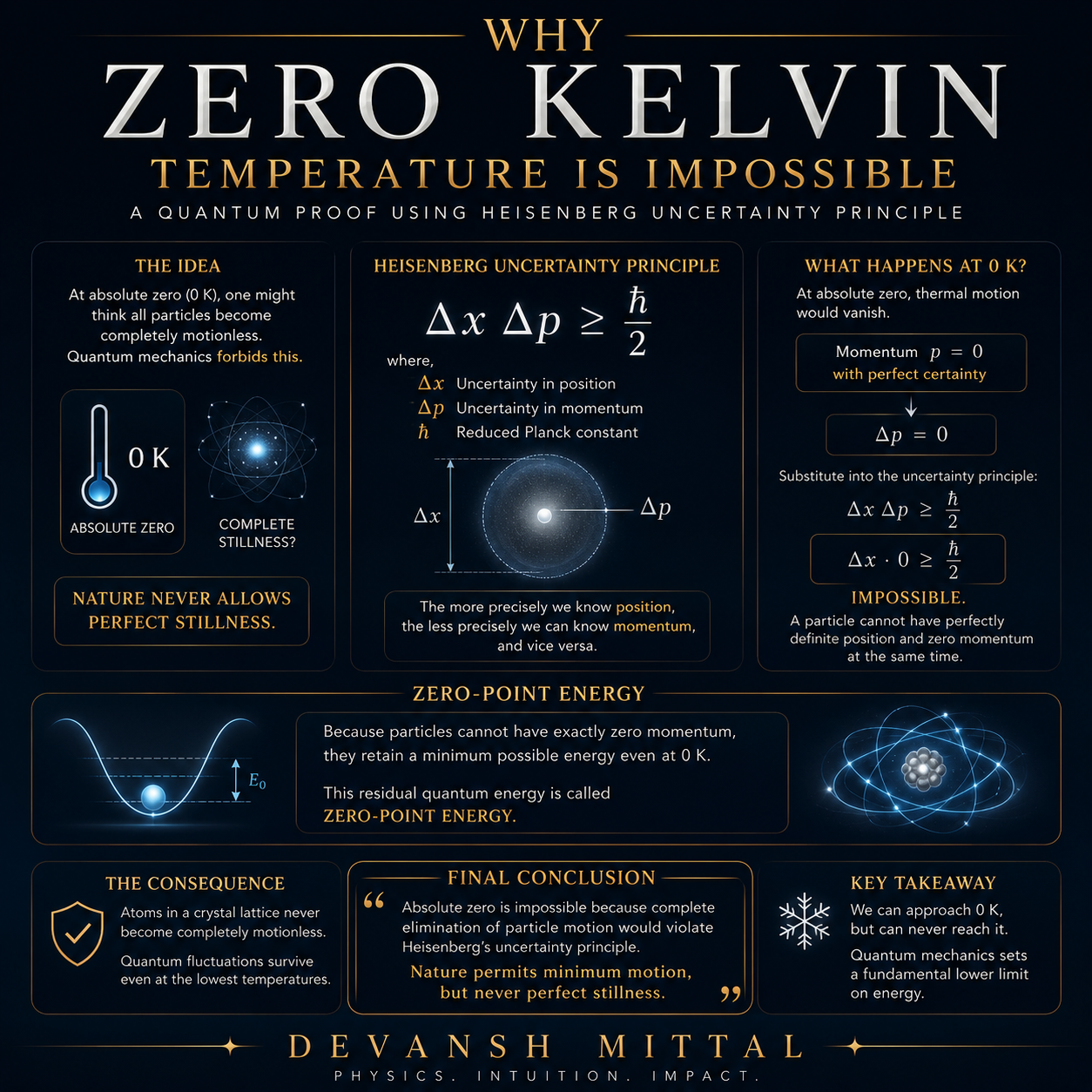
If that were possible, the system would reach the lowest possible temperature: 0 K, called absolute zero.

Classically, one might imagine that at 0 K all particles become perfectly motionless.

Quantum mechanics, however, forbids this possibility.


Heisenberg’s Uncertainty Principle

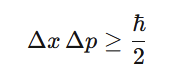
One of the foundational principles of quantum mechanics is Heisenberg’s uncertainty principle:

This principle states that a particle cannot simultaneously possess:

  • perfectly definite position,
  • and perfectly definite momentum.

This is not a limitation of measurement instruments. It is a fundamental law of nature.


Why Absolute Zero Is Impossible

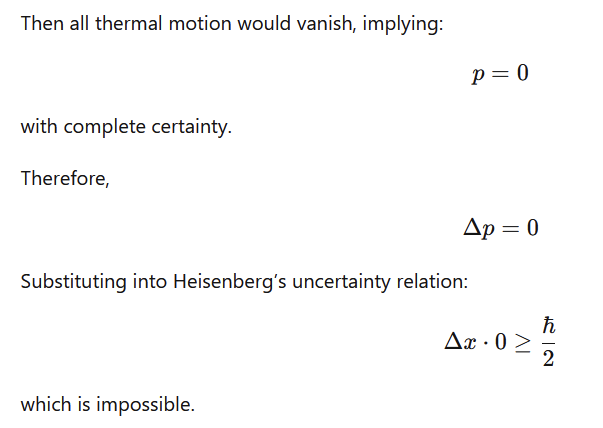
Suppose a particle inside a solid reaches absolute zero.

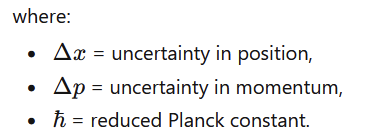
Hence a particle cannot simultaneously have:

  • zero momentum,
  • and a definite position inside matter.

Some residual momentum uncertainty must always remain.

As a result, particles retain a minimum unavoidable motion even at extremely low temperatures.

This residual energy is called zero-point energy.


Zero-Point Energy

Even near 0 K:

  • atoms in a crystal continue to vibrate slightly,
  • electrons retain quantum motion,
  • and complete stillness never occurs.

Nature permits minimum motion, but never perfect stillness.

Thus:

Absolute zero can be approached indefinitely, but never perfectly reached.


Final Conclusion

Temperature is a measure of microscopic random motion. As temperature decreases, this motion reduces, but quantum mechanics prevents it from becoming exactly zero.

Heisenberg’s uncertainty principle ensures that particles can never possess both perfectly definite position and zero momentum simultaneously.

Therefore:

0 K is Fundamentally Unattainable.

Absolute zero is not merely technologically difficult — it is forbidden by the quantum structure of nature itself.