When the Straight Line Is Not the Fastest Path
A Beautiful Idea from Physics
We often hear the statement:
“The shortest distance between two points is a straight line.”
In geometry, this is absolutely correct.
But physics teaches us something deeper:
The shortest path is not always the fastest path.
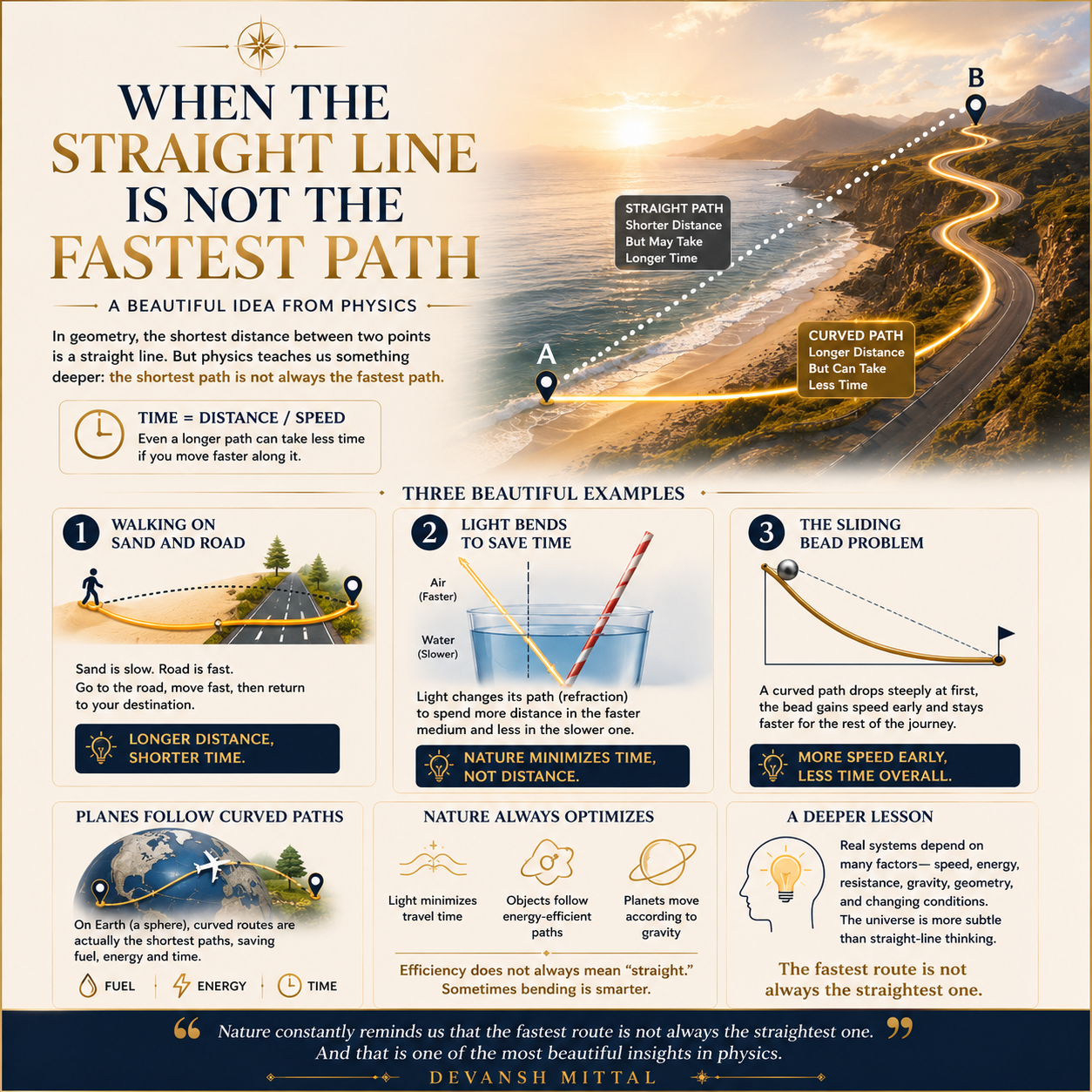
Sometimes a slightly longer curved path can take less time than a straight-line path.
At first this sounds impossible, but Nature gives many beautiful examples of this idea.
Distance and Time Are Not the Same Thing
Suppose you want to travel from one place to another.
Your travel time depends on two things:
- the distance traveled,
- and your speed during the journey.
Mathematically:
Time = Distance / Speed
This means that even if a path is longer, it can still take less time if you move faster along it.
This simple idea is the key to understanding the entire article.
Example 1: Walking on Sand and Road
Imagine you are standing on a beach.
- Walking on sand is slow.
- Walking on a road is much faster.
Now suppose your destination lies far away along the beach.
Should you walk directly toward it in a straight line through sand?
Not always.
A faster strategy may be:
- first move toward the road,
- travel quickly along the road,
- then return toward the destination.
Even though the total distance becomes larger, the total time can become smaller because most of the motion happens on the faster surface.
So:
Shortest distance ≠ shortest time.
Example 2: Light Does Not Always Travel in Straight Lines
Light usually travels in straight lines in air.
But when light enters water or glass, it bends.
This phenomenon is called:
Refraction
Why does light bend?
Because light travels slower in water than in air.
To save time, light changes its path so that it spends more distance in the faster medium.
This is why a straw placed in water appears bent.
Nature is not trying to minimize distance.
Nature is trying to minimize time.
Example 3: The Sliding Bead Problem
This is one of the most famous problems in physics.
Imagine a bead sliding under gravity from one point to another.
Which path will take the least time?
Most people naturally think:
“A straight line.”
But surprisingly, this is wrong.
A curved path can actually be faster.
Why?
Because the curved path drops steeply at first, allowing the bead to gain speed quickly due to gravity.
After gaining large speed early, the bead continues moving rapidly for the rest of the journey.
So although the curved path is longer, the higher speed makes the total time smaller.
This is one of the most beautiful ideas in physics.
Why Curved Paths Can Be Faster
There are two competing effects:
Straight Path
- shorter distance,
- but slower speed gain.
Curved Path
- longer distance,
- but faster speed gain.
Sometimes the increase in speed is more important than the extra distance.
That is why the curved path wins.
Airplanes Also Follow Curved Paths
When airplanes travel long distances on Earth, their routes often appear curved on maps.
But Earth is spherical, not flat.
The curved-looking route is actually the shortest path on a sphere.
This path helps save:
- fuel,
- energy,
- and travel time.
Again, Nature and engineering often prefer optimal paths rather than visually straight ones.
Nature Always Tries to Optimize
Many laws of physics are based on optimization principles.
For example:
- light tries to minimize travel time,
- objects move in ways that reduce energy,
- planets follow paths determined by gravity.
Physics repeatedly shows that Nature is extremely efficient.
But efficiency does not always mean “straight.”
Sometimes:
- bending is faster,
- curved motion is smarter,
- and indirect paths become optimal.
A Deeper Lesson
This idea teaches us something important beyond physics.
Our intuition often focuses only on distance.
But in real systems, many factors matter:
- speed,
- energy,
- resistance,
- gravity,
- geometry,
- and changing conditions.
The universe is more intelligent and subtle than simple straight-line thinking.
Final Thoughts
The statement:
“The shortest distance between two points is a straight line”
is true in geometry.
But physics asks a deeper question:
“What path takes the least time?”
And the answer is often very different.
Light bends.
Objects curve.
Airplanes follow arcs.
Sliding beads move faster on curved tracks.
Nature constantly reminds us that the fastest route is not always the straightest one.
And that is one of the most beautiful insights in physics.

