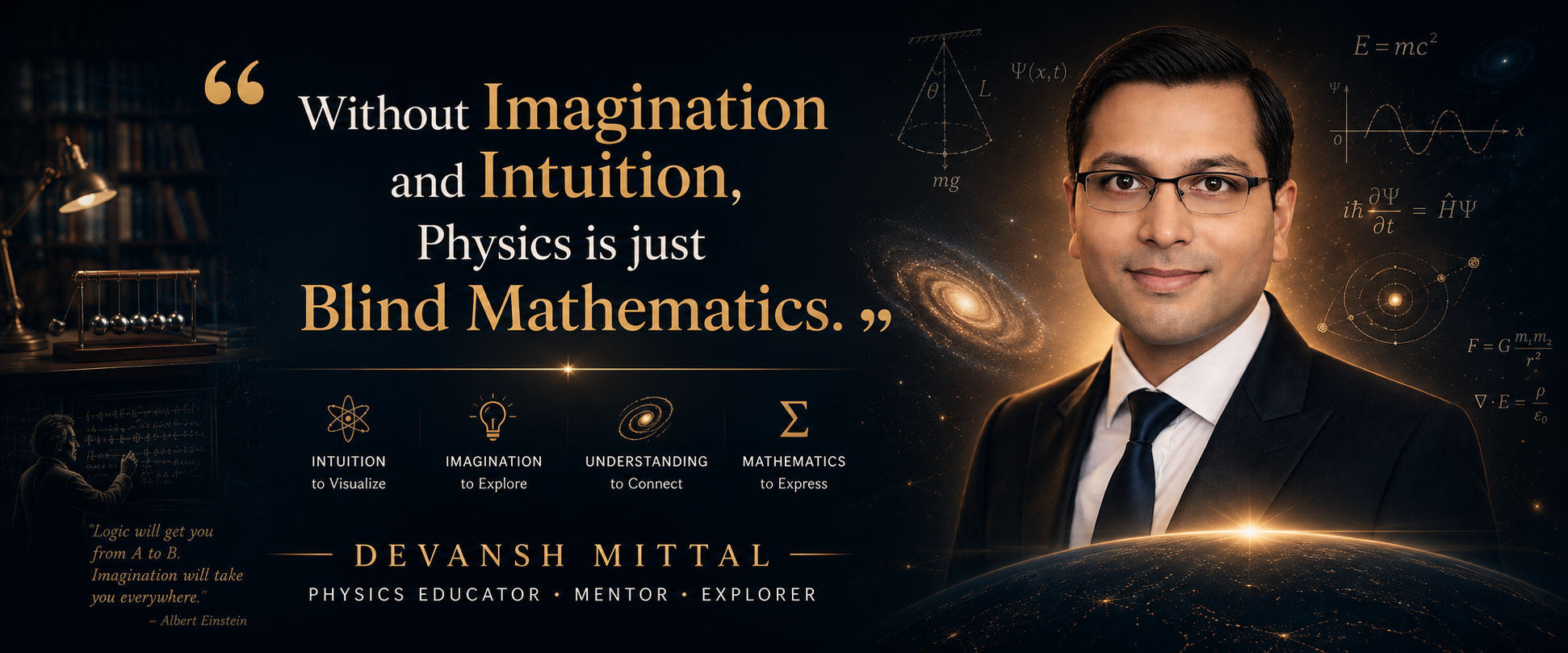
Beyond Equations: My Philosophy of Teaching Physics
Physics is often misunderstood as a subject of formulas, calculations, and mechanical problem-solving. Over the years, I have come to realize that this perception, although widespread, fails to capture the true spirit of the subject. To me, physics is not merely a collection of mathematical techniques—it is a way of observing reality, questioning nature, and developing a deeper understanding of the world around us.
At the heart of my teaching philosophy lies one fundamental belief:
Without intuition and imagination, physics becomes nothing more than blind mathematics.
Mathematics is undoubtedly the language of physics, but intuition is its soul. A student may memorize equations and solve problems mechanically, yet still remain disconnected from the essence of the subject. True understanding emerges only when concepts become intuitive—when students are able to visualize phenomena, develop physical insight, and think independently rather than merely applying formulas by habit.
This philosophy has deeply influenced the way I teach.
Teaching Beyond Memorization
In my classroom, I do not aim to produce students who can simply reproduce solutions. I strive to cultivate thinkers—students who are capable of reasoning, imagining, questioning, and understanding concepts from first principles.
Whenever I teach a topic, my emphasis is not limited to how a formula works, but why it works. I encourage students to develop an internal picture of physical phenomena. Whether we are discussing mechanics, electromagnetism, thermodynamics, or modern physics, I attempt to make the ideas intuitive before they become mathematical.
I believe that conceptual depth and problem-solving ability should grow together. Problem-solving without understanding creates superficial learning, while understanding without application remains incomplete. My goal is to develop both simultaneously.
For this reason, I often encourage students to:
- Visualize physical situations mentally,
- Think about limiting cases,
- Develop physical intuition,
- Question assumptions,
- And connect mathematical expressions with real-world meaning.
Physics becomes beautiful when students stop seeing equations as symbols on paper and begin seeing them as descriptions of reality itself.
The Influence of Albert Einstein
My teaching philosophy has been profoundly inspired by Albert Einstein, who emphasized the importance of imagination and intuition in scientific thinking. Einstein once remarked that imagination is more important than knowledge, and throughout history, many of the greatest scientific breakthroughs have emerged not from mechanical calculation alone, but from deep intuition and creative thought.
This perspective resonates strongly with me.
In my view, education should not suppress curiosity under excessive procedural training. Instead, it should cultivate the ability to think deeply, independently, and imaginatively. A student who develops intuition gains something far more valuable than the ability to solve examinations—they develop the ability to understand.
Mentorship Beyond the Classroom
Teaching, to me, extends far beyond delivering lectures.
A teacher’s responsibility is not confined to explaining academic content during class hours. Students often require guidance, encouragement, emotional support, and mentorship alongside academic instruction. For this reason, I make a conscious effort to remain accessible to my students even outside the classroom.
I regularly solve doubts beyond class timings, guide students personally whenever needed, and maintain communication with parents to ensure that students receive consistent support from all directions. I strongly believe that education becomes significantly more effective when teachers, students, and parents work together with mutual trust and understanding.
Over time, many students also approach me with personal struggles, emotional challenges, self-doubt, lack of confidence, or academic anxiety. In such moments, I believe that a teacher must first be human before being academic. If I can extend my helping hand and positively influence a student’s life beyond academics, I consider that equally meaningful.
Education should not merely create high scorers; it should help shape stronger, wiser, and more confident human beings.
Creating Independent Thinkers
One of my deepest aspirations as a teacher is to help students become intellectually independent. I do not want students to rely permanently on memorized patterns or external guidance. I want them to develop the confidence to think for themselves.
A student truly learns physics not when they memorize a derivation, but when they can independently reason through unfamiliar situations using clarity of thought and conceptual understanding.
This is why I constantly encourage curiosity, questioning, and intellectual honesty in my teaching approach. I believe that the purpose of education is not simply to fill the mind with information, but to sharpen the quality of thinking itself.
A Philosophy Rooted in Care and Responsibility
At its core, my philosophy of teaching is built upon sincerity, depth, mentorship, and responsibility toward every student I teach.
I do not see teaching as merely a profession. I see it as a long-term commitment toward nurturing potential, building confidence, and helping young minds grow intellectually as well as personally.
I guide.
I mentor.
I inspire.
I teach.
And whenever possible, I extend my helping hand to support my students in every way I can.
Because ultimately, education is not only about producing successful students—it is about helping individuals discover clarity, confidence, curiosity, and direction in life.
And that, to me, is the true purpose of teaching.

