Tag Archives: iitphysics

When the Straight Line Is Not the Fastest Path

Standard

When the Straight Line Is Not the Fastest Path

A Beautiful Idea from Physics

We often hear the statement:

“The shortest distance between two points is a straight line.”

In geometry, this is absolutely correct.

But physics teaches us something deeper:

The shortest path is not always the fastest path.

Sometimes a slightly longer curved path can take less time than a straight-line path.

At first this sounds impossible, but Nature gives many beautiful examples of this idea.


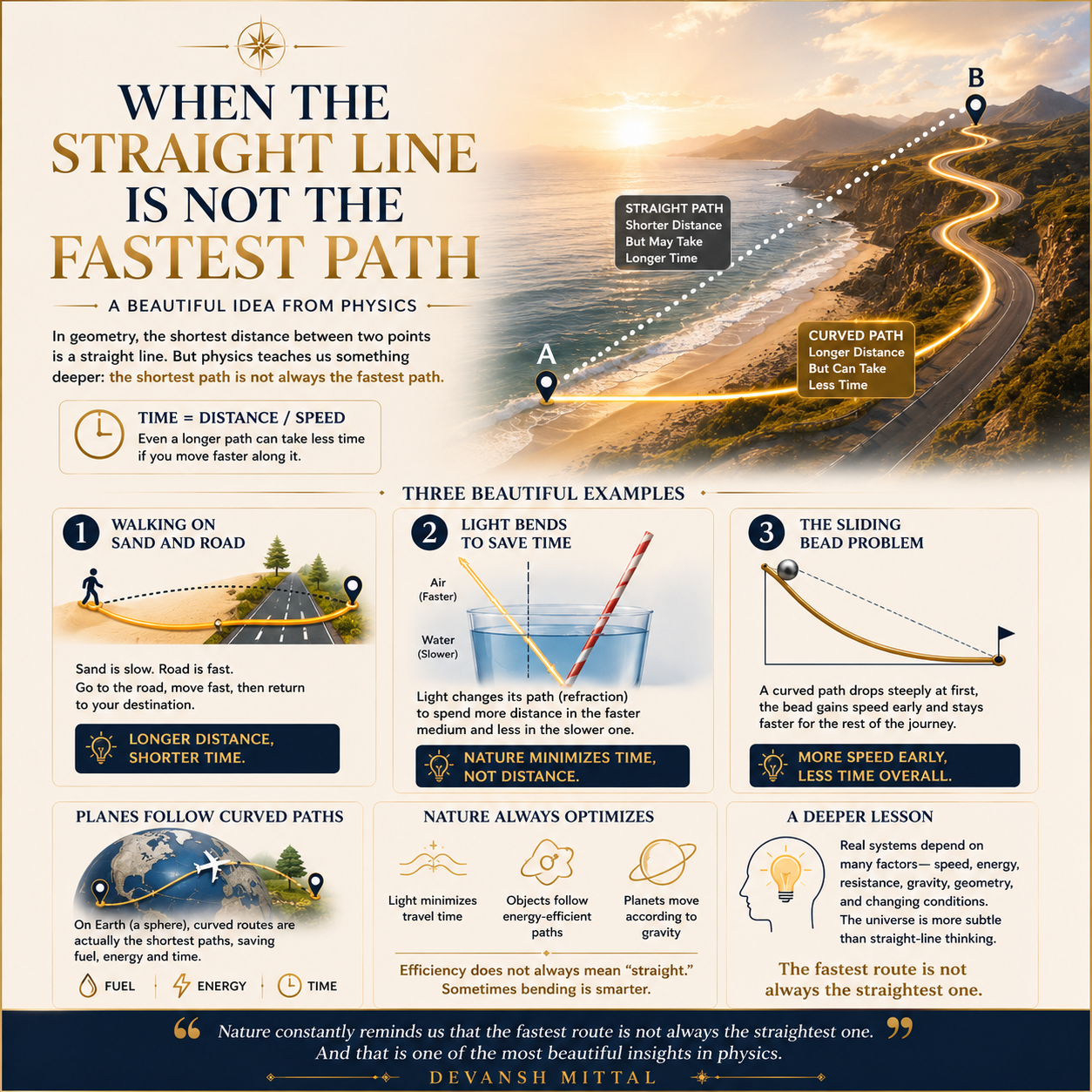
Distance and Time Are Not the Same Thing

Suppose you want to travel from one place to another.

Your travel time depends on two things:

  • the distance traveled,
  • and your speed during the journey.

Mathematically:

Time = Distance / Speed

This means that even if a path is longer, it can still take less time if you move faster along it.

This simple idea is the key to understanding the entire article.


Example 1: Walking on Sand and Road

Imagine you are standing on a beach.

  • Walking on sand is slow.
  • Walking on a road is much faster.

Now suppose your destination lies far away along the beach.

Should you walk directly toward it in a straight line through sand?

Not always.

A faster strategy may be:

  • first move toward the road,
  • travel quickly along the road,
  • then return toward the destination.

Even though the total distance becomes larger, the total time can become smaller because most of the motion happens on the faster surface.

So:

Shortest distance ≠ shortest time.


Example 2: Light Does Not Always Travel in Straight Lines

Light usually travels in straight lines in air.

But when light enters water or glass, it bends.

This phenomenon is called:

Refraction

Why does light bend?

Because light travels slower in water than in air.

To save time, light changes its path so that it spends more distance in the faster medium.

This is why a straw placed in water appears bent.

Nature is not trying to minimize distance.
Nature is trying to minimize time.


Example 3: The Sliding Bead Problem

This is one of the most famous problems in physics.

Imagine a bead sliding under gravity from one point to another.

Which path will take the least time?

Most people naturally think:

“A straight line.”

But surprisingly, this is wrong.

A curved path can actually be faster.

Why?

Because the curved path drops steeply at first, allowing the bead to gain speed quickly due to gravity.

After gaining large speed early, the bead continues moving rapidly for the rest of the journey.

So although the curved path is longer, the higher speed makes the total time smaller.

This is one of the most beautiful ideas in physics.


Why Curved Paths Can Be Faster

There are two competing effects:

Straight Path

  • shorter distance,
  • but slower speed gain.

Curved Path

  • longer distance,
  • but faster speed gain.

Sometimes the increase in speed is more important than the extra distance.

That is why the curved path wins.


Airplanes Also Follow Curved Paths

When airplanes travel long distances on Earth, their routes often appear curved on maps.

But Earth is spherical, not flat.

The curved-looking route is actually the shortest path on a sphere.

This path helps save:

  • fuel,
  • energy,
  • and travel time.

Again, Nature and engineering often prefer optimal paths rather than visually straight ones.


Nature Always Tries to Optimize

Many laws of physics are based on optimization principles.

For example:

  • light tries to minimize travel time,
  • objects move in ways that reduce energy,
  • planets follow paths determined by gravity.

Physics repeatedly shows that Nature is extremely efficient.

But efficiency does not always mean “straight.”

Sometimes:

  • bending is faster,
  • curved motion is smarter,
  • and indirect paths become optimal.

A Deeper Lesson

This idea teaches us something important beyond physics.

Our intuition often focuses only on distance.

But in real systems, many factors matter:

  • speed,
  • energy,
  • resistance,
  • gravity,
  • geometry,
  • and changing conditions.

The universe is more intelligent and subtle than simple straight-line thinking.


Final Thoughts

The statement:

“The shortest distance between two points is a straight line”

is true in geometry.

But physics asks a deeper question:

“What path takes the least time?”

And the answer is often very different.

Light bends.
Objects curve.
Airplanes follow arcs.
Sliding beads move faster on curved tracks.

Nature constantly reminds us that the fastest route is not always the straightest one.

And that is one of the most beautiful insights in physics.
What is Temperature? and Why Absolute Zero is not possible?

Standard

What Is Temperature?

Temperature is one of the most familiar quantities in physics, yet its true meaning is remarkably profound.

At the microscopic level, temperature measures the average random kinetic energy of particles in a system. In simpler terms:

The faster the particles move randomly, the higher the temperature.

In gases, particles move freely in all directions. In solids, atoms vibrate about fixed positions. As thermal motion increases, temperature rises.

Thus, temperature is fundamentally connected to microscopic motion.


What Happens When Temperature Decreases?

When a body cools:

  • particle motion decreases,
  • vibrations become weaker,
  • and the average kinetic energy reduces.

This naturally leads to an important question:

Can particle motion become completely zero?

If that were possible, the system would reach the lowest possible temperature: 0 K, called absolute zero.

Classically, one might imagine that at 0 K all particles become perfectly motionless.

Quantum mechanics, however, forbids this possibility.


Heisenberg’s Uncertainty Principle

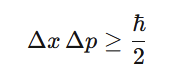
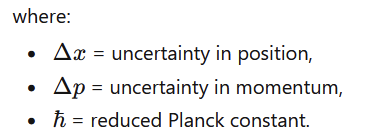
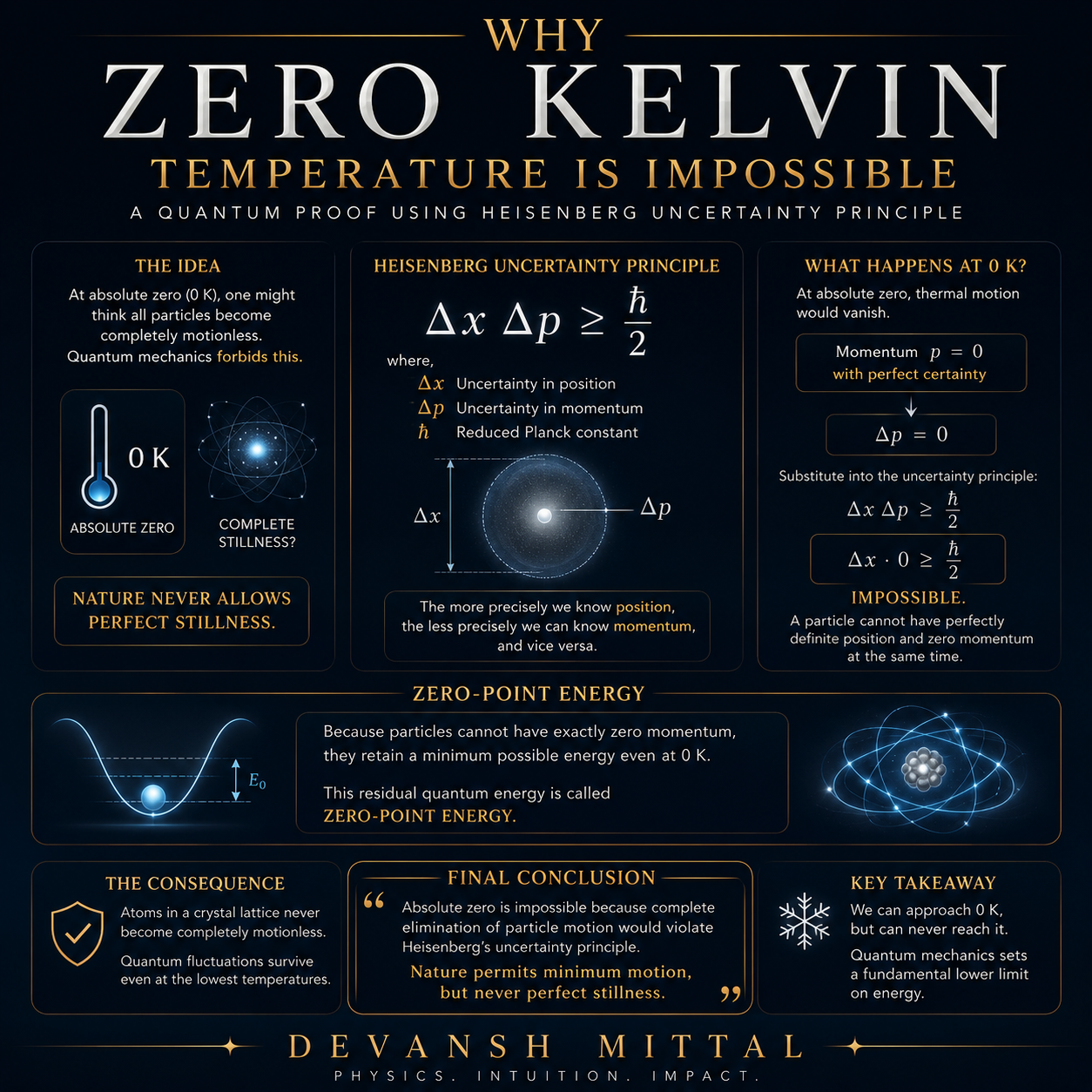
One of the foundational principles of quantum mechanics is Heisenberg’s uncertainty principle:

This principle states that a particle cannot simultaneously possess:

  • perfectly definite position,
  • and perfectly definite momentum.

This is not a limitation of measurement instruments. It is a fundamental law of nature.


Why Absolute Zero Is Impossible

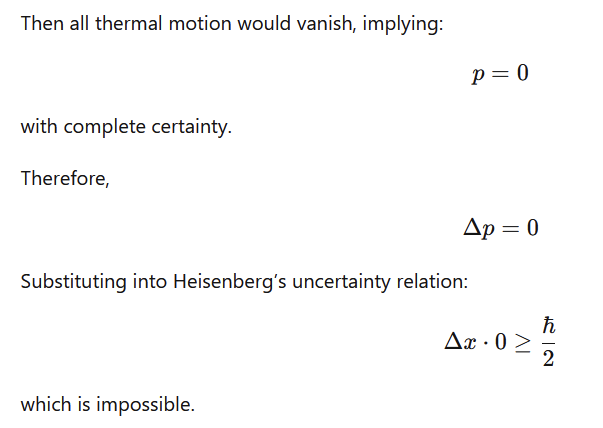
Suppose a particle inside a solid reaches absolute zero.

Hence a particle cannot simultaneously have:

  • zero momentum,
  • and a definite position inside matter.

Some residual momentum uncertainty must always remain.

As a result, particles retain a minimum unavoidable motion even at extremely low temperatures.

This residual energy is called zero-point energy.


Zero-Point Energy

Even near 0 K:

  • atoms in a crystal continue to vibrate slightly,
  • electrons retain quantum motion,
  • and complete stillness never occurs.

Nature permits minimum motion, but never perfect stillness.

Thus:

Absolute zero can be approached indefinitely, but never perfectly reached.


Final Conclusion

Temperature is a measure of microscopic random motion. As temperature decreases, this motion reduces, but quantum mechanics prevents it from becoming exactly zero.

Heisenberg’s uncertainty principle ensures that particles can never possess both perfectly definite position and zero momentum simultaneously.

Therefore:

0 K is Fundamentally Unattainable.

Absolute zero is not merely technologically difficult — it is forbidden by the quantum structure of nature itself.

“Physics Started Making Sense” — A Heartfelt IIT Bombay Student Testimonial

Standard

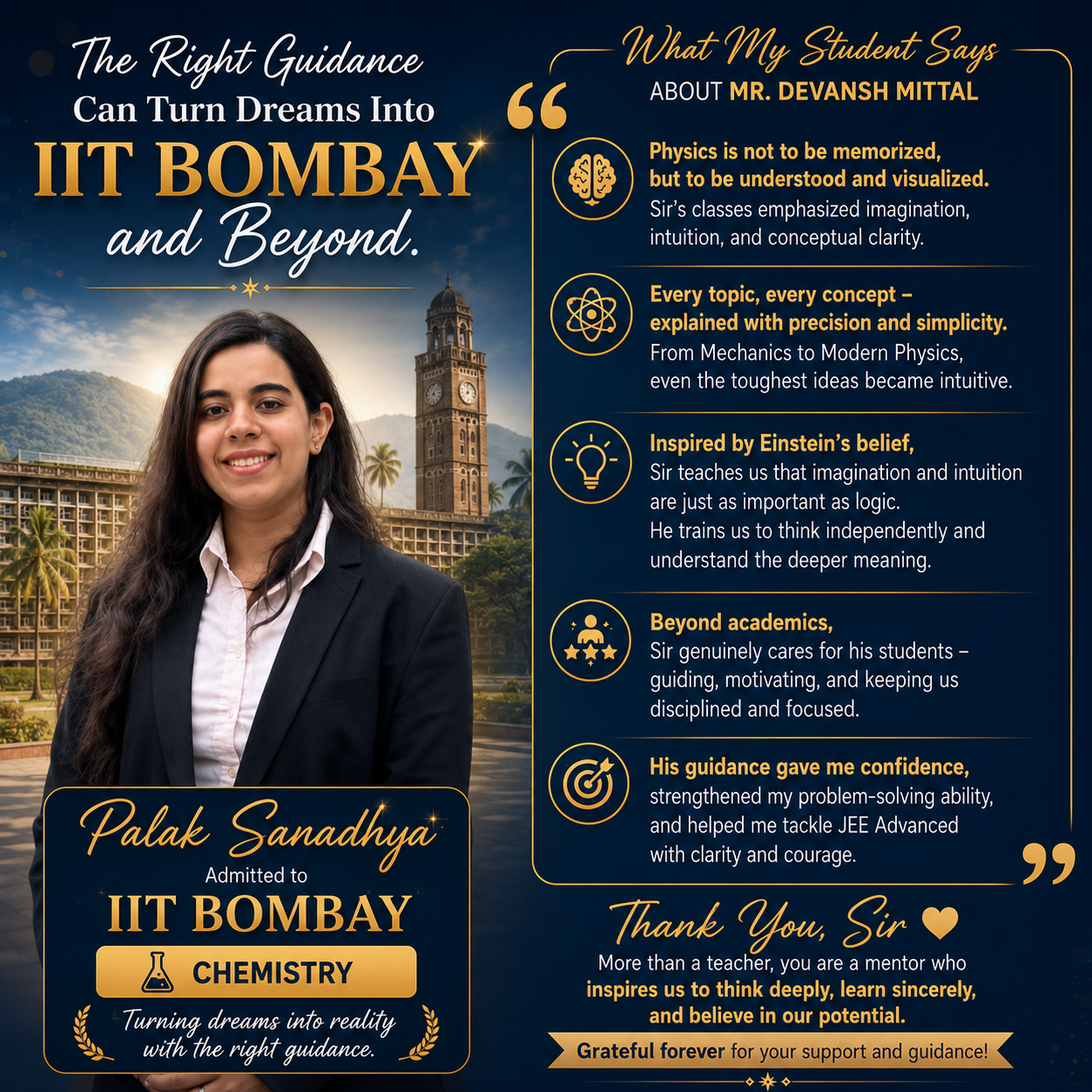
Sometimes, even a few months of the right guidance can completely transform a student’s confidence and way of thinking. Palak Sanadhya joined my classes only a short time before JEE Advanced, yet her sincerity, hard work, and deep commitment toward conceptual understanding helped her secure admission to Indian Institute of Technology Bombay in Chemical Engineering.

What makes her testimonial especially meaningful to me is that it reflects the very philosophy with which I teach Physics — not as a collection of formulas to memorize, but as a subject to be visualized, understood intuitively, and appreciated deeply. I am grateful to have played a small role in her remarkable journey.


Securing admission to Chemical Engineering at Indian Institute of Technology Bombay after clearing one of the most competitive examinations in the country was a dream come true for me. And although I studied under Mr. Devansh Mittal for only around three months before JEE Advanced, the impact of his teaching during that short period was truly remarkable.

What immediately stood out to me in his classes was the way he approached Physics — not as a subject to be memorized, but as something to be deeply understood and mentally visualized. In an environment where students often focus only on speed and formulas, his teaching emphasized imagination, intuition, and conceptual clarity.

Whether it was Mechanics, Thermodynamics, Waves & Oscillations, Electrodynamics, Optics, or Modern Physics, he explained every topic with extraordinary precision and simplicity. Even concepts that had previously felt confusing became intuitive after his explanations. His ability to connect physical understanding with mathematical problem-solving made a tremendous difference in my preparation.

One of the most unique aspects of his teaching was his belief, inspired by Albert Einstein, that imagination and intuition are just as important as logic in learning Physics. Instead of encouraging rote methods, he trained us to think independently and understand the deeper meaning behind every concept. That approach not only improved my problem-solving ability, but also gave me confidence while attempting challenging JEE Advanced questions.

Beyond academics, I was deeply touched by the sincerity and honesty with which he guided his students. He genuinely cared about our progress, regularly communicated with parents, and ensured that students remained disciplined, motivated, and mentally focused during such an important phase of preparation.

Despite the limited time I spent under his mentorship, his guidance had a lasting impact on my understanding of Physics and my confidence as a student.

Mr. Devansh Mittal is far more than an excellent teacher — he is a mentor who inspires students to think deeply, learn sincerely, and believe in their own potential.

I will always remain grateful for his support and guidance during one of the most important phases of my academic journey.

— Palak Sanadhya