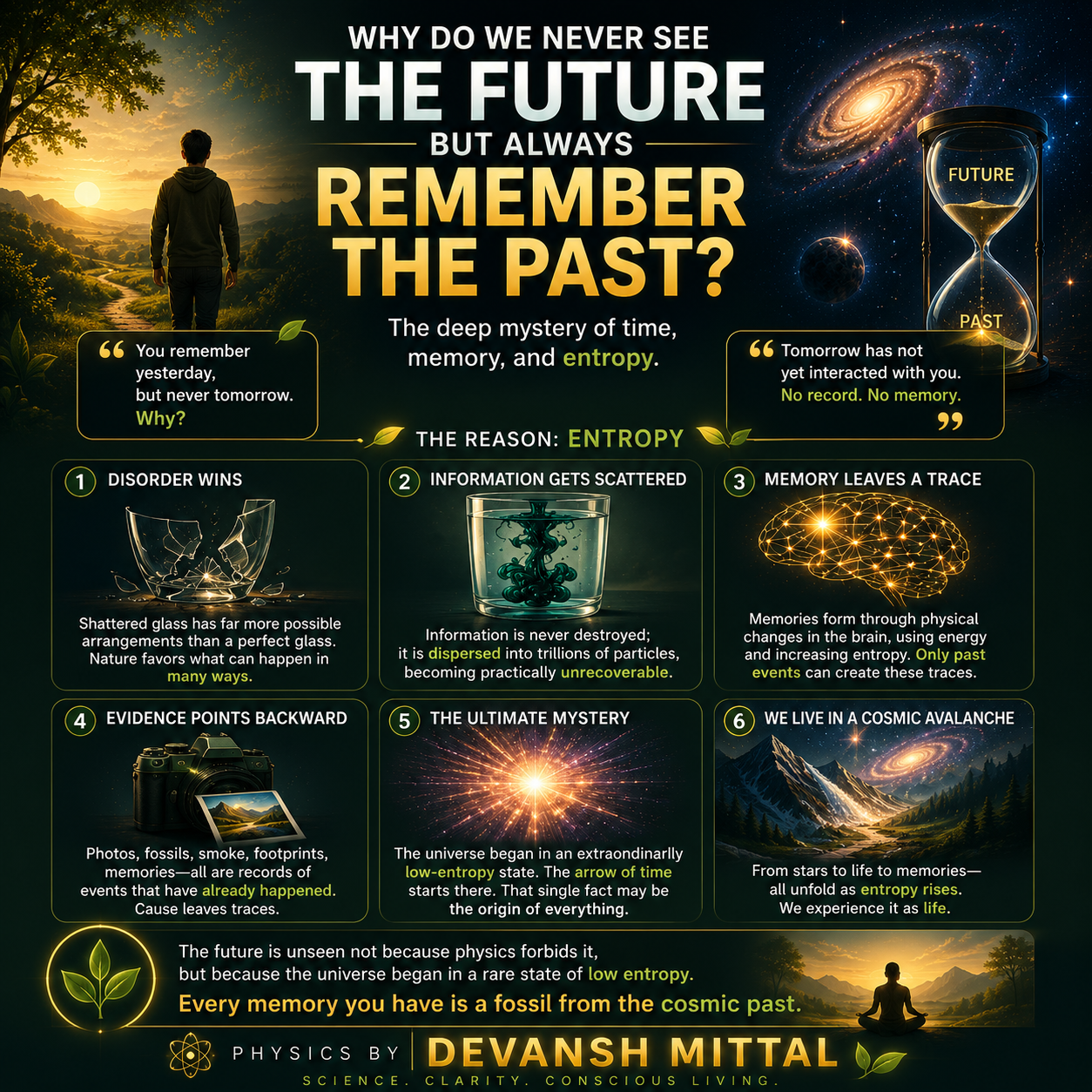
The Deep Mystery of Time, Memory, and Entropy
Every morning, the Sun rises. You remember what you ate yesterday, the conversation you had a few hours ago, and perhaps even moments from your childhood decades in the past. Yet hidden within these ordinary experiences is something profoundly mysterious: you have never remembered tomorrow. Not once.
At first glance, this seems so obvious that it hardly deserves attention. But from the perspective of physics, it is astonishing. Why should the past be accessible to memory while the future remains completely hidden? Why do we experience time as flowing in one direction? This simple question leads us to one of the deepest puzzles in modern science.
The Universe Has a Secret
Imagine watching a movie of two planets orbiting each other in space. Now play the movie backward. Surprisingly, the reversed motion still looks perfectly plausible. The same is true for two billiard balls colliding on a table or an electron moving through space. In most cases, the fundamental equations of physics work equally well whether time moves forward or backward.
This is one of the most surprising discoveries in science. At the microscopic level, nature appears almost indifferent to the direction of time. The laws themselves make very little distinction between past and future.
Yet our everyday experience is built entirely around that distinction. We remember the past but not the future. We can influence tomorrow but not yesterday. Physics seems almost time-symmetric, while human experience is overwhelmingly time-directed. Somewhere between microscopic laws and everyday life, something remarkable happens.
The Movie That Feels Wrong
Consider a glass falling from a table and shattering on the floor. Everyone immediately recognizes this as a normal event. Now imagine watching the same video in reverse. The scattered fragments suddenly leap together, assemble themselves into a perfect glass, and jump neatly back onto the table.
Nothing about the fundamental laws governing the atoms explicitly forbids such a process. Yet we instinctively know it never happens. The reversed movie feels absurd because it violates one of the most important statistical tendencies in nature.
The key to understanding this tendency is entropy.
The Tyranny of Probability
Entropy is often described as a measure of disorder, but a more accurate description is that it measures how many microscopic arrangements correspond to a particular macroscopic state.
An intact glass sitting on a table can exist in only a relatively small number of microscopic configurations. A shattered glass, however, can exist in an unimaginably larger number of configurations. There are vastly more ways for the pieces to be scattered than for them to be perfectly assembled.
As a result, nature overwhelmingly tends to move toward states that can be realized in more ways. This is not because nature has goals or intentions. It is simply a matter of probability. The shattered-glass state wins the statistical lottery by an enormous margin.
A Universe That Constantly Hides Information
Imagine placing a drop of ink into a glass of water. Initially, the ink occupies a tiny region. Over time, it spreads throughout the entire glass until it becomes uniformly mixed.
What happened to the information about the ink’s original location? Surprisingly, it was not destroyed. Instead, it became distributed among countless water molecules in extraordinarily complex ways. In principle, the information still exists. In practice, it has become effectively impossible to recover.
The universe rarely destroys information outright. More often, it disperses it so thoroughly that reconstruction becomes hopelessly difficult. The past has not vanished; it has simply been hidden.
Why Memory Points Only One Way
This brings us to the deepest part of the story. The reason you remember the past may be intimately connected to entropy itself.
A memory is not an abstract object. It is a physical record stored in matter. When your brain forms a memory, neurons modify their connections, energy is consumed, heat is generated, and entropy increases. Every memory is a physical trace left behind by an event.
This explains why memories point only toward the past. Yesterday physically interacted with your brain and left records behind. Tomorrow has not yet done so. No interaction has occurred, no trace exists, and therefore no memory can exist.
In this sense, memories are fossils of irreversible physical processes. Every remembered experience is evidence that entropy has already increased.
The Arrow Hidden in Every Photograph
The same idea extends far beyond human memory. Every photograph records a moment from the past because light from an event reached a camera and altered physical matter inside it. The event created the record; the record did not create the event.
This asymmetry appears everywhere. Footprints reveal where someone has been. Smoke reveals that a fire occurred. Fossils reveal organisms that once lived. Memories reveal experiences that already happened. Every piece of evidence in the universe points backward in time.
The arrow of time is written into the very concept of a record.
The Greatest Mystery of All
At this point, it may seem that the problem has been solved. Entropy increases, and therefore time appears to move forward.
But this answer immediately raises an even deeper question: why was entropy lower in the past?
Entropy can only increase if it starts from a relatively low value. Modern cosmology tells us that the early universe, shortly after the Big Bang, existed in an extraordinarily low-entropy state. Not merely low, but astonishingly low.
This fact may be the ultimate source of the arrow of time. Every broken egg, every memory, every aging face, every historical event, and every civilization may ultimately trace its existence to this remarkable initial condition of the cosmos.
We Live Inside a Cosmic Avalanche
A useful analogy is a mountain covered with snow. The early universe was like a snowpack balanced high on a slope. Once the process begins, the snow naturally moves downward. The avalanche unfolds.
Similarly, the universe has been evolving from its extraordinarily special low-entropy beginning toward states of higher entropy. Along the way, stars formed, galaxies emerged, planets developed, life appeared, and conscious beings began creating memories.
The arrow of time is not something separate from these processes. It is the unfolding of the entire cosmic story.
The Final Surprise
Perhaps the most astonishing possibility is that the flow of time itself may not be a fundamental feature of reality. The microscopic laws of physics are largely indifferent to past and future. What we experience as the passage of time may emerge from statistics, information, and the extraordinarily special conditions present at the birth of the universe.
In other words, the future may not be hidden because physics forbids us from seeing it. It may be hidden because the universe began in a state so extraordinarily improbable that everything we call history has been the gradual unfolding of that initial condition.
Every memory you possess is therefore more than a record of your personal past. It is also a clue to one of the deepest mysteries in science. The simple fact that you remember yesterday but not tomorrow may ultimately be telling us something profound about the origin of the universe itself.
 The Intuitive Physicist