Category Archives: Interviews

Inside the Mind of AIR 113: Rajdeep Gupta Reveals His Complete NEET 2026 Blueprint

Standard

What separates a NEET score of 600 from a score of 700+? What does the daily life of an AIR 113 holder actually look like—not the myth, but the reality? And what is the one decision that every future NEET topper makes early—often before Class 11 even begins?

I am Devansh Mittal, a Physics educator and mentor. I teach Physics for IIT-JEE Advanced, NEET, Olympiads, and students aspiring for top global universities. Over the years, I have worked closely with hundreds of students on their journey to elite ranks. But some conversations stay with you long after the call ends—and this was one of them.

In this in-depth interview, I sat down with Rajdeep Gupta, who secured All India Rank 113 in NEET UG 2026—a phenomenal result in an exam where over 20 lakh students compete for a handful of seats at India’s top medical colleges. Rajdeep is not just a topper; he is a strategist. Every decision he made—from his daily timetable and resource selection, to his OMR bubbling protocol and error-analysis system—was deliberate, data-driven, and ruthlessly optimized.

In this article, you will find Rajdeep’s complete, unfiltered blueprint: his exact daily schedule, how he read NCERT 25–30 times in Biology, the three-category Error Notebook that pushed him past 700, his approach to conquering Physics without fear, why he completely quit social media for two years, how his family’s sacrifices became the backbone of his success, and the precise exam-day strategy he executed on D-Day.

Whether you are a parent planning your child’s NEET journey, a student stuck at 500 in mock tests dreaming of AIIMS Delhi, or a Class 11 aspirant just starting out—this article was written for you.


PHASE 1: THE GENESIS & THE “WHY”

Q1.  The Result Moment: Walk us through the exact moment you (and your parents) saw that you secured a top All India Rank in NEET. What was that feeling like?

Rajdeep:  When the result was declared and I saw All India Rank 113 on the screen, I was completely overwhelmed with joy and happiness. At that exact moment, my mother was sitting right next to me. As soon as she saw the rank, she was bursting with pride and joy. My younger brother was also right there, and he started celebrating immediately! After that, I called my father to break the news to him, and he was immensely proud and happy. Seeing the happy faces of my parents and family made me realize that all the intense, unyielding hard work I put in over the last two full years had finally borne fruit. It felt incredibly gratifying.

Q2.  The Catalyst: When did you officially start your NEET preparation? How did you figure out your true academic interest? At what point did you decide to pursue medical over engineering or commerce?

Rajdeep:  My core interest in biological sciences started early back when I was in Class 9. I found Biology fascinating, especially reading about human anatomy, physiology, and how the human body functions. However, my official and structured preparation for NEET UG began when I entered Class 11 and enrolled at Allen Career Institute in Kota. From that point onward, I dedicated the next two full years entirely to systematic NEET preparation.

PHASE 2: ACADEMIC ARCHITECTURE & BLUEPRINT

Q3.  The Daily Routine: What did your daily routine look like? Did you follow a rigid timetable (by the hour) or a flexible, target-based approach?

Rajdeep:  Throughout my preparation in Kota, I maintained a very structured and consistent daily timetable. I used to wake up early at 7:00 AM, freshen up, and finish breakfast by 7:30 AM. My morning self-study session started at 8:00 AM sharp and went on until 12:30 PM. During this 4.5-hour block, I took one or two short 10-minute breaks to stay refreshed. At 12:30 PM, I had lunch and got ready for coaching. My classes at Allen Kota ran from 2:00 PM to 8:00 PM every day. After returning home at 8:00 PM, I had dinner, relaxed briefly, and sat down for my night self-study session from 9:00 PM to 11:30 PM. Finally, I went to sleep at 11:30 PM to ensure I got a full 7.5 hours of rest before waking up at 7:00 AM the next morning.

Q4.  Sleep & Cycles: How many hours of sleep did you prioritize? Did you prefer studying late at night or early in the morning?

Rajdeep:  That myth is completely false. Sleep is absolutely vital for brain health, memory consolidation, and mental clarity. I made sure to sleep 7 to 8 hours every single night throughout my preparation. Without proper sleep, your retention capacity drops drastically.

Q5.  Subject Allocation: How did you balance Physics, Chemistry, and Biology? Did you allocate equal time to all, or base it entirely on your weak points?

Rajdeep:  I did not split time equally; instead, I allocated time based on the specific demands of each subject. I assigned the maximum time to Physics—around 2.5 hours daily—because Physics requires extensive numerical problem-solving and deep conceptual application. For Chemistry, I spent about 2 hours daily, balancing Physical, Organic, and Inorganic branches. For Biology, I allocated about 1 to 1.5 hours daily because once you have thoroughly understood a Biology chapter, revising it takes significantly less time compared to solving Physics problems.

My philosophy was that in Physics, the more numerical problems you solve, the stronger and clearer your concepts become. Solving a wide variety of questions exposes you to different problem patterns, which builds speed, accuracy, and confidence for the final exam.

Q6.  The Material Trap: Did you rely strictly on your coaching modules, or did you use multiple reference books? Is it better to solve one book three times or three books once?

Rajdeep:  When I started Class 11, like many students, I began solving external reference books alongside my coaching modules. However, by the end of Class 11 and throughout Class 12, I realized that managing too many reference books was creating unnecessary stress and confusion. So I completely stopped solving external reference books and focused 100% of my energy on Allen’s coaching modules and NCERT textbooks. In my opinion, it is vastly superior to solve one quality module 3 to 4 times than to solve 5 different reference books superficially.

Q7.  Curating the Resource Stack: With hundreds of reference books available, what exact resource stack did you use for Biology, Chemistry, and Physics?

Rajdeep:  NCERT is absolute gold—it is the single most critical resource for NEET. In Biology, Organic Chemistry, and Inorganic Chemistry, almost 95% to 100% of the questions are picked directly from NCERT lines, diagrams, and tables. For Physics and Physical Chemistry, while NCERT provides foundational concepts, coaching modules supply the extra numerical problem-solving needed for competitive speed. Additionally, Allen provided a concise revision book called ‘First Step / Fast-Track Biology’, which summarized chapters into quick tables and flowcharts. Reading that book allowed me to revise entire units in less than 30 minutes.

Q8.  The 2:00 PM – 5:20 PM Bio-Clock Protocol: Since NEET-UG takes place during the afternoon slot, how did you train your brain to reach peak alertness during these exact 3 hours and 20 minutes? Did you actively avoid afternoon sleep?

Rajdeep:  I took three deliberate steps to condition myself. First, I always ate a light, simple lunch so that my body wouldn’t feel heavy or sleepy. Second, I strictly trained myself never to take afternoon naps on study days, breaking any habit of daytime sleepiness. Third, every Sunday our Allen mock tests were held precisely from 2:00 PM to 5:00 PM. Giving weekly tests in that exact slot trained my brain to automatically switch into high-alert exam mode every afternoon.

Q9.  NCERT Revision Count: Top rankers often say they read NCERT Biology 30 to 50 times. How many times did you read NCERT for Biology and Inorganic Chemistry line-by-line?

Rajdeep:  In Biology, I read the NCERT textbook line-by-line at least 25 to 30 times over two years, repeatedly revisiting weak chapters until every line was etched in my memory. For Inorganic Chemistry, I revised NCERT line-by-line about 10 to 15 times. For Organic Chemistry, I focused heavily on named reactions and NCERT tables. In Physics, I read the summary boxes, ‘Points to Ponder’, and key formulas from NCERT, while relying on module numericals for problem practice.

Q10.  Decoding Hidden NCERT Content: How did you study the ‘neglected’ parts of NCERT—such as scientist profiles, summary boxes, diagram captions, footnotes, and tables? Did you annotate your physical NCERT textbooks or build separate summary notebooks?

Rajdeep:  I gave tremendous importance to those hidden sections—scientist bios, diagram captions, footnotes, percentage data, and floral formulas are prime targets for NTA question setters! Instead of making separate bulky notebooks for NCERT, I highlighted key lines and wrote extra notes, mnemonics, and teacher insights directly on the margins of my NCERT textbook. That made revision incredibly fast.

Q11.  Managing Class 11th Backlogs: Almost every student accumulates backlogs in Class 11th (especially in Physics Mechanics or Plant Physiology). How did you systematically resolve your backlogs without delaying Class 12th topics?

Rajdeep:  My first rule was to study Class 11 so diligently in Class 11 itself that backlogs were kept to an absolute minimum. When Class 12 started, my top priority every day was completing Class 12 lectures and homework first so no new backlog accumulated. To revise Class 11, I utilized free self-study hours on weekdays and dedicated full Sundays specifically for Class 11 chapter revisions and tests.

Q12.  CBSE/State Board vs. NEET Prep: How did you balance board practicals, school attendance, and subjective answer writing with objective speed-solving for NEET?

Rajdeep:  Our coaching institute at Allen organized special morning practical classes once or twice a week, which covered all board practical experiments thoroughly. For subjective answer writing, coaching conducted board-pattern subjective mock tests 1 to 2 months prior to the board exams. Because my theoretical concepts were already crystal clear for NEET, writing subjective step-by-step answers for boards required very little extra effort.

Q13.  Active Recall & Memorization: How did you memorize thousands of anatomical terms, taxonomic classifications, floral formulas, and biochemical cycles (Krebs, Calvin, C4)? Did you use flashcards, Anki, or active recall sheets?

Rajdeep:  First, I built strong conceptual understanding from day one so that theoretical topics didn’t require constant rote learning. For memory-heavy topics like Morphology, Anatomy, and Animal Kingdom, I scheduled weekly active recall sessions. Additionally, Allen provided a concise revision book called ‘First Step / Fast-Track Biology’, which summarized chapters into quick tables and flowcharts. Reading that book allowed me to revise entire units in less than 30 minutes.

Q14.  Tackling New Question Formats: Recent NEET papers feature complex Statement I/II, Matching columns, and Assertion-Reasoning questions. How did you train to read these carefully without sacrificing speed?

Rajdeep:  In the beginning, I used to make silly mistakes in statement questions by missing words like ‘INCORRECT’ or ‘NOT TRUE’. To solve this, I developed a habit of reading every question word-for-word and physically circling key words like ‘CORRECT’ or ‘INCORRECT’ with my pen before looking at the options. Practicing hundreds of statement-based questions in mock tests gradually built high speed and 100% accuracy.

Q15.  Botany vs. Zoology Balance: Did you find Botany or Zoology more challenging? How did you master memory-intensive chapters like Plant Kingdom, Morphology, and Genetics?

Rajdeep:  I found Botany more challenging than Zoology. In Zoology, since most topics relate to human body systems, it is natural and easy to visualize. Botany involves abstract plant mechanisms and heavy memory work. For Genetics and Plant Physiology, I drew custom flowcharts, solved pedigree charts repeatedly, and revised NCERT diagrams until I had absolute clarity.

Q16.  Bridging the Mathematical Gap: Many medical aspirants enter Class 11th with hesitation in basic mathematics (Calculus, Trigonometry, Vectors). How did you build rock-solid mathematical fundamentals for Physics?

Rajdeep:  I never feared Physics because right at the start of Class 11, I focused heavily on mastering Basic Mathematics—vectors, calculus (differentiation & integration), and trigonometry. Once your mathematical tools are strong, Physics becomes logical and enjoyable. I maintained a dedicated Formula Notebook for quick formula recall and solved at least 100 to 150 numerical problems per chapter.

Q17.  Physics Speed & Accuracy: Physics in NEET requires solving 45 questions rapidly with zero numerical errors. Did you maintain a ‘Formula & Key Concepts Sheet’? How did you quickly identify which questions required calculations and which could be solved conceptually?

Rajdeep:  I never feared Physics because right at the start of Class 11, I focused heavily on mastering Basic Mathematics—vectors, calculus (differentiation & integration), and trigonometry. Once your mathematical tools are strong, Physics becomes logical and enjoyable. I maintained a dedicated Formula Notebook for quick formula recall and solved at least 100 to 150 numerical problems per chapter. For chapters that had too many formulas, I would write all the formulas on one or two pages so that I could revise them in a short time before any test.

Q18.  High-Yield Physics Chapters: Which chapters in Physics (e.g., Mechanics, Electrodynamics, Modern Physics, Optics) required the highest problem-solving volume?

Rajdeep:  In Class 11, Mechanics was the most important chapter, and in Class 12, Electrodynamics and Optics. I feel that the more questions we practice in these chapters, especially with a wide variety of problem types, the stronger our core becomes. These chapters are very important, and their weightage in the exam is also high. So we should practice as many questions as possible from these chapters.

Q19.  The 620–650 Ceiling: Many hardworking students get stuck in the 620–650 score range in mock tests. What specific analytical shift helped you bridge the gap from 650 to 700+?

Rajdeep:  Post-test analysis is where actual rank improvements happen. After every mock test, I spent 2 hours analyzing every incorrect and unattempted question. I maintained a dedicated ‘Error Notebook’ where I categorized my mistakes into three types: (1) Silly errors (calculation slips or misreading options), (2) Conceptual gaps (topics I forgot or misunderstood), and (3) Time-pressure misses. Before writing the next mock test, I thoroughly reviewed my Error Notebook to ensure I never repeated the same mistake twice.

PHASE 3: PSYCHOLOGY, ADVERSITIES, & THE MINDSET

Q20.  Tackling Failure: What were your best and worst scores in mock tests? How did you mentally recover from a disastrous test score?

Rajdeep:  Yes, everyone experiences score fluctuations. Whenever my score dipped in a mock test, I trained myself to view it as a positive diagnostic tool rather than a failure—a score drop highlights a weak area now so you can fix it before the final NEET exam! I discussed my mistakes openly with mentors like Devansh Sir and my parents, took short 15-minute breaks, and bounced back with renewed focus.

Q21.  The “Silly Mistakes” Protocol: Almost every student loses ranks to silly mistakes. Did you maintain a “mistake notebook,” and how did you actively minimize these errors?

Rajdeep:  I also used to make many silly mistakes in the beginning. Then I made a dedicated notebook in which I noted down all my mistakes—classifying them as either silly mistakes or conceptual errors. I worked on each one specifically so that the same silly mistakes would not be repeated in the next test. Before every subsequent mock test, I used to revise all the silly mistakes from my notebook, and this practice helped me avoid repeating such errors over time.

Q22.  Conquering Fear: Was there a specific topic (like Thermodynamics or Fluids) that terrified you? How did you overcome it?

Rajdeep:  In Physics, there were chapters that had many formulas, so I was afraid of them in the beginning—I would worry about how I would remember all the formulas during the exam. For that, I made a separate formula sheet and revised it before every exam so that all the formulas were fresh and there would be no mistake. In Inorganic Chemistry, whatever I used to revise, I would often forget. So I scheduled weekly revision sessions so that whenever I forgot, I could revise it again and it would stay in my mind during the exam.

Q23.  Digital Distractions: How did you handle smartphones and social media? Did you cut them off completely, or use them in moderation?

Rajdeep:  I used a basic smartphone strictly as a learning tool—for checking coaching schedules, lecture updates, and clearing doubts on messaging groups. I completely abstained from social media platforms like Instagram, Facebook, Snapchat, or watching random video shorts. Eliminating digital distractions saved hours of time and kept my mind calm.

Q24.  The “Burnout” Days: What did you do on days when you were completely exhausted and absolutely did not want to study?

Rajdeep:  On days when I did not feel like studying, I would still not waste time. Instead, I used to analyze my mistakes from previous tests, and organize and arrange my books and test papers sequence-wise. So even on exhausting days, I was still doing something productive related to my preparation.

Q25.  Sports: Did you only study during those preparation years or you also spent time in sports, workouts and other recreational activities?

Rajdeep:  I used to go to the gym for about half an hour every day. It kept me physically and mentally fit and helped me feel refreshed from the continuous studying. I would definitely suggest future students to also engage in sports, workouts, and recreational activities alongside their studies.

PHASE 4: THE ECOSYSTEM (FAMILY, MENTORS, & PEERS)

Q26.  The Parental Support Engine: How did your parents support your routine, diet, and emotional well-being throughout the 2-year marathon?

Rajdeep:  My parents helped me from the start to the end. Whenever I felt demotivated, they supported me and never let me feel alone. My mother was always there whenever I needed help. She used to cook healthy food for me so that I wouldn’t have to eat outside and could stay healthy and fit. My mother even relocated and spent the entire preparation period with me so I would always have family support. It was a big sacrifice from my parents to live with me and support me throughout the journey.

Q27.  The Peer Group: How important is a highly competitive friend circle in cracking NEET? Did you do group studies or doubt-solving with friends?

Rajdeep:  I did not actively make a close friend circle during my preparation. For doubt-solving, I mostly went to the teachers directly. Towards the end, after the tests, I would sometimes discuss questions with batchmates and learn from them, but not in the beginning. However, I do believe peer discussions are important because we get to know different ways to solve questions. If our concepts are wrong, peers can point it out—and there is a healthy competition that accelerates learning.

Q28.  The Mentors: Were you ever hesitant to ask doubts in a class full of brilliant students? How did your bond with your teachers help you beyond academics?

Rajdeep:  I did not usually ask questions during class. Instead, I used to go to the teachers at the counter after class and ask my doubts there. The teachers always explained things in a very clear and detailed way. Whenever I had a concept that I couldn’t understand, the teachers would sit and explain it thoroughly. They were always available to clear my doubts.

PHASE 5: THE D-DAY & THE AFTERMATH

Q29.  The Exam Strategy: Did you have a pre-decided sequence for attempting the paper (e.g., Biology, Chemistry, then Physics), or did you adapt based on the paper’s difficulty?

Rajdeep:  My subject order was fixed and tested across dozens of mock tests: I attempted Biology first (completing Botany & Zoology in ~40 to 45 minutes), followed by Chemistry (~40 to 45 minutes), and finally Physics (~60 to 70 minutes). Leaving 70 minutes for Physics gave me ample time to solve complex numericals calmly without rushing.

Q30.  Bubbling Strategy: Did you bubble the OMR sheet question-by-question, subject-by-subject, or all together at the end of the test?

Rajdeep:  I filled OMR bubbles section-wise. As soon as I completed all 90 questions in Biology, I immediately bubbled the Biology section on the OMR sheet. Next, after finishing Chemistry, I bubbled the Chemistry section, and finally Physics. Section-wise bubbling prevented last-minute rush and eliminated any risk of misaligned bubble marking.

Q31.  Round-Based Paper Attempt Strategy: How did you decide which questions to attempt in the first round versus the second round?

Rajdeep:  In Round 1, I went through the paper sequentially and solved all direct, easy, and conceptual questions that took less than a minute. If a question appeared overly calculative or complex, I marked it and skipped it immediately. In Round 2, with majority marks secured, I tackled the lengthy and complex numericals with total confidence.

Q32.  Exam Temperament: Were you nervous on the actual day of the exam, or did giving continuous mock tests eliminate the “exam fear”?

Rajdeep:  I was surprisingly not nervous at all! Because I had given dozens of full-syllabus mock tests in the exact 2:00 PM to 5:00 PM window, stepping into the NEET exam hall felt like just another routine Sunday mock test. The rigorous test practice completely eliminated exam fear.

PHASE 6: UNPLUGGED & RAPID FIRE (HUMANIZING THE SCHOLAR)

Q33.  The Single Golden Rule: If you could share only one piece of advice with millions of NEET aspirants starting their preparation today, what would it be?

Rajdeep:  My golden advice is to maintain unyielding daily consistency. Work hard every single day—regardless of whether it is a holiday, a Sunday, or a festival. If you stay disciplined from day one until exam day, no target is impossible to achieve.

Q34.  Message to Aspirants in Low-Score Phases: What message would you give to a student currently scoring 450–500 in mock tests who dreams of reaching AIIMS New Delhi?Rajdeep:  To students scoring 450-500: Do not lose heart! Every top ranker was once at 500. First, focus on plugging your conceptual gaps in weak chapters. Second, maintain a strict Error Notebook and analyze every mock test diligently. As you fix your weak concepts and stop repeating silly mistakes, your score will systematically rise from 500 to 600, and ultimately break 700+ for AIIMS Delhi!


1.  Master One Resource Deeply—Don’t Collect Books, Conquer Them.

Rajdeep stopped using external reference books by the end of Class 11 and focused 100% on Allen’s coaching modules and NCERT. His verdict: solving one quality module 3–4 times is vastly superior to solving 5 different books superficially. For future aspirants, the lesson is clear—depth of mastery over one resource beats shallow coverage of many.

2.  NCERT Is Non-Negotiable—Read It 25–30 Times for Biology, 10–15 Times for Inorganic Chemistry.

Rajdeep read NCERT Biology line-by-line at least 25–30 times and Inorganic Chemistry 10–15 times. He also studied the ‘hidden’ sections that most students skip—scientist profiles, diagram captions, footnotes, percentage data, and floral formulas—because these are prime targets for NTA question setters. He highlighted and annotated directly on the NCERT margins instead of making separate notebooks, making revision incredibly fast.

3.  Allocate Time by Subject Demand, Not by Equal Division.

Rajdeep gave Physics 2.5 hours daily (the most), Chemistry 2 hours, and Biology 1–1.5 hours. His logic: Physics needs heavy numerical practice to build conceptual strength, while Biology—once understood thoroughly—can be revised in far less time. Future aspirants should invest more time where the return on practice is highest, not distribute hours equally.

4.  Build the Three-Category Error Notebook—This Is What Breaks the 700 Barrier.

After every mock test, Rajdeep spent 2 hours analyzing every incorrect and unattempted question. He classified each mistake into one of three categories: (1) Silly errors—calculation slips or misreading options, (2) Conceptual gaps—topics forgotten or misunderstood, and (3) Time-pressure misses. Before every subsequent test, he reviewed this notebook religiously. This single habit is what separates students stuck at 620–650 from those who cross 700+.

5.  Sleep 7–8 Hours Every Night—The ‘3-Hour Sleep’ Myth Will Destroy Your Rank.

Rajdeep slept 7–8 hours every single night throughout his two-year preparation. He was emphatic: sleep is absolutely vital for brain health, memory consolidation, and mental clarity. Without proper sleep, retention capacity drops drastically. The myth that toppers survive on 3–4 hours of sleep is completely false.

6.  Condition Your Body Clock for the 2:00 PM–5:00 PM Exam Window.

Since NEET is held in the afternoon, Rajdeep deliberately trained his brain for peak performance during those exact hours. He ate light lunches, avoided afternoon naps completely, and took weekly mock tests from 2:00 PM to 5:00 PM every Sunday. By exam day, his brain automatically switched into high-alert mode at 2:00 PM.

7.  Eliminate Social Media Completely—No Exceptions, No Moderation.

For the entire two years of his NEET preparation, Rajdeep completely abstained from Instagram, Facebook, Snapchat, and random video shorts. He used his phone strictly as a learning tool—for checking coaching schedules and test results. This is not about moderation; the students who crack the top 100 treat digital distractions as a non-negotiable elimination.

8.  Build an Unshakable Mathematical Foundation in the First Month of Class 11.

Rajdeep never feared Physics because he invested heavily in mastering vectors, calculus, and trigonometry right at the start of Class 11. He knew these mathematical tools would be used in every subsequent chapter. He maintained a dedicated Formula Notebook and solved 100–150 numerical problems per chapter. For medical aspirants who dread Physics, the fix is simple: make your mathematical tools rock-solid before mechanics begins.

9.  On Exam Day, Follow a Fixed Subject Order and Round-Based Attempt Strategy.

Rajdeep’s exam-day sequence was fixed and battle-tested across dozens of mock tests: Biology first (~40–45 min), then Chemistry (~40–45 min), then Physics (~60–70 min). Within each subject, he executed a two-round strategy—solving all easy and direct questions in Round 1, then returning to calculative and complex ones in Round 2 with majority marks already secured. He filled OMR bubbles section-wise after completing each subject, preventing any last-minute bubbling errors.

10.  Consistency Is the Only Superpower—Work Hard Every Single Day, Without Exception.

When asked for his single golden piece of advice, Rajdeep’s answer was unequivocal: maintain unyielding daily consistency. Work hard every single day—holidays, Sundays, festivals. No day off. No excuses. If you stay disciplined from day one until exam day, no target is impossible to achieve. This is not motivational fluff—it is the operating system of every AIR under 200.

From 3 Olympiad Golds to MIT: Rudra Pethani Reveals the Complete Blueprint for Global Success

Standard

Every year, millions of students across India sit for JEE and NEET — two of the most competitive examinations on the planet. Separately, a handful of the nation’s brightest young minds compete at the International Science Olympiads, where representing India itself is an extraordinary achievement, and winning a gold medal places you among the finest scientific talents in the world. And then there are the global university admissions at institutions like MIT, Stanford, Oxford, and Imperial College London — universities whose acceptance rates hover between 3% and 6%, where even students with perfect scores and impeccable profiles are routinely rejected.

Now imagine a single student who conquered all of these — simultaneously.

Rudra Pethani did not just clear one of these milestones. He swept through every single one of them, in parallel, while studying Physics, Chemistry, Mathematics, and Biology (PCMB) concurrently — a dual-stream combination that most students and mentors would consider reckless. The result? A track record that defies belief:

Accepted at all four: Massachusetts Institute of Technology (MIT), Stanford University, University of Oxford, and Imperial College London — a quad-sweep that is almost unheard of for any student in the world.

99.98 percentile in JEE Main 2026, alongside top-tier qualifying scores in both JEE Advanced 2026 and NEET 2026.

Three International Gold Medals in three consecutive years at three different International Science Olympiads — a hat-trick that earned him a place in the India Book of Records:

– Gold Medal at the International Biology Olympiad (IBO) 2025, Philippines — World Rank 10, India Rank 1.

– Gold Medal at the International Earth Science Olympiad (IESO) 2024, China.

– Gold Medal at the International Junior Science Olympiad (IJSO) 2023, Thailand.

To put these achievements into perspective: MIT admits roughly 4% of its applicants globally. Stanford hovers near 3.5%. Oxford’s offer rate for international students in the sciences is under 10%. Imperial’s admission in biological sciences is similarly selective. Being accepted at any one of these institutions is a life-defining achievement. Being accepted at all four — while simultaneously scoring in the top 0.02% of over a million JEE Main candidates and winning three international gold medals — places Rudra Pethani in a category that is virtually unprecedented among Indian students.

Rudra has been a student of Devansh Mittal during his IJSO preparation, which has been a foundational building block in his entire journey. In this exclusive, in-depth interview conducted by Devansh Mittal, Rudra opens up about every dimension of his extraordinary journey — from his foundational years as a regular school student and city volleyball captain, to the pivotal moment at an IJSO training camp that redirected his ambition from medicine to fundamental science, to the intense final year where he juggled board exams, JEE, NEET, and foreign university applications simultaneously.

This article presents the complete, unfiltered conversation — structured across 34 questions, 7 thematic blocks, and 10 Key Insights from the entire conversation — covering:

The vision and mindset behind pursuing PCMB (dual-stream) against conventional wisdom.

A year-by-year chronological roadmap from Grade 8 through Grade 12.

Exam-specific strategies for IJSO, IBO, JEE Main (99.98%ile), JEE Advanced, and NEET — including exact resources, textbooks, and study methods.

Building a world-class profile for MIT, Stanford, Oxford, and Imperial — essays, LORs, SAT/APs, and the critical distinction between UK and US application systems.

Inside the interview rooms at Oxford (Magdalen College, St Hilda’s College), MIT, and Stanford — what was asked, how Rudra responded, and how to handle unfamiliar questions.

The psychology of sustained high performance — handling low mock scores, maintaining a mistake notebook, managing burnout, digital discipline, and the role of family.

Financial aid and full-ride scholarships — busting the myth that studying abroad is unaffordable.

Whether you are a Grade 8 student just beginning to explore Olympiads, a Grade 11 aspirant deep in JEE or NEET preparation, a student dreaming of studying at MIT or Oxford, or a parent seeking clarity on what it truly takes to reach the pinnacle of academic achievement — this conversation holds something profoundly valuable for you.

This is not motivational fluff. This is a verified, first-person operational blueprint from someone who has actually done it — every exam, every medal, every acceptance letter.

Read on. Take notes. And begin.


BLOCK 1: THE VISION, THE DECISIONS & THE MULTI-TRACK MINDSET

Q1. Walk us through the exact moments when you received acceptance notifications from MIT, Stanford, Oxford, and Imperial. How did you feel and how did your family react to these milestones?

The moment I opened these results, it didn’t really feel real. I couldn’t comprehend that I actually got into MIT. And this feeling was the strongest for MIT because it had been my dream for three years at that point. Seeing the acceptance, I just couldn’t believe it was real. And my parents were a lot more happier than me.

The feeling slowly kicks in after a while — after a week or so, you realize that, okay, I’m actually going to MIT, especially now. I’m really happy with myself and my parents are very proud of me. And that’s the most important thing for me.

Q2. Why did you decide to pursue both Mathematics and Biology in high school, rather than choosing one stream? Didn’t your mentors or parents advise against it, and how did you stay confident in this choice?

This began in ninth grade when I was really interested in biology, because both my parents are doctors. So it’s in my blood. And I was looking at the past papers for the International Biology Olympiad. And what I noticed was that every single question had some form of maths in them. There were equations, formulas, graphs — everything in every single question. And I was surprised.

At that point, I realized that it’s not just biology that you need for these Olympiads or for research at the highest level. And so that’s when I decided to also pursue maths, because a deeper understanding in maths will allow you to be more holistic in your approach towards science and develop that quantitative reasoning that you will need for all fields, be it biology or physics or chemistry.

And my parents supported me because they trusted me and trusted that I knew what I was doing. And my mentors also, because at that point, I had just qualified for the Junior Science Olympiad. So they knew that I was capable of taking both of them. So I received nothing but support and encouragement. And that was really nice to hear and see.

Q3. Did you always plan to apply abroad, or did that goal develop alongside your JEE/NEET and Olympiad preparation? At what point did these separate paths converge into a unified strategy?

Up until ninth grade, I really wanted to be a surgeon like my father. So I was always focused on just one goal, and that was AIIMS Delhi. But then as I qualified for the International Junior Science Olympiad, I went to Mumbai to the OCSC, and there I met all these wonderful people — the scientists, researchers, all the professors and other students, some of the most brilliant minds across India.

And I realized this entire world of science and academia. And I realized that I could have a much bigger impact on the world by being a scientist and discovering something rather than just being a surgeon and treating patients one at a time. So that’s when I decided to step away from this doctor’s dream of mine and go into pure science.

Q4. In what ways did your deep understanding of Mathematics help you in advanced Biology (e.g., computational biology, quantitative genetics), and how did your analytical biology training benefit your approach to Physics and Chemistry?

After a certain point, biology does not remain biology at all. It just becomes a combination of maths, physics and chemistry. Once you go into the protein structures or population ecology, it’s just numbers and formulas and equations and graphs. So to really analyze and understand all of that, you need to have some baseline experience in dealing with numbers and that sort of stuff, which luckily for me, I got from my JEE preparation for maths.

So there it was very important because I went to the International Biology Olympiad and in the first attempt itself, I managed to get a gold, which is really, really difficult. And I think the main reason for that was my mathematical background, paradoxically.

BLOCK 2: CHRONOLOGICAL ROADMAP & GRADE-WISE PROGRESSION

Q5. Could you share your entire journey with me? I would love to understand everything you did — from the time you first dreamed of getting into MIT until the day you were admitted. (Exams, activities, high-impact decisions, non-impactful efforts, lessons learned, and chronological progression).

Up until eighth grade, I was a regular school-going student. There was nothing special. I was the captain of my volleyball team, of the city volleyball team. And then in ninth grade, I enrolled into ALLEN. And there was an entrance exam. I passed that and I got into the special IJSO batch. There was a batch of like seven or eight students where the only target was the International Junior Science Olympiad and the first stage, which is the NSEJS. Up until that point, I had no idea what Olympiads even meant. And that was my introduction into this entire realm of Olympiads and JEE, NEET, everything.

I worked really hard at that time because everything was so new to me. And I loved the entire process. Every day I was learning new things, which were both challenging and exciting. After that point, I qualified through the stages of the IJSO. And when I reached 10th grade, there was the national training camp for the IJSO, and I qualified that, which meant that I was going to go international in the Junior Science Olympiad in Thailand.

After that point, in 10th grade, I began learning mathematics because I had a lot of backlog because in 9th, I was only doing PCB. So I had to transition to PCMB. I took extra classes in maths and stuff. And then I started preparing for other Olympiads. The first one I targeted was the Astronomy Olympiad, which I loved because I always had a telescope at home and I loved stars and everything. I made it to the national camp. And then I also got the opportunity to participate in the Earth Science Olympiad, which I also passed and I got to the international level in China. And I won a gold there.

And the next step for me was the International Biology Olympiad, because I was at a point where I could actually focus on that and give it my all. At that point, I was in 11th grade and I started preparing for the International Biology Olympiad. Again I got through all of the stages and I made it to the international level in July 2025.

After that, it was the last stretch for me and I had all this knowledge because of my Olympiads. So I decided that it would be better to give it my all for this last bit of time and prepare for JEE and NEET. So then I started preparing for JEE and at the same time I had to do my international admissions because I was pretty set on going to MIT. I was concurrently doing JEE along with working on my foreign applications.

After that, slowly I got through the first round, the early decision applications, then JEE Mains. Then there were the board exams and the regular decision applications. And after finishing all of that, I started preparing for JEE Advanced and NEET. So then I gave JEE Advanced, then NEET, and then unfortunately I had to give the re-NEET this year.

I got my MIT acceptance in March right in the middle of my board exams. And after that, I was pretty confident and I could relax finally — okay, I know where I’m going. So this last bit of studying I was doing was just to challenge myself and see how far I can go in these competitive exams.

Q6. What role did IJSO play in your entire journey?

I would say IJSO was the most important part of my journey, because it introduced me to the world of Olympiads and it connected me with students from all across India — the toppers, all the rankers — because IJSO is where teachers can really filter out and get to meet some of the strongest academic minds in India. That was how I got to know about all these other Olympiads and how I really learned how to study again. Developing the habits that got me to this point — the formative period was this IJSO experience.

Q7. Winning a gold medal at the International Biology Olympiad (IBO) requires extreme conceptual depth and advanced laboratory skills. How did you prepare for the practical exam? How did you balance this intense preparation with your ongoing JEE Physics/Math studies?

I have always had a strong practical hand and I spent a lot of time in our hospital learning about all the different techniques and instruments. And I also did a small internship at another hospital where I learned skills in hematology, biochemistry, microbiology — stuff like that — all of which really helped me throughout the International Biology Olympiad. And that’s what really got me into the Indian team. So the practical part for me was rather easy.

And the theoretical part — well, I had to read lots and lots of books because biology is the subject where you get more and more knowledge and you become better at it by reading rather than solving problems. So there are lots and lots of international books that I read, textbooks and stuff. So that’s what got me to the gold.

Q8. How did you manage board exams, the JEE Mains sprint, the NEET exam, and the massive workload of writing college essays and filling applications for MIT, Stanford, Oxford, and Imperial? Walk us through a week in your life during this peak period.

That part of my life was very chaotic. But what I used to do was block out certain periods of time or some days. For example, if I have the SAT coming up, then two days before that, I’ll stop my Olympiad stuff or JEE stuff. I’ll just attend the classes and focus solely on the exam at hand. I’ll give one or two days for that, and that would be enough for me.

That’s basically what I did. For example, before JEE Mains, I had 15 days to just focus on JEE Mains. That’s it. By that time, my early decision applications had been finished. So I could only focus on JEE Mains. And after that, I had my board exams where again, I took 15 days or so to just prepare for board exams. So this blocking and chopping up my time and my focus really helped me.

And there are also times where I had to do two or more things at once, like the Biology Olympiad and my JEE classes. So there I used to clearly divide my time throughout the day. For example, in the morning, I’ll study biology and in the afternoon and evenings, I’ll do JEE. And again, late night, I’ll study a bit of biology. So that’s basically according to my own body and when I can focus the most and how my circadian rhythm works. That’s how I planned my daily schedule.

Q9. If students preparing for JEE or NEET wish to aspire for global universities, then what extra effort, exams, and profile-building work will they need to do in order to achieve this milestone?

The biggest bottleneck for JEE or NEET aspirants is that they are too narrowly focused on just one exam, which is thus known for the Indian education system, whereas they require what we call a holistic application. You need to be well-developed in all aspects — be it how you contribute to society or your community, how good you are at academics, how good you are at social aspects, or what you are doing for your own passion, whether it be some sports or maybe some art form or whatever it is.

I think the most important thing that students need to cultivate alongside JEE and NEET preparation is focusing on what makes you unique in the world and developing that part of yourself to show it to all these colleges.

BLOCK 3: EXAM-SPECIFIC STRATEGY & RESOURCE BLUEPRINTS

Q10. What were your primary textbooks, online resources, and past paper sources for IJSO and IBO? How did you bridge the gap between Indian school textbooks and the international standards of IBO?

For the IJSO, because at that point, I wasn’t very knowledgeable on resources and stuff, I just did as my teachers told me to do. I listened to whatever they had to say. And I used their resources, their material, whatever they were giving me.

But for the IBO, at that point, I was quite experienced with this Olympiad stuff. And I knew what resources to take in biology. One book that comes to mind is Campbell, which is sort of the Bible for the Biology Olympiad. That is definitely one resource. And I also focused on more specialized books. For example, for each part of the syllabus of IBO, I would take one book and read it. So if there is the ecology part, then I’ll have a textbook for ecology. For genetics, a different book. That really helped me.

Other than that, I would say there are lots of resources available online. For example, MIT has their own website known as OCW, where they publish all of their lectures for every single course that they teach, completely free online. That really helped me out a lot. And along with that, you can find past year papers for all of these Olympiads online. And you can also find regional Olympiads. I used to solve lots of papers of the USA Biology Olympiad, the Sri Lankan Biology Olympiad, Russian Olympiad. And all of those also really helped me.

Q11. How did you prepare for JEE Main? What was your balance between coaching modules and standard reference books? How did you maintain high-speed mathematical problem-solving skills?

To be honest, I did not really use any reference books at all. I just took my notes. I revised and reviewed all my notes thoroughly. And I was also given past year papers that are organized by topic from my coaching. So that really helped. I had subject-wise and topic-wise past year papers, and I also had the solutions. So that’s how I developed my exam-taking skills, my analytical ability, and also timing myself as per the exam.

Q12. NEET requires rapid recall and deep familiarity with NCERT. How did your strategy for NEET differ from your analytical, problem-solving approach to JEE Main and the research-focused IBO?

For NEET, I had to completely switch off that research part or analytical part of my mind, and all I had to do was focus on NCERT and learn every single bit. At the end of every sentence that I read, I would question myself — if this part was to be asked in the exam, then how would they frame a question? That sort of thinking, although it was a bit slow for reading, really emphasised every single line in my mind and it really helped me memorise stuff quicker.

Q13. Which specific resources did you use during your JEE and NEET preparation?

For JEE, I only used modules and my notes, because the teachers also give us questions and homework and that sort of stuff. So those notes and modules and the other assignments or whatever we are given — that’s it for JEE.

And for NEET, I did nothing but NCERT, that’s it. You have the textbooks and also the lab manuals that NCERT publishes — those, along with past year papers and just mock tests — that’s it for NEET.

Q14. Students often collect too many books and finish none. What is your advice on resource selection? Is it better to solve a single resource multiple times or scan through multiple books?

Students often have huge stacks of books. And I think that’s because they are afraid of missing out. If they hear some other student who is doing Irodov in 10th grade, then they also feel that they are left out. So they buy these books and try to attempt them. But that’s of no use because every student is different and everyone has their own speed and their own way of preparing. And you can’t change that based on what others say or what others believe. So it’s really important to just focus on yourself and where you are weak and where you fall short rather than what other people do.

And I would say that it’s definitely better to pick one book that your teachers recommend or that you feel is good for you and stick to it. Because if you go through it multiple times, that’s the only way you will discover your own mistakes and actually correct those mistakes, rather than just going through a book and saying, okay, that’s enough. If you go through each and every mistake of yours thoroughly, that’s how you ensure that in the final exam, you won’t make those mistakes again.

BLOCK 4: BUILDING A WORLD-CLASS PROFILE FOR GLOBAL ADMISSIONS

Q15. How did your IJSO and IBO Gold Medals impact your applications to MIT, Stanford, Imperial, and Oxford? How did you highlight these achievements in your application portals?

Honestly, I believe that my Olympiad performance was the single greatest factor that got me into these universities, especially MIT, because for international admissions, MIT really values Olympiad performance and medals. So that I feel was the biggest part of it.

And I also did not just list them out in the application. I used them as part of my story, as part of who I am — as someone who has always been passionate in science and to take that passion to the highest level, I participated in the Olympiads. And I also connected it with my history, my roots, with my parents’ background of medicine, as well as my village, my native village, where I’ve grown up around using science in agriculture and how we can make our farms and the yield more efficient and better. That’s how I connected my Olympiads with my own background, which I think is the most important thing.

Q16. What was your strategy for the SAT, AP exams (if any), and maintaining school GPA alongside your JEE/NEET preparation?

I think the most important thing for all these exams is that you really learn what the exam is about. You strategize and plan effectively. You get what the exam is and what the examiner is trying to achieve with the problems that he or she gives. Focusing a lot of your time on past year papers or their official websites helps a lot.

Along with that, a bit of targeted practice just to convert your already existing knowledge into a language that the specific exam accepts is all you need. And so for the SAT or the APs, I hardly took a couple of days to prepare. Same for the TOEFL exam. I think a few days of targeted practice that converts your experience or your base into a form that can fetch you marks in the final exam is what’s important.

Q17. How did you write your personal statement/essays? What story did you tell? How did you convey a unified scientific interest despite preparing for exams as diverse as JEE and NEET?

I talked about my village — how I’ve grown up in our farms, learning about all the different practices that are performed there, that have been going on for decades, and how I, as someone with an education in science, have tried to help improve them or change them and do something that benefits all the people around me. That was the base of my profile.

And that’s how I connected it with the Olympiads, because through the Olympiads, like the Biology Olympiad and the Earth Science Olympiad, I learned a lot of things that I could take back to my village and apply on my own farm to improve my yields, to make our practice more sustainable and be better towards the environment. That was basically my main spike, as we call it. Every student has one spike or something that makes them stand out to the admissions officer. For me, my spike was this connection between my village and my performance in the International Olympiads.

Q18. Who did you ask for LORs (school teachers, coaching mentors, research advisors)? How did you ensure your letters reflected your deep academic capability?

I asked my school teachers and I also asked a mentor of mine that I met in these Olympiad training camps. I think his letter especially stood out because he’s a renowned professor who has done lots of research and his words obviously carry a lot of weight. I think that was the most beneficial letter of recommendation for me.

But otherwise, it’s really important to maintain good relationships with your school teachers because you will need them to write strong letters for you. And for that, they actually need to know who you are. They need to remember you and understand — yeah, this student was like this and he does this. And while you approach them to ask for these letters, it’s really good to have a sort of list of pointers about you, your achievements or what you are or how the teacher might remember you, so that it’s easier for the teacher to not just write a generic letter and instead write something that’s tailored specifically to you and something that is unique and will make you stand out amidst all the other general standard letters that teachers write.

Q19. The UK process (Oxford, Imperial) is highly academic and focused on your specific major, whereas the US process (MIT, Stanford) is holistic. How did your preparation differ for these two systems?

The process for the UK is a lot more straightforward. You focus mostly on your academics, much like India, and there is a single personal statement that you have to write along with listing out all of your achievements and your stats basically. So there it was fairly straightforward. For me it was just my performance in the exams and my boards and whatnot along with my Olympiads.

The US is more difficult because it’s holistic — you need to give them a 360 perspective on who you are and it’s not just a single exam or a good rank or a gold medal that will get you into any of these universities. You need to show them a variety of things and show them every aspect of yourself, and each of them must be unique enough that the admissions committee remembers your application, remembers who you are, and recommends you for admission.

BLOCK 5: ACADEMIC & HOLISTIC INTERVIEWS

Q20. Oxford and Imperial interviews are famous for live problem-solving. Can you walk us through what your interviews were like? What kinds of questions did they ask, and how did you explain your thinking process under pressure?

My UK interviews were very fast-paced. All of them were less than 15 minutes long and it was just question after question after question, rapid fire. They were pertaining to biology, so they would ask me a question or show me a certain diagram and we would go through the problem together by parts. They would begin by asking me a question and then we would build off of that to move on to the next part of the problem, and slowly they introduce higher and higher levels of complexity.

I didn’t have any interviews for Imperial. I had three total interviews and all of them were for Oxford, because Oxford has a lot of different colleges within itself. I had two of the colleges ask me for interviews — I had two interviews from Magdalen College and one from St Hilda’s College. So that was a total of three interviews and all of them were like hardly eight to ten minutes long.

Q21. How did your interviews for MIT and Stanford differ? What non-academic or personality aspects did the interviewers focus on?

The MIT and Stanford interviews were completely different. I don’t think there was a single academic thing discussed throughout. And I think for the US, the interviews depend very much on who your interviewer is specifically. I can’t generalize the MIT interview experience off of my specific interview because your interviewer would probably differ. So the conversation would go in a completely different direction.

But basically the theme of these interviews is to get to know you more and to see who you actually are — not just off of your words or essays or some pieces of paper, but rather by talking to you, they can get an idea of who you are and whether you are fit for their culture or the college’s specific traits or not. And that sort of analysis of your character happens through certain questions they may ask or certain experiences that they will ask you to share about yourself.

For example, my Stanford interview — my interviewer was a businesswoman who had been working on her startup and had done an MBA from Stanford. So our conversation focused a lot on the business side of the farming in my village that I do on the side. Whereas for my MIT interview, that was more of a general test of my personality. He would ask me a lot of questions about myself and my extracurriculars and how I prepare for those and how those affected me and stuff like that.

Q22. What did you do when an interviewer asked you a question or presented a scientific scenario you had absolutely no prior knowledge about?

That happened a lot more than I expected in these interviews, and I think the most important thing is not freezing up or giving them a big pause. Rather, just speak out loud whatever’s going on in your mind. Walk them through your own thinking process, so that way they know that you are not just completely blank and you can actually take them through your own process. And they’ll instead help you and guide you to get to the answer, instead of just sitting there and hesitating to talk.

BLOCK 6: MINDSET, PSYCHOLOGY, DISTRACTIONS & OVERCOMING SETBACKS

Q23. What were your lowest scores in mock exams (JEE/NEET) or practice Olympiad tests? How did you handle the disappointment, analyze your mistakes, and bounce back?

I have always had pretty atrocious scores in all these exams. I remember my first ever mock test I gave for the IJSO when I just got into the batch — I got, I think, two marks in physics out of 50 or something. I only scored two marks because it was the first time I had been exposed to such a high level of academics at such a young age. I remember I didn’t even know what a vector was at the time. I just couldn’t understand that stuff.

But the main thing was I had enough mental resilience in me to take that as a challenge and work on it rather than just being discouraged by it. I always saw lower marks — rather than a discouragement, I took it as a collection of things that I still wasn’t an expert of. So it was a guide for me to know what I need to focus on next. And that sort of mindset is very healthy and it will take you further, rather than just focusing on scoring higher and higher marks.

Q24. Did you maintain a system to track your silly mistakes and conceptual gaps? How did you actively review and eliminate these errors before the actual exams?

Absolutely. It is very important to deeply analyze all of your exams or tests that you give and maintain a list — however way you like, be it a notebook or some sort of annotation in the exam paper — of where you are going wrong, where you are making silly mistakes, where you are spending more time than you need to, or where you feel like you are not confident in your problem solving.

And what I used to do was I took that collection or that analysis of mine and before every major exam, I used to review it completely — like the night before — and instead of studying or cramming for the syllabus, I think reading through your own mistakes is much more beneficial.

Q25. High-level prep across multiple exams is exhausting. Did you experience burnout? What were your stress-busters, and how did you integrate sports, hobbies, or social activities to maintain mental health?

Burnout is very real. I especially experienced it at the end of this because I had exam after exam after exam — the JEE and NEET stuff. But it is really important to have some things that completely detach you from this stressful academic life and where you can be free and just reset your brain. For me, that was my parents, my friends, my village, and the volleyball, like I mentioned. All these sports and these activities that I used to do — they really clear your mind and reset all of your stress and struggles and they ensure that you start again fresh and completely ready for any challenge.

I feel like instead of studying seven days a week continuously, it would be better to take one day off where you don’t study anything — maybe a Sunday or something — and you just do the things that you love and what you enjoy. I think that would be, over the long run, more beneficial because in the six remaining days of studies, you’d be much more focused and much more enthusiastic towards your studies.

Q26. What was your relationship with your smartphone, social media, and online distractions during these preparation years? What boundaries did you establish?

I never really used social media. And I think the main reason for that was because I was enrolled in this special IJSO batch in the beginning. All of my friends were also very high achieving and purely focused on their studies. So since none of my friends used any social media, I never used social media.

I think that was a really big thing for me because having peers around you who are focusing on the right thing will also ensure that you yourself are doing the right thing in the long run. And it stops these social media and all these distractions from your life, which is incredibly beneficial. And I realized how lucky I was now when I actually started using social media after all my exams were over.

Q27. How were your relations during all these preparation years with your teachers and your peer groups? And what kind of relations would you suggest future aspirants to have with their teachers and peer group to achieve these milestones?

I was always quite social and outgoing. I always made lots of friends in my classes and my peer groups and stuff. But I think teachers, for students, are a greatly underutilized resource. I feel like we do not talk to teachers nearly as much as we should because interacting with them, learning from them is, I think, the single greatest way to study or improve yourself because they have so many years of experience and thousands of people just like you who they have taught and who they have taken across this barrier that you are currently facing.

I think maintaining very strong relationships with your teachers, being frank with them, talking to them, learning from them is crucial for any student.

Q28. What has been the role of your parents, family members, and extended family members in the milestones you have achieved thus far?

My parents, I think, played the single biggest contributing factor to my success throughout. They have always supported me and encouraged me no matter what I go through. And I think that’s really important in times where you feel like you are really struggling. Even though I have all these achievements on paper, there have been lots and lots of times where I feel depressed or where I feel like I’m not achieving enough or where I’m not performing. Everyone has those periods and it’s those times that really define who you are as a person. And it’s necessary to have people around you that care for you and who can take you above this and elevate you. For me, that was my parents.

And among my parents, I feel like my father was sort of a coach for me. He helped me strategize and plan for all these exams and my approach. Whereas my mom was more like a manager because I was giving all of these exams and stuff — she used to manage my time, help me know which exams I have to give, what I have to do at specific periods of my time.

Involving your parents or your relatives or your friends is really important because this is such a massive journey that you alone cannot go through it. You need people around you who can help you.

BLOCK 7: LEGACY, FINANCIAL AID & RAPID-FIRE INSIGHTS

Q29. What is the one core habit that every serious academic aspirant must develop?

Reflection and analysis. Every day, at the end of the day, analyzing whether you learned something new today, whether you improved yourself in some way or the other, and whether you used your time effectively or not. I feel like that little practice at the end of every single day can take you very far.

Q30. What is the single biggest mistake students make when preparing for Olympiads or national competitive exams?

I feel like lots of students prepare for the syllabus rather than preparing for the exam. And what I mean by that is they’ll look at the syllabus, they’ll study everything, learn for it, but then not focus enough on the actual exam — like what kind of questions are going to be asked on the paper, how you will attempt those questions, in what order, in what way, at what point in the exam, how you will manage your time, all the different scenarios that you can imagine. Like if I solve the paper too quickly, or if I can’t solve any of the questions, if it’s too hard or too easy — that sort of planning and strategizing is really, really important.

I feel like that is the most important thing, rather than studying for a single topic or cramming the entire syllabus. Planning and knowing yourself is much, much more important.

Q31. What is an early opportunity (in Grade 8 or 9) that students should actively look out for?

I can only say the International Junior Science Olympiad, because that really changed my life. And I’m sure that any student preparing for it will feel the same way.

Q32. What is the biggest myth about Ivy League or MIT admissions that Indian students believe?

I think it’s the feeling that there is a specific formula for getting into MIT or any of these colleges. You show some research or you do some superficial community work, you get good academics, you do some project, and that should be enough to get into these colleges. But the truth is, there is no single template that you can follow to get into these universities.

What they look for is you trying to be the best version of yourself. And no other person can teach you how to do that. I think rather than doing these things that they are expecting and that you think the admissions office will like, you should focus more on what you like, what you are passionate about, and developing those hobbies and those parts of yourself.

Q33. Many students believe that studying abroad is extremely expensive and beyond their financial scope. Can anyone aspiring for global universities get scholarships? What are the scholarship criteria and opportunities for full-ride financial aid?

There are lots and lots of opportunities for scholarship, especially for those who are struggling financially or they feel like they can’t financially cope up with foreign colleges. There are so many different resources that the colleges themselves provide, or there are other organizations, even the government, who can give scholarships — huge amounts of scholarship, like up to 90% or even 100%, a full ride. If you qualify for it financially, like if you can show to them that you do not have the funds to send your kid abroad, then they will give you these scholarships generously.

Even MIT has a huge — I think it’s more than 70% of students who get some form of scholarship or the other — because they know that it’s very rare for such high-achieving students to be able to pay for such exorbitant fees on their own. So they like to help students out because they know that these are going to be the leaders of the next generation. So they invest heavily into students like us.

And I don’t think that should be a factor that scares students away from going abroad, because there are so many such scholarships, even merit-based scholarships that you can apply based on your success in, say, the Olympiads or something, which can give you full-ride scholarships to such amazing colleges all around the world.

Q34. What is your final message to students sitting in classrooms today, dreaming of cracking JEE/NEET, winning Olympiads, or studying at the world’s finest universities?

I would like to say that it is all in your head. If you truly believe that you can achieve these things, then you will. There are so many distractions or things that deter you from achieving your full potential. And the only way you can get to that level is by believing in yourself and going ahead with all these decisions, no matter how radical or how stupid others may think of them.

Nobody had ever imagined that I could get three international medals when I got into ALLEN first, but I made that happen solely because I was delusional enough to think that I could get three medals. So believing in yourself and going ahead with what you believe is right is really, really important and necessary to build strength in yourself.


1. Start Early with the International Junior Science Olympiad (IJSO) Rudra credits IJSO as the single most important milestone of his entire journey. It introduced him to competitive science in Grade 9, connected him with top academic minds across India, and fundamentally changed how he studied. For students in Grades 8 and 9, qualifying for the NSEJS and entering the Olympiad pipeline is the highest-leverage opportunity available — it builds analytical rigour, opens doors to senior Olympiads (IBO, IESO, IAO), and creates the foundational habits that compound over years.
2. Dare to Take PCMB — Cross-Disciplinary Mastery Is a Superpower At a time when every mentor advises choosing either PCM or PCB, Rudra chose both. His reasoning was grounded in evidence: every advanced IBO question contained mathematical equations, graphs, and data analysis. His JEE-level mathematical training became the primary reason he won a gold medal at the International Biology Olympiad on his very first attempt (World Rank 10). The lesson is clear — at the highest levels of science, disciplinary boundaries dissolve. Students willing to embrace the difficulty of dual streams gain a decisive competitive edge.
3. Master One Resource Deeply, Rather Than Collecting Many Rudra’s resource list is strikingly minimal. For JEE: coaching modules, class notes, and topic-wise past year papers — that’s it. For NEET: NCERT textbooks, NCERT lab manuals, past year papers, and mock tests — nothing more. For IBO: Campbell Biology as the core, supplemented by one specialized textbook per syllabus domain, MIT OCW lectures, and past papers from international Olympiads (USA, Sri Lanka, Russia). His explicit advice: pick one trusted resource and go through it multiple times. Repeatedly solving the same material is the only way to discover and eliminate your personal error patterns. Stacking books out of FOMO leads nowhere.
4. Prepare for the Exam, Not Just the Syllabus Rudra identifies this as the single biggest mistake students make. Many aspirants study every topic thoroughly but never practise actual exam execution — question selection strategy, time management under pressure, how to handle a paper that is too hard or too easy, and planning your attempt order. His NEET strategy is a vivid example: after reading every sentence in NCERT, he would pause and ask himself, ‘If an examiner were to frame a question from this exact line, how would it look?’ Preparing for the exam means understanding how the examiner thinks, not just what the syllabus covers.
5. Use Time-Blocking and Strategic Isolation to Manage Multiple Exams During his peak period in Grade 12, Rudra simultaneously handled JEE Main, JEE Advanced, NEET, board exams, and foreign university applications for MIT, Stanford, Oxford, and Imperial. His method was strict time-blocking: 15 dedicated days before JEE Main with all other work paused, 15 dedicated days before board exams, and 2–3 focused days before each SAT or TOEFL exam. During dual-preparation phases (e.g., IBO and JEE classes running concurrently), he divided his day according to his circadian rhythm — biology in the early morning and late night, JEE problem-solving in the afternoon and evening. This discipline of isolating focus made parallel preparation manageable.
6. Build an Authentic Personal ‘Spike’ for Global Admissions For US holistic admissions (MIT, Stanford), a high test score alone is not enough. Rudra’s ‘spike’ was the authentic connection between his native agricultural village, his scientific education, and his international Olympiad achievements. His personal statement described growing up on his family’s farm, observing traditional practices, and applying insights from the Biology Olympiad and Earth Science Olympiad to improve yields and sustainability. Every student needs one unique, genuine narrative that connects their background, their passion, and their achievements into a story that no other applicant can tell.
7. Understand That UK and US Admissions Are Fundamentally Different Systems The UK process (Oxford, Imperial) is straightforward and purely academic — your transcripts, Olympiad credentials, entrance test performance, and a focused academic personal statement determine your outcome. The US process (MIT, Stanford) is holistic and multidimensional — admissions committees evaluate your personal values, essays, leadership, extracurricular depth, community contribution, and institutional fit alongside academic excellence. Rudra prepared for both by treating them as separate systems with different requirements, not by trying to use a single template.
8. In Interviews, Think Out Loud — Never Freeze Rudra faced rapid-fire live problem-solving sessions at Oxford (three interviews across Magdalen College and St Hilda’s College, each 8–10 minutes long) and conversational personality assessments at MIT and Stanford. His most important advice for handling unfamiliar questions: never freeze or go silent. Instead, speak your thinking process out loud, walk the interviewer through your reasoning step by step, and let them guide you. Top university interviewers are not testing whether you know the answer — they are evaluating how you think, adapt, and reason when pushed beyond your existing knowledge.
9. Maintain a Mistake Log and Review It Before Every Major Exam After every mock test, Rudra catalogued his errors — categorizing them into silly calculation slips, conceptual gaps, time-management misjudgements, and areas of low confidence. The night before every major exam, instead of studying new material or cramming the syllabus, he would review his mistake log thoroughly. This single practice ensured that the specific error patterns he had identified would not reappear in the actual exam. He calls it the most beneficial pre-exam preparation strategy he ever used.
10. Financial Constraints Should Never Stop You from Applying Abroad Rudra directly addresses the widespread belief among Indian families that studying abroad is financially impossible. The reality: top US universities like MIT practise need-blind or full-need-met admissions for international students — if you are admitted, they cover up to 100% of your demonstrated financial need, including tuition, housing, and living expenses. Over 70% of MIT undergraduates receive some form of financial aid. Additionally, merit-based external scholarships exist for international Olympiad medalists that can provide full-ride funding. The financial barrier is far lower than most families believe, and it should never deter a talented student from applying.

Inside the Mind of a Global Scholar: Jayveer Kochhar Reveals the Blueprint to Stanford, Cambridge, Imperial & Duke

Standard

Every year, thousands of ambitious students dream of studying at Stanford, MIT, Harvard, Cambridge, and other world-leading universities. But very few understand what it actually takes to build the kind of academic and personal profile that stands out at that level.

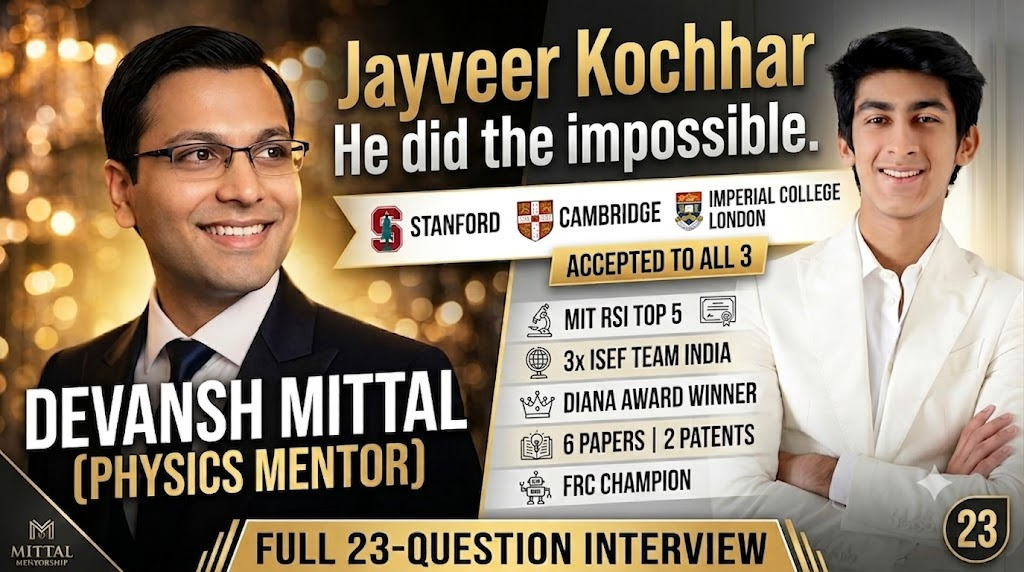
In this exclusive interview, Devansh Mittal speaks with his student Jayveer Kochhar, who has been accepted to Stanford University, Class of 2030, where he intends to pursue Applied Mathematics and Computer Science. Jayveer’s journey is exceptional: he was selected for MIT’s Research Science Institute, received a Top 5 Written Research Paper Award there, represented Team India at Regeneron ISEF for three consecutive years, published six research papers in platforms such as IEEE and Springer, developed two patents, contributed to award-winning robotics teams, earned The Diana Award for social impact, and achieved perfect 5/5 scores in multiple AP Physics exams.

Across 23 thoughtful questions, Jayveer shares the real story behind his admission: how he discovered his interests, built depth in applied mathematics, pursued research and robotics, balanced academics with high-level competitions, handled pressure, chose meaningful opportunities, and developed the strategic mindset required for elite university admissions. This interview is not merely about getting into Stanford. It is a practical roadmap for students who want to build intellectual depth, authentic impact, and a profile worthy of the world’s best universities.


BLOCK 1 – The Dream

Q1: Congratulations on your admission — take us back to the moment you found out. What did that feel like, and who was the first person you called?

When I received my acceptance from Stanford, I was not at home — I was in Bangalore attending a training camp for the International Science and Engineering Fair (ISEF). The admissions decisions are released at US time, which meant it was 5:30 AM in India. I had set an alarm on my phone, woke up, checked the portal, and saw that I had been admitted to Stanford.

The first people I called were my parents, to share the news with them, because they have been an integral part of my journey. After that, I told a few close friends, slept for another three to four hours, and then woke up and texted my mentors and teachers to thank them for their support.

Q2: When did you first truly decide, that a place like Stanford is your goal?

Although I was not entirely certain that Stanford would be my final destination, I knew from around Grade 9 that I wanted to target a top US university, and I began preparing with that goal in mind ever since. The specific decision to apply early to Stanford was made around August or September of Grade 12 (2025), approximately three to four months before the early application deadline.

BLOCK 2 – Building the Foundation

Q3: Could you share your entire journey with me? I would love to understand everything you did — from the time you first dreamed of getting into Stanford until the day you were admitted. Specifically, I’d like to know: which exams you appeared for; what activities, projects, or achievements you pursued; which decisions and efforts had the greatest impact on your admission; which things, in hindsight, were not particularly impactful; and any lessons you learned or things you wish you had done differently. A chronological account of your journey would be incredibly helpful.

Even before Grade 8, I was always more inclined toward academics. I would participate in competitions such as the AMC (American Mathematics Competitions) and NMTC (National Mathematics Talent Contest) for math. At that stage, it was purely out of curiosity rather than any specific college goal. I also did basic robotics using Lego kits and learned Scratch coding.

Things really accelerated toward the end of Grade 8 and the start of Grade 9. That is when I first got involved in FTC (First Tech Challenge), a global robotics competition. This is where I picked up a lot of my coding skills. Combined with some coding classes I took, I learned programming fundamentals. I participated in FTC for two years, competing in both Indian Nationals and traveling to Australia to represent India.

My entire robotics journey culminated in 2025 when I was participating in the First Robotics Competition (FRC). My team became the first Indian team to ever win a Regional — this was in Istanbul, Turkey. After that, we also represented India at the World Championships in Texas, USA. Robotics has been one major pillar of my journey.

The other major pillar has been exams and Olympiads. Throughout Grades 9 to 12, I have been participating in the Sir Isaac Newton exam, NSEP (the National Standard Examination in Physics, which is India’s qualifier for the International Physics Olympiad), IOQM (the qualifier for the International Mathematical Olympiad), and the AMC. I would advise that there are many Olympiads available, but if one truly cares about going down the path of reaching the Indian team, one should focus on the national-level qualifiers like NSEP or IOQM. Many other Olympiads may not be as useful or prestigious, even though they call themselves Olympiads.

In terms of research projects and activities: my research journey began in Grade 8, when I started my first project under my mentor. It was related to human breathing and how external sensors can be used to track respiratory patterns. That project marked the beginning of a very important journey for me, because it led to my participation in the qualifying fairs for ISEF (International Science and Engineering Fair). ISEF is the world’s largest and most prestigious high school STEM science fair. Only 20 projects are selected to represent India — making selection almost comparable to making a national Olympiad team. The first step is the IRIS National Science Fair.

I started participating in IRIS in Grade 9. In Grades 10, 11, and 12 — all three years — I qualified to represent India at ISEF and won awards in multiple years. That research, which started in Grades 8 and 9, was incredibly important for me, because it led me to write six research papers. Writing these papers helped me realize my true interests, as I explored different fields: three of my papers were in biomedical engineering (developing working prototypes), for which I received a utility patent. My other projects were more theoretical — for example, developing algorithms and computer vision techniques for motion tracking, or classifying stars using astrophysics and machine learning.

Beyond research, other components that strengthened my application included social service (I donated my respiratory diagnostic prototypes to public hospitals), leadership (I served as Head Boy of my school), and sport (I have practiced Taekwondo since the age of three and competed at an international level).

As for things that were not particularly impactful in hindsight: participating in random, minor competitions that lack real prestige or recognition does not add much value. The key lesson I learned is that depth matters far more than breadth — committing deeply to one area and building a sustained track record is what makes a real difference.

Q4: What specific habits and study strategies you followed to achieve this goal?

One challenge I have always faced — and still work on to this day — is organization and time management. Staying organized is extremely beneficial when you are balancing academics, research, competitions, and applications.

In terms of study strategy, I believe it is important not to study blindly for hours. Many students study continuously without evaluating their progress, which is inefficient. My approach has always been to focus on problem-solving first. If I encountered a question I could not solve, I would go back to the theory, revise that specific concept, and then return to the problems. This reverse-revision method — solving first, then learning theory as needed — worked exceptionally well for me.

BLOCK 3 – Building a World-Class Profile

Q5: Which exams, Olympiads, research projects or extracurricular activities had the greatest impact?

Because US universities evaluate profiles holistically, every component plays a role. However, certain achievements had an outsized impact on my application:

First, the MIT Research Science Institute (RSI). RSI is a six-week program at MIT where you are assigned a research mentor and work alongside real PhD students in a laboratory. It is extremely competitive — only three to four students from India are selected each year. Getting into RSI signals to US universities that you are truly ready for the next level of academic work.

Second, the International Science and Engineering Fair (ISEF). Representing Team India at ISEF for three consecutive years (2023, 2024, and 2025) and winning awards was a significant component. Training for the Olympiad is a major time commitment, and I chose a slightly different path by focusing on ISEF. US universities value sustained participation in ISEF highly.

Third, the Diana Award. This is a social service award given by the British Royal Family. I received it for using my respiratory diagnostic prototypes for public benefit — I donated several devices to public hospitals where they could be used for patient care. I believe this signaled to the universities that I was applying my skills and patents to do good for others, which also had a significant impact.

While reaching the national team for the International Mathematical Olympiad (IMO) or International Physics Olympiad (IPhO) is also extremely prestigious and would make a huge impact, I chose a different path. Students should weigh their options carefully and choose between the Olympiad route and the research/science fair route based on their strengths and interests.

Q6: Rank the following by importance and explain why: Academics, Olympiads, SAT/AP, Research, Essays, Leadership, Recommendation Letters, Interviews, extracurricular activities.

The ranking depends entirely on whether you are applying to the UK or the US, because the two systems are fundamentally different.

For UK universities, the process is far more straightforward and heavily academic. Extracurricular activities, leadership, and research are given almost no importance. The ranking is: (1) School Academics and Grades — this is the primary baseline; (2) University Entrance Exams — the ESAT, TMUA, or PAT, depending on your subject; (3) Technical Interview — this is a purely technical, physics-and-math-based problem-solving interview; (4) Recommendation Letters; (5) Personal Statement/Essays. Everything else is essentially irrelevant in the UK system.

For US universities, the process is holistic. The ranking is: (1) Academics, SAT, and AP Exams combined — these serve as the threshold baseline; without strong scores, your application may not even be reviewed; (2) Extracurricular Activities, Olympiads, Research, and Leadership — I would group all of these together as the second most important layer, as they are what differentiate you from other academically strong applicants; (3) Essays and Recommendation Letters — these are crucial for presenting your personality, character, and the human being behind the achievements; (4) Admissions Interviews — these do not make a significant difference for US admissions.

Q7: Given the goal in our context, what opportunities do Indian students have and they most commonly miss?

One major opportunity that many Indian students miss is participation in science fairs. Science fairs are a big deal for US admissions, yet most students preparing for competitive examinations like JEE are not even aware they exist. For example, submitting your research projects to IRIS (the Indian national science fair) is a significant opportunity that I feel more students should take advantage of. IRIS is the qualifier for ISEF, and making it to ISEF is comparable in prestige to representing India at an Olympiad.

Apart from IRIS and ISEF, there are other research competitions such as the S.T. Yau High School Science Award (where initial submissions are online and finals are held in Hong Kong and China) and the Genius Olympiad. These are all research paper competitions that provide excellent platforms to showcase scientific work.

Robotics is another commonly missed opportunity. To start an FTC (First Tech Challenge) team, you essentially need only seven or eight dedicated people. Through competitive robotics, students learn not just engineering and coding, but also fundraising, project management, manufacturing skills, and teamwork — all of which are extremely valuable for a university application. These are skills that standard school curricula simply do not teach.

BLOCK 4 – The Admission Journey

Q8: What do you think ultimately earned you admission?

I believe what ultimately earned me my admission was perseverance — not any single award or exam score. Because the US admissions process is holistic, it is impossible to credit any one achievement. What mattered most was the fact that I persevered through doing so many things simultaneously, through many tough times with enormous workloads, and I continued to deliver results. If you can genuinely push through those challenges, you will earn a strong admission.

Q9: What did your application primarily focus on?

I applied for Applied Mathematics as my first-preference major, with Computer Science as my second preference, and I will likely pursue both at Stanford as a double major.

Although my projects span very different domains — biomedical engineering, computer vision, astrophysics, physics — one thing that is common throughout all of them is the application of advanced mathematics. I do not mean basic math like solving a quadratic equation; I mean university-level applied mathematics: Fourier space analysis, complex error propagation, stochastic calculus, and even quaternions (four-dimensional numbers used in computer graphics generation).

My entire application was built around the narrative that I am someone who applies mathematical knowledge to solve real-world problems across different disciplines. When your application weaves all your experiences into a coherent personal story, it leaves a lasting impression.

Q10: What role did essays, recommendations and interviews play?

Essays are extremely important because, while it is one thing to present a list of awards, universities genuinely want to see what kind of person you are. Your essays must be unique and deeply personal — they cannot be generic. Essays are what bring your application to life.

Recommendation letters are also important, though not as critical as essays. They provide external validation of your character and academic ability from people who know you well.

For US admissions, the interview does not matter much, to be honest. However, for UK admissions, it is the exact opposite. In the UK, the interview is the final and most decisive stage — it consists entirely of technical questions in physics and mathematics, and you must perform well to receive an offer. So for the UK, interviews are the most important component, while for the US, essays hold that position.

Q11: What misconceptions about admissions should students stop believing?

There are several significant misconceptions that students and parents need to stop believing:

First, people must understand that US admissions are holistic. The admissions committee is not looking at any one specific thing — they evaluate your entire application in the context of where you are from. It is not the case that winning one Olympiad guarantees admission. Your application must be well-rounded.

Second, many families refrain from applying to US universities because they believe it is too expensive or that there are not enough scholarships. This is simply not true. Many top universities — including MIT and Harvard — are need-blind, which means that if you are admitted and cannot afford the fees, they will cover whatever financial need you demonstrate. Students should never hold back from applying simply because they assume it will be too expensive.

Third, there is a common belief that students only apply abroad because the Indian system is too hard for them. This is also incorrect. The US admissions process is genuinely very tough, particularly for Indian passport holders. For example, while approximately 25 people from India may be admitted to Stanford in a given year, about 10 of them would hold US passports. That means only around 15 actual Indian-passport students are admitted. The numbers are extremely low, and the competition is fierce.

BLOCK 5 – Challenges & Mindset

Q12: What was the toughest phase of your journey? How did you handle pressure, setbacks and self-doubt?

I had two particularly tough periods during my journey.

The first was during my Grade 10 board exams. My board exams coincided with traveling to Los Angeles for ISEF. It was a very challenging time because I was simultaneously preparing for my board exams and for ISEF, and I had to travel internationally. I actually had to give my board exams during the competition — in between judging sessions, I would sit and write my papers. Just two months after ISEF, I also traveled to Australia for the First Tech Challenge. There was an enormous amount of work happening at once, along with ongoing preparation for physics classes and other commitments.

The second tough period was during the second term of Grade 11. I had to travel to Turkey in March for the FRC Regional, to the US in April for the FRC World Championships, and to Columbus, Ohio in May for ISEF. Since I study in the IB Diploma Programme, my Grade 11 second-term examinations were critically important — these are the exams based on which teachers assign predicted grades, and those predicted grades are sent to US universities (because the final IB exams happen in May, after admissions decisions). All of this was happening at the same time.

To handle the pressure and setbacks, it is important to stay focused on your goal. You have to accept that these challenges will happen, and if you want to achieve your goal, you simply have to push through them. Everyone has different coping mechanisms, but for me personally, it was a matter of telling myself: whatever the problem is, I will deal with it, because I want to achieve my goal of getting into a top university.

Q13: What role did your family, mentors and friends play?

My family was absolutely essential. My mother has been one of my greatest supporters. None of this would have been possible without her, because she helped me stay organized, find teachers, discover new opportunities, and manage the entire process. Although she herself is not a STEM student and never studied math or physics, she always tried her best to help in every way she could. Both my parents have been truly supportive throughout the entire journey.

Mentors are also an incredibly important part — not only for your admission, but for who you become as a person. They shape many of your beliefs, because as a young student, these are the people who are teaching you and influencing your development. For mentors, I would say that Devansh Mittal Sir is the best physics teacher I’ve ever had — his classes were essential in helping me develop a strong foundation in physics and in learning how to apply it wherever I needed to. My robotics mentor was also instrumental throughout my journey.

Friends are always there to support you through everything. Sometimes you need a lighthearted conversation and a chance to relax, and friends provide that essential balance.

BLOCK 6 – The Roadmap

Q14: Design an ideal roadmap for a student aspiring for global universities?

I will describe an ideal roadmap for a STEM student. For US universities, it is important to be involved in some form of research work — you do not need to write six research papers; even one or two is helpful. At the same time, you need to cover all aspects of your application: play a sport, do some social service, and perhaps take on a leadership role. These are all secondary components.

The most critical step is to choose one area where you want to demonstrate depth. For me, that was applied mathematics — I did all my work in that area. If someone is interested in chemistry, for example, they should do all their projects in chemistry, participate in chemistry competitions, and show that they are uniquely accomplished in that field. Aim for achievements that other people could not easily replicate — whether that is through Olympiads, research competitions, or patents.

In summary: apart from the baseline activities like social service and leadership, the ideal roadmap is to pick one area and excel in it at the highest possible level.

Q15: What should students focus on in Classes 8, 9, 10, 11 and 12?

Apart from the application itself, the most important thing students should focus on is developing a strong conceptual base. I am able to carry out the research projects I do today only because I have a strong conceptual foundation in math, physics, and coding.

When you have a strong base, and you then go and apply your knowledge in a robotics competition or a research project, you gain enormously more benefit than someone who jumps straight into projects without understanding the fundamentals. Furthermore, even if a student manages to gain admission to a top US university purely based on achievements but without a solid conceptual base, they will lag behind once they reach university.

Therefore, throughout your school years, in whichever subjects you wish to pursue, you should be learning the underlying theory deeply and well. Strong academics and deep conceptual understanding should be the non-negotiable foundation upon which everything else is built.

Q16: What books, websites, YouTube channels and mentors would you recommend?

For physics, I used the standard H.C. Verma textbooks (Concepts of Physics). I also had Irodov (Problems in General Physics) at home, though I used it selectively for a few specific problems.

For math, I strongly recommend the website Art of Problem Solving (AoPS). It is an outstanding resource because it covers every topic you would ever need for Olympiad math, with questions organized by topic and difficulty. The platform also tracks every question you solve, allows you to review past problems, and includes actual past-paper questions from various Olympiads. For math preparation, it is probably the best resource available.

For coding and machine learning, I primarily used YouTube. There are excellent channels for learning Python, TensorFlow, and machine learning concepts. GitHub is another invaluable resource — you can study other people’s code repositories and learn from their implementations.

In terms of general academic YouTube channels, I watch Veritasium and 3Blue1Brown — the latter is probably my favourite YouTube channel for developing mathematical intuition.

For mentors: Devansh Mittal Sir is the best physics teacher I have ever had. His classes have been quite essential to me, actually developing a strong base in physics and applying it wherever I needed to. For robotics, I attended classes at Omotech, which were excellent. Having the right mentors early on saves months of trial and error.

Q17: How should students balance school, extracurricular activities, Olympiads, JEE (if applicable) with international admissions?

If you are not preparing for JEE, then school should always be your first priority, because academics are the most important component. Without strong academics, you will not secure your admission. Extracurricular activities form the second layer — they are built on top of the academic foundation. If you are preparing for JEE, the same principle applies: JEE should be your first priority because it is the exam that secures your admission to Indian institutions.

For your secondary focus, you should choose between Olympiads and project-based extracurriculars depending on your working style. Olympiads require a very specific skill set — you sit down for three hours and solve written problems under pressure. That may not be everyone’s style. Some students prefer working over multiple days to solve larger, more complex problems that span multiple subjects. If that describes you, then research, patents, and science fairs may be the better path.

Olympiads are extremely prestigious, but they are not for everyone. And if you choose not to pursue Olympiads, there are many other ways to demonstrate excellence for the US application process. The key is to not try to do everything simultaneously — pick your path and commit to it.

BLOCK 7 – Legacy & Rapid Fire

Q18: One habit every successful student should develop.

Not giving up. That is the most important thing. You should always persevere through the challenges life throws at you — whether it is a difficult question, a stressful exam season, or any personal setback. Perseverance is non-negotiable.

Q19: One mistake every student should avoid.

Losing focus and being inconsistent. You cannot study physics intensively for six months and then abandon it for the next six months — that is not how learning works; you would forget everything. You have to be consistent. While it is not always possible to maintain a perfectly fixed schedule throughout the year, you must try your best to maintain consistency in your efforts.

Q20: One opportunity students should pursue early.

No student should be held back by their school curriculum. This was instrumental for me. If you feel the school curriculum is too easy or basic, start learning higher-level material immediately — move on to the next level. If school physics feels too easy, begin studying Olympiad-level physics. This is true for any subject, not just physics.

You should always be pushing yourself and learning at a higher level. For example, I am currently pursuing mathematics at Stanford, and this summer I have been studying material for courses I will likely take in my second year of university. You should never be satisfied with your current level and think “this is good enough.” Always keep learning the higher-level material.

Q21: One myth about Ivy League admissions.

That they are objective. They are not. The US admissions process is not completely random, but there is a genuine element of randomness involved. For example, I was admitted to Stanford, but I did not get into several other top universities — including Harvard and Princeton. It is not 100% guaranteed that a great profile with no glaring weakness will get you into every school. You will get into some top university — that is true — but not necessarily the one you expect. The process contains randomness, and it is perfectly fine to not get into the highest-ranked school.

Q22: One piece of advice for parents.

It is important to push your children from an early age and encourage them to take up high-level challenges. But at the same time, you must listen to what your child has to say. If your child wants to study chemistry, do not force them to do math — that does not make sense. Support your child’s genuine interests and push them to take those interests further. Help them pursue what they truly want to do, and encourage them to do it at the highest level possible.

Q23: Your message for students dreaming of studying at the world’s best universities.

Work smart. Especially if you want to get into a good US university, just blindly working hard is not the correct approach. You have to be strategic — evaluate what is going to benefit you, what will appear on your application, and work accordingly. Work backwards: look at your final goal, and then determine what you need to do to achieve it.

Second, understand the college admissions process for the US. Understand where you should apply early, where you should apply in the regular round — these are critically important strategic decisions. Be strategic, not just hard-working. Hard work is obviously important, but to secure a strong admission, it is equally important to have a well-thought-out strategy.


1. Stop trying to build an application. Start building a serious intellectual life.

Jayveer’s Stanford acceptance was not the result of last-minute profile building. It was the outcome of years spent exploring mathematics, physics, coding, robotics, research, and real-world problem-solving. Elite universities can usually distinguish between students who collect achievements and students who genuinely live their interests.

2. The strongest profile is not the longest profile. It is the most coherent one.

Jayveer’s work covered biomedical engineering, computer vision, astrophysics, machine learning, physics, robotics, and patents. Yet the common thread was applied mathematics. Future applicants should not chase random activities. They should build a clear intellectual story that connects their choices, projects, and ambitions.

3. Research is one of the most powerful ways to prove readiness for top universities.

Programs and platforms such as MIT RSI, ISEF, IRIS, and serious independent research projects allow students to show originality, persistence, technical maturity, and the ability to work beyond the school curriculum. For STEM aspirants, meaningful research can become a defining differentiator.

4. Olympiads are prestigious, but they are not the only path to excellence.

Jayveer makes an important distinction: Olympiads such as NSEP, IOQM, IMO, and IPhO are highly valuable, but they suit a particular kind of learner. Students who are not naturally aligned with Olympiad-style timed problem-solving can still demonstrate excellence through research, robotics, engineering projects, social impact, and advanced academic work.

5. Do not let the school curriculum become the ceiling of your ambition.

One of Jayveer’s strongest messages is that students should move beyond school-level learning when they are ready. If school Physics feels basic, explore Olympiad Physics. If school Mathematics feels easy, study advanced mathematics. The students who reach the highest levels usually start learning beyond the syllabus much earlier than others.

6. For US admissions, essays reveal the person behind the achievements.

Awards and scores show what a student has done, but essays explain who the student is. Jayveer emphasizes that strong essays must be personal, specific, and authentic. A generic essay weakens even a strong profile, while a thoughtful essay can connect achievements into a memorable human story.

7. UK and US admissions are completely different games.

Jayveer’s ranking of application components is extremely important. UK universities prioritize academics, subject entrance tests, and technical interviews. US universities look more holistically at academics, research, extracurricular depth, essays, recommendations, and context. Students must prepare for the system they are actually applying to, not rely on vague global-admission advice.

8. Financial fear should not stop serious students from applying abroad.

Many Indian students avoid applying to top US universities because they assume the cost is impossible. Jayveer points out that several leading universities offer strong financial aid, and some are need-blind for international applicants. Students should research financial aid carefully before ruling themselves out.

9. Perseverance is more valuable than a perfect journey.

Jayveer faced periods where board exams, ISEF, robotics travel, IB predicted grades, research, and regular academics overlapped intensely. His lesson is simple: ambitious paths will contain difficult phases. The students who succeed are not those who avoid pressure, but those who continue working through it with clarity and purpose.

10. Work backwards from the dream, then work smart every day.

Jayveer’s final advice is not just to work hard, but to work strategically. Understand your target universities, know what they value, choose opportunities carefully, decide where to apply early, and build your profile intentionally. Hard work matters, but direction multiplies effort. Without strategy, even sincere effort can be wasted.


The central lesson from Jayveer Kochhar’s journey is clear: elite university admissions are not won by shortcuts, generic activities, or a checklist mentality. They are earned through deep learning, authentic curiosity, meaningful work, strong mentorship, perseverance, and intelligent strategy. Students who begin early, think clearly, and build depth in what they truly care about give themselves the best chance of standing out in the most competitive admissions processes in the world.

Inside the Mind of AIR 1: Rajit Gupta’s Complete JEE Advanced Strategy

Standard

Every year, hundreds of thousands of students dream of securing a top rank in JEE Advanced. Yet only one becomes All India Rank 1. What truly sets that student apart? Is it exceptional intelligence, relentless hard work, or a fundamentally different way of thinking?

In this exclusive interview, I speak with Rajit Gupta (AIR 1, JEE Advanced 2025), one of my former students, to explore the complete journey behind his remarkable achievement. Through 23 carefully curated questions, Rajit shares the study strategies, mindset, discipline, decision-making process, and lessons that helped him reach the pinnacle of one of the world’s most challenging entrance examinations.

This is more than the story of an extraordinary rank. It is a practical blueprint for every serious JEE aspirant who wants to study smarter, avoid common mistakes, build lasting conceptual understanding, and take meaningful steps toward achieving their own IIT dream.


Q1. The Result Moment: Walk us through the exact moment you (and your parents) saw that you secured a top All India Rank. What was that feeling like?

A: It was an incredibly special moment. The feeling of seeing All India Rank 1 on the screen is hard to describe—it was pure excitement and relief. I was with my parents when the results were declared, and we saw it together. They were absolutely thrilled, and sharing that immediate happiness with them meant everything to me. Shortly after, the news spread and the congratulations started rolling in, but that initial private moment with my parents is what I will cherish most.

Q2. The Catalyst: When did you officially start your JEE preparation? Was getting into an IIT always your ultimate dream, or did the realization happen later?

A: I officially started my JEE preparation at the beginning of Class 10. Getting into an IIT wasn’t actually a lifelong dream; rather, it was a decision that took shape later. After finishing my Junior Science Olympiad (IJSO) preparation, I was at a crossroads trying to decide between the medical and engineering streams. After consulting with my father, we decided that the engineering pathway and preparing for JEE was the right fit for my academic interests.

Q3. Identifying the Path: How did you figure out your true academic interest? At what point did you decide to pursue engineering over medical or commerce?

A: My exposure during the IJSO preparation gave me a strong foundation in Physics, Chemistry, Mathematics, and Biology (PCMB), but I didn’t have much exposure to other fields like commerce. At the beginning of Class 10, I had a lot of doubts about whether to pursue medicine or engineering. My father suggested engineering because it involves Mathematics at a much higher and more conceptual level, which appealed to me. Additionally, we realized that switching from engineering to medical fields later is generally much harder than transitioning within technical sciences, so engineering felt like a more logical and flexible choice.

Q4. The Olympiad Edge: You have represented India in international Olympiads. How important are these exams (like IJSO, NSEP) in building the foundation for JEE?

A: Interestingly, I never specifically prepared for the senior Olympiads. While many believe Olympiad prep helps JEE, my experience was the reverse—preparing rigorously for JEE is what actually helped me succeed in the Olympiads, particularly in Physics. I never studied for the Olympiads in isolation. Once my JEE core syllabus was strong, transitioning to IPhO (International Physics Olympiad) requirements was straightforward. So, a solid JEE Advanced foundation is incredibly powerful and naturally opens doors to success in these prestigious international exams.

Q5. The Daily Routine: What did your daily routine look like? Did you follow a rigid timetable (by the hour) or a flexible, target-based approach?

A: I did not follow a rigid, hour-by-hour timetable. Instead, I maintained a very normal and flexible routine centered around day-to-day goals. My approach was target-based: I made sure to complete my scheduled studies, attend coaching classes, and revise notes, but I also left ample time for meals, relaxation, and play. If I felt productive, I would study more; if I felt tired, I would adjust. Maintaining this balance and flexibility helped me stay consistent without burning out.

Q6. Sleep & Cycles: How many hours of sleep did you prioritize? Did you prefer studying late at night or early in the morning?

A: I prioritized sleep and never compromised on it. There is a common misconception that toppers sleep very little, but in my case, I made sure to get around 7 hours of sleep daily to maintain my efficiency. If I slept less—for instance, only 4 hours—I would inevitably feel exhausted, lose concentration in class, and become irritable. Getting the right amount of sleep is crucial for your brain to process information and perform at its best during long study hours.

Q7. Subject Allocation: How did you balance Physics, Chemistry, and Math? Did you allocate equal time to all, or base it entirely on your weak points?

A: My baseline strategy was to divide my daily study time equally among Physics, Chemistry, and Mathematics, primarily guided by the coaching homework. However, I kept this allocation dynamic. If I was struggling with a particular topic—such as coordinate geometry in Math—I would dedicate an extra hour or two specifically for revision and practice assignments. Giving equal initial weight to all subjects is important, but you must dynamically allocate extra time to strengthen your weaker areas until they match the level of the rest.

Q8. The Material Trap: Did you rely strictly on your coaching modules, or did you use multiple reference books (like H.C. Verma)? Is it better to solve one book three times or three books once?

A: I strongly believe in finding a trusted teacher and completely following their guidance rather than jumping between multiple sources. The same philosophy applies to study materials. It is far better to solve a single high-quality book or module three times than to solve three different books once. When you solve a book only once, you miss the deeper conceptual connections. Reviewing the same questions twice or three times helps solidify the problem-solving patterns in your mind so that the concept becomes permanently ingrained.

Q9. Material: Which material did you use for IJSO and what material did you use for IIT?

A: My preparation was heavily centered around my class notes and coaching materials, which I revised repeatedly.

• For Physics: I relied on the Allen modules, Concepts of Physics by H.C. Verma, and selected problems from Irodov. I also found Ashish Arora Sir’s lectures extremely helpful. Occasionally, I solved selected problems from Pathfinder.
• For Chemistry: Class notes were my primary resource for all three branches (Physical, Organic, Inorganic). For Physical Chemistry, I used Neeraj Kumar Sir’s book for select topics. For Inorganic Chemistry, I read specific chapters of J.D. Lee Concise alongside NCERT and the Allen modules.
• For Mathematics: I stuck strictly to the Allen modules, test series, and assignments.
• For IJSO (Biology & Science): I was entirely dependent on my biology class notes, which I revised upwards of 20 times by covering the page and recalling the content from memory.

Q10. Biology and IJSO: Being an IIT aspirant, how was your attitude towards Biology during IJSO preparation?

A: Since I hadn’t decided on engineering until the start of Class 10, my mindset during IJSO preparation was simply that of a dedicated Science Olympiad student, not an IIT aspirant. I took Biology very seriously, and that commitment was reflected in my performance across the selection stages. I believe every IJSO aspirant should study Biology diligently. It is a core part of the exam, and skipping it or treating it lightly simply because your future goal might be IIT is not a wise approach.

Q11. IOQM and IMO: Should students focus on IOQM if their future goal is IIT?

A: While appearing for IOQM is fine, preparing heavily for it is risky if your primary goal is JEE Advanced. The Mathematics Olympiad syllabus is vast and requires an immense amount of time and dedicated effort. A student with solid JEE preparation can easily achieve a decent score in IOQM in Class 12 without separate prep. If you dive too deep into Olympiad-level Math, you risk compromising your core JEE preparation in Physics and Chemistry, which could hurt your final rank.

Q12. School and Coaching: How did you manage the time with both school and coaching?

A: I didn’t actually attend regular school. I secured attendance relaxation and enrolled in a non-attending (dummy) school format. This is a common arrangement for serious JEE aspirants, as it allowed me to bypass daily school obligations and focus my energy entirely on coaching and self-study.

Q13. Sports: Did you only study during those preparation years or you also spent time in sports, workouts and other recreational activities?

A: I absolutely made sports and recreation a priority. I didn’t spend all my time studying; I loved playing cricket and badminton to unwind. In fact, even the day before the JEE Advanced exam, I went out to play. Engaging in sports was my preferred way to refresh my mind, maintain my energy, and prevent burnout.

Q14. Tackling Failure: What were your best and worst scores in mock tests? How did you mentally recover from a disastrous test score?

A: Fluctuations in mock test scores are completely normal; everyone experiences low scores at some point. When I got a poor score, I trained myself to look at it rationally rather than emotionally. Instead of feeling down or judging myself harshly, I treated the score as feedback. I would analyze the paper to find out why I lost marks, identify the weak areas, and write down a clear plan of action to fix them. Whether it was a conceptual gap or a simple calculation error, I viewed mistakes as valuable lessons to learn from.

Q15. The “Silly Mistakes” Protocol: Almost every student loses ranks to silly mistakes. Did you maintain a “mistake notebook,” and how did you actively minimize these errors?

A: I used to make a lot of silly mistakes because I would rush through the paper to save time for review. However, I realized that once your mind is set on a certain way of solving a question, you will likely read right past your own mistakes during review. Reviewing was not helping me catch errors, and rushing was causing them.

My parents and teachers suggested that I stop trying to save time for a final review. Instead, I focused on reading the question carefully, noting the data accurately, and solving it correctly the first time. Slowing down and ensuring accuracy on the first pass significantly reduced my silly mistakes.

Q16. Conquering Fear: Was there a specific topic (like Thermodynamics or Fluids) that terrified you? How did you overcome it?

A: If you are afraid of a topic, the only way to overcome it is through consistent practice, repeated revision of class notes, and clearing all doubts with your teachers.

However, it’s also important to distinguish between ‘fear’ and ‘preference.’ Fear is a weakness that you must overcome with effort. Preference is a strategic choice. For example, if there is a highly complex chapter that you find low-yielding, you might choose to prioritize other topics in the exam to maximize your score. But if a topic genuinely terrifies you, face it head-on by asking questions and practicing until the fear disappears.

Q17. Digital Distractions: How did you handle smartphones and social media? Did you cut them off completely, or use them in moderation?

A: I avoided major social media platforms like Facebook and Instagram entirely during my preparation years. My digital usage was restricted to WhatsApp and YouTube. YouTube was used strictly for light entertainment and relaxation during my breaks. WhatsApp was my primary communication tool, which I used in moderation to stay in touch with friends and participate in group discussions to solve study doubts.

Q18. The “Burnout” Days: What did you do on days when you were completely exhausted and absolutely did not want to study?

A: On days when I felt completely exhausted and had no motivation to study, I simply took a break and left my books alone. I would watch TV, play sports, or just relax. I knew that taking a break meant I would have to put in double the effort the next day to catch up, but I was mentally prepared for that. Forcing yourself to study during a state of burnout is counterproductive, so it is far better to rest and recharge.

Q19. The Peer Group: How important is a highly competitive friend circle in cracking JEE? Did you do group studies or doubt-solving with friends?

A: A highly competitive peer group is extremely beneficial. It fosters healthy competition and provides the positive peer pressure needed to keep your motivation high. Moreover, since every student has a unique thinking process, discussing problems with friends exposes you to multiple different ways of solving the same question. It refines your conceptual clarity and expands your problem-solving toolkit.

Q20. The Mentors: Were you ever hesitant to ask doubts in a class full of brilliant students? How did your bond with your teachers help you beyond academics?

A: I never hesitated to ask doubts, and I believe no student should. Your relationship with your teachers should be built on deep respect and trust. If you trust their guidance and communicate openly, you will not only clear your academic doubts but also receive invaluable mentorship. Teachers have years of experience guiding students through this high-pressure journey, and their support is essential for maintaining your confidence.

Q21. The Exam Strategy: Did you have a pre-decided sequence for attempting the paper (e.g., Chemistry, then Physics, then Math), or did you adapt based on the paper’s difficulty?

A: I recommend that students never stop experimenting with different sequences during mock tests to find what suits them best. My personal preference was to attempt the paper in the PCM (Physics, Chemistry, Mathematics) order. My primary strategy was to focus on scanning the paper for easy questions and solving them first. Remember, the goal of the exam is to maximize your marks, not to feed your ego by getting stuck on a tough question. If a question is too difficult or time-consuming, be flexible and move on.

Q22. Exam Temperament: Were you nervous on the actual day of the exam, or did giving continuous mock tests eliminate the “exam fear”?

A: I didn’t feel nervous on the day of the actual exam. Giving consistent mock tests throughout my preparation years essentially eliminated any exam fear. I treated mock tests as a practice playground where I could make mistakes and learn. By the time D-Day arrived, the actual JEE Advanced exam felt just like another mock test. I was able to stay calm and focus purely on solving the questions.

Q23. The Ultimate Advice: What is your final, defining piece of advice for the millions of juniors who want to be in your shoes next year?

A: My most crucial advice is to learn how to control your temperament under pressure. While studying will make your concepts strong, delivering that knowledge in the exam hall requires emotional control. Do not get emotional or panicked if a strong topic turns out to be difficult in the exam—act like a machine, make rational choices, and move on. Secondly, follow your teachers’ guidance strictly; they are far more experienced than you. Finally, establish a consistent study schedule, and keep your parents supportive without letting them micromanage your preparation.


What Every JEE Aspirant Should Take Away from This Interview

1. You Don’t Need to Study 16 Hours a Day

Rajit followed a flexible, target-based routine — not a rigid hourly timetable. He prioritized 7 hours of sleep every single night and never compromised on it. He played cricket and badminton regularly, including the day before his JEE Advanced exam. The lesson is clear: consistency and efficiency beat raw hours. If you are sleeping 4 hours and grinding 16, you are hurting yourself, not helping.

2. One Book Three Times > Three Books Once

This is perhaps the most important insight in the entire interview. Rajit strictly followed his coaching modules and his teachers’ recommendations. He did not chase multiple reference books. He solved the same high-quality material repeatedly until the concepts were permanently ingrained. Stop hoarding books. Pick one trusted source, master it, and move on.

3. Trust Your Teacher Completely — Or Find One You Can

Rajit’s philosophy was simple: find a teacher you trust and follow their guidance without question. He never hesitated to ask doubts — whether they were basic or advanced. Your teacher has guided hundreds of students through this journey before you. Their experience is your shortcut. Use it.

4. Silly Mistakes Are Not Random — They Are a System Failure

Rajit discovered that rushing through problems to save time for review was actually causing his mistakes, not preventing them. His fix was counterintuitive: stop saving time for review entirely. Instead, read the question carefully, note the data accurately, and solve it correctly the first time. Accuracy on the first pass is worth more than a rushed review at the end.

5. Distinguish Between Fear and Preference

Rajit made an important distinction that most students miss. If a topic terrifies you, that is fear — and you must conquer it through practice and doubt-clearing. But if a topic is simply low-yielding and complex, you can strategically deprioritize it in the exam. Know the difference. Don’t waste energy fighting a preference when you should be conquering a fear.

6. Mock Tests Are Not Practice — They Are the Actual Training

Mock tests eliminated Rajit’s exam fear entirely. By the time JEE Advanced arrived, it felt like just another mock. Use mocks to experiment with your attempting sequence (PCM, CPM, MPC — find what works for you). Use mocks to normalize the pressure. Use mocks to learn that score fluctuations are normal. The student who has written 50 mocks will always outperform the student who has written 5.

7. JEE Preparation Naturally Opens Olympiad Doors

Rajit never prepared separately for senior Olympiads like NSEP or INPhO. His rigorous JEE preparation was sufficient to clear multiple Olympiad stages. If your JEE foundation is rock-solid, Olympiad success becomes a natural byproduct. However, do not dive deep into IOQM if your primary goal is JEE — it requires a vastly different skillset and can compromise your Physics and Chemistry preparation.

8. Burnout Is Real — Respect It

On days when Rajit had zero motivation, he simply stopped studying. He watched TV, played sports, or relaxed — knowing he would compensate the next day. Forcing yourself to study during burnout is counterproductive. Your brain needs rest to consolidate what it has learned. Take the break. Come back stronger.

9. Cut Social Media — But Don’t Cut Communication

Rajit completely avoided Facebook and Instagram. But he kept WhatsApp for academic discussions and YouTube for light entertainment during breaks. The key is not total digital isolation — it is ruthless elimination of time-wasting platforms while keeping the channels that serve your preparation.

10. On Exam Day, Be a Machine — Not a Student

Rajit’s ultimate advice is about emotional control. If your strongest subject turns out to be unexpectedly difficult in the exam, do not panic. Do not get emotional. Act like a machine: make rational choices, skip what you cannot solve, and maximize the marks available to you. The exam rewards composure, not ego.

Inside the Mind of AIR 7 | Arnav Gautam Shares His JEE Advanced Strategy | Exclusive Interview

Standard

Every JEE aspirant dreams of securing a single-digit rank, but very few truly understand what separates the best from the rest.

In this exclusive interview, I speak with Arnav Gautam, one of my former students, who achieved the remarkable feat of securing AIR 7 in JEE Advanced 2026 and AIR 5 in JEE Main 2026. Beyond JEE, Arnav has built an extraordinary academic profile through his success in multiple national Olympiads, including Physics, Chemistry, Astronomy, and the Junior Science Olympiad, reaching the prestigious OCSC stage.

Through 23 carefully curated questions, Arnav shares the strategies, habits, decision-making processes, and mindset that shaped his journey. From Olympiad preparation and study planning to exam temperament, mistake analysis, digital discipline, and the role of mentors, this interview offers practical lessons that every serious JEE aspirant can immediately apply.

Whether you are beginning your preparation or aiming to improve your rank, this conversation provides a rare opportunity to learn directly from one of India’s finest young minds.


PHASE 1: THE GENESIS & THE “WHY”

Q1. The Result Moment: Walk us through the exact moment you (and your parents) saw that you secured a top All India Rank. What was that feeling like?

A: When the results were announced, I knew my rank would be good, but I was not entirely sure whether I would make it into the top 10. Realizing that I had secured All India Rank (AIR) 7 was a moment of immense happiness and relief. Since my mother and father were right there with me, we celebrated the moment together. The very first person I called to share the news with was my grandfather.

Q2. The Catalyst: When did you officially start your JEE preparation? Was getting into an IIT always your ultimate dream, or did the realization happen later?

A: My interest in Mathematics was strong from the very beginning. However, my official journey toward IIT JEE preparation started at the end of Class 9. It was during this time that I realized that pursuing an engineering degree at an IIT was the best academic path for my interests, and I aligned my focus entirely toward it.

Q3. Identifying the Path: How did you figure out your true academic interest? At what point did you decide to pursue engineering over medical or commerce?

A: My choice of engineering over other fields like medical or commerce was driven entirely by my passion for Mathematics. Math was always my favorite subject, and since engineering is heavily centered around mathematics and problem-solving, choosing the IIT pathway was a natural and clear choice for me.

Q4. The Olympiad Edge: You have represented India in international Olympiads. How important are these exams (like IJSO, NSEP) in building the foundation for JEE?

A: Preparing for junior Olympiads like the IJSO builds an excellent foundation for JEE. Because I had already covered many basic and intermediate topics during my Olympiad preparation, I was able to save significant time during my core JEE years. This freed up time to tackle more challenging questions and address my weak areas. Additionally, Olympiads provide valuable early exposure to competitive exam environments.

I highly recommend that aspirants participate in IJSO, NSEP, and NSEC. Regarding the alignment of senior Olympiads with JEE:

• Chemistry (NSEC/INChO): If you prepare in Class 10 or 11, the second stage requires studying a significant amount of extra advanced theory. However, by Class 12, the entire curriculum is fully aligned with the JEE Advanced syllabus.
• Astronomy (NSEA/INAO): Excluding the astronomy-specific topics (like celestial mechanics or observation theory), the rest of the syllabus is entirely relevant to JEE.
• Physics (NSEP/INPhO): The syllabus is almost entirely relevant to JEE Advanced, with the exception of specific topics like theory of relativity taught at the OCSC and international stages.

PHASE 2: ACADEMIC ARCHITECTURE & BLUEPRINT

Q5. The Daily Routine: What did your daily routine look like? Did you follow a rigid timetable (by the hour) or a flexible, target-based approach?

A: I did not follow a rigid, hour-by-hour timetable where I scheduled specific subjects for exact times. Instead, I preferred a flexible, target-based routine. I had fixed wake-up and sleep times to maintain a healthy body clock, but my day-to-day study schedule was flexible. My daily goals were centered around attending classes, completing the homework assigned by my teachers, spending a little time playing in the evening to refresh myself, and dedicating the remaining hours to revision.

Q6. Sleep & Cycles: How many hours of sleep did you prioritize? Did you prefer studying late at night or early in the morning?

A: I prioritized getting eight hours of sleep every night and never compromised on it. My routine was to sleep by 11:00 PM and wake up at 7:00 AM. I believe that every student needs a healthy amount of rest to keep their brain active and maintain high concentration levels during classes and self-study sessions. Rest is essential for mental efficiency.

Q7. Subject Allocation: How did you balance Physics, Chemistry, and Math? Did you allocate equal time to all, or base it entirely on your weak points?

A: My study time was allocated dynamically based on the demands of each subject. I dedicated the most time to Mathematics because the homework volume was high, and Math requires extensive practice to master. Conversely, I allocated the least time to Physics. Having already cleared NSEP and NSEA (Astronomy Stage 1) in Class 10, my conceptual foundation in Physics was very strong, so it required less day-to-day effort. For Chemistry, which requires frequent revision to retain facts and reactions, I shifted my focus heavily during the final 5 to 6 months of preparation, dedicating the majority of my time to revising it.

Q8. The Material Trap: Did you rely strictly on your coaching modules, or did you use multiple reference books (like H.C. Verma)? Is it better to solve one book three times or three books once?

A: I strictly followed the coaching modules and my teachers’ advice, and I did not feel the need to chase multiple extra materials. Many of my peers secured top ranks using this exact same focused approach. For JEE preparation, there is absolutely no need to study from dozens of different reference books. Focusing on completing and revising the prescribed coaching materials and following the guidelines of your teachers is more than enough to secure a top rank.

Q9. Material: Which material did you use for IJSO and what material did you use for IIT?

A: While my core preparation revolved around the coaching modules and assignments, I also used a select few reference books recommended by my teachers:

• Physics: Concepts of Physics by H.C. Verma, Pathfinder for Olympiad and JEE (Advanced), and Problems in General Physics by I.E. Irodov.
• Mathematics: Pathfinder, Higher Algebra by Hall & Knight, and Coordinate Geometry by S.L. Loney.
• Chemistry: Concise Inorganic Chemistry by J.D. Lee, along with the Kota Question Bank.
• IJSO Preparation: For my Junior Science Olympiad prep (specifically Biology), I relied heavily on my class notes and revised them thoroughly to build a strong foundation.

Q10. Biology and IJSO: Being an IIT aspirant, how was your attitude towards Biology during IJSO preparation?

A: Initially, as an engineering aspirant, I did not enjoy Biology very much. However, I kept an open mind and approached it as an opportunity to learn something new. My perspective shifted completely during the Orientation-cum-Selection Camp (OCSC), where I realized that Biology can be highly logical. The OCSC biology exam questions were designed around logical deduction rather than rote memorization, which made it far more interesting than I had expected.

Q11. IOQM and IMO: Should students focus on IOQM if their future goal is IIT?

A: I consider the IOQM/IMO track and the IIT JEE track to be completely different pathways. The type of mathematics asked in IOQM is non-routine and highly specialized compared to the structured, routine mathematics of the JEE Advanced syllabus. For standard JEE aspirants, I would advise against diverting focus toward IOQM, as it requires a separate time commitment. However, if a student has been preparing for math Olympiads since childhood and has a strong foundation, they can certainly give it a try.

Q12. School and Coaching: How did you manage the time with both school and coaching?

A: I managed my preparation by enrolling in a dummy school, which provided me with relaxation in attendance and allowed me to focus my time and energy on coaching and self-study. For students who do not have the option of attendance relaxation and must manage regular school along with coaching, my advice is to prioritize coaching. If you find yourself in a position where you have to compromise due to time constraints, choose to compromise on schoolwork rather than coaching preparation.

Q13. Sports: Did you only study during those preparation years or you also spent time in sports, workouts and other recreational activities?

A: I did not spend all my time studying; I made it a point to play cricket for half an hour every evening. Engaging in sports has numerous benefits: it helps maintain physical fitness, improves posture after long hours of sitting, and breaks the monotony of study. It is a highly effective way to refresh your mind.

PHASE 3: PSYCHOLOGY, ADVERSITIES, & THE MINDSET

Q14. Tackling Failure: What were your best and worst scores in mock tests? How did you mentally recover from a disastrous test score?

A: Whenever I received a low score on a mock test, the first thing I did was discuss the paper with my friends to understand how they had performed. This helped me gauge the relative difficulty of the test. If everyone scored lower than usual, it indicated that the paper itself was challenging, which took away the individual pressure. However, if my score was low relative to the peer group, I immediately consulted my teachers to analyze the errors, discuss how to minimize silly mistakes, and seek advice on improving concentration during exams.

Q15. The “Silly Mistakes” Protocol: Almost every student loses ranks to silly mistakes. Did you maintain a “mistake notebook,” and how did you actively minimize these errors?

A: Minimizing silly mistakes requires consistent practice through mock tests and regular homework. I also used a structured analysis approach: after every test, I compiled a detailed list of my mistakes and classified them into categories, such as calculation errors or reading errors. Through this classification, I discovered that I made far more reading errors (misreading questions or data), so I focused heavily on increasing my concentration while reading.

Additionally, I followed a unique strategy suggested by my teachers to combat calculation fatigue:

• If a question was long and complex—taking about six minutes to solve—I split the process. I would solve the first half (about three minutes), move on to another question, and then return later to finish the remaining calculations.
• When you work continuously on a single long question for five or six minutes, your mind gets fatigued and is highly prone to making errors in the final steps. Splitting the problem-solving time keeps the mind fresh and helps prevent these late-stage errors.

Q16. Conquering Fear: Was there a specific topic (like Thermodynamics or Fluids) that terrified you? How did you overcome it?

A: When I was in Class 9, I was terrified of Rotational Mechanics. However, as I transitioned to higher classes and practiced consistently, my fear gradually dissipated. I realized that rotation is simply a combination of linear force and angular torque. The questions might look longer and more complex, but the underlying concepts are not inherently harder. Demystifying the topic and practicing consistently is the key to overcoming any academic fear.

Q17. Digital Distractions: How did you handle smartphones and social media? Did you cut them off completely, or use them in moderation?

A: I did not maintain an Instagram or other major social media accounts during my preparation, which naturally eliminated a lot of digital distractions. I only used WhatsApp for essential communication and study groups, along with Google and YouTube for academic search and light learning. Because my digital footprint was so limited, I never had to struggle with controlling my screen time.

Q18. The “Burnout” Days: What did you do on days when you were completely exhausted and absolutely did not want to study?

A: I was fortunate not to experience major burnout or prolonged phases of feeling unmotivated during my preparation. However, if a student finds themselves completely exhausted and unable to focus, I suggest taking a short, one-hour nap to refresh the mind before trying to study again. Alternatively, taking a break to talk to parents is a wonderful way to relieve stress and regain motivation.

PHASE 4: THE ECOSYSTEM (FAMILY, MENTORS, & PEERS)

Q19. The Peer Group: How important is a highly competitive friend circle in cracking JEE? Did you do group studies or doubt-solving with friends?

A: A competitive peer group is extremely important during JEE preparation. I regularly discussed questions with my friends, which benefited me in two ways:

• For very challenging problems, we shared our individual methods, exposing each other to different logical pathways and shorter tricks.
• For concepts already discussed in class that needed clarification, I preferred discussing them with friends first before approaching teachers.

Having meaningful, academic discussions with peers is highly beneficial as it expands your conceptual understanding and speed.

Q20. The Mentors: Were you ever hesitant to ask doubts in a class full of brilliant students? How did your bond with your teachers help you beyond academics?

A: I never hesitated to ask questions in class, regardless of how basic or advanced they were. I asked my teachers both silly, fundamental doubts and complex, high-level queries. Developing a strong, open relationship with mentors is essential. It ensures that you clear every conceptual bottleneck immediately and gives you the confidence that your teachers are always there to support you through the ups and downs of preparation.

PHASE 5: THE D-DAY & THE AFTERMATH

Q21. The Exam Strategy: Did you have a pre-decided sequence for attempting the paper (e.g., Chemistry, then Physics, then Math), or did you adapt based on the paper’s difficulty?

A: An exam strategy is highly individual and depends heavily on the student and the paper. Throughout Class 11 and 12, I tried attempting Chemistry first, followed by Physics, and then Mathematics (CPM). However, toward the end of Class 12, I experimented and found that starting with Mathematics, followed by Chemistry, and then Physics (MCP) worked best for me. I stuck to this MCP sequence in the actual JEE Advanced exam, and it benefited me significantly. Within Mathematics, I also prioritized column-matching questions first because they were faster to solve.

I advise students to use mock tests to experiment with different sequences and find what suits them. There is no one-size-fits-all strategy: some students build confidence by starting with their strongest subject, while others might get overexcited or bogged down. Mock tests are the best playground to figure out your own optimal strategy.

Q22. Exam Temperament: Were you nervous on the actual day of the exam, or did giving continuous mock tests eliminate the “exam fear”?

A: It is natural to feel some minor nervousness on the day of the exam, and I did as well. However, because I had written regular mock tests throughout my preparation, I was highly confident in my capabilities. Continuous mock tests normalize the examination hall environment, giving you the confidence to manage nervous energy and focus entirely on the questions in front of you.

PHASE 6: UNPLUGGED & RAPID FIRE (HUMANIZING THE SCHOLAR)

Q23. The Ultimate Advice: What is your final, defining piece of advice for the millions of juniors who want to be in your shoes next year?

A: My ultimate advice for juniors is to maintain consistent and open communication with your teachers. Discuss your mistakes and weaknesses with them frankly so they can guide you on how to improve. Secondly, stay away from digital and social distractions, as they disrupt your focus. Finally, consistency is key—keep working hard and stay dedicated to your goal every single day.


1. Start Early, Win Bigger.

Arnav’s journey toward IIT did not begin in Class 11—it began years earlier through Olympiads. Early conceptual learning creates an enormous competitive advantage that compounds over time.

2. Olympiads Don’t Distract You from JEE—They Accelerate Your Success.

Many students believe Olympiads waste valuable JEE preparation time. Arnav’s experience proves the opposite. Olympiads build deep conceptual understanding, allowing students to learn JEE topics faster and solve tougher problems with greater confidence.

3. Success Comes from Following One System Exceptionally Well.

Arnav did not chase dozens of books or online resources. He trusted his teachers, completed his coaching material thoroughly, revised it repeatedly, and resisted the temptation to constantly search for “better” resources.

4. Sleep Is a Competitive Advantage.

Eight hours of quality sleep was never negotiable. While many students sacrifice sleep to study longer, Arnav protected it because peak concentration, memory, and decision-making depend on a well-rested brain.

5. Don’t Measure Yourself by Mock Test Scores—Measure Yourself by What You Learn Afterwards.

A mock test is not a judgment of your ability. It is a diagnostic tool. Arnav carefully analyzed every mistake, identified recurring error patterns, and systematically eliminated them. Improvement—not marks—became the real objective.

6. The Biggest Enemy Is Not a Difficult Question—It Is a Distracted Mind.

Instead of trying to control social media usage, Arnav largely removed it from his life. By protecting his attention, he protected his future. In today’s world, focus has become one of the rarest and most valuable skills.

7. Top Performers Don’t Study Every Minute—They Recover Intelligently.

Playing cricket every evening, maintaining a healthy sleep schedule, and taking short breaks kept Arnav mentally fresh throughout his preparation. Sustainable excellence always beats unsustainable intensity.

8. Great Teachers Can Save You Years of Trial and Error.

One of Arnav’s strongest messages is simple: ask questions fearlessly. A close relationship with mentors allows students to identify weaknesses early, avoid unnecessary mistakes, and continuously improve with expert guidance.

9. Your Examination Strategy Can Change Your Rank.

The smartest students do not simply solve questions—they optimize how they solve them. Arnav experimented with multiple subject sequences, refined his approach through mock tests, and entered the actual examination with a strategy already validated by experience.

10. Consistency Always Defeats Motivation.

Motivation comes and goes. Consistency remains. Fixed sleep timings, daily targets, disciplined revision, regular mock tests, and continuous communication with teachers created a system that produced extraordinary results. Success was not the outcome of occasional brilliance—it was the result of disciplined habits repeated every single day.


Perhaps the greatest lesson from Arnav’s journey is this:

Extraordinary ranks are rarely achieved by students who simply study the hardest. They are achieved by students who build the smartest systems, seek the best guidance, eliminate distractions, analyze every mistake, and remain relentlessly consistent over several years.

AIR 7 was not created on the day of the examination. It was built through thousands of disciplined decisions made long before the final paper.

Inside the Minds of JEE Advanced AIR 32 and 169 – Mahrood and Masroor Share Their Complete Bluprint

Standard

Every year, millions of students begin their journey toward IIT, but only a handful reach the very top. What separates them from everyone else? Is it intelligence, hard work, discipline, strategy, or something deeper?

In this exclusive interview, I speak with Mahroof (AIR 32) and Masroor (AIR 169)—two of my former students who secured outstanding ranks in JEE Advanced 2026 after an exceptional journey through Olympiads and rigorous preparation. Over the course of 23 carefully curated questions, they share the principles, habits, struggles, and decisions that shaped their success.

This conversation goes far beyond study schedules and book recommendations. It explores how top performers think, learn, recover from setbacks, manage pressure, build relationships with mentors, and maintain consistency over several years. Whether you are just beginning your preparation or are already deep into your JEE journey, the insights in this interview can help you study more intelligently, avoid common mistakes, and develop the mindset required to perform at the highest level.

If you aspire to see your name among the top ranks one day, this interview is worth reading from beginning to end.


PHASE 1: THE GENESIS & THE “WHY”

Q1. The Result Moment: Walk us through the exact moment you (and your parents) saw that you secured a top All India Rank. What was that feeling like?

A: When the results were announced, the first person we shared the news with was our mother. She was incredibly emotional and happy because she had made significant sacrifices for us, including leaving her job to support our education. Seeing our hard work bear fruit was an amazing feeling, and it brought immense joy to both of us as twin brothers. Our father was also extremely proud and encouraged us to continue pushing ourselves further.

Q2. The Catalyst: When did you officially start your JEE preparation? Was getting into an IIT always your ultimate dream, or did the realization happen later?

A: We officially started our preparation in Class 8 and 9. We built a strong conceptual foundation by preparing for the Junior Science Olympiad (IJSO). After that, we shifted to Kota in Class 10 and dedicated three years (Classes 10, 11, and 12) to rigorous JEE preparation, which ultimately helped us secure top ranks.

Q3. Identifying the Path: How did you figure out your true academic interest? At what point did you decide to pursue engineering over medical or commerce?

A: We figured out our interest in Class 8 and 9 when we participated in Maths Olympiads in school. We realized we were naturally drawn to problem-solving and conceptual questions rather than rote memorization. Since Biology required a lot of memorization, which we didn’t enjoy as much, we decided to pursue the engineering stream because of our deep love for Mathematics.

Q4. The Olympiad Edge: You have represented India in international Olympiads. How important are these exams (like IJSO, NSEP) in building the foundation for JEE?

A: Preparing for Olympiads is highly beneficial. IJSO is particularly important because the Physics and Chemistry syllabus builds strong conceptual clarity at an early stage. Senior Olympiads, like the Physics Olympiad (NSEP), are closely aligned with the JEE Advanced syllabus. Participating in them acts as a diagnostic tool, providing a realistic test-like experience before the actual JEE and helping you identify and rectify your strong and weak areas.

PHASE 2: ACADEMIC ARCHITECTURE & BLUEPRINT

Q5. The Daily Routine: What did your daily routine look like? Did you follow a rigid timetable (by the hour) or a flexible, target-based approach?

A: Our routine was target-based and flexible. A typical day started at 6:00 AM. We did coaching homework from 8:15 AM to 2:00 PM, took a lunch break and rested until 3:00 PM, and studied again from 3:00 PM to 5:00 PM. We dedicated 5:00 PM to 6:00 PM to playing badminton. We then studied from 6:00 PM to 9:00 PM, had dinner, and did a final study session until 11:00 PM. We didn’t keep a rigid, hour-by-hour schedule; instead, we adjusted the hours dynamically based on our daily homework and targets.

Q6. Sleep & Cycles: How many hours of sleep did you prioritize? Did you prefer studying late at night or early in the morning?

A: We prioritized sleep and never compromised on it, keeping a consistent schedule of 7 to 8 hours of sleep daily. Compromising on sleep is highly counterproductive; if you cut down on rest one day, your focus and efficiency will drop the next day. A rested mind is essential for high-quality self-study and class attentiveness.

Q7. Subject Allocation: How did you balance Physics, Chemistry, and Math? Did you allocate equal time to all, or base it entirely on your weak points?

A: We initially divided our study time equally among Physics, Chemistry, and Mathematics based on our daily coaching homework. However, if we felt weak in a particular topic, we would allocate an extra hour daily for revision and extra practice assignments. It is crucial to give equal priority to all subjects while dynamically dedicating extra time to strengthen your weaker areas.

Q8. The Material Trap: Did you rely strictly on your coaching modules, or did you use multiple reference books (like H.C. Verma)? Is it better to solve one book three times or three books once?

A: You do not need to solve dozens of reference books to secure a top rank. It is far better to solve a limited set of high-quality materials multiple times than to solve many different books once. Doing a module repeatedly builds deep conceptual clarity and helps you understand different angles of the same problem. Trust the resources prescribed by your teachers and focus on perfection rather than quantity.

Q9. Material: Which material did you use for IJSO and what material did you use for IIT?

A: Our core materials were our coaching modules and the specific books recommended by our teachers:

• Physics: Concepts of Physics by H.C. Verma, selected problems from Irodov, and coaching sheets.
• Chemistry: Neeraj Kumar Sir’s book for Physical Chemistry, Concise Inorganic Chemistry by J.D. Lee (primarily the theory and exercises) for Inorganic Chemistry, and Sonal Rajoria’s question banks for Organic Chemistry.
• Mathematics: Pathfinder for Olympiad Mathematics for advanced practice, alongside our coaching modules and assignments.
• IJSO Biology: We relied entirely on our biology class notes, revising them multiple times to ensure memorization.

Q10. Biology and IJSO: Being an IIT aspirant, how was your attitude towards Biology during IJSO preparation?

A: Although our long-term goal was IIT, our immediate priority during IJSO prep was to qualify and represent the Indian team. Since Biology is a highly scoring subject in IJSO if memorized well, we dedicated substantial time to it. At the same time, we made sure to stay in touch with Mathematics by solving problems side-by-side so our core math skills remained sharp.

Q11. IOQM and IMO: Should students focus on IOQM if their future goal is IIT?

A: Preparing for the initial stages of the Mathematics Olympiad (IOQM and RMO) is highly beneficial for JEE, as it teaches you to tackle tough questions with patience and avoid panic. However, pursuing the advanced stages of the Olympiad requires a high level of non-routine mathematics, which is not required for JEE and can end up hampering or compromising your core JEE preparation. We recommend attempting the initial stages but keeping your main focus on the JEE syllabus unless you have an exceptional interest in pure math.

Q12. School and Coaching: How did you manage the time with both school and coaching?

A: We managed our time by being extremely attentive during coaching classes, which covered 90% of our learning. To balance school, we completed our school homework as quickly as possible. When the workload became heavy, we prioritized coaching materials and self-study, and even took leaves from school. A school environment should provide relaxation; if it becomes a burden, you must prioritize your coaching preparation to achieve your final goals.

Q13. Sports: Did you only study during those preparation years or you also spent time in sports, workouts and other recreational activities?

A: We firmly believe in balancing studies with physical activity. We dedicated an hour every evening (from 5:00 PM to 6:00 PM) to playing badminton. It was a crucial part of our routine that helped relieve stress, refresh our minds, and keep us physically fit during those intensive preparation years.

PHASE 3: PSYCHOLOGY, ADVERSITIES, & THE MINDSET

Q14. Tackling Failure: What were your best and worst scores in mock tests? How did you mentally recover from a disastrous test score?

A: Getting low marks in mock tests was initially frustrating. To cope, we would play sports or talk to friends to relieve the immediate stress. Once calm, we did a thorough test analysis and discussed our mistakes with our teachers to understand where we could improve. We realized there was no point in worrying about low marks; the key was to treat the mock test as a diagnostic tool and focus on performing better in the next one.

Q15. The “Silly Mistakes” Protocol: Almost every student loses ranks to silly mistakes. Did you maintain a “mistake notebook,” and how did you actively minimize these errors?

A: We used to make silly mistakes due to reading the questions too fast or having disorganized rough work. To minimize calculation errors, we adopted a strategy suggested by our teachers: we folded our rough sheet into two columns and did each question’s calculations strictly in its own section to prevent overlapping scribbles. Additionally, we allocated a few extra seconds to read each question carefully—especially checking for terms like ‘incorrect’ or ‘correct’—which drastically reduced reading errors.

Q16. Conquering Fear: Was there a specific topic (like Thermodynamics or Fluids) that terrified you? How did you overcome it?

A: If you are afraid of a specific topic, the solution is continuous practice and constant revision of your class notes. Discussing your difficulties with your teachers is also essential, as their guidance and reassurance can help break down complex topics. With time, patience, and persistent practice, any weak topic can eventually become a strength.

Q17. Digital Distractions: How did you handle smartphones and social media? Did you cut them off completely, or use them in moderation?

A: We kept our mobile and tablet usage to the bare minimum. We used our devices for about half an hour daily, solely to communicate with our teachers and share doubts in study groups. We stayed completely away from social media platforms like Facebook or Instagram, as these are major distractions that eat up hours of study time and disrupt focus.

Q18. The “Burnout” Days: What did you do on days when you were completely exhausted and absolutely did not want to study?

A: When we felt completely exhausted, we kept our schedule flexible and took a break to play or rest. Forcing yourself to study in a state of exhaustion is counterproductive—you won’t absorb any information and it only leads to frustration and low efficiency. Instead, rest on your off days, and compensate by studying harder and clearing backlogs when your energy and mood are high.

PHASE 4: THE ECOSYSTEM (FAMILY, MENTORS, & PEERS)

Q19. The Peer Group: How important is a highly competitive friend circle in cracking JEE? Did you do group studies or doubt-solving with friends?

A: A competitive and supportive peer group is extremely beneficial. It creates a healthy environment of competition that motivates everyone to score higher. Additionally, since everyone has a different thinking process, discussing doubts in a peer group exposes you to multiple, alternative solutions to the same problem, which significantly refines your conceptual understanding and speed.

Q20. The Mentors: Were you ever hesitant to ask doubts in a class full of brilliant students? How did your bond with your teachers help you beyond academics?

A: We had some initial hesitation, but as doubts started to pile up, we realized it would hurt our test scores if we didn’t ask. Over time, as we interacted more, our teachers became like friends. Having open, normal conversations with them made it easy to ask doubts and seek guidance. Building a strong bond with your mentors accelerates your learning and gives you emotional support.

PHASE 5: THE D-DAY & THE AFTERMATH

Q21. The Exam Strategy: Did you have a pre-decided sequence for attempting the paper (e.g., Chemistry, then Physics, then Math), or did you adapt based on the paper’s difficulty?

A: Our initial strategy was to attempt Chemistry first, followed by Physics and then Mathematics. However, we kept this flexible. If Physics was exceptionally difficult, we would jump to Math or Chemistry. We strictly followed a round-wise approach: in the first round, we solved the easiest questions across all three subjects; in the second round, we tackled the medium ones; and we saved the toughest questions for the final round. It is not necessary to attempt the entire paper—prioritize accuracy and easy marks first.

Q22. Exam Temperament: Were you nervous on the actual day of the exam, or did giving continuous mock tests eliminate the “exam fear”?

A: While we felt a little nervous on the morning of the exam, the anxiety completely vanished the moment we sat at our computers. Because we had given so many mock tests in the exact same Computer-Based Test (CBT) format, the actual JEE Advanced felt just like another practice test. Giving continuous mock tests helps normalize the exam environment, allowing you to stay calm and focus purely on problem-solving.

PHASE 6: UNPLUGGED & RAPID FIRE (HUMANIZING THE SCHOLAR)

Q23. The Ultimate Advice: What is your final, defining piece of advice for the millions of juniors who want to be in your shoes next year?

A: Our ultimate advice is to build a strong bond with your teachers and never hesitate to clear your doubts. Stay consistent in your preparation, communicate openly with your parents and friends for support, and avoid taking unnecessary stress. If you stay motivated, maintain a balanced routine, and follow your mentors’ guidance strictly, you will easily achieve your goals.


1. Top ranks are built over years—not months.

Mahroof and Masroor did not begin preparing in Class 11. Their journey started in middle school through Olympiads, where they developed deep conceptual understanding long before JEE became their primary goal. Great results are the outcome of long-term compounding.

2. Intelligence matters far less than consistency.

Their success was not based on marathon study sessions or extraordinary talent. They consistently met daily targets, revised regularly, and trusted the process. Small improvements repeated every day eventually produced extraordinary results.

3. Solve fewer books—but solve them exceptionally well.

One of the biggest myths in JEE preparation is that solving dozens of books guarantees success. The twins emphasized mastering a limited set of high-quality coaching material and revisiting it multiple times until every concept became second nature.

4. Sleep is a performance enhancer—not a luxury.

Many students proudly sacrifice sleep, believing it increases productivity. Mahroof and Masroor did exactly the opposite. They consistently slept 7–8 hours because they understood that memory, concentration, and problem-solving all depend on proper recovery.

5. Mock tests are meant to expose weaknesses—not measure your worth.

Low scores never discouraged them. Instead, every mock test became a diagnostic report that revealed what needed improvement. The students who improve the fastest are not those who score the highest initially, but those who analyze their mistakes most honestly.

6. A strong relationship with your teachers is one of the greatest competitive advantages.

They repeatedly emphasized that asking doubts without hesitation, seeking guidance regularly, and building trust with mentors accelerated their learning far more than studying in isolation ever could.

7. Balance creates sustainability.

Contrary to popular belief, they did not study every waking hour. They played badminton daily, took breaks when mentally exhausted, and understood that long-term consistency is impossible without physical activity and mental recovery.

8. Eliminate distractions before they eliminate your dreams.

Their use of smartphones was limited almost entirely to academic purposes. By staying away from social media during preparation, they protected their attention—the most valuable resource any serious student possesses.

9. Examination success depends as much on strategy as on knowledge.

They approached JEE Advanced systematically: solving easier questions first, adapting to the paper’s difficulty, minimizing silly mistakes, and maintaining accuracy instead of chasing every question. Smart decision-making during the exam can improve rank dramatically.

10. Success is never achieved alone.

Behind every top rank lies the combined support of dedicated parents, inspiring teachers, disciplined peers, and the student’s own perseverance. Academic excellence is rarely an individual achievement—it is the result of an entire ecosystem working together toward a common goal.


The greatest lesson from this interview is that top ranks are not produced by shortcuts, secret books, or extraordinary intelligence. They are earned through clarity of purpose, disciplined execution, continuous learning, humility, and unwavering consistency. If you cultivate these qualities, your rank will eventually become a natural consequence of your preparation—not a matter of luck.

Inside the Mind of AIR 23 | JEE Advanced 2025 | Aksh Gogi Shares His Success Story

Standard

Every year, thousands of students dream of securing a top rank in JEE Advanced, but only a select few discover what truly separates exceptional performers from the rest.

In this exclusive interview, I sit down with Aksh Gogi, one of my former students, who secured an outstanding All India Rank 23 in JEE Advanced 2025. Beginning his competitive journey through the Junior Science Olympiad and later excelling in JEE Advanced, Aksh built his success on disciplined preparation, intelligent planning, and relentless consistency rather than shortcuts or excessive study hours.

Through 23 carefully curated questions, Aksh shares the strategies, habits, mistakes, examination techniques, and mindset that shaped his remarkable journey. From choosing the right study material and managing coaching to overcoming failures, handling distractions, optimizing mock tests, and developing an effective exam strategy, this interview provides practical guidance that every serious JEE aspirant can immediately implement.

If your goal is not merely to study harder but to prepare smarter, this interview will serve as a practical roadmap toward achieving your own IIT dream.


PHASE 1: THE GENESIS & THE “WHY”

Q1. The Result Moment: Walk us through the exact moment you (and your parents) saw that you secured a top All India Rank. What was that feeling like?

A: When the JEE Advanced results were declared, my parents actually checked the website and found my result before I did. Since we had already checked our answers against the official answer keys and calculated our marks, I had a gradual idea of where my score would stand, so the rank was not entirely a surprise. Nonetheless, officially seeing All India Rank (AIR) 23 was a wonderful feeling, and it was a moment of great joy and celebration for my family.

Q2. The Catalyst: When did you officially start your JEE preparation? Was getting into an IIT always your ultimate dream, or did the realization happen later?

A: I officially started my JEE preparation in Class 10. Prior to that, in Class 9, I prepared for the Junior Science Olympiad (IJSO). The goal of getting into an IIT took concrete shape during these years as I transitioned from Olympiad preparation to the core JEE syllabus.

Q3. Identifying the Path: How did you figure out your true academic interest? At what point did you decide to pursue engineering over medical or commerce?

A: My academic path became clear through my early exposure to competitive sciences. During Class 9, my preparation for the Junior Science Olympiad (IJSO) helped me build a very strong foundation in Physics and Chemistry. Although I temporarily set Mathematics aside to focus on the IJSO syllabus, returning to Math in Class 10 made me realize my interest in the engineering stream. My natural inclination toward problem-solving, particularly in Physics—which became my strongest subject—solidified my decision to pursue the IIT engineering track rather than other streams.

Q4. The Olympiad Edge: You have represented India in international Olympiads. How important are these exams (like IJSO, NSEP) in building the foundation for JEE?

A: Preparing for junior Olympiads like the IJSO helps build a solid foundation, especially in Physics and Chemistry. In my case, it made my base in Physics very strong. However, I believe that preparing for the Mathematics Olympiad (IOQM) offers even greater benefits for developing problem-solving skills, even though I did not prepare for it myself.

Regarding senior Olympiads like the Physics Olympiad (NSEP):

• Up to the first stage (NSEP), the syllabus coincides heavily with the JEE Advanced syllabus, so they can be prepared for concurrently. I did not prepare separately for NSEP; I prepared for JEE and took NSEP as a practice exam.
• Beyond the first stage, the Olympiad syllabus begins to diverge from JEE. My recommendation for JEE aspirants is to focus primarily on their IIT prep and treat NSEP as a diagnostic practice exam, unless their specific, ultimate goal is to represent India at the International Physics Olympiad (IPhO).

PHASE 2: ACADEMIC ARCHITECTURE & BLUEPRINT

Q5. The Daily Routine: What did your daily routine look like? Did you follow a rigid timetable (by the hour) or a flexible, target-based approach?

A: My daily routine was flexible and adjusted based on whether I had scheduled classes or not. On days with coaching classes, I studied for a maximum of 8 effective hours. On self-study days without classes, my goal was to study for 10 hours, although achieving that target perfectly could sometimes be challenging due to natural variations in day-to-day efficiency. Rather than sticking to a rigid hourly timetable, I preferred planning my day around completing specific tasks and managing my workload adaptively.

Q6. Sleep & Cycles: How many hours of sleep did you prioritize? Did you prefer studying late at night or early in the morning?

A: I prioritized sleep and made sure never to compromise on it, generally sleeping for 6 to 7 hours every night. While there were rare days when I slept as little as 3 hours due to preparation demands, I strongly advise students not to keep their sleep cycles variable. If you want to sustain high performance over a two-year preparation journey, a consistent sleep schedule is essential for maintaining daily concentration and health.

Q7. Subject Allocation: How did you balance Physics, Chemistry, and Math? Did you allocate equal time to all, or base it entirely on your weak points?

A: I did not allocate equal time to all subjects. Instead, my balance was dynamic and based entirely on what topics were currently being taught, my relative strength in each subject, and where my weak areas lay. I believe the best approach is to work hard across all subjects, but to allocate extra time and effort dynamically to address your weak points and reinforce the subjects that require more attention.

Q8. The Material Trap: Did you rely strictly on your coaching modules, or did you use multiple reference books (like H.C. Verma)? Is it better to solve one book three times or three books once?

A: I relied primarily on my coaching modules and the specific resources recommended by my teachers. In Class 11, I strictly followed this path. In Physics, I did solve Pathfinder later on, but that was strictly for extra practice rather than trying to chase multiple competitive sources. If you ever feel that your study material is insufficient, it is far better to ask your teachers for additional targeted assignments than to go out and buy multiple reference books. Strictly adhering to your coaching materials and teacher recommendations is more than sufficient to secure a top-100 rank.

Q9. Material: Which material did you use for IJSO and what material did you use for IIT?

A: The specific materials I used during my preparation were:

**For IJSO Preparation**:
• Physics: Concepts of Physics by H.C. Verma.
• Physical Chemistry: Neeraj Kumar.
• Organic Chemistry: Coaching modules.
• Biology: Class notes, MCQs, and past year papers.

**For IIT JEE Preparation**:
• Physics: Coaching modules, class notes, and Pathfinder.
• Chemistry: Coaching modules, class notes, and Concise Inorganic Chemistry by J.D. Lee (which was highly recommended by my teachers).
• Mathematics: Coaching modules, class notes, and specific books recommended by my teachers containing advanced problem sets.

Q10. Biology and IJSO: Being an IIT aspirant, how was your attitude towards Biology during IJSO preparation?

A: During my IJSO preparation in Class 9, I took Biology very seriously and studied it thoroughly using class notes, MCQs, and past year papers. Since my immediate goal was to clear the Olympiad, I even completely paused my Mathematics studies to accommodate the Biology syllabus. While this temporary pause in Math did affect my mathematical momentum when transitioning to JEE in Class 10, it was a trade-off I chose to make in order to perform well in the Olympiad.

Q11. IOQM and IMO: Should students focus on IOQM if their future goal is IIT?

A: I did not prepare for IOQM, but looking back, I believe I should have participated. The problem-solving skills and mathematical depth developed through Olympiad mathematics are highly beneficial for JEE Advanced. While there may be some trade-offs or disadvantages that I am not aware of, I feel that attempting IOQM is a valuable experience for students whose future goal is IIT.

Q12. School and Coaching: How did you manage the time with both school and coaching?

A: Managing time between school and coaching evolved across different phases:

• Classes 9 and 10: In Class 9, during the COVID-19 pandemic, my classes were online, which naturally saved commuting time. In Class 10, I obtained permission from my school to leave after half a day. This provided me with crucial extra hours for self-study.
• Classes 11 and 12: I moved to Kota and enrolled in a dummy school. This eliminated daily school attendance requirements, allowing me to focus entirely on my coaching and self-study routine.

Q13. Sports: Did you only study during those preparation years or you also spent time in sports, workouts and other recreational activities?

A: I definitely did not spend all my time studying, and the idea that toppers do nothing else is a misconception. In Class 9 and 10, sports were a regular part of my school schedule. In Class 11 and 12 in Kota, I played table tennis or played the guitar during my study breaks. Engaging in these recreational activities served as a perfect mental break and helped keep my mind fresh.

PHASE 3: PSYCHOLOGY, ADVERSITIES, & THE MINDSET

Q14. Tackling Failure: What were your best and worst scores in mock tests? How did you mentally recover from a disastrous test score?

A: Initially, scoring poorly on a mock test would put me in a bad mood. However, as I wrote more computer-based mock tests, I realized that score fluctuations are a completely normal part of the process. I got used to these fluctuations, stopped taking low scores personally, and focused on analyzing the mistakes. The best way to recover from a disappointing score is to analyze why it happened, learn from the errors, and move forward.

Q15. The “Silly Mistakes” Protocol: Almost every student loses ranks to silly mistakes. Did you maintain a “mistake notebook,” and how did you actively minimize these errors?

A: I did not maintain a physical notebook for silly mistakes; instead, I mentally noted the exact nature of each error and made a conscious effort to remain aware of them during exams to avoid repeating them.

More importantly, I realized that many errors labeled as ‘silly mistakes’ are actually caused by a poor exam strategy. If your strategy is flawed, you will find yourself under immense time pressure toward the end of the exam, which inevitably leads to rushed calculations and errors. To minimize these mistakes, do not dismiss them as simple slips. Analyze the underlying cause—whether it was time pressure, stress, or a tactical error—and refine your overall exam strategy to address it.

Q16. Conquering Fear: Was there a specific topic (like Thermodynamics or Fluids) that terrified you? How did you overcome it?

A: I made sure never to avoid any topic, because to secure a rank in the top 100, you cannot afford to leave gaps in your preparation. Naturally, some topics are more challenging than others. Whenever I encountered a difficult topic, I dedicated extra time and focused practice to it. With patience and persistent effort, the difficulty slowly resolves, and the fear associated with the topic melts away.

Q17. Digital Distractions: How did you handle smartphones and social media? Did you cut them off completely, or use them in moderation?

A: I had a smartphone during my preparation, and it was a very useful tool because I used WhatsApp groups for academic discussions and doubt-solving. However, I did experience minor distractions. To handle this, I deleted the YouTube app when I realized it was taking up too much time, and I placed restrictions on my phone and application usage. Setting boundaries and maintaining self-discipline with your devices is crucial to keeping them as productive tools rather than distractions.

Q18. The “Burnout” Days: What did you do on days when you were completely exhausted and absolutely did not want to study?

A: On days when I felt completely exhausted and lacked the motivation to study, my productivity and efficiency naturally dropped. In such situations, I would sometimes force myself to study despite the lower efficiency. However, when that became counterproductive, I would take a break to change my mindset and refresh, and then resume my studies once I felt recharged.

PHASE 4: THE ECOSYSTEM (FAMILY, MENTORS, & PEERS)

Q19. The Peer Group: How important is a highly competitive friend circle in cracking JEE? Did you do group studies or doubt-solving with friends?

A: A competitive and supportive peer group is extremely valuable. I found online WhatsApp groups specifically dedicated to academic discussions to be highly useful. Discussing challenging problems with peers exposes you to different viewpoints and alternative methods, which refines your understanding and helps you learn faster.

Q20. The Mentors: Were you ever hesitant to ask doubts in a class full of brilliant students? How did your bond with your teachers help you beyond academics?

A: I maintained a close and proactive relationship with my teachers. In Class 11, I strictly followed their guidance. Whenever I needed additional practice material, I did not hesitate to ask them, and they always provided me with targeted resources. Having a strong bond with mentors gives you the confidence to ask questions and ensures you receive the right academic guidance throughout the high-pressure JEE journey.

PHASE 5: THE D-DAY & THE AFTERMATH

Q21. The Exam Strategy: Did you have a pre-decided sequence for attempting the paper (e.g., Chemistry, then Physics, then Math), or did you adapt based on the paper’s difficulty?

A: My exam strategy was based on allocating time rather than strictly attempting subjects in a fixed sequence, and it was designed to prevent getting stuck on any one subject.

Initially, I would allocate a set time block—such as 50 minutes for Physics—and then switch subjects. I typically started with Physics since it was my strongest subject. I would attempt to go through all the questions in that time block to identify what was solvable. If I ran into a block where I couldn’t solve any of the first six questions, I would immediately switch to Chemistry. I preferred keeping Chemistry between the other two subjects to allow time for the inorganic questions where I might need to spend more time thinking.

Rather than scanning the entire paper first to do easy questions in rounds, I preferred working through a subject comprehensively within its allocated time block, tackling both easy and medium questions as I went. However, flexibility is key. If a paper is highly unusual or one subject is exceptionally difficult, you must adapt your strategy dynamically and avoid over-investing time in a section that will yield fewer marks.

Q22. Exam Temperament: Were you nervous on the actual day of the exam, or did giving continuous mock tests eliminate the “exam fear”?

A: I felt a little nervous on the morning of the exam. However, the moment the test started, my anxiety vanished. Because I had written so many mock tests during my preparation, the actual JEE Advanced felt exactly like just another mock test. Writing continuous mock tests normalizes the exam environment and enables you to focus completely on problem-solving.

PHASE 6: UNPLUGGED & RAPID FIRE (HUMANIZING THE SCHOLAR)

Q23. The Ultimate Advice: What is your final, defining piece of advice for the millions of juniors who want to be in your shoes next year?

A: My defining advice for juniors is to prioritize sleep and maintain a consistent schedule. Since JEE is a long, two-year journey, keeping your sleep cycle variable will drain your energy and drop your daily efficiency. Secondly, plan your study targets daily and ensure that you follow through to achieve them. If you stay consistent, maintain self-discipline, and execute your daily plans, success will naturally follow.


1. Success Is Built Through Thousands of Small Disciplined Decisions.

Top ranks are not produced by one brilliant study session. They are created by consistently making the right decisions every single day—sleeping on time, completing daily targets, revising regularly, and trusting the process.

2. Don’t Chase Resources. Master the Ones You Already Have.

Many students believe success requires collecting dozens of books. Aksh’s preparation proves otherwise. Coaching modules, teacher guidance, and repeated revision are more than sufficient to secure a top rank when studied thoroughly.

3. Your Teachers Know What You Need Better Than the Internet Does.

Whenever Aksh required additional practice, he did not search online for new books. He simply approached his teachers, who provided targeted assignments suited to his weaknesses. Personalized guidance always outperforms random resource collection.

4. Mock Tests Don’t Reveal Your Intelligence—They Reveal Your Strategy.

Poor mock test scores should never damage your confidence. Instead, they expose weaknesses in preparation, time management, and examination strategy. Students who analyze every mock test improve far faster than students who merely attempt more tests.

5. Most “Silly Mistakes” Aren’t Silly at All.

According to Aksh, calculation errors often originate from poor examination strategy rather than carelessness. When you feel rushed during the final minutes of the paper, mistakes become inevitable. Improve your strategy, and many so-called silly mistakes disappear automatically.

6. Flexibility Is More Powerful Than a Perfect Timetable.

Aksh never followed a rigid hour-by-hour schedule. Instead, he worked with daily targets and adjusted his study plan according to coaching classes, self-study requirements, and weaker subjects. Effective preparation adapts to reality instead of forcing unrealistic routines.

7. Consistent Sleep Is One of the Highest-Return Investments You Can Make.

Students often believe sacrificing sleep demonstrates dedication. Aksh believes exactly the opposite. A stable sleep schedule protects concentration, memory, decision-making, and long-term productivity throughout the demanding two-year preparation journey.

8. Eliminate Digital Distractions Before They Eliminate Your Rank.

Rather than relying on willpower alone, Aksh simply removed unnecessary temptations. He deleted distracting applications, restricted screen time, and transformed his smartphone into a productive academic tool instead of an endless source of entertainment.

9. Even Top Rankers Need Recreation.

Contrary to popular belief, Aksh did not spend every waking hour studying. Playing table tennis, practicing guitar, and taking meaningful breaks helped him maintain mental freshness and prevented burnout. Sustainable preparation always outperforms constant exhaustion.

10. Success Belongs to Students Who Execute, Not Those Who Merely Plan.

Knowledge alone never secures a top rank. What matters is daily execution—completing today’s targets, learning from today’s mistakes, asking today’s doubts, and improving a little every single day. Consistency transforms ordinary students into extraordinary achievers.


Perhaps the greatest lesson from Aksh Gogi’s journey is this:

Top ranks are rarely achieved by students who know the most. They are achieved by students who execute the fundamentals better than everyone else.

Simple routines. Smart strategies. Trusted mentors. Disciplined habits. Consistent effort.

When these principles are followed relentlessly over two years, exceptional ranks become the natural outcome—not a matter of luck.

Inside the Mind of a Stanford Admit: Vanya Gupta Reveals the Complete Blueprint to Elite University Admissions

Standard

Every year, thousands of talented students dream of studying at universities like Stanford, MIT, Harvard, and Cambridge. Yet only a small number receive that life-changing acceptance. What truly distinguishes these students? Is it perfect grades, extraordinary test scores, or something much deeper?

In this exclusive interview, I speak with Vanya Gupta, who recently earned admission to Stanford University (Class of 2030). Beyond her Stanford acceptance, Vanya has built an exceptional profile through award-winning scientific research, international recognition at Regeneron ISEF 2025, innovative patents, community impact, leadership initiatives, and years of sustained intellectual curiosity. Her journey demonstrates that admission to the world’s best universities is not about checking boxes—it is about becoming a person capable of creating meaningful impact.

Across 21 carefully curated questions, Vanya shares the complete roadmap behind her journey: how she discovered her interests, built an authentic profile, pursued original research, wrote compelling essays, balanced academics with extracurricular activities, handled setbacks, and ultimately earned admission to one of the world’s most selective universities.

Whether your dream is Stanford, MIT, Harvard, Cambridge, Oxford, Imperial College London, or any other leading global institution, this interview offers invaluable lessons on building not just a successful application, but a meaningful life.


Q1: Congratulations for your admission — so take us back to the moment you found out about your Stanford acceptance, how did that feel like, and who was the first person you share it with?

A: Honestly, it didn’t feel real at all at first. I had replayed that moment in my head so many times that when I finally opened the decision letter, I just froze. I stared at the screen for a few seconds because I couldn’t process it. The first thing I saw was just the confetti, and then five minutes later, after it sank in, I read the acceptance letter. The first people I told were my parents and my brother because they had been part of every late night, every competition rejection, and every crazy idea. At that moment, it felt less like ‘I got in’ and more like ‘we got here together’ because they had been such an integral part of the journey. The entire feeling was a mix of excitement and gratitude. Reflecting on it, I realized how many people had believed in me before I fully believed in myself, and that this wasn’t an individual journey but a very collective one.

Q2: When did you first truly decide, that a place like Stanford is your goal?

A: My goal to study in the US became pretty clear around Grade 9. As for Stanford specifically, it had actually been my dream school since the 5th or 6th grade because I was obsessed with the campus and its environment. But in Grade 9, I started learning about its culture, values, and how much the university values engineering, entrepreneurship, research, design, and interdisciplinary decisions. What attracted me the most was that Stanford is an environment where building something new and scaling it is encouraged rather than being treated as unusual.

Q3: Could you share your entire journey with me? I would love to understand everything you did—from the time you first dreamed of getting into Stanford until the day you were admitted. Specifically, I’d like to know: Which exams you appeared for, what activities, projects, or achievements you pursued, which decisions and efforts had the greatest impact on your admission, which things, in hindsight, were not particularly impactful, and any lessons you learned or things you wish you had done differently. A chronological account of your journey would be incredibly helpful.

A: My journey started around Grade 6 or 7. Initially, it was nothing specific or dedicated like ‘I want to go to university, that’s why I’m doing this.’ At that point, I had no clue. It just started off with curiosity. I explored everything from programming to robotics, mathematics, physics, and chemistry.

In Grade 9, I committed to long-term work. I spent several years pursuing robotics, trying to understand it—though it’s a huge field, so I probably only know 30% to 40% of it. I also continued practicing Mallakhamb, an Indian traditional yoga sport that I’ve been doing since I was 10 years old. It is just a genuine passion and hobby for me. Around the same time, I started teaching STEM to underserved students at local NGOs and schools. Instead of simply absorbing existing knowledge, I began asking research questions.

The biggest turning point was in Grade 10 and 11, when I started conducting original research, presenting my projects internationally, winning medals, founding a STEM initiative, and working with professors. More than thinking about competitions, I switched my focus to solving real problems because I enjoyed it, rather than just collecting awards and certificates.

Grade 12 was not about adding new activities, projects, or awards. It was about improving what was already built, strengthening my essays, publishing my research, and compiling my application. The application phase is about presenting a cohesive story—finding the link between my five or six years of work and putting it into one small application.

In terms of exams, I took my school’s IGCSE and A-level exams, prepared for and appeared in basic Olympiads, and took the SAT and IELTS.

For activities and projects, I had four or five main ones. One was a cognitive science project trying to measure the cognitive ability of underserved students without depending on literacy or factors acquired by more privileged students. Another project mapped the skills of factory and shop floor workers to appropriate jobs to boost their wages and empower their livelihoods. I also patented a seizure identification wristwatch for toddlers that records vitals and alerts guardians before a seizure occurs. Additionally, I developed a gamified, sensory-adaptive cognitive impairment screening tool for geriatrics, which won grand and special awards at Regeneron ISEF 2025.

As for what had the greatest impact versus what didn’t: random competitions done just to look good on the application were not impactful, and I didn’t even list them. The biggest contributors were my research publications, leadership demonstrated through my activities, long-term community impact, essays (common app and supplements), and recommendations. If I could do one thing differently, I would have started writing essays and reflecting earlier. Curating a meaningful story isn’t something you can do in three or four months; it’s something collected over the years.

Q4: What specific habits and study strategies you followed to achieve this goal?

A: Consistency was key for me. I didn’t set a goal of working a specific number of hours, but I made sure that whenever I studied, I was completely focused. Multitasking and distractions were avoided. Even if I sat at my desk for only 20 minutes on some days and 8 hours on others, showing up consistently made a huge impact. Reflection was also crucial. I regularly sat down and asked myself: ‘Am I actually enjoying this, or am I doing it just for the sake of it? What is genuinely exciting me, and what have I learned?’ These questions saved me from wasting hours on things I wasn’t passionate about. Focus comes with passion; if you enjoy something, you naturally stay focused.

Q5: Which exams, Olympiads, research projects or extracurricular activities had the greatest impact?

A: In order of importance, the things that had the greatest impact on my goal were independent research projects, long-term community impact initiatives, leadership roles, school academic records (IGCSE/A-levels), and standardized test scores like the SAT.

Q6: Rank the following by importance and explain why: Academics, Olympiads, SAT/AP, Research, Essays, Leadership, Recommendation Letters, Interviews, extracurricular activities.

A: Here is my ranking and explanation of the various components, ordered from the most fundamental baseline requirements to the differentiating elements:

1. Academics (5/5) & SAT (5/5) [The Non-Negotiable Foundation]: These are threshold requirements. You need top-tier school grades and a strong SAT score to get your application reviewed. Top universities receive applications from top students worldwide, so academic excellence is the basic entry requirement. Standardized test scores have been reinstated by almost all Ivy League and top US universities, making the SAT extremely important.

2. Essays (5/5) [The Differentiator]: Essays are the most critical part of the application because they showcase your personality, voice, and authenticity. Your grades and activities list show what you have done, but your essays demonstrate who you are as a person.

3. Research Papers (5/5) [Intellectual Depth]: Independent research is highly impactful because it demonstrates deep passion, intellectual curiosity, and the ability to solve complex, real-world problems. It shows you want to go beyond classroom boundaries.

4. Extracurricular Activities (4/5) & Leadership (4/5) [Personality & Impact]: Extracurricular activities show who you are outside of coursework, while leadership roles demonstrate social and people skills. You cannot just sit and study all day; you need to show how you engage with others and create impact.

5. Recommendation Letters (4/5) [Credibility]: LORs are very important because they provide third-party credibility. They verify your claims and hours of work, adding depth to your file from the perspective of trusted teachers and mentors.

6. AP Exams & Subject Olympiads [Additional Tracks]: AP exams are useful if you use them to explore subjects outside your school stream (e.g., taking a psychology AP if you are a science student) to show breadth. Taking them in the same subjects you study in school (like physics/chemistry in A-levels) is redundant. International Olympiads (representing Team India) are extremely important (5/5) but represent just one path; you can achieve the same impact through research.

7. Interviews [Complementary]: Interviews complement the application by providing a personal dimension to verify your interest and communication skills.

*My top five most impactful components (excluding the non-negotiable academics/SAT baseline) are: Essays, Leadership, Extracurricular activities, Research, and Recommendation Letters.*

Q7: What story did your application tell?

A: My application told a story of breaking barriers and pursuing niche, unique things. It showed that I identify overlooked problems, understand them deeply, and build human-centered solutions that connect with people in real life. It connected my technical research skills with my community leadership and service, showing that my work is driven by empathy and curiosity rather than a desire to collect credentials.

Q8: What role did essays, recommendations and interviews play?

A: These three components provide the human dimension and credibility to your application:

– **Essays** are the voice of the application. They explain the ‘why’ behind everything you do and demonstrate your authenticity, self-reflection, and character.

– **Recommendations** provide third-party validation and credibility. They assure admission officers that your achievements and community hours are genuine and that your mentors have high trust in your abilities.

– **Interviews** serve as a conversational verification, helping universities see your personality, communication style, and genuine fit for the campus culture beyond written words.

Q9: What misconceptions about admissions should students stop believing?

A: The biggest misconception is that admissions are about perfection. It’s not about being the most perfect student; it’s about being the most authentic one. Another common myth is that you need a checklist of trendy achievements—like starting 10 companies or launching multiple startups—to get in. You should focus on doing a few very meaningful, deep, and consistent things over several years rather than trying to do everything for the sake of your resume.

Q10: What was the toughest phase of your journey?

A: The toughest phase was definitely during Grade 11 and 12, when I had to balance school exams, SAT preparation, research deadlines, and college applications simultaneously. There’s a saying that ‘nothing can happen in 10 years, but 10 years can happen in a week.’ That was very true for me during weeks when everything hit priority status at the same time, and I had to learn how to manage competing deadlines.

Q11: How did you handle pressure, setbacks and self-doubt?

A: I had two main ways of handling setbacks and pressure. First, I separated the outcome from the effort. Rejections and redirections hurt, but that doesn’t mean the work you’ve done is meaningless; one setback cannot change the value of your entire journey. Second, I leaned heavily on my support system—my parents, my brother, my teachers, and my friends. I would go to them, admit that I couldn’t handle everything at the moment, and talk things through. Sometimes they gave me solutions, and other times I found the solutions myself just by talking to them.

Q12: What role did your family, mentors and friends play?

A: Each group played an equally important role in keeping me balanced and supported:

– **My family** gave me the freedom to explore. My parents never restricted me; they always supported my ideas and encouraged me to study and think to my heart’s content.

– **My mentors** provided resources and academic support, but more importantly, they challenged me. They didn’t just hand me the answers—they asked questions until I figured out the solutions myself, which completely shaped my thinking.

– **My friends** kept me sane. They reminded me that there is a life outside of awards and applications, and they were always there when I needed a mental break.

Q13: What should students focus on from grade 8 – 12 for this goal?

A: Based on my journey, here is a structured roadmap for students preparing for top global universities:

– **Grade 8 & 9 [Exploration & Core Habits]**: Focus on exploration and curiosity. Learn programming, robotics, math, or whatever science subjects excite you. This is also the time to establish a solid physical or creative hobby (like my Mallakhamb practice) and begin volunteering at local NGOs. Establish consistency in your study habits.

– **Grade 10 & 11 [Committed Focus & Independent Projects]**: Narrow down your interest areas and commit to long-term projects. Instead of just studying, start asking research questions and conducting independent research. Seek out mentors or professors in your field. Shift your focus from winning random competitions to solving real, human-centered problems.

– **Grade 12 [Refining & Storytelling]**: Focus on executing and finishing your projects, writing and publishing your research papers, and preparing your college applications. Dedicate ample time to reflecting on your journey and writing your common app and supplemental essays. Your main task here is finding the thread that connects your five years of work into a cohesive story.

Q14: What books, websites, YouTube channels and mentors would you recommend?

A: I recommend the following resources based on what helped me:

– **Websites**: Khan Academy for academic learning, MIT OpenCourseWare for advanced science concepts, and arXiv for reading scientific research papers.

– **YouTube Channels**: Veritasium and 3Blue1Brown for intuitive physics and math concepts, along with self-help videos on time management, productivity, and prioritization.

– **Books**: *Atomic Habits* (one of my favorites for building systems), *Deep Work* for focused study habits, *Mindset* by Carol Dweck, and books addressing the global impact of AI.

Q15: How should students balance school, extracurricular activities, Olympiads, JEE (if applicable) with international admissions?

A: The key is focus and prioritization: do not try to excel at five completely unrelated things. In my opinion, you should structure your time around a clear framework: have one deep academic focus, one major extracurricular/community initiative, one physical activity, and one creative hobby. Not everything has to be done for the sake of applications. Most importantly, build a reliable support system and lean on them whenever the pressure becomes too high.

Q16: One habit every successful student should develop.

A: Reflection. You must regularly sit down with yourself and honestly think about whether you enjoy what you are doing, what you are learning, and what genuinely excites you, rather than just executing tasks blindly.

Q17: One mistake every student should avoid.

A: Doing things just for the sake of doing them. Don’t build a resume or join clubs just because you think you have to; focus on building your actual skills and personal growth.

Q18: One opportunity students should pursue early.

A: Research. Pursuing independent research early is incredibly valuable—not because it looks impressive, but because it teaches you the vital skill of how to ask meaningful questions.

Q19: One myth about Ivy League admissions.

A: That there is a secret formula or a specific template of an admitted student. There isn’t. Every admitted student looks completely different. What they all share is authenticity, sustained impact, and long-term consistency.

Q20: One piece of advice for parents.

A: Support your child’s exploration instead of trying to direct, restrict, or force a particular academic decision. The strongest college applications are born from genuine curiosity and passion, which can only thrive under support rather than pressure.

Q21: Your message for students dreaming of studying at the world’s best universities.

A: Don’t spend your middle and high school years trying to become the student you think universities want to accept. Instead, spend those years trying to become someone you value and respect. The ultimate goal is not to receive an acceptance letter; the goal is to become the kind of person who will thrive at a place like Stanford regardless of whether you get accepted or not. If you focus on that growth, your application will naturally become a genuine reflection of your journey rather than a curated performance.


1.  Stanford Doesn’t Admit Perfect Students — It Admits Authentic Ones.

The biggest misconception in Ivy League admissions is that you need a flawless, ‘tick-every-box’ profile. Vanya shatters this myth with a single insight: “It’s not about being the most perfect student; it’s about being the most authentic one.” Admissions committees are not looking for the student who did the most things; they are looking for the student who meant what they did. Stop curating a performance and start living a story worth telling. Authenticity is not a soft skill — it is the single hardest thing to fake and the single most powerful thing to possess.

2.  Your Application Is Not a Résumé — It Is a Narrative.

Most students treat college applications like a list of accomplishments. Vanya treated hers like a story. Her application told the narrative of someone who ‘identifies overlooked problems, understands them deeply, and builds human-centred solutions.’ Every activity, every research project, and every essay pointed back to one coherent thread. If your activities cannot be connected by a single sentence that explains who you are, you don’t have an application — you have a spreadsheet. Start with the story you want to tell, not the awards you want to list.

3.  Essays Are the Admission — Everything Else Is the Screening.

Vanya rates essays 5 out of 5 — the single most critical differentiator. “Your grades and activities list show what you have done, but your essays demonstrate who you are as a person.” Grades and test scores get your file reviewed; essays get you admitted. Yet most students spend 80% of their time on test preparation and 20% on essays — exactly backwards. The best essays are not written in three months during application season; they are reflections collected over years. Start journaling, reflecting, and understanding yourself today.

4.  The ‘Resume-Padding’ Strategy Is Dead — Depth Wins, Not Breadth.

Vanya explicitly states that random competitions done ‘just to look good on the application’ were not impactful — and she did not even list them. Instead, she committed to four or five deep, multi-year projects that solved real problems: a patented wristwatch for seizure detection in toddlers, a cognitive screening tool for the elderly, and a skills-mapping project for factory workers. The era of joining 15 clubs and winning 30 certificates is over. One transformative project that changes someone’s life will always outweigh a hundred participation certificates that changed nothing.

5.  Research Is Not About Looking Impressive — It’s About Learning to Ask Questions.

When asked what opportunity students should pursue early, Vanya’s answer was immediate: research. But her reason is counterintuitive. She does not recommend research because it looks good on an application — she recommends it because “it teaches you the vital skill of how to ask meaningful questions.” Most students are trained to answer questions. The ones who get into Stanford are the ones who learn to ask them. The ability to identify problems that nobody else sees is more valuable than the ability to solve problems that everyone already knows about.

6.  Grade 12 Is Too Late to Start Building — It’s Only for Storytelling.

Vanya’s most strategic insight is her timeline. Grade 12 was not about adding new activities or winning more awards. It was entirely dedicated to ‘improving what was already built, strengthening essays, publishing research, and compiling the application.’ If you are starting your extracurriculars in Grade 11 or 12, you have already lost the long game. The students who win Stanford admissions in Grade 12 are the ones who started building in Grade 8. By the time you write your Common App essay, you should be curating five years of work — not scrambling to create it.

7.  There Is No Secret Formula — and That’s the Best News You’ll Ever Hear.

“There is no secret formula or a specific template of an admitted student. There isn’t. Every admitted student looks completely different.” This is both the most terrifying and the most liberating truth about Ivy League admissions. There is no template to copy, no formula to hack, and no consultant who holds the ‘secret code.’ What every admitted student shares is authenticity, sustained impact, and long-term consistency. The implication is profound: the most strategic thing you can do is stop being strategic and start being genuine.

8.  Consistency Beats Intensity — 20 Focused Minutes Outperform 8 Distracted Hours.

Vanya didn’t set a goal of working a specific number of hours. Instead, she made sure that whenever she studied, she was completely focused. ‘Even if I sat at my desk for only 20 minutes on some days and 8 hours on others, showing up consistently made a huge impact.’ The cult of ‘hours studied’ is misleading. What matters is the quality of attention, not the quantity of time. Build a system of showing up every single day — even if it’s just for twenty minutes — and you will outperform every student who brags about pulling all-nighters but checks their phone every five minutes.

9.  Parents: Support Exploration, Don’t Direct It — The Best Applications Are Born from Freedom.

Vanya’s advice for parents is blunt and transformative: “Support your child’s exploration instead of trying to direct, restrict, or force a particular academic decision.” The strongest applications come from students who were given the freedom to follow their curiosity — not students who were handed a checklist of activities by anxious parents. Vanya’s own family gave her the space to explore everything from robotics to Mallakhamb to cognitive science, trusting that depth would emerge from exploration. The paradox of Ivy League admissions is this: the more you try to engineer your child’s application, the less authentic — and therefore less competitive — it becomes.

10.  Don’t Become the Student Universities Want — Become Someone You Respect.

Vanya’s final message is the most powerful sentence in this entire interview: “Don’t spend your middle and high school years trying to become the student you think universities want to accept. Instead, spend those years trying to become someone you value and respect.” This single idea, if truly internalized, would render every ‘how to get into Stanford’ guide obsolete. The goal is not an acceptance letter. The goal is to become the kind of person who will thrive at a place like Stanford — regardless of whether you get accepted. If you focus on that growth, your application will naturally become a genuine reflection of your journey rather than a curated performance. That is not just admissions advice. That is life advice.

The Making of Excellence:An In-Depth Conversation with JEE Advanced AIR 56 & IJSO Gold Medalist – Vasu Vijay

Standard

Every JEE aspirant wants a top rank, but very few understand the principles that consistently produce one.

In this exclusive interview, I speak with Vasu Vijay, one of my former students, who secured an outstanding AIR 56 in JEE Advanced 2025. Beyond his remarkable JEE performance, Vasu is also an International Junior Science Olympiad (IJSO) Gold Medalist, reflecting years of exceptional scientific aptitude and disciplined preparation. His journey demonstrates how a strong conceptual foundation built through Olympiads can become a powerful advantage for succeeding in one of the world’s toughest entrance examinations.

Through 23 thoughtfully designed questions, Vasu shares the strategies, habits, and mindset that guided his preparation—from Olympiads and concept-building to study planning, mock-test analysis, exam strategy, stress management, and the importance of mentors. More than a discussion about cracking JEE, this interview explores how top performers learn, think, and continuously improve.

Whether you are just beginning your preparation or striving for a top rank, the lessons in this conversation will help you study with greater clarity, confidence, and purpose.


Phase 1: The Journey Begins

Question 1: The Result Moment

Walk us through the exact moment you (and your parents) saw that you secured a top All India Rank. What was that feeling like?

Response 1:

It was early in the morning, around 6 A.M., when I checked the result. Seeing my rank was an incredibly happy and satisfying moment. When I shared the news with my family, they were overjoyed. It was a moment of celebration and relief for all of us after years of hard work.

Question 2: The Catalyst

When did you officially start your JEE preparation? Was getting into an IIT always your ultimate dream, or did the realization happen later?

Response 2:

I started preparing seriously for JEE during Classes 10 to 12. The idea of getting into an IIT had been in my mind for a few years before that, so it was a goal I had been working towards for quite some time.

Question 3: Identifying the Path

How did you figure out your true academic interest? At what point did you decide to pursue engineering over medical or commerce?

Response 3:

The decision developed gradually. I was always interested in building things, solving problems, and understanding how systems work. Engineering felt like the natural path because it combined creativity, innovation, and problem-solving.

Question 4: The Olympiad Edge

You have represented India in international Olympiads. How important are these exams (like IJSO, NSEP) in building the foundation for JEE?

Response 4:

Preparing seriously for Olympiads like IJSO helps build strong fundamentals, develops problem-solving skills, and teaches you how to learn effectively. These skills become extremely valuable later during JEE preparation.

Preparing for NSEP is a good idea if you are preparing for IIT, because the syllabus for both is very similar.

However, as you move on to the higher stages beyond NSEP towards IPhO, the Olympiad syllabus starts deviating from the IIT path. I would recommend my juniors to take NSEP very seriously, but not necessarily the higher stages of the Physics Olympiad if they do not wish to compromise their IIT preparation.

If they believe they can manage both the Olympiad and IIT, then they can continue with all the stages of IPhO.

Similar are my views towards the Chemistry Olympiad.

Phase 2: Academic Architecture & Blueprint

Question 5: The Daily Routine

What did your daily routine look like? Did you follow a rigid timetable (by the hour) or a flexible, target-based approach?

Response 5:

I mainly focused on completing my daily goals. Rather than following a rigid timetable, I preferred a target-based approach where the priority was getting important work done consistently. I always tried to study 6-8 hours daily, apart from my classes which used to consume around 5-6 hours of time. On a holiday, I used to study a minimum of 10 hours.

Question 6: Sleep & Cycles

How many hours of sleep did you prioritize? Did you prefer studying late at night or early in the morning?

Response 6:

I generally preferred studying a little later at night, but I always tried to get at least 6–7 hours of sleep. Adequate sleep was important for maintaining concentration and productivity.

Question 7: Subject Allocation

How did you balance Physics, Chemistry, and Math? Did you allocate equal time to all, or base it entirely on your weak points?

Response 7:

In the beginning, I gave roughly equal attention to all three subjects. During revision, however, I adjusted my time according to my needs, spending more time on weaker subjects or topics that required additional work.

Question 8: The Material Trap

Did you rely strictly on your coaching modules, or did you use multiple reference books (like H.C. Verma)? Is it better to solve one book three times or three books once?

Response 8:

For concept-building, solving the same high-quality material multiple times is usually sufficient. It also saves time because you can focus on strengthening weak areas rather than repeatedly solving questions you are already comfortable with.

In my opinion, you should follow the material provided in your coaching institute and the material which your teachers recommend. That is generally sufficient.

However, if you feel bored or want additional practice, exploring new books can provide fresh problem formulations based on similar concepts. But more is not always better, hunting for new books all the time is also not a good idea.

Question 9: Study Material

Which material did you use for IJSO and what material did you use for IIT?

Response 9:

For Physics during IJSO preparation, I mainly used H.C. Verma and Past Year Questions. In other subjects I primarily used class notes and Past Year Questions of NSEJS and INJSO.

For IIT-JEE, I relied primarily on coaching material. In physics, in addition I used H.C. Verma and selected topics from I.E. Irodov. In the other subjects, my primary focus remained on coaching material. If at all I followed any other resources, they were only the ones suggested by my teachers to me. My recommendation is, just follow your coaching material and your teachers.

Question 10: Biology and IJSO

Being an IIT aspirant, how was your attitude towards Biology during IJSO preparation?

Response 10:

One thing I enjoyed about IJSO Biology was that it was highly application-oriented and logical. Because of that, I found it interesting and engaging rather than something that had to be memorized. Since I was in Class 9 at the time, I also had sufficient time to balance it with future JEE preparation.

Question 11: IOQM and IMO

Should students focus on IOQM if their future goal is IIT?

Response 11:

I think this depends largely on personal interest. Attempting IOQM can be a good way to stay connected with mathematical thinking. However, the skills and syllabus required for higher-level Olympiad mathematics are quite different from JEE, so it is not necessary for every IIT aspirant.

Question 12: School and Coaching

How did you manage the time with both school and coaching?

Response 12:

I was enrolled in a dummy school, so managing regular school commitments was not a challenge for me.

Question 13: Sports and Recreation

Did you only study during those preparation years or did you also spend time in sports, workouts, and other recreational activities?

Response 13:

I practiced yoga in the mornings during my JEE preparation. Apart from that, I occasionally watched television, but most of my time was focused on academics.

Phase 3: Psychology, Adversities & Mindset

Question 14: Tackling Failure

What were your best and worst scores in mock tests? How did you mentally recover from a disastrous test score?

Response 14:

My best score was around 330 out of 360, while my lowest was around 190. Whenever I performed poorly, I carefully analysed where I had lost marks and why. I also discussed both the academic and psychological aspects of the situation with my teachers. At the end of the day, a mock test is only a tool for improvement, not a final judgment.

Question 15: The “Silly Mistakes” Protocol

Almost every student loses ranks to silly mistakes. Did you maintain a “mistake notebook,” and how did you actively minimize these errors?

Response 15:

Instead of maintaining a separate notebook, I marked questions directly in my hard copies and categorised them according to the type of mistake and its underlying cause. I would carefully review these questions the day after the exam and focus on preventing similar errors in the future.

Question 16: Conquering Fear

Was there a specific topic (like Thermodynamics or Fluids) that terrified you? How did you overcome it?

Response 16:

Topics such as parts of Rigid Body Dynamics and Fluid Dynamics were initially difficult because building intuition for them took time. Some concepts were also quite dense. Rather than fearing them, I accepted that they would require more effort and invested additional time in understanding them properly.

Question 17: Digital Distractions

How did you handle smartphones and social media? Did you cut them off completely, or use them in moderation?

Response 17:

I used my phone normally, but primarily for communication through WhatsApp. I did not spend significant time on social media platforms, which helped me stay focused without feeling completely disconnected.

Question 18: The “Burnout” Days

What did you do on days when you were completely exhausted and absolutely did not want to study?

Response 18:

If I felt genuinely tired, I would take a short nap or play a game for a while before returning to work. Since I lived at home, burnout was not a major issue for me, but I always tried to listen to my body when I needed a break.

Phase 4: The Ecosystem (Family, Mentors & Peers)

Question 19: The Peer Group

How important is a highly competitive friend circle in cracking JEE? Did you do group studies or doubt-solving with friends?

Response 19:

Discussing doubts and brainstorming with friends helped me develop a much deeper understanding of concepts. It also provided a useful reality check regarding my preparation. At the same time, it is important not to feel intimidated by what others are doing. What matters most is how effectively you are using your own time and opportunities.

Question 20: The Mentors

Were you ever hesitant to ask doubts in a class full of brilliant students? How did your bond with your teachers help you beyond academics?

Response 20:

Yes, I did feel hesitant in some classes initially. However, overcoming that hesitation and asking doubts is extremely valuable. Building a strong relationship with teachers helps not only academically but also in developing confidence, perspective, and better decision-making throughout the preparation journey.

Phase 5: The Exam Day & The Aftermath

Question 21: The Exam Strategy

Did you have a pre-decided sequence for attempting the paper (e.g., Chemistry, then Physics, then Math), or did you adapt based on the paper’s difficulty?

Response 21:

I always adapted my strategy according to the paper. My priority was to identify and solve the easier questions first, secure those marks, and then return to the more challenging questions later.

Question 22: Exam Temperament

Were you nervous on the actual day of the exam, or did giving continuous mock tests eliminate the “exam fear”?

Response 22:

By the time the actual exam arrived, I had very little exam anxiety. Regular mock tests had helped me build familiarity with the exam environment and develop the confidence needed to perform calmly under pressure.

Once I started attempting my actual IIT exam, it felt like a regular mock test only to me.

Phase 6: Unplugged & Rapid Fire

Question 23: The Ultimate Advice

What is your final, defining piece of advice for the millions of juniors who want to be in your shoes next year?

Response 23:

Build strong relationships with your teachers, focus deeply on conceptual understanding, surround yourself with a positive and motivated peer group, and make sure you have a healthy way to manage stress. These factors may seem simple, but over time they can make a tremendous difference in both your preparation and your final outcome.


1. Build Concepts Before You Chase Ranks.

Vasu’s greatest strength was never memorization—it was understanding. A deep conceptual foundation built through Olympiads made advanced JEE problems feel logical instead of intimidating. Students who truly understand concepts rarely fear difficult questions.

2. Learn Once, Revise Many Times.

The temptation to keep buying new books is one of the biggest mistakes aspirants make. Vasu recommends mastering one excellent resource repeatedly rather than collecting dozens of unfinished books. Depth always beats variety.

3. Olympiads Can Give You a Multi-Year Advantage.

Preparing for Olympiads such as IJSO and NSEP develops analytical thinking, scientific curiosity, and advanced problem-solving skills long before JEE preparation becomes intensive. Students who start early often spend less time struggling later.

4. Hard Work Without Reflection Is Incomplete.

Every mock test should answer one question: “Why did I lose marks?” Instead of worrying about scores, Vasu analyzed mistakes, discussed them with teachers, and transformed every failure into a lesson for the next examination.

5. Great Students Don’t Fear Difficult Topics—They Invest More Time in Them.

Instead of avoiding challenging chapters like Fluid Mechanics or Rotational Dynamics, Vasu simply accepted that some concepts demand additional effort. Fear disappears when understanding increases.

6. Your Teachers Can Accelerate Your Journey More Than Any Book.

One of Vasu’s strongest messages is to build meaningful relationships with your teachers. Asking doubts without hesitation, seeking guidance regularly, and discussing both academic and psychological challenges dramatically shortens the learning curve.

7. Study Targets Matter More Than Study Timetables.

Rather than following a rigid hourly schedule, Vasu focused on completing meaningful daily goals. Flexible, target-based planning allowed him to remain productive without becoming trapped by unrealistic timetables.

8. Examination Strategy Is a Skill That Must Be Practiced.

On the actual exam day, Vasu did not blindly follow a fixed subject order. He adapted intelligently, solved easier questions first, secured guaranteed marks, and returned later to tougher problems. Smart decisions inside the examination hall can significantly improve your final rank.

9. Success Doesn’t Require Isolation.

Contrary to popular belief, Vasu maintained a healthy routine that included yoga, meaningful discussions with friends, and balanced use of technology. Sustainable success comes from managing your energy—not from studying every waking minute.

10. The Best Students Never Stop Improving.

Perhaps the most inspiring lesson from Vasu’s journey is his growth mindset. Every difficult topic became an opportunity to learn. Every mock test became feedback. Every conversation with teachers became a chance to improve. This relentless commitment to continuous learning ultimately separated him from thousands of equally hardworking aspirants.


The defining lesson from Vasu Vijay’s journey is simple:

Extraordinary ranks are not achieved by students who merely solve the maximum number of questions. They are achieved by students who understand concepts deeply, revise intelligently, trust great mentors, analyze every mistake, and keep improving every single day.

When learning becomes deeper than memorization, preparation becomes more enjoyable, confidence grows naturally, and success becomes the logical outcome rather than a matter of chance.