Tag Archives: astronomy

Gravity Can Slow Down Time: The Strange Reality You Experience Every Day

Standard

What If Time Is Not the Same Everywhere?

Most of us grow up believing that time is universal. A second is a second, a minute is a minute, and a clock in your room, a clock on a mountain, and a clock in space should all tick at exactly the same rate. It feels obvious. In fact, it feels difficult to imagine reality behaving any other way.

Yet one of the most astonishing discoveries in the history of science revealed something deeply counterintuitive: gravity can slow down time itself. Not just in science fiction, not just near black holes, and not just somewhere far away in the universe. This phenomenon is happening right now, all around us on Earth, and modern technology depends on it every day.

The Experiment That Changes Everything

Imagine that you have two perfectly accurate clocks. You leave one on Earth and place the other aboard a spacecraft. After some time, the spacecraft returns and you compare the clocks. Common sense suggests that they should agree perfectly. After all, time is time.

But nature has a surprise waiting. The clocks show different times. One clock has actually experienced more time than the other. This is not because one of the clocks malfunctioned or lost accuracy. It is because time itself flowed differently for them. What sounds like science fiction is actually a real and experimentally verified consequence of modern physics.

Why This Sounds Impossible

Our everyday experience teaches us that time is constant. Whether you are drinking tea, riding a bicycle, studying physics, or watching a movie, time appears to move forward at the same steady pace. Gravity, meanwhile, seems completely unrelated. Gravity makes apples fall, keeps planets in orbit, and pulls us toward the ground. Why should it have anything to do with clocks? Why should it affect the passage of time?

This is where our intuition begins to fail. The universe is under no obligation to behave according to our everyday expectations.

Einstein’s Revolutionary Insight

In 1915, Albert Einstein introduced the theory of General Relativity, forever changing our understanding of gravity. Before Einstein, gravity was viewed as a force acting between objects. Einstein proposed something far more profound: massive objects such as planets, stars, and galaxies change the very structure of spacetime itself.

A useful analogy is to imagine placing a heavy bowling ball on a stretched rubber sheet. The sheet bends around the ball. If a smaller ball is placed nearby, it rolls toward the bowling ball because the surface is curved. Although spacetime is not literally a rubber sheet, the analogy captures the essential idea: mass tells spacetime how to curve, and curved spacetime tells matter how to move.

What makes this idea truly extraordinary is that the curvature affects not only space but also time.

The Deeper You Are in Gravity, the Slower Time Flows

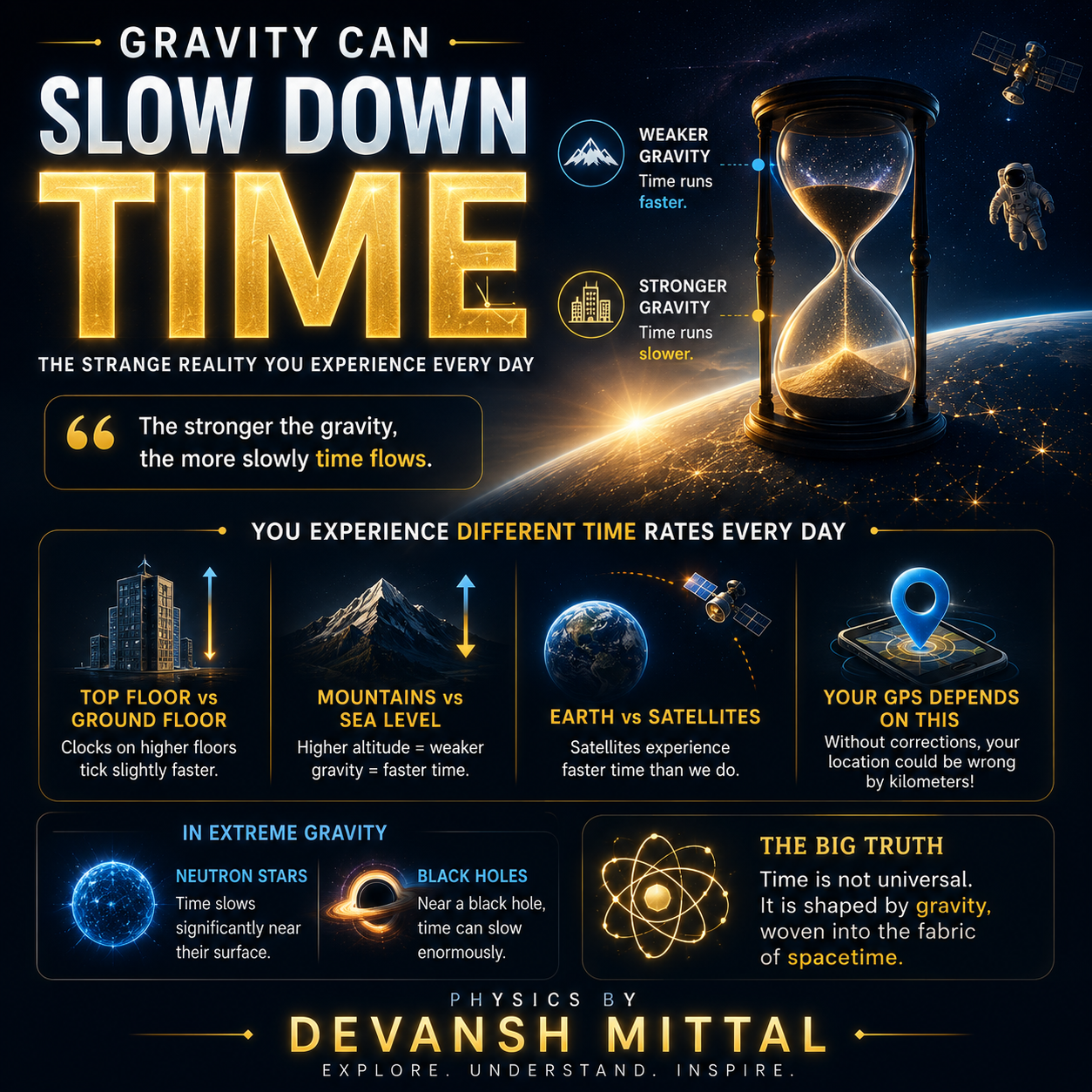
According to General Relativity, a clock located closer to a massive object ticks more slowly than a clock farther away. The stronger the gravitational field, the greater this effect becomes. Physicists call this phenomenon gravitational time dilation.

Consider two identical twins. One spends their life at sea level while the other lives on a high mountain. Because gravity is slightly weaker at higher altitudes, the mountain twin’s clock ticks a little faster. Over a lifetime, the twin on the mountain will age slightly more than the twin at sea level. The difference is extremely small, but it is real and measurable with modern instruments.

You Are Already Living in Different Time Zones of Gravity

Gravitational time dilation is not limited to exotic objects such as neutron stars or black holes. It exists everywhere. Time passes very slightly more slowly on the ground floor of a skyscraper than on the top floor. People living at high altitudes experience slightly faster time than people at sea level. Astronauts aboard satellites and spacecraft experience different rates of time compared with people on Earth.

The differences are tiny, but they reveal something profound: the universe does not provide a single universal clock. Every location experiences its own flow of time.

The Technology in Your Pocket Depends on This

Perhaps the most surprising part of the story is that gravitational time dilation is not merely a theoretical curiosity. The GPS system in your smartphone depends on it.

GPS satellites orbit thousands of kilometers above Earth, where gravity is weaker than it is on the surface. As a result, the clocks aboard those satellites tick slightly faster than clocks on the ground. If scientists and engineers ignored this effect, GPS errors would accumulate rapidly, causing navigation systems to drift by several kilometers each day.

Every time you navigate to a destination, track a package, locate a nearby restaurant, or call a ride-sharing service, you are relying on technology that corrects for the fact that gravity changes the rate at which time passes. Einstein’s century-old theory is quietly working inside your smartphone every moment.

The Universe’s Most Extreme Clocks

The effect becomes dramatically larger near extremely massive objects. A neutron star, for example, packs more mass than the Sun into an object roughly the size of a city. Its gravitational field is so intense that time noticeably slows near its surface.

Black holes take this phenomenon to the extreme. Near a black hole, gravity becomes so powerful that time can slow enormously compared with distant observers. Someone far away watching a clock near a black hole would see it ticking more and more slowly. To that observer, time itself could appear to be almost frozen.

At this point, the universe begins to feel less like a collection of objects moving through space and more like a vast landscape where time itself flows at different speeds in different places.

A New Way to Think About Time

We often imagine time as a universal river flowing uniformly throughout the cosmos. Modern physics paints a far stranger and more beautiful picture. Time is woven into the fabric of spacetime, and its flow depends on gravity and motion. Different observers can genuinely experience different amounts of time, not because of faulty measurements or optical illusions, but because reality itself is structured that way.

This realization forces us to rethink one of our deepest assumptions about the universe.

The Most Beautiful Lesson

Perhaps the most beautiful lesson is not simply that gravity slows time. It is that the universe is far deeper, stranger, and more elegant than our everyday intuition suggests. The same force that keeps your feet on the ground also influences the passage of time. The same theory that explains black holes helps your phone determine its location. And the same universe that appears ordinary during a morning walk hides profound mysteries beneath every step.

The next time you glance at a clock, remember that time is not as universal as it seems. The stronger the gravity around you, the more slowly time flows. Right now, at this very moment, gravity is quietly shaping the passage of time itself.
Why Is the Night Sky Dark?

Standard

A Question So Simple That It Shook Cosmology

Step outside on a clear night and look up at the sky. You will see thousands of stars scattered across the darkness, some shining brilliantly while others appear as faint points of light. Most of us never question why the spaces between those stars are dark. It feels completely natural. Yet this seemingly ordinary observation hides one of the most profound questions in the history of science: Why is the night sky dark at all?

At first glance, the answer appears obvious. Many people assume that the sky is dark because most of space is empty. Surprisingly, that explanation is not correct. In fact, this simple question puzzled astronomers for centuries and eventually helped reveal one of the most important discoveries about the universe itself.

The Puzzle Nobody Expected

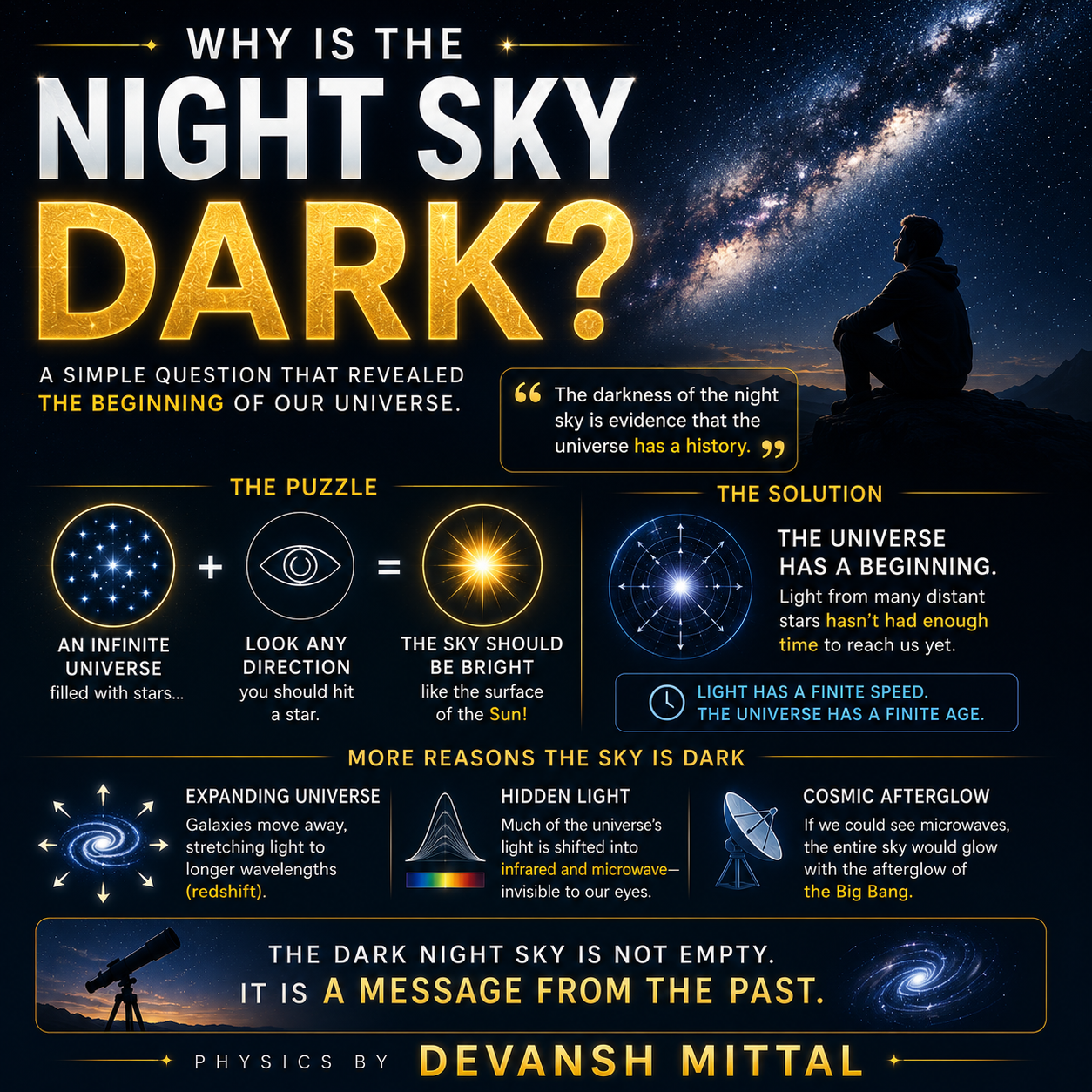
Imagine a universe that is infinitely large, filled with stars in every direction, and has existed forever. In such a universe, no matter where you looked, your line of sight would eventually end on the surface of a star. A useful analogy is a dense forest: wherever you look, your view ultimately terminates at a tree. By the same reasoning, every direction in the sky should eventually terminate at a star.

If this picture were correct, the entire night sky should glow with starlight. In fact, it should be almost as bright as the surface of the Sun. Yet the real night sky is overwhelmingly dark. This striking contradiction became known as Olbers’ Paradox, and it challenged some of the greatest scientific minds for generations.

Could Dust Be Blocking the Light?

One proposed solution was that enormous clouds of cosmic dust might be absorbing the light from distant stars before it reached Earth. At first, this idea seemed promising. However, it contains a fatal flaw. Dust that absorbs starlight cannot remain cold forever. Over time, it would heat up and begin emitting radiation of its own. Eventually, the dust would glow just as brightly as the light it absorbed, leaving the sky bright once again.

The darkness of the night sky therefore demanded a deeper explanation.

The Astonishing Solution

The breakthrough came when astronomers realized something extraordinary: the universe is not infinitely old. Instead, it had a beginning. Today, we call that beginning the Big Bang.

Because the universe has existed for only a finite amount of time, light from many distant stars and galaxies simply has not had enough time to reach us. When we gaze into the darkness of space, we are not necessarily looking into empty regions. In many directions, we are looking beyond the observable horizon of the universe, toward places whose light is still traveling toward us. The darkness of the night sky is therefore evidence that the cosmos has a finite age and a history.

Darkness as a Cosmic Message

The story becomes even more fascinating when we consider that the universe is expanding. As distant galaxies move away from us, their light becomes stretched to longer wavelengths through a process known as redshift. Over billions of years, much of the radiation produced throughout cosmic history has been shifted beyond the range of visible light into infrared and microwave wavelengths.

In other words, the universe is not truly dark. It is flooded with radiation. Our eyes simply cannot detect most of it. If human vision were sensitive to microwaves, the sky would appear to glow in every direction with the faint afterglow of the Big Bang itself.

The Next Time You Look Up

The darkness above you is not merely the absence of light; it is a source of information. It tells us that the universe has not existed forever. It tells us that light travels at a finite speed. It tells us that the cosmos is expanding and evolving with time.

Perhaps the most beautiful realization is that the dark night sky is not empty at all. It is a silent record of the universe’s origin, age, and history. Every star visible in the night sky is a reminder of the vastness of the cosmos, but the darkness between those stars may be even more profound. It is the darkness itself that reveals one of the greatest truths ever discovered: our universe had a beginning, and the night sky quietly tells that story every single night.

Why Black Holes Bend Light?

Standard

Why Black Holes Bend Light

The Strange Prediction of Gravity

We usually think gravity pulls only on things that have mass.

A falling apple has mass.
A planet has mass.
You have mass.

But light has no mass.

So why does light bend near a black hole?

This question confused scientists for centuries — until Einstein completely changed our understanding of gravity.


Gravity Is Not Really a Force

According to Isaac Newton, gravity is a force between masses.

But Einstein introduced a much deeper idea.

He said gravity is actually the bending of space and time itself.

Imagine placing a heavy bowling ball on a stretched rubber sheet. The sheet bends around the ball. If you roll a marble nearby, the marble curves toward the bowling ball — not because the ball is “pulling” it directly, but because the surface itself is curved.

Einstein proposed that space behaves in a similar way.

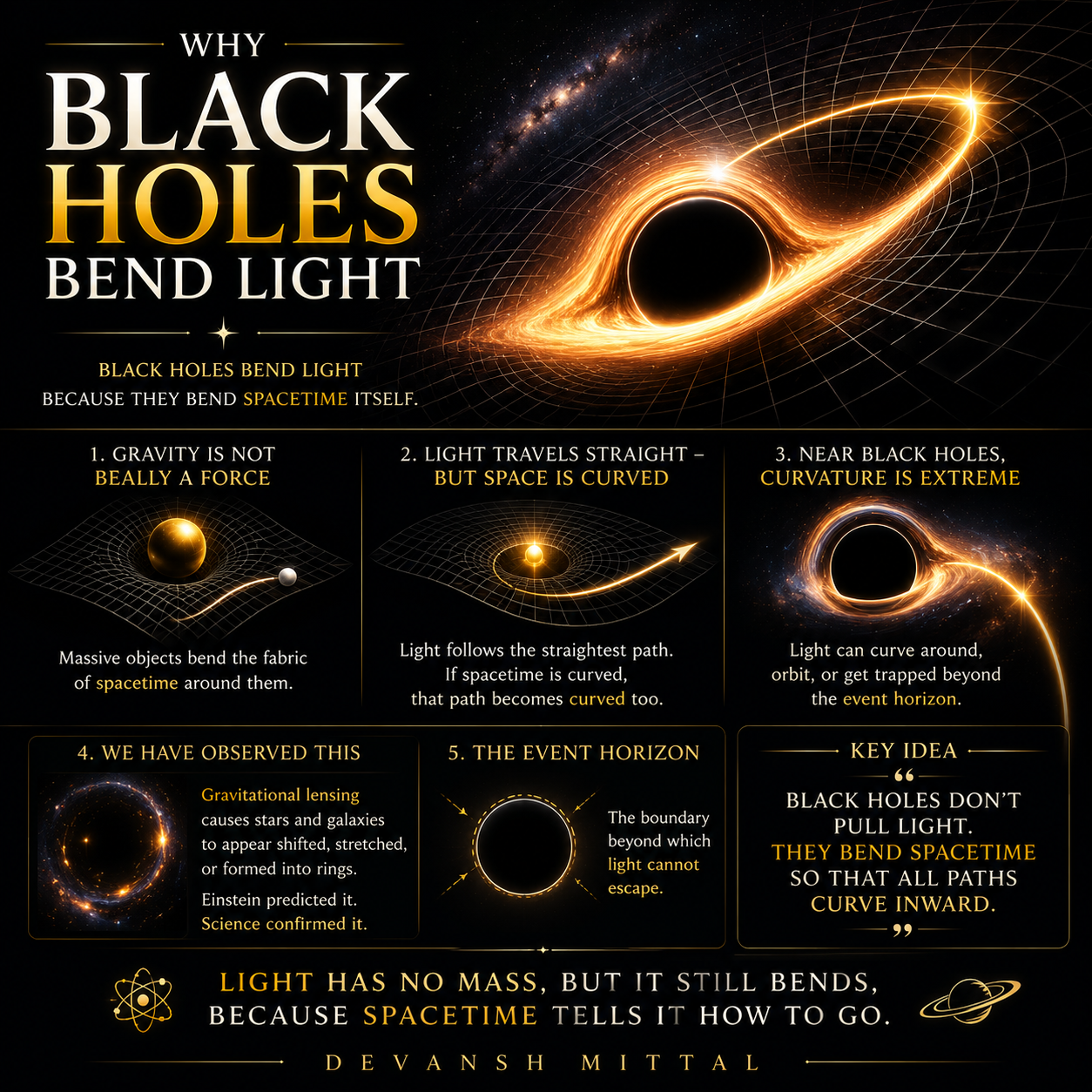
Massive objects bend the fabric of spacetime around them.


Light Always Travels Straight — But Space Is Curved

This is the key idea students often miss:

Light always tries to move in the straightest possible path.

But if space itself is curved, then the “straight path” also becomes curved.

Imagine walking straight on the curved surface of Earth. Even though you feel you are moving straight, your path curves around the planet.

Similarly, near a black hole, spacetime becomes extremely curved. So light follows that curvature.

As a result, light bends.


Why Black Holes Bend Light So Strongly

A black hole contains an enormous amount of mass compressed into an incredibly tiny region.

This creates extreme spacetime curvature.

Near the black hole, the bending becomes so intense that light can:

  • curve around the black hole,
  • orbit it temporarily,
  • or even become trapped forever.

The boundary beyond which light cannot escape is called the event horizon.

Once light crosses this boundary, escaping becomes impossible.

That is why black holes appear black.


We Have Actually Observed This

This is not just theory.

Scientists have observed stars appearing in shifted positions because their light bends around massive objects. This phenomenon is called gravitational lensing.

Sometimes a distant galaxy even appears stretched into rings or arcs because its light bends around another massive galaxy lying in front of it.

Einstein predicted this long before telescopes could observe it.

Later, experiments proved him correct.


The Deep Idea

Black holes do not “grab” light like a vacuum cleaner.

Instead, they bend spacetime so dramatically that every possible path light can take curves inward.

In other words:

Black holes bend light because they bend spacetime itself.

When the Straight Line Is Not the Fastest Path

Standard

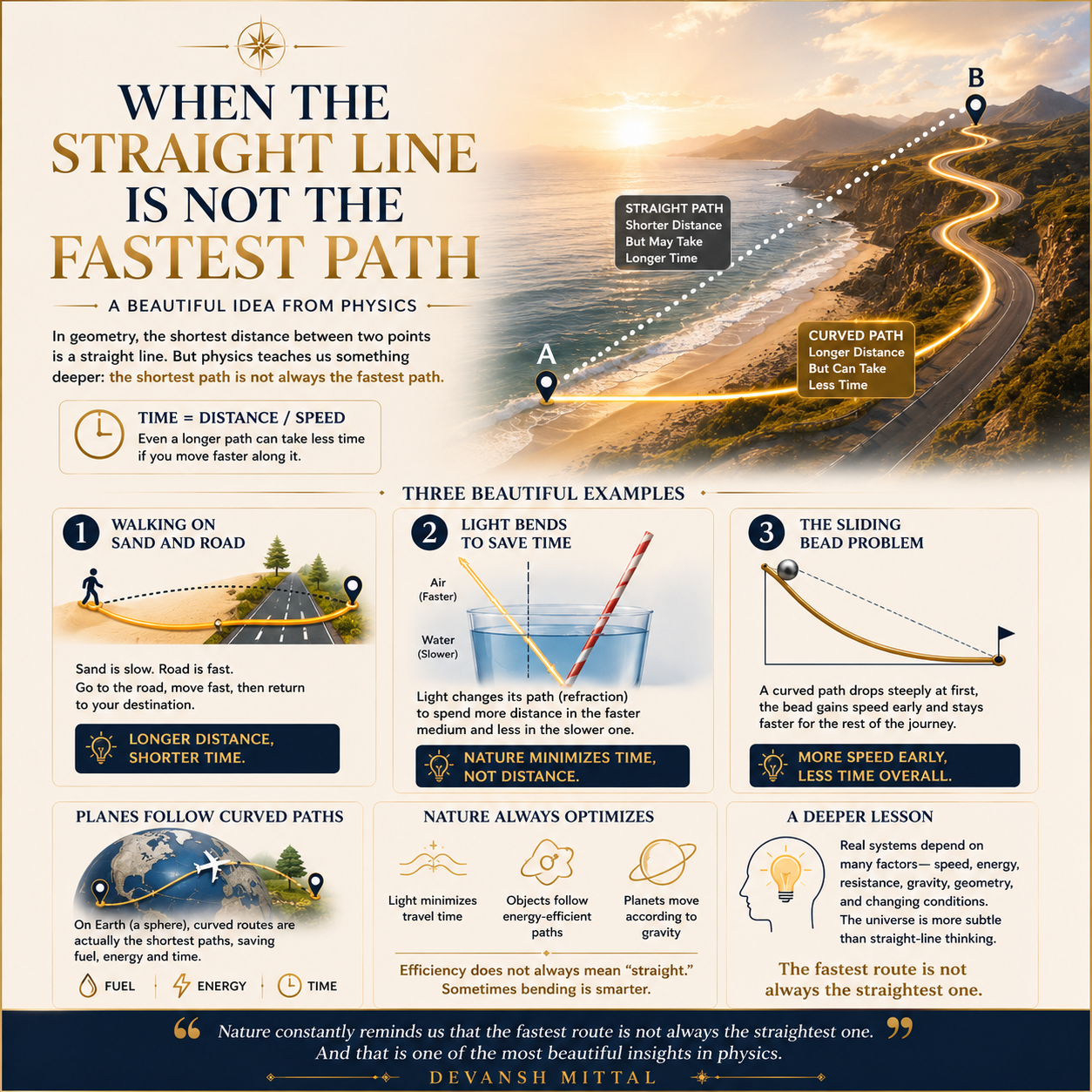
When the Straight Line Is Not the Fastest Path

A Beautiful Idea from Physics

We often hear the statement:

“The shortest distance between two points is a straight line.”

In geometry, this is absolutely correct.

But physics teaches us something deeper:

The shortest path is not always the fastest path.

Sometimes a slightly longer curved path can take less time than a straight-line path.

At first this sounds impossible, but Nature gives many beautiful examples of this idea.


Distance and Time Are Not the Same Thing

Suppose you want to travel from one place to another.

Your travel time depends on two things:

  • the distance traveled,
  • and your speed during the journey.

Mathematically:

Time = Distance / Speed

This means that even if a path is longer, it can still take less time if you move faster along it.

This simple idea is the key to understanding the entire article.


Example 1: Walking on Sand and Road

Imagine you are standing on a beach.

  • Walking on sand is slow.
  • Walking on a road is much faster.

Now suppose your destination lies far away along the beach.

Should you walk directly toward it in a straight line through sand?

Not always.

A faster strategy may be:

  • first move toward the road,
  • travel quickly along the road,
  • then return toward the destination.

Even though the total distance becomes larger, the total time can become smaller because most of the motion happens on the faster surface.

So:

Shortest distance ≠ shortest time.


Example 2: Light Does Not Always Travel in Straight Lines

Light usually travels in straight lines in air.

But when light enters water or glass, it bends.

This phenomenon is called:

Refraction

Why does light bend?

Because light travels slower in water than in air.

To save time, light changes its path so that it spends more distance in the faster medium.

This is why a straw placed in water appears bent.

Nature is not trying to minimize distance.
Nature is trying to minimize time.


Example 3: The Sliding Bead Problem

This is one of the most famous problems in physics.

Imagine a bead sliding under gravity from one point to another.

Which path will take the least time?

Most people naturally think:

“A straight line.”

But surprisingly, this is wrong.

A curved path can actually be faster.

Why?

Because the curved path drops steeply at first, allowing the bead to gain speed quickly due to gravity.

After gaining large speed early, the bead continues moving rapidly for the rest of the journey.

So although the curved path is longer, the higher speed makes the total time smaller.

This is one of the most beautiful ideas in physics.


Why Curved Paths Can Be Faster

There are two competing effects:

Straight Path

  • shorter distance,
  • but slower speed gain.

Curved Path

  • longer distance,
  • but faster speed gain.

Sometimes the increase in speed is more important than the extra distance.

That is why the curved path wins.


Airplanes Also Follow Curved Paths

When airplanes travel long distances on Earth, their routes often appear curved on maps.

But Earth is spherical, not flat.

The curved-looking route is actually the shortest path on a sphere.

This path helps save:

  • fuel,
  • energy,
  • and travel time.

Again, Nature and engineering often prefer optimal paths rather than visually straight ones.


Nature Always Tries to Optimize

Many laws of physics are based on optimization principles.

For example:

  • light tries to minimize travel time,
  • objects move in ways that reduce energy,
  • planets follow paths determined by gravity.

Physics repeatedly shows that Nature is extremely efficient.

But efficiency does not always mean “straight.”

Sometimes:

  • bending is faster,
  • curved motion is smarter,
  • and indirect paths become optimal.

A Deeper Lesson

This idea teaches us something important beyond physics.

Our intuition often focuses only on distance.

But in real systems, many factors matter:

  • speed,
  • energy,
  • resistance,
  • gravity,
  • geometry,
  • and changing conditions.

The universe is more intelligent and subtle than simple straight-line thinking.


Final Thoughts

The statement:

“The shortest distance between two points is a straight line”

is true in geometry.

But physics asks a deeper question:

“What path takes the least time?”

And the answer is often very different.

Light bends.
Objects curve.
Airplanes follow arcs.
Sliding beads move faster on curved tracks.

Nature constantly reminds us that the fastest route is not always the straightest one.

And that is one of the most beautiful insights in physics.