This testimonial comes from two extraordinary brothers, Mahroof and Masroor, whose journeys reflect the power of deep conceptual learning and disciplined thinking. Under my mentorship, Mahroof went on to win a Gold Medal at the International Junior Science Olympiad (IJSO) and secure AIR 32 in JEE Advanced 2026 and AIR 44 in JEE Main 2026, while Masroor achieved AIR 169 in JEE Advanced 2026 and AIR 58 in JEE Main 2026 after qualifying for the IJSO OCSC. In this heartfelt message, they share how intuition, imagination, and conceptual clarity shaped their success and express their sincere gratitude for the role my teaching played in their academic journey.
Respected Devansh Sir,
We are Mahroof and Masroor, your former students, and we are writing this to express our deepest gratitude for the invaluable role you have played in our academic and personal journeys.
Looking back at our milestones, we realize that the foundation of our success was laid entirely under your mentorship.
With your guidance, we were privileged to achieve milestones we once thought were distant dreams:
Representing India and winning a Gold Medal for the nation at the International Junior Science Olympiad (IJSO)
AIR 32 & AIR 169 in JEE Advanced 2026
AIR 44 & AIR 58 in JEE Main 2026
While these ranks and medals are a testament to hard work, the true catalyst was the way you taught us to think.
What set your classes apart was a relentless emphasis on INTUITION OVER ROTE MEMORIZATION.
You constantly pushed us to seek the deeper meaning behind every concept, urging us to ask WHY a physical phenomenon occurs before figuring out how to calculate it.
YOUR UNIQUE APPROACH
You taught us the power of imagination. You trained us to visualize complex physical setups and build mental models before touching a pen to paper.
This gift of visualization became our ultimate strength, giving us the confidence to break down completely unfamiliar problems, whether we were competing on an international Olympiad stage or tackling the toughest questions in JEE Advanced.
THE POWER OF CONCEPTUAL CLARITY
In a competitive landscape where many rely on pattern recognition and formula shortcuts, your focus on absolute conceptual clarity became our greatest competitive advantage.
By ensuring our fundamentals were unshakeable, you stripped away the fear of the unknown. When faced with highly complex, multi-concept problems in JEE Advanced and the Olympiads—questions designed to break standard formulas—our strong conceptual foundation allowed us to derive solutions from first principles.
You didn’t just teach us Physics; you gave us the ultimate toolkit to conquer any high-stakes examination.
A MESSAGE TO OUR JUNIORS
To our juniors who are currently learning under Devansh Sir, our biggest advice is to trust his process completely.
In the beginning, focusing deeply on concepts and visualization might feel slower than just memorizing a formula to get a quick answer. But commit to it anyway.
The intuition Sir builds in you is a superpower that compounds over time. When the syllabus expands and the problems get tougher, it is this conceptual depth—not shortcuts—that will carry you through.
Listen to his insights, ask the “WHYS”, and embrace the way he teaches you to think.
SHAPING OUR ACADEMIC FUTURE
Your impact on us goes far beyond these examinations.
You didn’t just prepare us for a test; you genuinely transformed the way we approach learning itself. By instilling a rigorous scientific temperament and a passion for deep inquiry, you have permanently shaped our future academic paths.
The analytical mindset and problem-solving resilience we developed in your classroom are the very tools we will carry forward into our higher education and future careers in science and technology.
A NOTE OF DEEP APPRECIATION
Sir, we feel incredibly fortunate to have been mentored by an educator of your caliber.
Your boundless passion for Physics, your patience, and your genuine investment in our growth have left an indelible mark on our lives. You made a notoriously difficult subject beautiful and enjoyable.
Thank you for your tireless guidance, your unwavering belief in our potential, and for helping us bring pride to the country.
WE WILL ALWAYS REMAIN PROFOUNDLY GRATEFUL TO YOU.
WITH SINCERE RESPECT AND GRATITUDE,
MAHROOF Gold Medalist, IJSO AIR 32, JEE Advanced 2026 | AIR 44, JEE Main 2026
MASROOR IJSO OCSC AIR 169, JEE Advanced 2026 | AIR 58, JEE Main 2026
Every JEE aspirant wants a top rank, but very few understand the principles that consistently produce one.
In this exclusive interview, I speak with Vasu Vijay, one of my former students, who secured an outstanding AIR 56 in JEE Advanced 2025. Beyond his remarkable JEE performance, Vasu is also an International Junior Science Olympiad (IJSO) Gold Medalist, reflecting years of exceptional scientific aptitude and disciplined preparation. His journey demonstrates how a strong conceptual foundation built through Olympiads can become a powerful advantage for succeeding in one of the world’s toughest entrance examinations.
Through 23 thoughtfully designed questions, Vasu shares the strategies, habits, and mindset that guided his preparation—from Olympiads and concept-building to study planning, mock-test analysis, exam strategy, stress management, and the importance of mentors. More than a discussion about cracking JEE, this interview explores how top performers learn, think, and continuously improve.
Whether you are just beginning your preparation or striving for a top rank, the lessons in this conversation will help you study with greater clarity, confidence, and purpose.
The Conversation
Phase 1: The Journey Begins
Question 1: The Result Moment
Walk us through the exact moment you (and your parents) saw that you secured a top All India Rank. What was that feeling like?
Response 1:
It was early in the morning, around 6 A.M., when I checked the result. Seeing my rank was an incredibly happy and satisfying moment. When I shared the news with my family, they were overjoyed. It was a moment of celebration and relief for all of us after years of hard work.
Question 2: The Catalyst
When did you officially start your JEE preparation? Was getting into an IIT always your ultimate dream, or did the realization happen later?
Response 2:
I started preparing seriously for JEE during Classes 10 to 12. The idea of getting into an IIT had been in my mind for a few years before that, so it was a goal I had been working towards for quite some time.
Question 3: Identifying the Path
How did you figure out your true academic interest? At what point did you decide to pursue engineering over medical or commerce?
Response 3:
The decision developed gradually. I was always interested in building things, solving problems, and understanding how systems work. Engineering felt like the natural path because it combined creativity, innovation, and problem-solving.
Question 4: The Olympiad Edge
You have represented India in international Olympiads. How important are these exams (like IJSO, NSEP) in building the foundation for JEE?
Response 4:
Preparing seriously for Olympiads like IJSO helps build strong fundamentals, develops problem-solving skills, and teaches you how to learn effectively. These skills become extremely valuable later during JEE preparation.
Preparing for NSEP is a good idea if you are preparing for IIT, because the syllabus for both is very similar.
However, as you move on to the higher stages beyond NSEP towards IPhO, the Olympiad syllabus starts deviating from the IIT path. I would recommend my juniors to take NSEP very seriously, but not necessarily the higher stages of the Physics Olympiad if they do not wish to compromise their IIT preparation.
If they believe they can manage both the Olympiad and IIT, then they can continue with all the stages of IPhO.
Similar are my views towards the Chemistry Olympiad.
Phase 2: Academic Architecture & Blueprint
Question 5: The Daily Routine
What did your daily routine look like? Did you follow a rigid timetable (by the hour) or a flexible, target-based approach?
Response 5:
I mainly focused on completing my daily goals. Rather than following a rigid timetable, I preferred a target-based approach where the priority was getting important work done consistently. I always tried to study 6-8 hours daily, apart from my classes which used to consume around 5-6 hours of time. On a holiday, I used to study a minimum of 10 hours.
Question 6: Sleep & Cycles
How many hours of sleep did you prioritize? Did you prefer studying late at night or early in the morning?
Response 6:
I generally preferred studying a little later at night, but I always tried to get at least 6–7 hours of sleep. Adequate sleep was important for maintaining concentration and productivity.
Question 7: Subject Allocation
How did you balance Physics, Chemistry, and Math? Did you allocate equal time to all, or base it entirely on your weak points?
Response 7:
In the beginning, I gave roughly equal attention to all three subjects. During revision, however, I adjusted my time according to my needs, spending more time on weaker subjects or topics that required additional work.
Question 8: The Material Trap
Did you rely strictly on your coaching modules, or did you use multiple reference books (like H.C. Verma)? Is it better to solve one book three times or three books once?
Response 8:
For concept-building, solving the same high-quality material multiple times is usually sufficient. It also saves time because you can focus on strengthening weak areas rather than repeatedly solving questions you are already comfortable with.
In my opinion, you should follow the material provided in your coaching institute and the material which your teachers recommend. That is generally sufficient.
However, if you feel bored or want additional practice, exploring new books can provide fresh problem formulations based on similar concepts. But more is not always better, hunting for new books all the time is also not a good idea.
Question 9: Study Material
Which material did you use for IJSO and what material did you use for IIT?
Response 9:
For Physics during IJSO preparation, I mainly used H.C. Verma and Past Year Questions. In other subjects I primarily used class notes and Past Year Questions of NSEJS and INJSO.
For IIT-JEE, I relied primarily on coaching material. In physics, in addition I used H.C. Verma and selected topics from I.E. Irodov. In the other subjects, my primary focus remained on coaching material. If at all I followed any other resources, they were only the ones suggested by my teachers to me. My recommendation is, just follow your coaching material and your teachers.
Question 10: Biology and IJSO
Being an IIT aspirant, how was your attitude towards Biology during IJSO preparation?
Response 10:
One thing I enjoyed about IJSO Biology was that it was highly application-oriented and logical. Because of that, I found it interesting and engaging rather than something that had to be memorized. Since I was in Class 9 at the time, I also had sufficient time to balance it with future JEE preparation.
Question 11: IOQM and IMO
Should students focus on IOQM if their future goal is IIT?
Response 11:
I think this depends largely on personal interest. Attempting IOQM can be a good way to stay connected with mathematical thinking. However, the skills and syllabus required for higher-level Olympiad mathematics are quite different from JEE, so it is not necessary for every IIT aspirant.
Question 12: School and Coaching
How did you manage the time with both school and coaching?
Response 12:
I was enrolled in a dummy school, so managing regular school commitments was not a challenge for me.
Question 13: Sports and Recreation
Did you only study during those preparation years or did you also spend time in sports, workouts, and other recreational activities?
Response 13:
I practiced yoga in the mornings during my JEE preparation. Apart from that, I occasionally watched television, but most of my time was focused on academics.
Phase 3: Psychology, Adversities & Mindset
Question 14: Tackling Failure
What were your best and worst scores in mock tests? How did you mentally recover from a disastrous test score?
Response 14:
My best score was around 330 out of 360, while my lowest was around 190. Whenever I performed poorly, I carefully analysed where I had lost marks and why. I also discussed both the academic and psychological aspects of the situation with my teachers. At the end of the day, a mock test is only a tool for improvement, not a final judgment.
Question 15: The “Silly Mistakes” Protocol
Almost every student loses ranks to silly mistakes. Did you maintain a “mistake notebook,” and how did you actively minimize these errors?
Response 15:
Instead of maintaining a separate notebook, I marked questions directly in my hard copies and categorised them according to the type of mistake and its underlying cause. I would carefully review these questions the day after the exam and focus on preventing similar errors in the future.
Question 16: Conquering Fear
Was there a specific topic (like Thermodynamics or Fluids) that terrified you? How did you overcome it?
Response 16:
Topics such as parts of Rigid Body Dynamics and Fluid Dynamics were initially difficult because building intuition for them took time. Some concepts were also quite dense. Rather than fearing them, I accepted that they would require more effort and invested additional time in understanding them properly.
Question 17: Digital Distractions
How did you handle smartphones and social media? Did you cut them off completely, or use them in moderation?
Response 17:
I used my phone normally, but primarily for communication through WhatsApp. I did not spend significant time on social media platforms, which helped me stay focused without feeling completely disconnected.
Question 18: The “Burnout” Days
What did you do on days when you were completely exhausted and absolutely did not want to study?
Response 18:
If I felt genuinely tired, I would take a short nap or play a game for a while before returning to work. Since I lived at home, burnout was not a major issue for me, but I always tried to listen to my body when I needed a break.
Phase 4: The Ecosystem (Family, Mentors & Peers)
Question 19: The Peer Group
How important is a highly competitive friend circle in cracking JEE? Did you do group studies or doubt-solving with friends?
Response 19:
Discussing doubts and brainstorming with friends helped me develop a much deeper understanding of concepts. It also provided a useful reality check regarding my preparation. At the same time, it is important not to feel intimidated by what others are doing. What matters most is how effectively you are using your own time and opportunities.
Question 20: The Mentors
Were you ever hesitant to ask doubts in a class full of brilliant students? How did your bond with your teachers help you beyond academics?
Response 20:
Yes, I did feel hesitant in some classes initially. However, overcoming that hesitation and asking doubts is extremely valuable. Building a strong relationship with teachers helps not only academically but also in developing confidence, perspective, and better decision-making throughout the preparation journey.
Phase 5: The Exam Day & The Aftermath
Question 21: The Exam Strategy
Did you have a pre-decided sequence for attempting the paper (e.g., Chemistry, then Physics, then Math), or did you adapt based on the paper’s difficulty?
Response 21:
I always adapted my strategy according to the paper. My priority was to identify and solve the easier questions first, secure those marks, and then return to the more challenging questions later.
Question 22: Exam Temperament
Were you nervous on the actual day of the exam, or did giving continuous mock tests eliminate the “exam fear”?
Response 22:
By the time the actual exam arrived, I had very little exam anxiety. Regular mock tests had helped me build familiarity with the exam environment and develop the confidence needed to perform calmly under pressure.
Once I started attempting my actual IIT exam, it felt like a regular mock test only to me.
Phase 6: Unplugged & Rapid Fire
Question 23: The Ultimate Advice
What is your final, defining piece of advice for the millions of juniors who want to be in your shoes next year?
Response 23:
Build strong relationships with your teachers, focus deeply on conceptual understanding, surround yourself with a positive and motivated peer group, and make sure you have a healthy way to manage stress. These factors may seem simple, but over time they can make a tremendous difference in both your preparation and your final outcome.
Devansh Sir’s 10 Insights
1. Build Concepts Before You Chase Ranks.
Vasu’s greatest strength was never memorization—it was understanding. A deep conceptual foundation built through Olympiads made advanced JEE problems feel logical instead of intimidating. Students who truly understand concepts rarely fear difficult questions.
2. Learn Once, Revise Many Times.
The temptation to keep buying new books is one of the biggest mistakes aspirants make. Vasu recommends mastering one excellent resource repeatedly rather than collecting dozens of unfinished books. Depth always beats variety.
3. Olympiads Can Give You a Multi-Year Advantage.
Preparing for Olympiads such as IJSO and NSEP develops analytical thinking, scientific curiosity, and advanced problem-solving skills long before JEE preparation becomes intensive. Students who start early often spend less time struggling later.
4. Hard Work Without Reflection Is Incomplete.
Every mock test should answer one question: “Why did I lose marks?” Instead of worrying about scores, Vasu analyzed mistakes, discussed them with teachers, and transformed every failure into a lesson for the next examination.
5. Great Students Don’t Fear Difficult Topics—They Invest More Time in Them.
Instead of avoiding challenging chapters like Fluid Mechanics or Rotational Dynamics, Vasu simply accepted that some concepts demand additional effort. Fear disappears when understanding increases.
6. Your Teachers Can Accelerate Your Journey More Than Any Book.
One of Vasu’s strongest messages is to build meaningful relationships with your teachers. Asking doubts without hesitation, seeking guidance regularly, and discussing both academic and psychological challenges dramatically shortens the learning curve.
7. Study Targets Matter More Than Study Timetables.
Rather than following a rigid hourly schedule, Vasu focused on completing meaningful daily goals. Flexible, target-based planning allowed him to remain productive without becoming trapped by unrealistic timetables.
8. Examination Strategy Is a Skill That Must Be Practiced.
On the actual exam day, Vasu did not blindly follow a fixed subject order. He adapted intelligently, solved easier questions first, secured guaranteed marks, and returned later to tougher problems. Smart decisions inside the examination hall can significantly improve your final rank.
9. Success Doesn’t Require Isolation.
Contrary to popular belief, Vasu maintained a healthy routine that included yoga, meaningful discussions with friends, and balanced use of technology. Sustainable success comes from managing your energy—not from studying every waking minute.
10. The Best Students Never Stop Improving.
Perhaps the most inspiring lesson from Vasu’s journey is his growth mindset. Every difficult topic became an opportunity to learn. Every mock test became feedback. Every conversation with teachers became a chance to improve. This relentless commitment to continuous learning ultimately separated him from thousands of equally hardworking aspirants.
Final Thought
The defining lesson from Vasu Vijay’s journey is simple:
Extraordinary ranks are not achieved by students who merely solve the maximum number of questions. They are achieved by students who understand concepts deeply, revise intelligently, trust great mentors, analyze every mistake, and keep improving every single day.
When learning becomes deeper than memorization, preparation becomes more enjoyable, confidence grows naturally, and success becomes the logical outcome rather than a matter of chance.
Among the many students I have had the privilege of teaching, Arnav Gautam stands out as one of the most accomplished. In 2026, he secured AIR 7 in JEE Advanced and AIR 5 in JEE Main, achievements that place him among the very top students in the country. His journey, however, extends far beyond JEE. Over the years, he qualified prestigious examinations including NSEJS, INJSO, NSEP, INPhO, INChO, and INAO, and attended the OCSC camps for both Junior Science and Physics Olympiads.
What makes Arnav’s testimonial especially meaningful to me is not merely the extraordinary list of achievements, but his reflection on the deeper aspects of learning. In the words that follow, he shares how an emphasis on conceptual understanding, intuition, visualization, and independent thinking helped shape his approach to Physics and problem-solving. He also speaks about the role that mentorship, personal guidance, and scientific thinking played throughout his academic journey.
I am delighted to share Arnav’s thoughts and experiences in his own words. His journey is a powerful reminder that lasting success is built not only on hard work, but also on a strong foundation of understanding and a genuine love for learning.
Respected Devansh Sir,
I am Arnav Gautam. I was your student in the IJSO batches earlier.
This year, I secured AIR 7 in JEE Advanced 2026 and AIR 5 in JEE Main 2026. Along the way, I also qualified NSEJS, INJSO, NSEP, INPhO, INChO, and INAO multiple times, and attended the OCSC camps for both Junior Science and Physics Olympiads.
I would like to sincerely thank you for the role you played in this journey.
One thing that always made your classes different was your emphasis on understanding rather than memorization. You never encouraged us to blindly apply formulas. Instead, you taught us to think deeply about concepts, build intuition, and visualize physical phenomena. This approach completely changed the way I looked at Physics.
Your classes not only strengthened my problem-solving abilities but also developed the confidence to tackle unfamiliar and challenging questions. Whether it was preparing for Olympiads or JEE, the strong conceptual foundation built in your classes helped me immensely.
I am also grateful for the effort and personal attention you invested in your students. Your guidance, suggestions, and constant encouragement motivated me throughout my preparation. The problem-solving mindset and scientific way of thinking that I learned from you have benefited me far beyond examinations.
Looking back, I realize that many of my achievements would not have been possible without the foundation you helped me build. Thank you for inspiring me to genuinely enjoy Physics and for always pushing me to think independently.
I will always remain grateful for your mentorship and support.
Best regards,
Arnav Gautam AIR 7, JEE Advanced 2026 AIR 5, JEE Main 2026
Have you ever looked at electric wires on the roadside and wondered:
“How can birds sit on high-voltage wires without getting electrocuted?”
After all, we humans are warned constantly about the dangers of electricity. Touching a live wire can be deadly.
Yet tiny birds sit peacefully on electric lines every single day.
Are birds somehow immune to electricity?
Not at all.
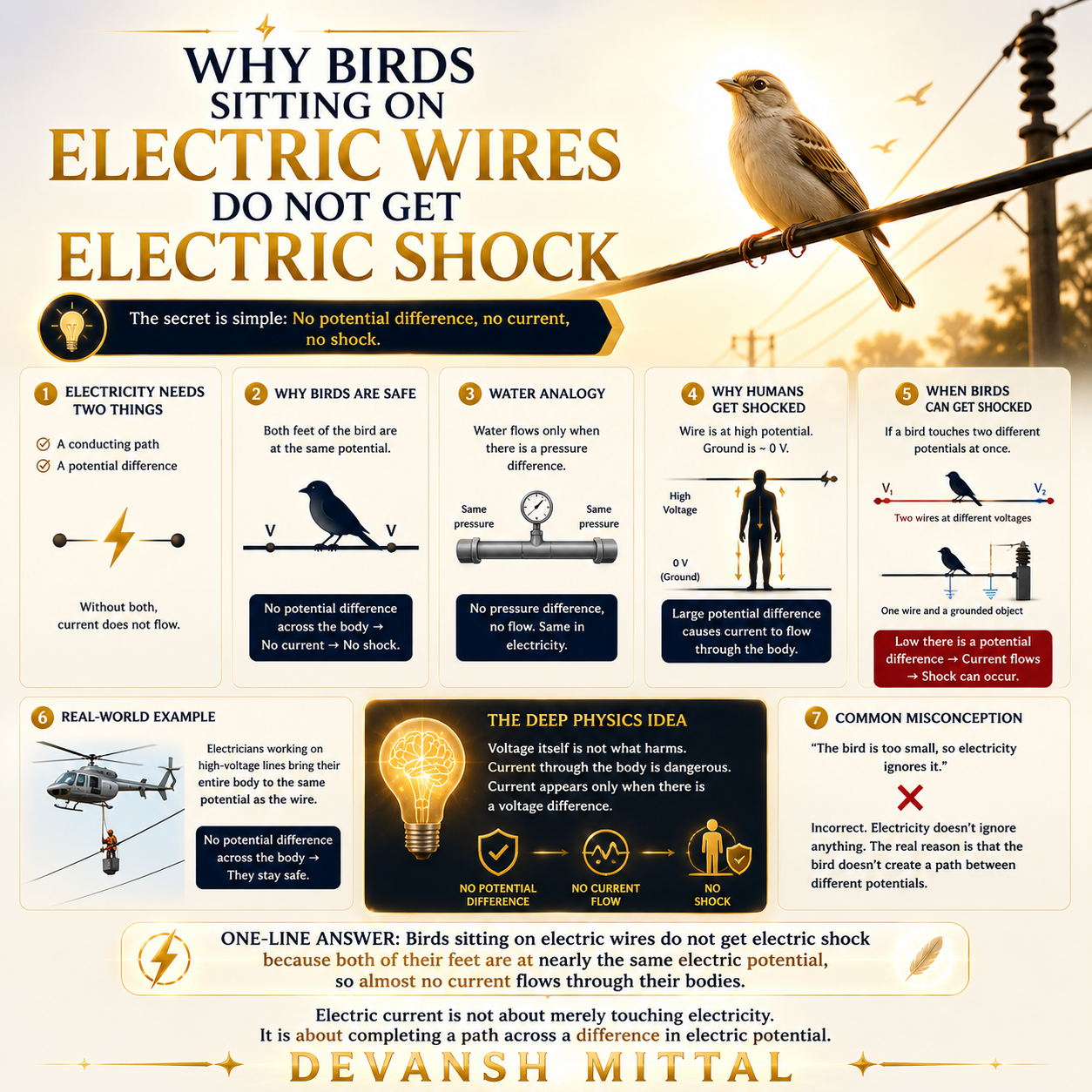
The real answer reveals one of the most important ideas in electricity — electric current flows only when there is a difference in electric potential.
And once you understand this idea deeply, many electrical phenomena suddenly become intuitive.
Electricity Does Not Flow Just Because a Wire is “Live”
This is the biggest misconception students usually have.
Many people think:
“If a wire contains electricity, touching it automatically gives a shock.”
But that is not how electricity works.
Electric current flows only when there is:
A conducting path, and
A potential difference between two points.
Without both conditions, current does not flow through the body.
A bird sitting on a single wire usually touches only one point of the electrical system.
That changes everything.
The Real Reason Birds Stay Safe
When a bird sits on one wire:
Both of its feet are almost at the same electric potential.
Therefore, there is almost no potential difference across its body.
Since current depends on potential difference, almost no current flows through the bird.
And without significant current through the body, there is no electric shock.
The bird is simply becoming part of the wire at the same voltage.
An Easy Water Analogy
Imagine water flowing through pipes.
Water flows only when there is a pressure difference.
If both ends of a pipe section are at the same pressure, water does not move through that section.
Electric current behaves similarly.
Here:
I = current
V = potential difference
R = resistance
If the voltage difference across the bird is nearly zero, the current is also nearly zero.
This is the key idea.
Then Why Do Humans Get Shocked?
Suppose a person touches a live wire while standing on the ground.
Now two parts of the body are at very different potentials:
The wire may be at thousands of volts.
The ground is approximately zero volts.
This creates a large potential difference across the body.
Electric current now finds a path:
Wire → Body → Ground
And dangerous current flows through the person.
That is an electric shock.
Why Birds Must Be Careful Too
Birds are safe only under specific conditions.
They can still get electrocuted if they simultaneously touch:
Two wires at different voltages, or
One wire and a grounded object like a metal pole.
Now there is a voltage difference across the bird’s body.
Current flows through the bird.
And the result can be fatal.
This is why large birds with wide wingspans are more vulnerable near power lines.
A Powerful Real-World Example
Electricians working on high-voltage transmission lines sometimes use helicopters and special suits.
Surprisingly, they can safely touch wires carrying hundreds of thousands of volts.
How?
Because their entire body is brought to the same electric potential as the wire before contact.
Again, the secret is not “low voltage.”
The secret is:
No significant potential difference across the body.
This is exactly the same principle that protects birds.
The Deep Physics Idea
Students often memorize formulas in electricity without understanding the physical meaning.
But this example teaches a profound lesson:
Voltage itself is not what harms living beings.
Current through the body is what becomes dangerous.
And current appears only when there is a voltage difference that drives charges through the body.
That is why:
Birds survive on wires,
Electricians use insulation and grounding carefully,
And electrical safety rules focus on preventing current paths.
A Common Misconception
People often say:
“The bird is too small, so electricity ignores it.”
This is incorrect.
Electricity does not “choose” to avoid the bird.
The real reason is that the bird does not provide a useful path between different potentials.
Physics is governed by electric fields, resistance, and potential differences — not by intention.
The One-Line Answer
Birds sitting on electric wires do not get electric shock because both of their feet are at nearly the same electric potential, so almost no current flows through their bodies.
Final Thought
The next time you see birds resting calmly on power lines, remember:
They are demonstrating one of the deepest principles of electricity in nature.
Electric current is not about merely touching electricity.
It is about completing a path across a difference in electric potential.
And that simple idea powers everything from mobile chargers to giant electrical grids.
Most of us grow up believing that time is universal. A second is a second, a minute is a minute, and a clock in your room, a clock on a mountain, and a clock in space should all tick at exactly the same rate. It feels obvious. In fact, it feels difficult to imagine reality behaving any other way.
Yet one of the most astonishing discoveries in the history of science revealed something deeply counterintuitive: gravity can slow down time itself. Not just in science fiction, not just near black holes, and not just somewhere far away in the universe. This phenomenon is happening right now, all around us on Earth, and modern technology depends on it every day.
The Experiment That Changes Everything
Imagine that you have two perfectly accurate clocks. You leave one on Earth and place the other aboard a spacecraft. After some time, the spacecraft returns and you compare the clocks. Common sense suggests that they should agree perfectly. After all, time is time.
But nature has a surprise waiting. The clocks show different times. One clock has actually experienced more time than the other. This is not because one of the clocks malfunctioned or lost accuracy. It is because time itself flowed differently for them. What sounds like science fiction is actually a real and experimentally verified consequence of modern physics.
Why This Sounds Impossible
Our everyday experience teaches us that time is constant. Whether you are drinking tea, riding a bicycle, studying physics, or watching a movie, time appears to move forward at the same steady pace. Gravity, meanwhile, seems completely unrelated. Gravity makes apples fall, keeps planets in orbit, and pulls us toward the ground. Why should it have anything to do with clocks? Why should it affect the passage of time?
This is where our intuition begins to fail. The universe is under no obligation to behave according to our everyday expectations.
Einstein’s Revolutionary Insight
In 1915, Albert Einstein introduced the theory of General Relativity, forever changing our understanding of gravity. Before Einstein, gravity was viewed as a force acting between objects. Einstein proposed something far more profound: massive objects such as planets, stars, and galaxies change the very structure of spacetime itself.
A useful analogy is to imagine placing a heavy bowling ball on a stretched rubber sheet. The sheet bends around the ball. If a smaller ball is placed nearby, it rolls toward the bowling ball because the surface is curved. Although spacetime is not literally a rubber sheet, the analogy captures the essential idea: mass tells spacetime how to curve, and curved spacetime tells matter how to move.
What makes this idea truly extraordinary is that the curvature affects not only space but also time.
The Deeper You Are in Gravity, the Slower Time Flows
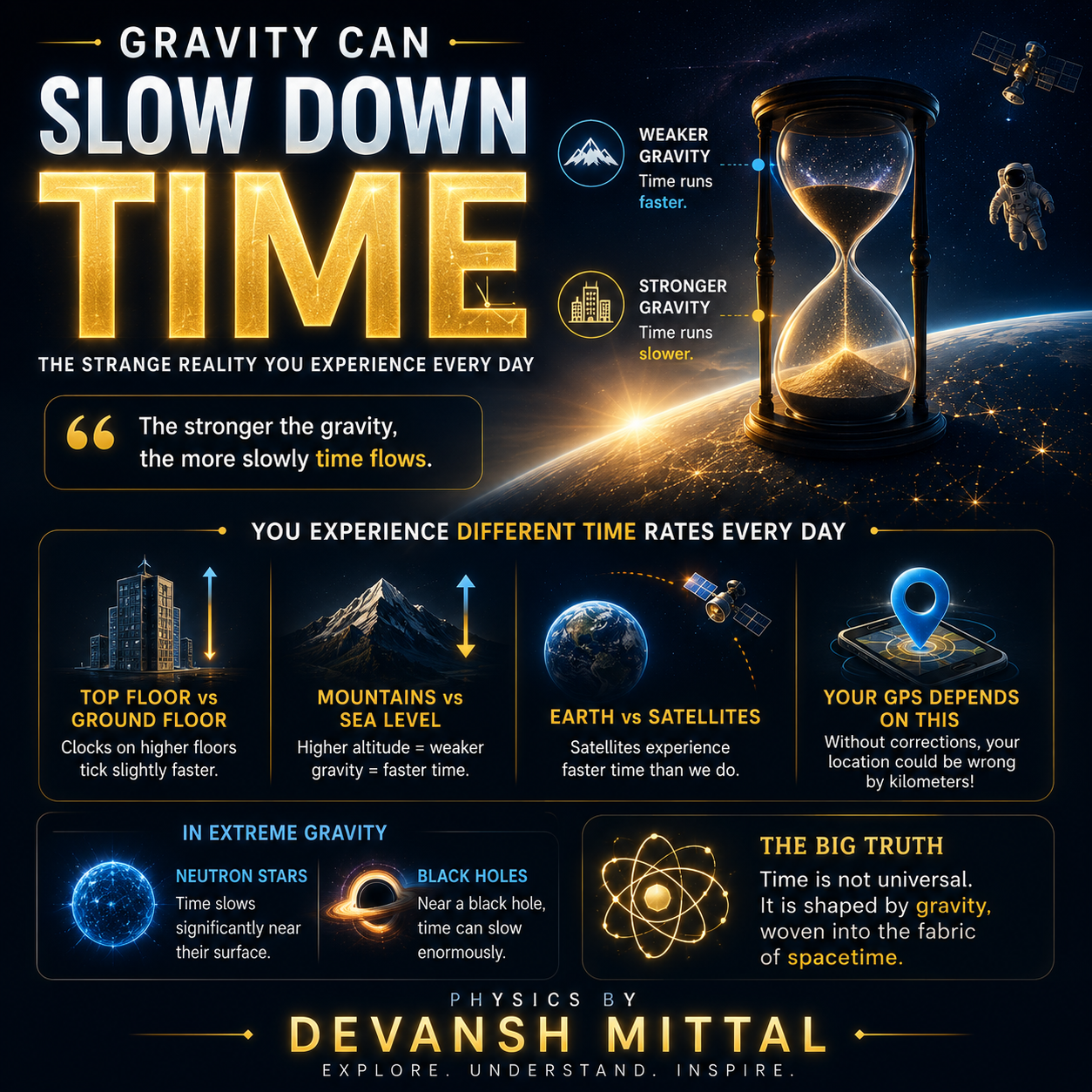
According to General Relativity, a clock located closer to a massive object ticks more slowly than a clock farther away. The stronger the gravitational field, the greater this effect becomes. Physicists call this phenomenon gravitational time dilation.
Consider two identical twins. One spends their life at sea level while the other lives on a high mountain. Because gravity is slightly weaker at higher altitudes, the mountain twin’s clock ticks a little faster. Over a lifetime, the twin on the mountain will age slightly more than the twin at sea level. The difference is extremely small, but it is real and measurable with modern instruments.
You Are Already Living in Different Time Zones of Gravity
Gravitational time dilation is not limited to exotic objects such as neutron stars or black holes. It exists everywhere. Time passes very slightly more slowly on the ground floor of a skyscraper than on the top floor. People living at high altitudes experience slightly faster time than people at sea level. Astronauts aboard satellites and spacecraft experience different rates of time compared with people on Earth.
The differences are tiny, but they reveal something profound: the universe does not provide a single universal clock. Every location experiences its own flow of time.
The Technology in Your Pocket Depends on This
Perhaps the most surprising part of the story is that gravitational time dilation is not merely a theoretical curiosity. The GPS system in your smartphone depends on it.
GPS satellites orbit thousands of kilometers above Earth, where gravity is weaker than it is on the surface. As a result, the clocks aboard those satellites tick slightly faster than clocks on the ground. If scientists and engineers ignored this effect, GPS errors would accumulate rapidly, causing navigation systems to drift by several kilometers each day.
Every time you navigate to a destination, track a package, locate a nearby restaurant, or call a ride-sharing service, you are relying on technology that corrects for the fact that gravity changes the rate at which time passes. Einstein’s century-old theory is quietly working inside your smartphone every moment.
The Universe’s Most Extreme Clocks
The effect becomes dramatically larger near extremely massive objects. A neutron star, for example, packs more mass than the Sun into an object roughly the size of a city. Its gravitational field is so intense that time noticeably slows near its surface.
Black holes take this phenomenon to the extreme. Near a black hole, gravity becomes so powerful that time can slow enormously compared with distant observers. Someone far away watching a clock near a black hole would see it ticking more and more slowly. To that observer, time itself could appear to be almost frozen.
At this point, the universe begins to feel less like a collection of objects moving through space and more like a vast landscape where time itself flows at different speeds in different places.
A New Way to Think About Time
We often imagine time as a universal river flowing uniformly throughout the cosmos. Modern physics paints a far stranger and more beautiful picture. Time is woven into the fabric of spacetime, and its flow depends on gravity and motion. Different observers can genuinely experience different amounts of time, not because of faulty measurements or optical illusions, but because reality itself is structured that way.
This realization forces us to rethink one of our deepest assumptions about the universe.
The Most Beautiful Lesson
Perhaps the most beautiful lesson is not simply that gravity slows time. It is that the universe is far deeper, stranger, and more elegant than our everyday intuition suggests. The same force that keeps your feet on the ground also influences the passage of time. The same theory that explains black holes helps your phone determine its location. And the same universe that appears ordinary during a morning walk hides profound mysteries beneath every step.
The next time you glance at a clock, remember that time is not as universal as it seems. The stronger the gravity around you, the more slowly time flows. Right now, at this very moment, gravity is quietly shaping the passage of time itself.
Step outside on a clear night and look up at the sky. You will see thousands of stars scattered across the darkness, some shining brilliantly while others appear as faint points of light. Most of us never question why the spaces between those stars are dark. It feels completely natural. Yet this seemingly ordinary observation hides one of the most profound questions in the history of science: Why is the night sky dark at all?
At first glance, the answer appears obvious. Many people assume that the sky is dark because most of space is empty. Surprisingly, that explanation is not correct. In fact, this simple question puzzled astronomers for centuries and eventually helped reveal one of the most important discoveries about the universe itself.
The Puzzle Nobody Expected
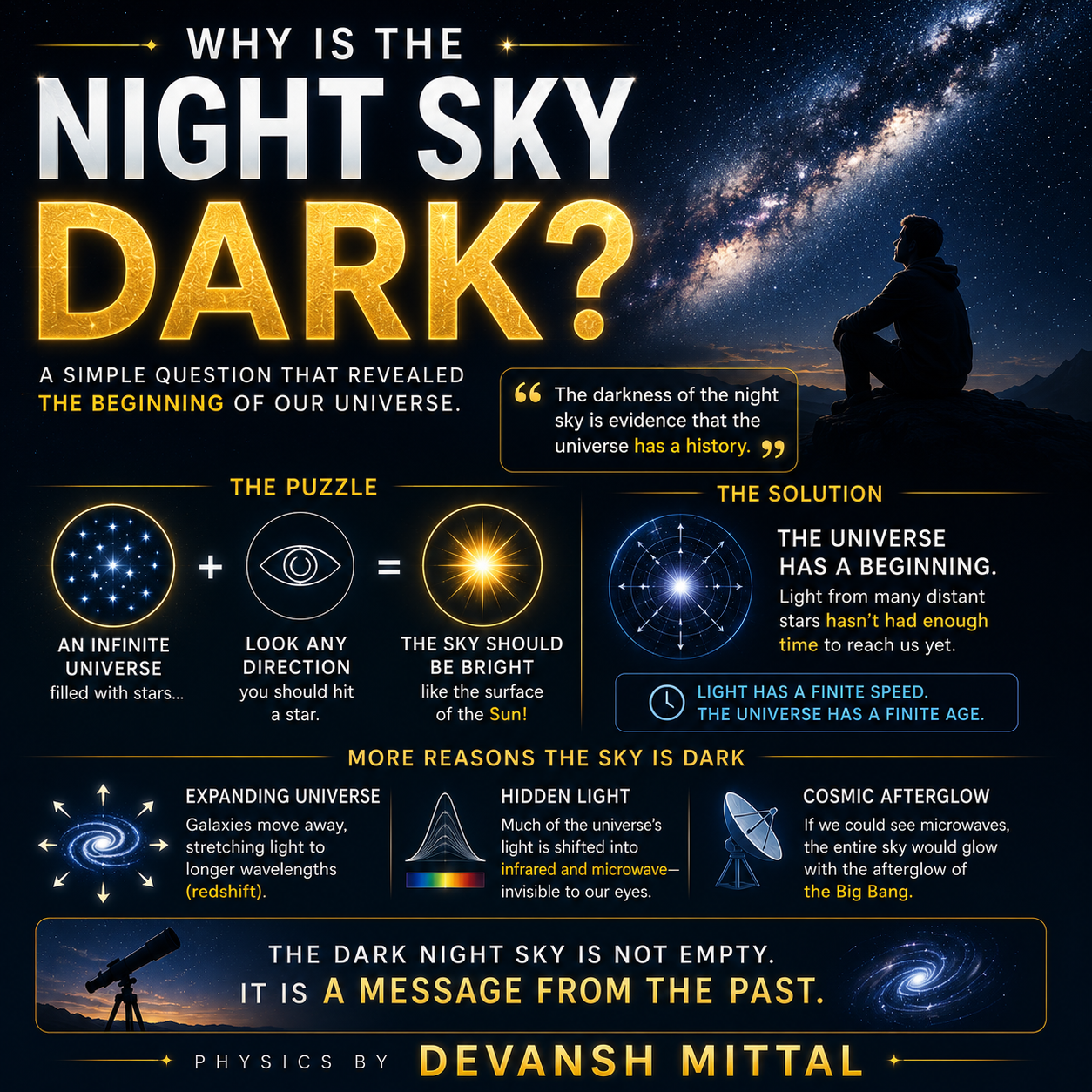
Imagine a universe that is infinitely large, filled with stars in every direction, and has existed forever. In such a universe, no matter where you looked, your line of sight would eventually end on the surface of a star. A useful analogy is a dense forest: wherever you look, your view ultimately terminates at a tree. By the same reasoning, every direction in the sky should eventually terminate at a star.
If this picture were correct, the entire night sky should glow with starlight. In fact, it should be almost as bright as the surface of the Sun. Yet the real night sky is overwhelmingly dark. This striking contradiction became known as Olbers’ Paradox, and it challenged some of the greatest scientific minds for generations.
Could Dust Be Blocking the Light?
One proposed solution was that enormous clouds of cosmic dust might be absorbing the light from distant stars before it reached Earth. At first, this idea seemed promising. However, it contains a fatal flaw. Dust that absorbs starlight cannot remain cold forever. Over time, it would heat up and begin emitting radiation of its own. Eventually, the dust would glow just as brightly as the light it absorbed, leaving the sky bright once again.
The darkness of the night sky therefore demanded a deeper explanation.
The Astonishing Solution
The breakthrough came when astronomers realized something extraordinary: the universe is not infinitely old. Instead, it had a beginning. Today, we call that beginning the Big Bang.
Because the universe has existed for only a finite amount of time, light from many distant stars and galaxies simply has not had enough time to reach us. When we gaze into the darkness of space, we are not necessarily looking into empty regions. In many directions, we are looking beyond the observable horizon of the universe, toward places whose light is still traveling toward us. The darkness of the night sky is therefore evidence that the cosmos has a finite age and a history.
Darkness as a Cosmic Message
The story becomes even more fascinating when we consider that the universe is expanding. As distant galaxies move away from us, their light becomes stretched to longer wavelengths through a process known as redshift. Over billions of years, much of the radiation produced throughout cosmic history has been shifted beyond the range of visible light into infrared and microwave wavelengths.
In other words, the universe is not truly dark. It is flooded with radiation. Our eyes simply cannot detect most of it. If human vision were sensitive to microwaves, the sky would appear to glow in every direction with the faint afterglow of the Big Bang itself.
The Next Time You Look Up
The darkness above you is not merely the absence of light; it is a source of information. It tells us that the universe has not existed forever. It tells us that light travels at a finite speed. It tells us that the cosmos is expanding and evolving with time.
Perhaps the most beautiful realization is that the dark night sky is not empty at all. It is a silent record of the universe’s origin, age, and history. Every star visible in the night sky is a reminder of the vastness of the cosmos, but the darkness between those stars may be even more profound. It is the darkness itself that reveals one of the greatest truths ever discovered: our universe had a beginning, and the night sky quietly tells that story every single night.
Imagine standing beside a road as a car passes at 60 km/h. If another car follows behind at 80 km/h, it gains on the first car at 20 km/h. This feels completely natural because velocities usually add and subtract according to common sense.
Now consider something far stranger.
Suppose you switch on a flashlight while standing still. You measure the light leaving the flashlight and find that it travels at about 300,000 kilometers per second. So far, nothing seems surprising.
But what if you switch on the same flashlight while traveling in a spaceship at an enormous speed? Common sense suggests that the light should move faster when measured by an outside observer. Yet nature refuses to cooperate.
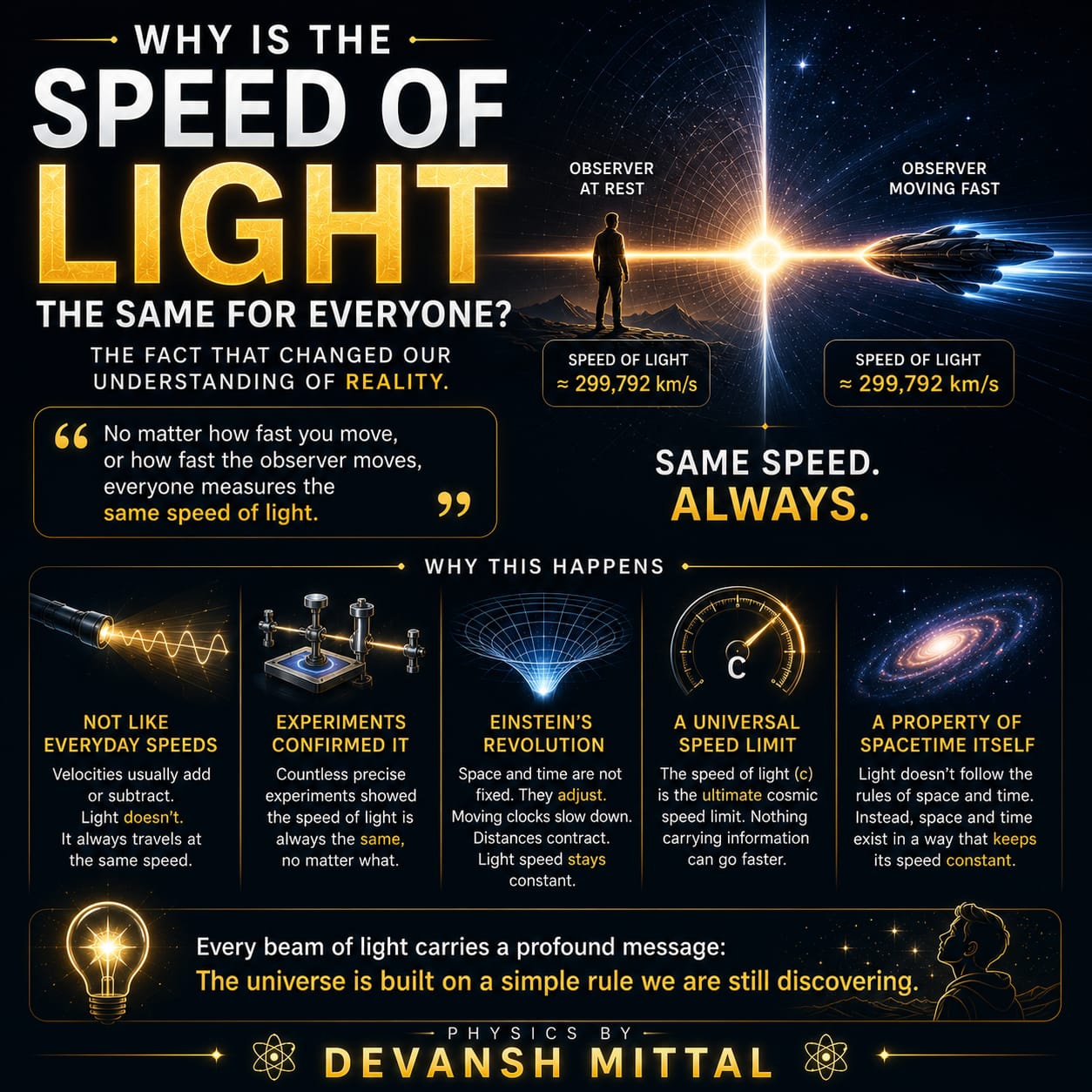
No matter how fast you move, and no matter how fast the observer moves, everyone measures exactly the same speed of light.
This is not a theory. It is an experimental fact.
And it may be one of the strangest facts in the entire universe.
The Experiment That Shocked Physics
In the late nineteenth century, scientists expected light to behave like sound. If you run toward a sound source, the sound seems different. If you move away, it changes again. Surely light should behave similarly.
To test this idea, physicists performed increasingly precise experiments. To their astonishment, the speed of light remained unchanged.
Every measurement pointed to the same conclusion: light does not obey our everyday intuition about motion.
The result was so shocking that it forced physicists to rethink the nature of space and time themselves.
Einstein’s Radical Insight
In 1905, Einstein proposed a bold solution.
Perhaps the speed of light is not changing.
Perhaps space and time are.
This idea sounds absurd at first. We think of space as a fixed stage and time as a universal clock. Einstein suggested that both are flexible and can adjust themselves so that the speed of light remains the same for all observers.
The consequences were extraordinary.
Moving clocks run more slowly. Distances can contract. Two observers moving relative to one another may disagree about the timing of events.
Yet through all these changes, the speed of light remains constant.
A Universal Speed Limit
The speed of light is more than the speed at which light travels. It appears to be a fundamental speed limit built into the structure of reality.
Nothing carrying information can travel faster.
Just as every mountain has a highest peak, the universe appears to have a maximum speed.
Light travels at that limit.
The Deeper Mystery
Perhaps the most beautiful way to think about it is this: the speed of light is not merely a property of light. It is a property of spacetime itself.
Light does not obey the rules of space and time.
Instead, space and time arrange themselves around this fundamental cosmic rule.
The Next Time You Switch On a Light
The next time you turn on a flashlight or see sunlight streaming through a window, remember that you are witnessing something profoundly mysterious.
The light reaching your eyes is traveling at exactly the same speed for every observer in the universe, regardless of how they are moving.
This simple fact shattered centuries of intuition, transformed our understanding of reality, and revealed that space and time are far stranger than anyone had imagined.
Sometimes the greatest mysteries are not hidden in distant galaxies or black holes.
Sometimes they arrive every morning with the sunlight.
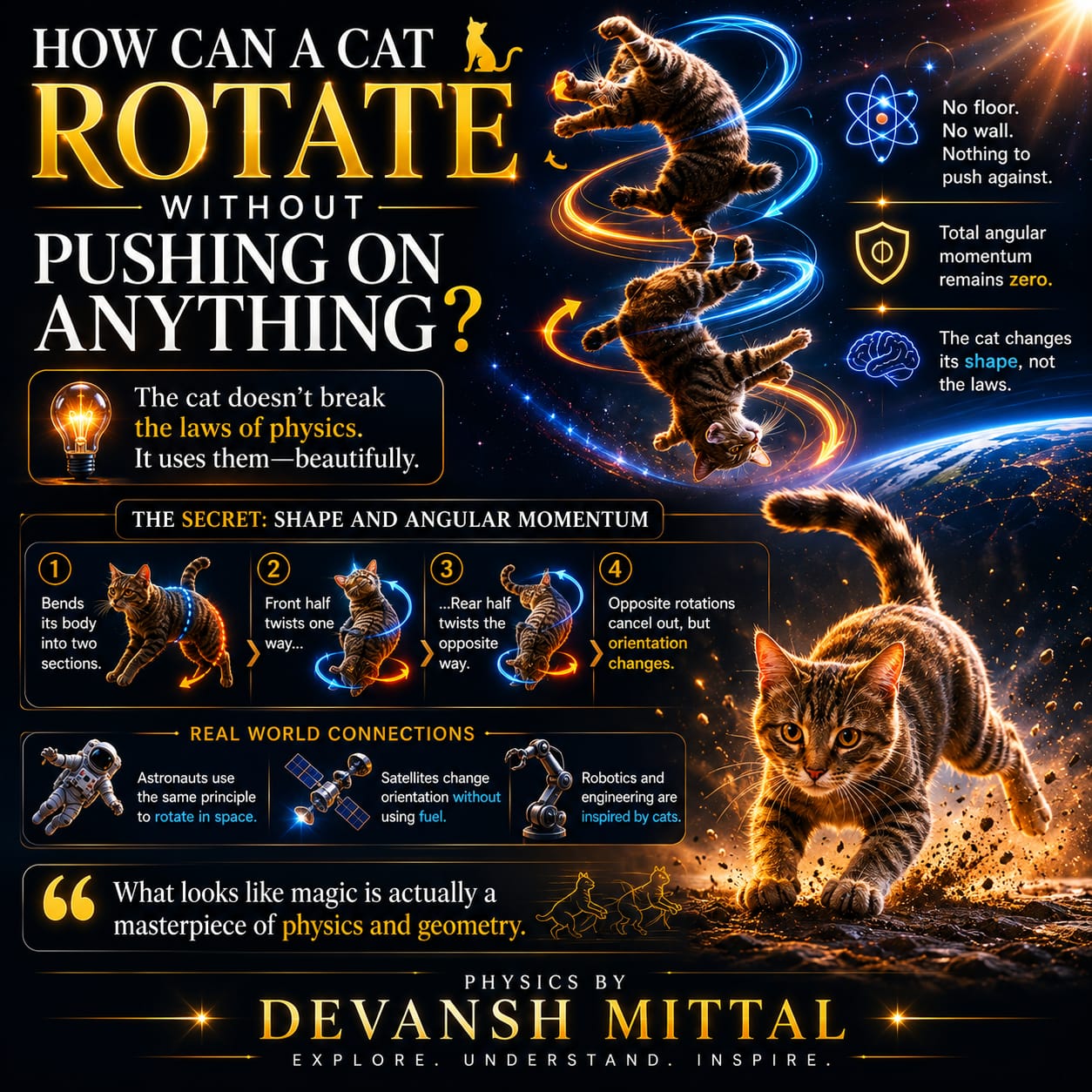
Imagine holding a cat upside down and gently releasing it.
For a brief moment, the cat is falling through the air. There is no floor beneath it, no wall beside it, and nothing obvious for it to push against.
Yet something remarkable happens.
The cat twists its body, rotates in midair, and lands gracefully on its feet.
Most people accept this as a charming feline talent. Physicists, however, see something much deeper.
The falling cat appears to be violating one of the most important laws in physics.
How can something rotate if nothing is making it rotate?
The Puzzle
Suppose an astronaut is floating alone in deep space, far from any planets, stars, or spacecraft. If the astronaut is initially not spinning, can they suddenly start spinning without pushing on anything?
The answer is no.
According to the conservation of angular momentum, an isolated object cannot spontaneously begin rotating. Angular momentum is one of nature’s most fundamental conserved quantities.
This makes the cat’s behavior seem impossible.
If the cat starts falling without any overall rotation, how can it end up turning around?
For decades, this question fascinated some of the world’s greatest physicists.
The Secret Is Shape
The answer lies in a subtle distinction that our intuition often misses.
The cat does not create angular momentum out of nowhere. Instead, it changes the shape of its body.
A falling cat first bends its body into two sections. It pulls in its front legs while extending its rear legs. Then it twists the front half of its body in one direction and the rear half in the opposite direction.
Because the front and rear parts have different distributions of mass, they rotate by different amounts. The opposite rotations cancel in terms of total angular momentum, but they do not cancel in terms of orientation.
By repeating this process, the cat gradually changes its overall orientation while keeping its total angular momentum equal to zero.
The cat rotates without ever violating the laws of physics.
A Surprising Analogy
Imagine sitting on a swivel chair holding two heavy dumbbells. By moving your arms inward and outward, you can change how fast you spin without anyone pushing you.
The cat performs a far more sophisticated version of this idea. It uses the flexibility of its body to rearrange its mass in a carefully coordinated sequence.
What appears to be magic is actually a brilliant exploitation of geometry and conservation laws.
Why Physicists Love This Problem
The falling-cat problem is much more than an amusing curiosity.
The same principles appear in spacecraft control, robotics, biomechanics, and even advanced areas of mathematics. Engineers designing satellites often use ideas inspired by the cat’s maneuver to change orientation without expelling fuel.
A household pet inadvertently demonstrates concepts that connect everyday life to cutting-edge science.
The Most Beautiful Lesson
The next time you watch a cat land effortlessly on its feet, remember that you are witnessing a masterpiece of physics.
The cat is not breaking the laws of nature. It is obeying them with extraordinary elegance.
Perhaps that is one of the deepest lessons science teaches us. The universe often appears mysterious not because its laws are violated, but because those laws are far more subtle and beautiful than our intuition expects.
Sometimes, one of the most profound demonstrations of physics is not found in a laboratory or an observatory.
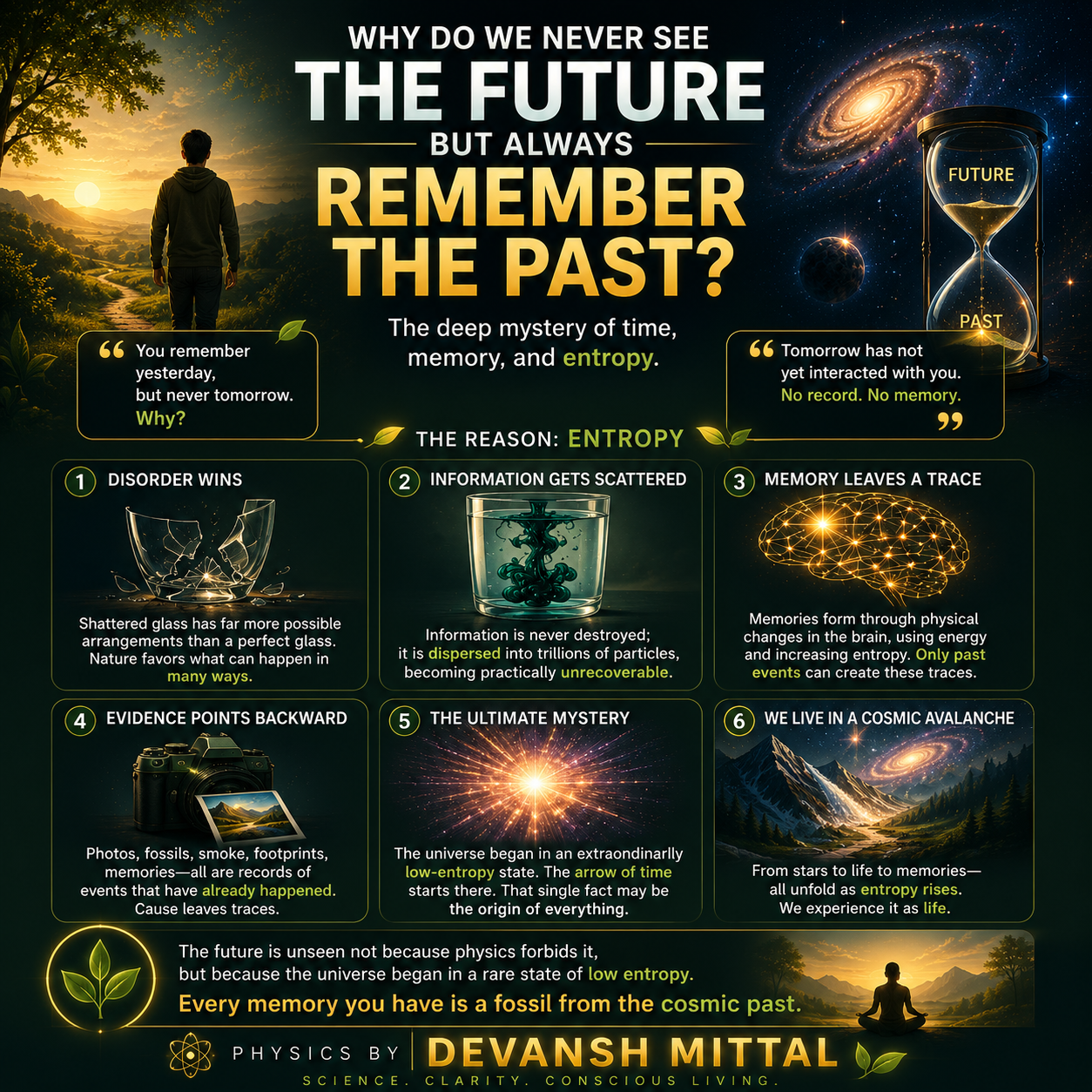
Every morning, the Sun rises. You remember what you ate yesterday, the conversation you had a few hours ago, and perhaps even moments from your childhood decades in the past. Yet hidden within these ordinary experiences is something profoundly mysterious: you have never remembered tomorrow. Not once.
At first glance, this seems so obvious that it hardly deserves attention. But from the perspective of physics, it is astonishing. Why should the past be accessible to memory while the future remains completely hidden? Why do we experience time as flowing in one direction? This simple question leads us to one of the deepest puzzles in modern science.
The Universe Has a Secret
Imagine watching a movie of two planets orbiting each other in space. Now play the movie backward. Surprisingly, the reversed motion still looks perfectly plausible. The same is true for two billiard balls colliding on a table or an electron moving through space. In most cases, the fundamental equations of physics work equally well whether time moves forward or backward.
This is one of the most surprising discoveries in science. At the microscopic level, nature appears almost indifferent to the direction of time. The laws themselves make very little distinction between past and future.
Yet our everyday experience is built entirely around that distinction. We remember the past but not the future. We can influence tomorrow but not yesterday. Physics seems almost time-symmetric, while human experience is overwhelmingly time-directed. Somewhere between microscopic laws and everyday life, something remarkable happens.
The Movie That Feels Wrong
Consider a glass falling from a table and shattering on the floor. Everyone immediately recognizes this as a normal event. Now imagine watching the same video in reverse. The scattered fragments suddenly leap together, assemble themselves into a perfect glass, and jump neatly back onto the table.
Nothing about the fundamental laws governing the atoms explicitly forbids such a process. Yet we instinctively know it never happens. The reversed movie feels absurd because it violates one of the most important statistical tendencies in nature.
The key to understanding this tendency is entropy.
The Tyranny of Probability
Entropy is often described as a measure of disorder, but a more accurate description is that it measures how many microscopic arrangements correspond to a particular macroscopic state.
An intact glass sitting on a table can exist in only a relatively small number of microscopic configurations. A shattered glass, however, can exist in an unimaginably larger number of configurations. There are vastly more ways for the pieces to be scattered than for them to be perfectly assembled.
As a result, nature overwhelmingly tends to move toward states that can be realized in more ways. This is not because nature has goals or intentions. It is simply a matter of probability. The shattered-glass state wins the statistical lottery by an enormous margin.
A Universe That Constantly Hides Information
Imagine placing a drop of ink into a glass of water. Initially, the ink occupies a tiny region. Over time, it spreads throughout the entire glass until it becomes uniformly mixed.
What happened to the information about the ink’s original location? Surprisingly, it was not destroyed. Instead, it became distributed among countless water molecules in extraordinarily complex ways. In principle, the information still exists. In practice, it has become effectively impossible to recover.
The universe rarely destroys information outright. More often, it disperses it so thoroughly that reconstruction becomes hopelessly difficult. The past has not vanished; it has simply been hidden.
Why Memory Points Only One Way
This brings us to the deepest part of the story. The reason you remember the past may be intimately connected to entropy itself.
A memory is not an abstract object. It is a physical record stored in matter. When your brain forms a memory, neurons modify their connections, energy is consumed, heat is generated, and entropy increases. Every memory is a physical trace left behind by an event.
This explains why memories point only toward the past. Yesterday physically interacted with your brain and left records behind. Tomorrow has not yet done so. No interaction has occurred, no trace exists, and therefore no memory can exist.
In this sense, memories are fossils of irreversible physical processes. Every remembered experience is evidence that entropy has already increased.
The Arrow Hidden in Every Photograph
The same idea extends far beyond human memory. Every photograph records a moment from the past because light from an event reached a camera and altered physical matter inside it. The event created the record; the record did not create the event.
This asymmetry appears everywhere. Footprints reveal where someone has been. Smoke reveals that a fire occurred. Fossils reveal organisms that once lived. Memories reveal experiences that already happened. Every piece of evidence in the universe points backward in time.
The arrow of time is written into the very concept of a record.
The Greatest Mystery of All
At this point, it may seem that the problem has been solved. Entropy increases, and therefore time appears to move forward.
But this answer immediately raises an even deeper question: why was entropy lower in the past?
Entropy can only increase if it starts from a relatively low value. Modern cosmology tells us that the early universe, shortly after the Big Bang, existed in an extraordinarily low-entropy state. Not merely low, but astonishingly low.
This fact may be the ultimate source of the arrow of time. Every broken egg, every memory, every aging face, every historical event, and every civilization may ultimately trace its existence to this remarkable initial condition of the cosmos.
We Live Inside a Cosmic Avalanche
A useful analogy is a mountain covered with snow. The early universe was like a snowpack balanced high on a slope. Once the process begins, the snow naturally moves downward. The avalanche unfolds.
Similarly, the universe has been evolving from its extraordinarily special low-entropy beginning toward states of higher entropy. Along the way, stars formed, galaxies emerged, planets developed, life appeared, and conscious beings began creating memories.
The arrow of time is not something separate from these processes. It is the unfolding of the entire cosmic story.
The Final Surprise
Perhaps the most astonishing possibility is that the flow of time itself may not be a fundamental feature of reality. The microscopic laws of physics are largely indifferent to past and future. What we experience as the passage of time may emerge from statistics, information, and the extraordinarily special conditions present at the birth of the universe.
In other words, the future may not be hidden because physics forbids us from seeing it. It may be hidden because the universe began in a state so extraordinarily improbable that everything we call history has been the gradual unfolding of that initial condition.
Every memory you possess is therefore more than a record of your personal past. It is also a clue to one of the deepest mysteries in science. The simple fact that you remember yesterday but not tomorrow may ultimately be telling us something profound about the origin of the universe itself.
Between you and your phone, between Earth and the Moon, and even between galaxies, there appears to be nothing at all.
We call it “empty space.”
But modern physics has uncovered a remarkable truth:
Empty space may be one of the most active things in the universe.
In fact, what we casually call “nothing” is not really nothing.
It is something far stranger.
A Lesson from a Coffee Cup
Imagine placing a coffee cup on a table.
You might think the cup is made of solid matter and the air around it is empty.
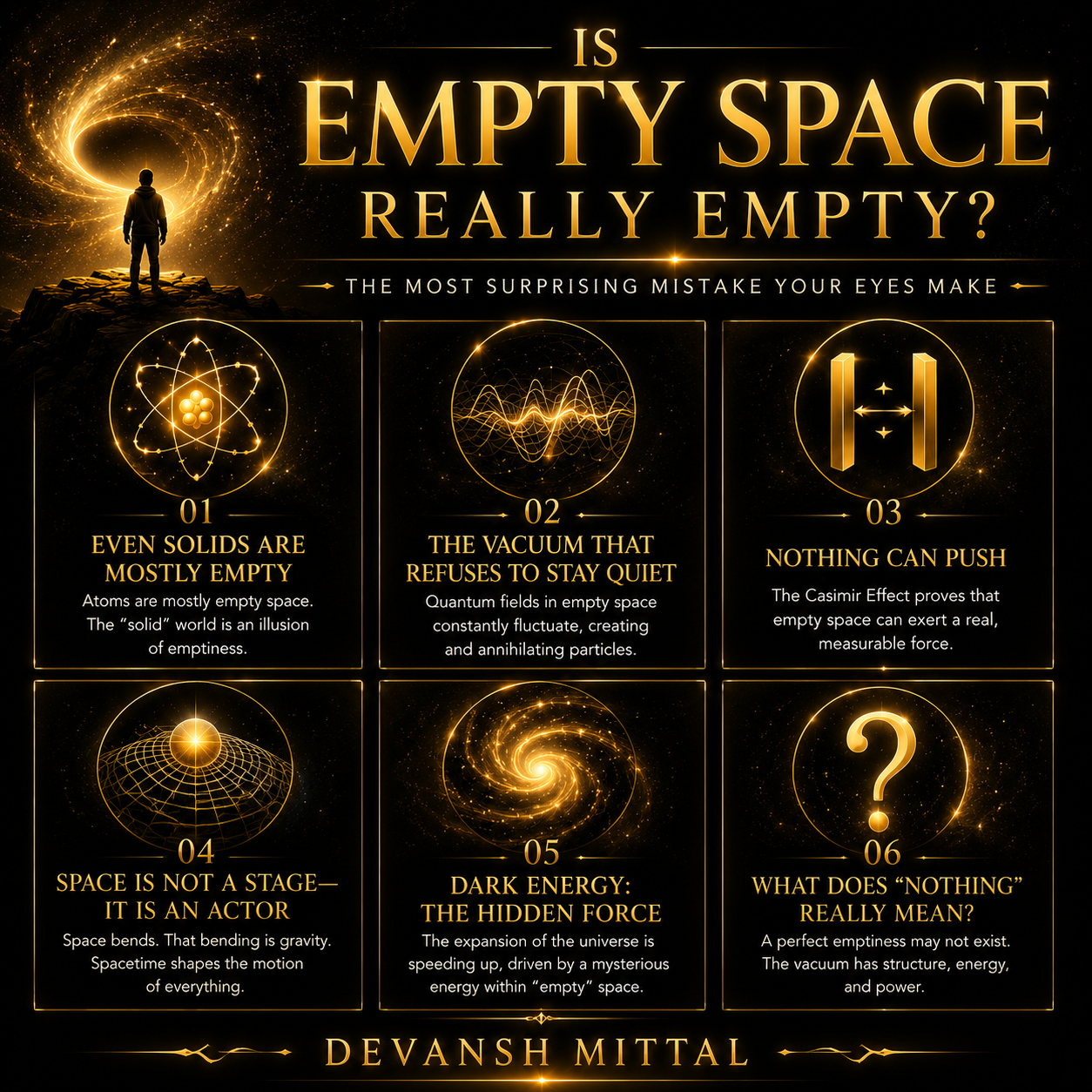
Surprisingly, the cup itself is mostly empty space.
If every atom inside the cup were enlarged so that its nucleus became the size of a marble, the electrons would orbit hundreds of meters away. Almost all of the cup’s volume would be empty.
So even “solid” objects are largely made of emptiness.
But then another question appears:
What exactly fills the space between those atoms?
The Vacuum That Refuses to Stay Quiet
According to classical physics, a vacuum is simply a region with nothing inside it.
Quantum physics shattered this picture.
In the quantum world, space behaves more like a restless ocean than a silent void.
Even when all particles are removed, invisible quantum fields remain.
These fields constantly fluctuate.
Tiny particle-antiparticle pairs briefly appear and disappear.
Physicists call these events “quantum fluctuations.”
The vacuum is therefore not empty. It is alive with activity that normally remains hidden from our senses.
Nothing Can Push
This sounds impossible.
How can “nothing” exert a force?
Yet experiments show exactly that.
When two extremely smooth metal plates are placed incredibly close together in a vacuum, they experience a tiny attraction.
This phenomenon, known as the
Casimir Effect
arises because quantum fluctuations in empty space are altered between the plates.
The force has been measured experimentally.
In other words, “empty” space can physically push and pull objects.
Space Is Not a Stage—It Is an Actor
Many people imagine space as a passive background where cosmic events unfold.
Modern physics tells a different story.
Space bends around stars and planets.
That bending is what we perceive as gravity.
According to General Relativity, Earth is not being pulled through space by an invisible force. Instead, Earth moves through curved spacetime created by the Sun.
Space itself participates in the drama of the universe.
It is not merely the stage.
It is one of the actors.
The Biggest Mystery in the Cosmos
The story becomes even stranger.
Astronomers have discovered that the expansion of the universe is speeding up.
Something appears to be pushing galaxies apart faster and faster.
One possible explanation is that empty space itself contains energy.
This mysterious phenomenon is known as
Dark Energy.
Today, dark energy is thought to make up most of the cosmic energy budget.
Think about that for a moment.
The dominant ingredient of the universe may be hidden within what we call “empty” space.
What Does “Nothing” Really Mean?
The deeper physicists investigate reality, the more difficult it becomes to define nothingness.
A truly empty universe may not even be possible.
Even the vacuum possesses structure, energy, fluctuations, and physical consequences.
What appears to be a featureless void is actually a dynamic fabric woven into the workings of nature itself.
The Next Time You Look at the Sky…
On a clear night, look up at the dark space between the stars.
It may seem like the emptiest place imaginable.
Yet that darkness is not a barren void.
It is a restless quantum arena, a flexible geometric fabric, and perhaps the reservoir of the mysterious energy driving the expansion of the cosmos.
The greatest surprise of modern physics is not that the universe contains extraordinary things.
It is that what appears to be nothing may be one of the most extraordinary things of all.



 The Intuitive Physicist