The Fact That Shouldn’t Be True
Imagine standing beside a road as a car passes at 60 km/h. If another car follows behind at 80 km/h, it gains on the first car at 20 km/h. This feels completely natural because velocities usually add and subtract according to common sense.
Now consider something far stranger.
Suppose you switch on a flashlight while standing still. You measure the light leaving the flashlight and find that it travels at about 300,000 kilometers per second. So far, nothing seems surprising.
But what if you switch on the same flashlight while traveling in a spaceship at an enormous speed? Common sense suggests that the light should move faster when measured by an outside observer. Yet nature refuses to cooperate.
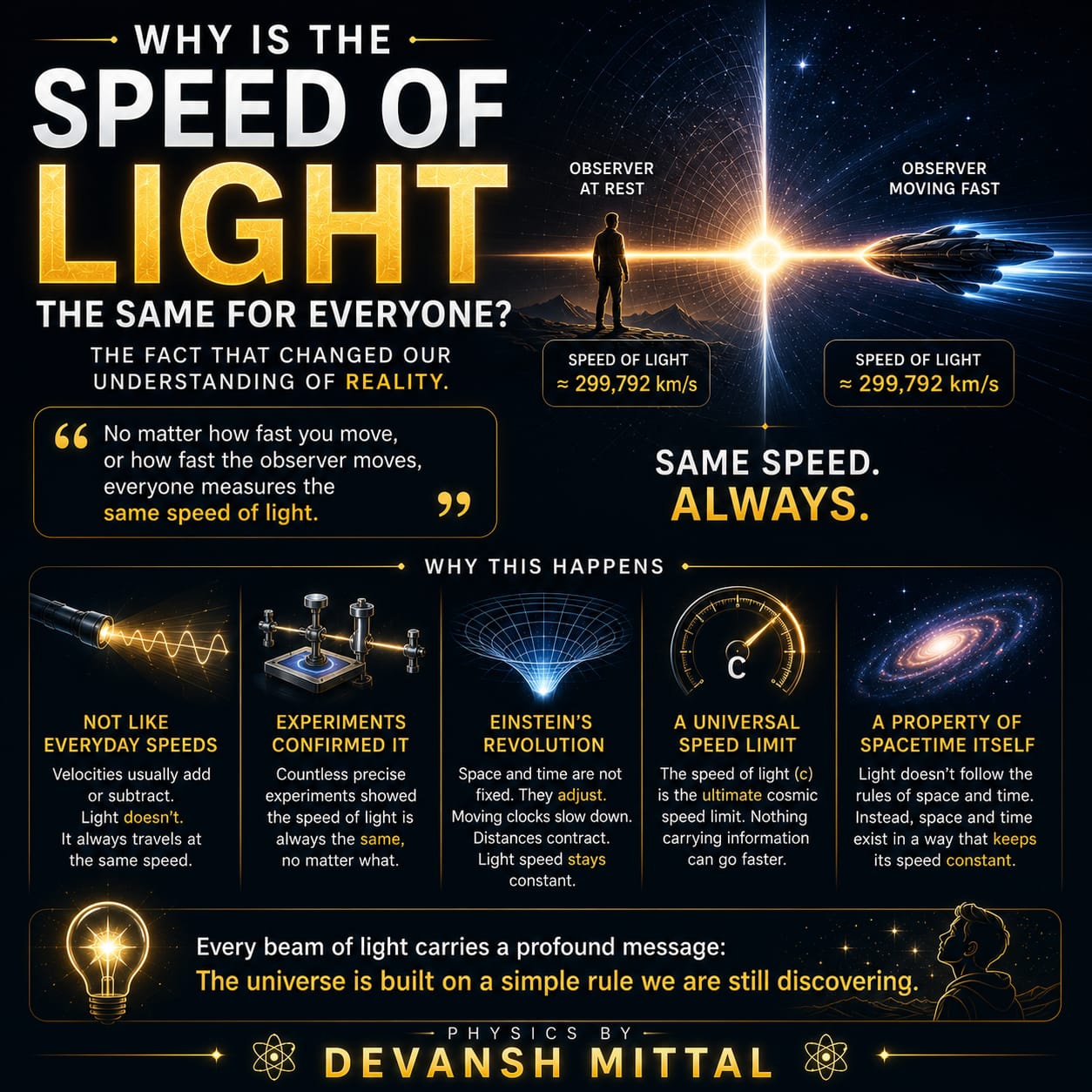
No matter how fast you move, and no matter how fast the observer moves, everyone measures exactly the same speed of light.
This is not a theory. It is an experimental fact.
And it may be one of the strangest facts in the entire universe.
The Experiment That Shocked Physics
In the late nineteenth century, scientists expected light to behave like sound. If you run toward a sound source, the sound seems different. If you move away, it changes again. Surely light should behave similarly.
To test this idea, physicists performed increasingly precise experiments. To their astonishment, the speed of light remained unchanged.
Every measurement pointed to the same conclusion: light does not obey our everyday intuition about motion.
The result was so shocking that it forced physicists to rethink the nature of space and time themselves.
Einstein’s Radical Insight
In 1905, Einstein proposed a bold solution.
Perhaps the speed of light is not changing.
Perhaps space and time are.
This idea sounds absurd at first. We think of space as a fixed stage and time as a universal clock. Einstein suggested that both are flexible and can adjust themselves so that the speed of light remains the same for all observers.
The consequences were extraordinary.
Moving clocks run more slowly. Distances can contract. Two observers moving relative to one another may disagree about the timing of events.
Yet through all these changes, the speed of light remains constant.
A Universal Speed Limit
The speed of light is more than the speed at which light travels. It appears to be a fundamental speed limit built into the structure of reality.
Nothing carrying information can travel faster.
Just as every mountain has a highest peak, the universe appears to have a maximum speed.
Light travels at that limit.
The Deeper Mystery
Perhaps the most beautiful way to think about it is this: the speed of light is not merely a property of light. It is a property of spacetime itself.
Light does not obey the rules of space and time.
Instead, space and time arrange themselves around this fundamental cosmic rule.
The Next Time You Switch On a Light
The next time you turn on a flashlight or see sunlight streaming through a window, remember that you are witnessing something profoundly mysterious.
The light reaching your eyes is traveling at exactly the same speed for every observer in the universe, regardless of how they are moving.
This simple fact shattered centuries of intuition, transformed our understanding of reality, and revealed that space and time are far stranger than anyone had imagined.
Sometimes the greatest mysteries are not hidden in distant galaxies or black holes.
Sometimes they arrive every morning with the sunlight.
 The Intuitive Physicist