Tag Archives: philosophy

Gravity Can Slow Down Time: The Strange Reality You Experience Every Day

Standard

What If Time Is Not the Same Everywhere?

Most of us grow up believing that time is universal. A second is a second, a minute is a minute, and a clock in your room, a clock on a mountain, and a clock in space should all tick at exactly the same rate. It feels obvious. In fact, it feels difficult to imagine reality behaving any other way.

Yet one of the most astonishing discoveries in the history of science revealed something deeply counterintuitive: gravity can slow down time itself. Not just in science fiction, not just near black holes, and not just somewhere far away in the universe. This phenomenon is happening right now, all around us on Earth, and modern technology depends on it every day.

The Experiment That Changes Everything

Imagine that you have two perfectly accurate clocks. You leave one on Earth and place the other aboard a spacecraft. After some time, the spacecraft returns and you compare the clocks. Common sense suggests that they should agree perfectly. After all, time is time.

But nature has a surprise waiting. The clocks show different times. One clock has actually experienced more time than the other. This is not because one of the clocks malfunctioned or lost accuracy. It is because time itself flowed differently for them. What sounds like science fiction is actually a real and experimentally verified consequence of modern physics.

Why This Sounds Impossible

Our everyday experience teaches us that time is constant. Whether you are drinking tea, riding a bicycle, studying physics, or watching a movie, time appears to move forward at the same steady pace. Gravity, meanwhile, seems completely unrelated. Gravity makes apples fall, keeps planets in orbit, and pulls us toward the ground. Why should it have anything to do with clocks? Why should it affect the passage of time?

This is where our intuition begins to fail. The universe is under no obligation to behave according to our everyday expectations.

Einstein’s Revolutionary Insight

In 1915, Albert Einstein introduced the theory of General Relativity, forever changing our understanding of gravity. Before Einstein, gravity was viewed as a force acting between objects. Einstein proposed something far more profound: massive objects such as planets, stars, and galaxies change the very structure of spacetime itself.

A useful analogy is to imagine placing a heavy bowling ball on a stretched rubber sheet. The sheet bends around the ball. If a smaller ball is placed nearby, it rolls toward the bowling ball because the surface is curved. Although spacetime is not literally a rubber sheet, the analogy captures the essential idea: mass tells spacetime how to curve, and curved spacetime tells matter how to move.

What makes this idea truly extraordinary is that the curvature affects not only space but also time.

The Deeper You Are in Gravity, the Slower Time Flows

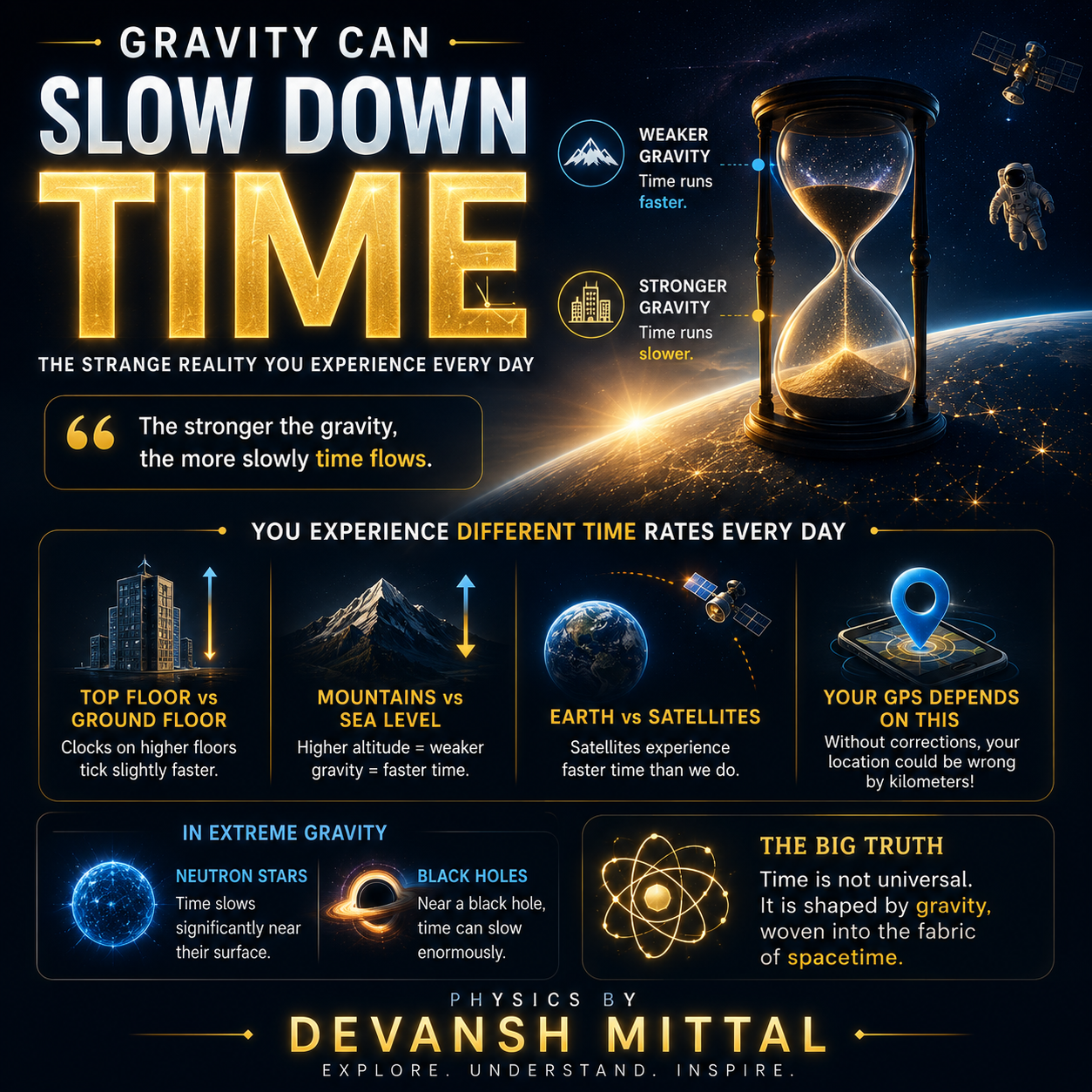
According to General Relativity, a clock located closer to a massive object ticks more slowly than a clock farther away. The stronger the gravitational field, the greater this effect becomes. Physicists call this phenomenon gravitational time dilation.

Consider two identical twins. One spends their life at sea level while the other lives on a high mountain. Because gravity is slightly weaker at higher altitudes, the mountain twin’s clock ticks a little faster. Over a lifetime, the twin on the mountain will age slightly more than the twin at sea level. The difference is extremely small, but it is real and measurable with modern instruments.

You Are Already Living in Different Time Zones of Gravity

Gravitational time dilation is not limited to exotic objects such as neutron stars or black holes. It exists everywhere. Time passes very slightly more slowly on the ground floor of a skyscraper than on the top floor. People living at high altitudes experience slightly faster time than people at sea level. Astronauts aboard satellites and spacecraft experience different rates of time compared with people on Earth.

The differences are tiny, but they reveal something profound: the universe does not provide a single universal clock. Every location experiences its own flow of time.

The Technology in Your Pocket Depends on This

Perhaps the most surprising part of the story is that gravitational time dilation is not merely a theoretical curiosity. The GPS system in your smartphone depends on it.

GPS satellites orbit thousands of kilometers above Earth, where gravity is weaker than it is on the surface. As a result, the clocks aboard those satellites tick slightly faster than clocks on the ground. If scientists and engineers ignored this effect, GPS errors would accumulate rapidly, causing navigation systems to drift by several kilometers each day.

Every time you navigate to a destination, track a package, locate a nearby restaurant, or call a ride-sharing service, you are relying on technology that corrects for the fact that gravity changes the rate at which time passes. Einstein’s century-old theory is quietly working inside your smartphone every moment.

The Universe’s Most Extreme Clocks

The effect becomes dramatically larger near extremely massive objects. A neutron star, for example, packs more mass than the Sun into an object roughly the size of a city. Its gravitational field is so intense that time noticeably slows near its surface.

Black holes take this phenomenon to the extreme. Near a black hole, gravity becomes so powerful that time can slow enormously compared with distant observers. Someone far away watching a clock near a black hole would see it ticking more and more slowly. To that observer, time itself could appear to be almost frozen.

At this point, the universe begins to feel less like a collection of objects moving through space and more like a vast landscape where time itself flows at different speeds in different places.

A New Way to Think About Time

We often imagine time as a universal river flowing uniformly throughout the cosmos. Modern physics paints a far stranger and more beautiful picture. Time is woven into the fabric of spacetime, and its flow depends on gravity and motion. Different observers can genuinely experience different amounts of time, not because of faulty measurements or optical illusions, but because reality itself is structured that way.

This realization forces us to rethink one of our deepest assumptions about the universe.

The Most Beautiful Lesson

Perhaps the most beautiful lesson is not simply that gravity slows time. It is that the universe is far deeper, stranger, and more elegant than our everyday intuition suggests. The same force that keeps your feet on the ground also influences the passage of time. The same theory that explains black holes helps your phone determine its location. And the same universe that appears ordinary during a morning walk hides profound mysteries beneath every step.

The next time you glance at a clock, remember that time is not as universal as it seems. The stronger the gravity around you, the more slowly time flows. Right now, at this very moment, gravity is quietly shaping the passage of time itself.
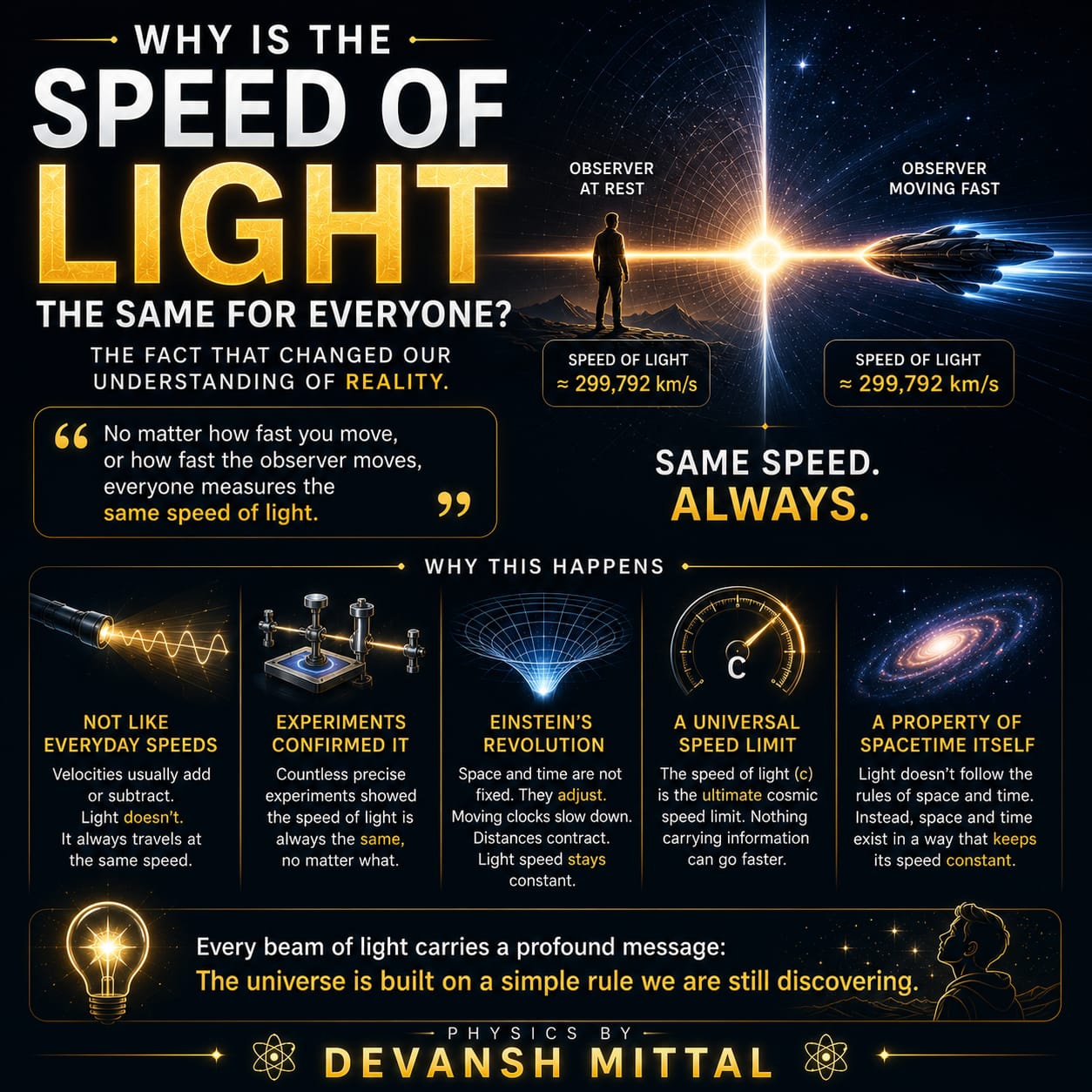
Why Is the Speed of Light the Same for Everyone?

Standard

The Fact That Shouldn’t Be True

Imagine standing beside a road as a car passes at 60 km/h. If another car follows behind at 80 km/h, it gains on the first car at 20 km/h. This feels completely natural because velocities usually add and subtract according to common sense.

Now consider something far stranger.

Suppose you switch on a flashlight while standing still. You measure the light leaving the flashlight and find that it travels at about 300,000 kilometers per second. So far, nothing seems surprising.

But what if you switch on the same flashlight while traveling in a spaceship at an enormous speed? Common sense suggests that the light should move faster when measured by an outside observer. Yet nature refuses to cooperate.

No matter how fast you move, and no matter how fast the observer moves, everyone measures exactly the same speed of light.

This is not a theory. It is an experimental fact.

And it may be one of the strangest facts in the entire universe.

The Experiment That Shocked Physics

In the late nineteenth century, scientists expected light to behave like sound. If you run toward a sound source, the sound seems different. If you move away, it changes again. Surely light should behave similarly.

To test this idea, physicists performed increasingly precise experiments. To their astonishment, the speed of light remained unchanged.

Every measurement pointed to the same conclusion: light does not obey our everyday intuition about motion.

The result was so shocking that it forced physicists to rethink the nature of space and time themselves.

Einstein’s Radical Insight

In 1905, Einstein proposed a bold solution.

Perhaps the speed of light is not changing.

Perhaps space and time are.

This idea sounds absurd at first. We think of space as a fixed stage and time as a universal clock. Einstein suggested that both are flexible and can adjust themselves so that the speed of light remains the same for all observers.

The consequences were extraordinary.

Moving clocks run more slowly. Distances can contract. Two observers moving relative to one another may disagree about the timing of events.

Yet through all these changes, the speed of light remains constant.

A Universal Speed Limit

The speed of light is more than the speed at which light travels. It appears to be a fundamental speed limit built into the structure of reality.

Nothing carrying information can travel faster.

Just as every mountain has a highest peak, the universe appears to have a maximum speed.

Light travels at that limit.

The Deeper Mystery

Perhaps the most beautiful way to think about it is this: the speed of light is not merely a property of light. It is a property of spacetime itself.

Light does not obey the rules of space and time.

Instead, space and time arrange themselves around this fundamental cosmic rule.

The Next Time You Switch On a Light

The next time you turn on a flashlight or see sunlight streaming through a window, remember that you are witnessing something profoundly mysterious.

The light reaching your eyes is traveling at exactly the same speed for every observer in the universe, regardless of how they are moving.

This simple fact shattered centuries of intuition, transformed our understanding of reality, and revealed that space and time are far stranger than anyone had imagined.

Sometimes the greatest mysteries are not hidden in distant galaxies or black holes.

Sometimes they arrive every morning with the sunlight.

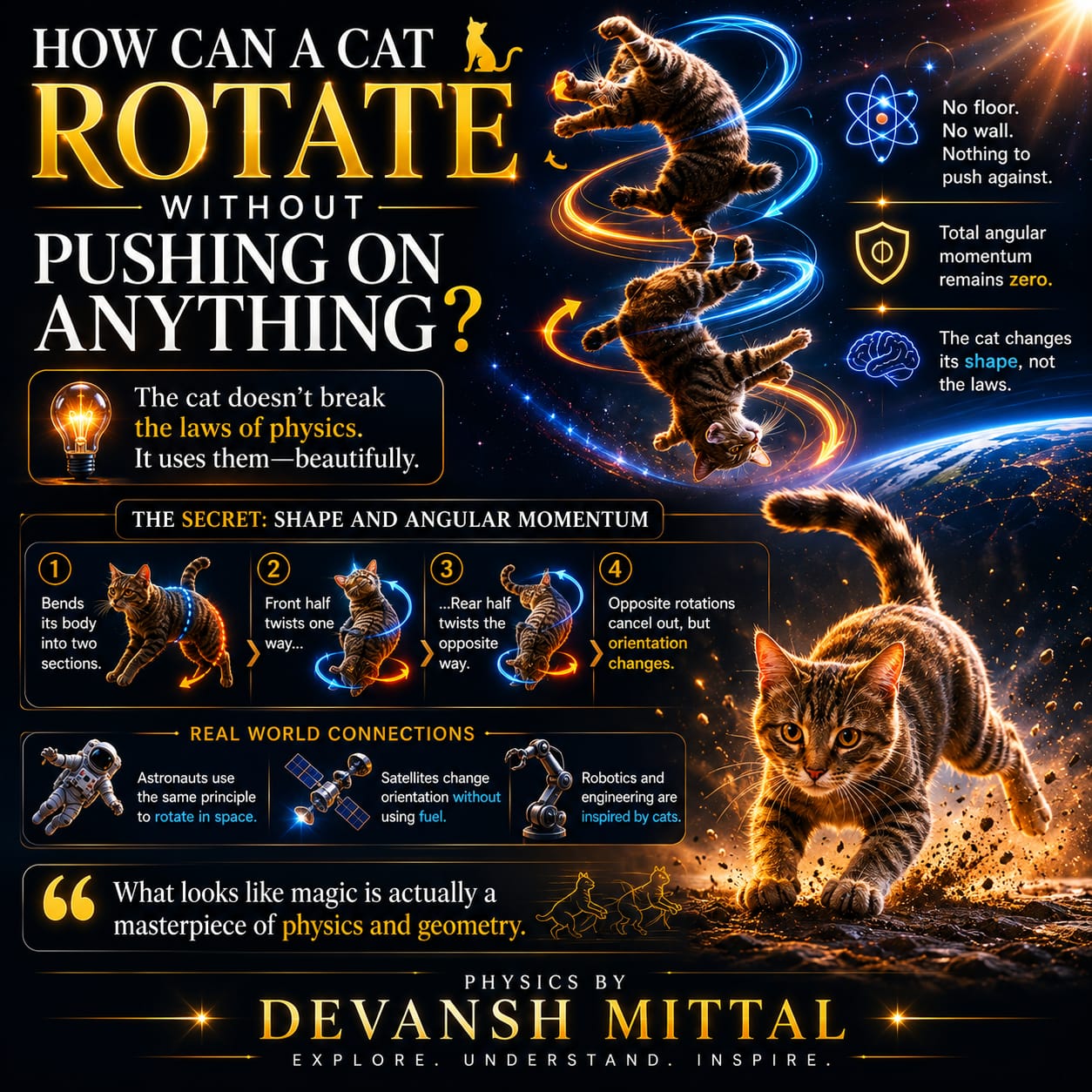
How Can a Cat Rotate Without Pushing on Anything?

Standard

The Falling Cat That Defied Common Sense

Imagine holding a cat upside down and gently releasing it.

For a brief moment, the cat is falling through the air. There is no floor beneath it, no wall beside it, and nothing obvious for it to push against.

Yet something remarkable happens.

The cat twists its body, rotates in midair, and lands gracefully on its feet.

Most people accept this as a charming feline talent. Physicists, however, see something much deeper.

The falling cat appears to be violating one of the most important laws in physics.

How can something rotate if nothing is making it rotate?

The Puzzle

Suppose an astronaut is floating alone in deep space, far from any planets, stars, or spacecraft. If the astronaut is initially not spinning, can they suddenly start spinning without pushing on anything?

The answer is no.

According to the conservation of angular momentum, an isolated object cannot spontaneously begin rotating. Angular momentum is one of nature’s most fundamental conserved quantities.

This makes the cat’s behavior seem impossible.

If the cat starts falling without any overall rotation, how can it end up turning around?

For decades, this question fascinated some of the world’s greatest physicists.

The Secret Is Shape

The answer lies in a subtle distinction that our intuition often misses.

The cat does not create angular momentum out of nowhere. Instead, it changes the shape of its body.

A falling cat first bends its body into two sections. It pulls in its front legs while extending its rear legs. Then it twists the front half of its body in one direction and the rear half in the opposite direction.

Because the front and rear parts have different distributions of mass, they rotate by different amounts. The opposite rotations cancel in terms of total angular momentum, but they do not cancel in terms of orientation.

By repeating this process, the cat gradually changes its overall orientation while keeping its total angular momentum equal to zero.

The cat rotates without ever violating the laws of physics.

A Surprising Analogy

Imagine sitting on a swivel chair holding two heavy dumbbells. By moving your arms inward and outward, you can change how fast you spin without anyone pushing you.

The cat performs a far more sophisticated version of this idea. It uses the flexibility of its body to rearrange its mass in a carefully coordinated sequence.

What appears to be magic is actually a brilliant exploitation of geometry and conservation laws.

Why Physicists Love This Problem

The falling-cat problem is much more than an amusing curiosity.

The same principles appear in spacecraft control, robotics, biomechanics, and even advanced areas of mathematics. Engineers designing satellites often use ideas inspired by the cat’s maneuver to change orientation without expelling fuel.

A household pet inadvertently demonstrates concepts that connect everyday life to cutting-edge science.

The Most Beautiful Lesson

The next time you watch a cat land effortlessly on its feet, remember that you are witnessing a masterpiece of physics.

The cat is not breaking the laws of nature. It is obeying them with extraordinary elegance.

Perhaps that is one of the deepest lessons science teaches us. The universe often appears mysterious not because its laws are violated, but because those laws are far more subtle and beautiful than our intuition expects.

Sometimes, one of the most profound demonstrations of physics is not found in a laboratory or an observatory.

Sometimes, it is found in a falling cat.

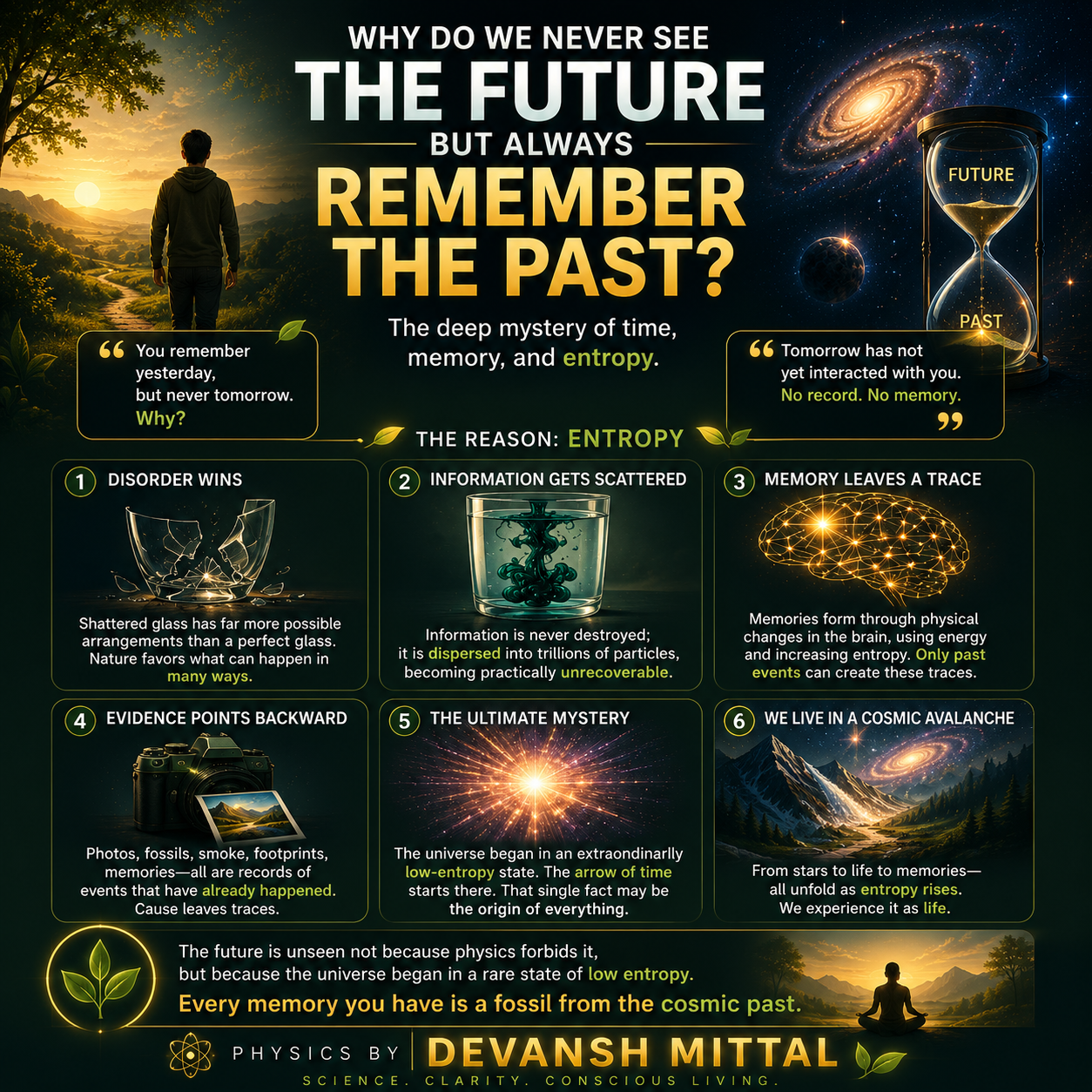
Why Do We Never See the Future but Always Remember the Past?

Standard

The Deep Mystery of Time, Memory, and Entropy

Every morning, the Sun rises. You remember what you ate yesterday, the conversation you had a few hours ago, and perhaps even moments from your childhood decades in the past. Yet hidden within these ordinary experiences is something profoundly mysterious: you have never remembered tomorrow. Not once.

At first glance, this seems so obvious that it hardly deserves attention. But from the perspective of physics, it is astonishing. Why should the past be accessible to memory while the future remains completely hidden? Why do we experience time as flowing in one direction? This simple question leads us to one of the deepest puzzles in modern science.

The Universe Has a Secret

Imagine watching a movie of two planets orbiting each other in space. Now play the movie backward. Surprisingly, the reversed motion still looks perfectly plausible. The same is true for two billiard balls colliding on a table or an electron moving through space. In most cases, the fundamental equations of physics work equally well whether time moves forward or backward.

This is one of the most surprising discoveries in science. At the microscopic level, nature appears almost indifferent to the direction of time. The laws themselves make very little distinction between past and future.

Yet our everyday experience is built entirely around that distinction. We remember the past but not the future. We can influence tomorrow but not yesterday. Physics seems almost time-symmetric, while human experience is overwhelmingly time-directed. Somewhere between microscopic laws and everyday life, something remarkable happens.

The Movie That Feels Wrong

Consider a glass falling from a table and shattering on the floor. Everyone immediately recognizes this as a normal event. Now imagine watching the same video in reverse. The scattered fragments suddenly leap together, assemble themselves into a perfect glass, and jump neatly back onto the table.

Nothing about the fundamental laws governing the atoms explicitly forbids such a process. Yet we instinctively know it never happens. The reversed movie feels absurd because it violates one of the most important statistical tendencies in nature.

The key to understanding this tendency is entropy.

The Tyranny of Probability

Entropy is often described as a measure of disorder, but a more accurate description is that it measures how many microscopic arrangements correspond to a particular macroscopic state.

An intact glass sitting on a table can exist in only a relatively small number of microscopic configurations. A shattered glass, however, can exist in an unimaginably larger number of configurations. There are vastly more ways for the pieces to be scattered than for them to be perfectly assembled.

As a result, nature overwhelmingly tends to move toward states that can be realized in more ways. This is not because nature has goals or intentions. It is simply a matter of probability. The shattered-glass state wins the statistical lottery by an enormous margin.

A Universe That Constantly Hides Information

Imagine placing a drop of ink into a glass of water. Initially, the ink occupies a tiny region. Over time, it spreads throughout the entire glass until it becomes uniformly mixed.

What happened to the information about the ink’s original location? Surprisingly, it was not destroyed. Instead, it became distributed among countless water molecules in extraordinarily complex ways. In principle, the information still exists. In practice, it has become effectively impossible to recover.

The universe rarely destroys information outright. More often, it disperses it so thoroughly that reconstruction becomes hopelessly difficult. The past has not vanished; it has simply been hidden.

Why Memory Points Only One Way

This brings us to the deepest part of the story. The reason you remember the past may be intimately connected to entropy itself.

A memory is not an abstract object. It is a physical record stored in matter. When your brain forms a memory, neurons modify their connections, energy is consumed, heat is generated, and entropy increases. Every memory is a physical trace left behind by an event.

This explains why memories point only toward the past. Yesterday physically interacted with your brain and left records behind. Tomorrow has not yet done so. No interaction has occurred, no trace exists, and therefore no memory can exist.

In this sense, memories are fossils of irreversible physical processes. Every remembered experience is evidence that entropy has already increased.

The Arrow Hidden in Every Photograph

The same idea extends far beyond human memory. Every photograph records a moment from the past because light from an event reached a camera and altered physical matter inside it. The event created the record; the record did not create the event.

This asymmetry appears everywhere. Footprints reveal where someone has been. Smoke reveals that a fire occurred. Fossils reveal organisms that once lived. Memories reveal experiences that already happened. Every piece of evidence in the universe points backward in time.

The arrow of time is written into the very concept of a record.

The Greatest Mystery of All

At this point, it may seem that the problem has been solved. Entropy increases, and therefore time appears to move forward.

But this answer immediately raises an even deeper question: why was entropy lower in the past?

Entropy can only increase if it starts from a relatively low value. Modern cosmology tells us that the early universe, shortly after the Big Bang, existed in an extraordinarily low-entropy state. Not merely low, but astonishingly low.

This fact may be the ultimate source of the arrow of time. Every broken egg, every memory, every aging face, every historical event, and every civilization may ultimately trace its existence to this remarkable initial condition of the cosmos.

We Live Inside a Cosmic Avalanche

A useful analogy is a mountain covered with snow. The early universe was like a snowpack balanced high on a slope. Once the process begins, the snow naturally moves downward. The avalanche unfolds.

Similarly, the universe has been evolving from its extraordinarily special low-entropy beginning toward states of higher entropy. Along the way, stars formed, galaxies emerged, planets developed, life appeared, and conscious beings began creating memories.

The arrow of time is not something separate from these processes. It is the unfolding of the entire cosmic story.

The Final Surprise

Perhaps the most astonishing possibility is that the flow of time itself may not be a fundamental feature of reality. The microscopic laws of physics are largely indifferent to past and future. What we experience as the passage of time may emerge from statistics, information, and the extraordinarily special conditions present at the birth of the universe.

In other words, the future may not be hidden because physics forbids us from seeing it. It may be hidden because the universe began in a state so extraordinarily improbable that everything we call history has been the gradual unfolding of that initial condition.

Every memory you possess is therefore more than a record of your personal past. It is also a clue to one of the deepest mysteries in science. The simple fact that you remember yesterday but not tomorrow may ultimately be telling us something profound about the origin of the universe itself.

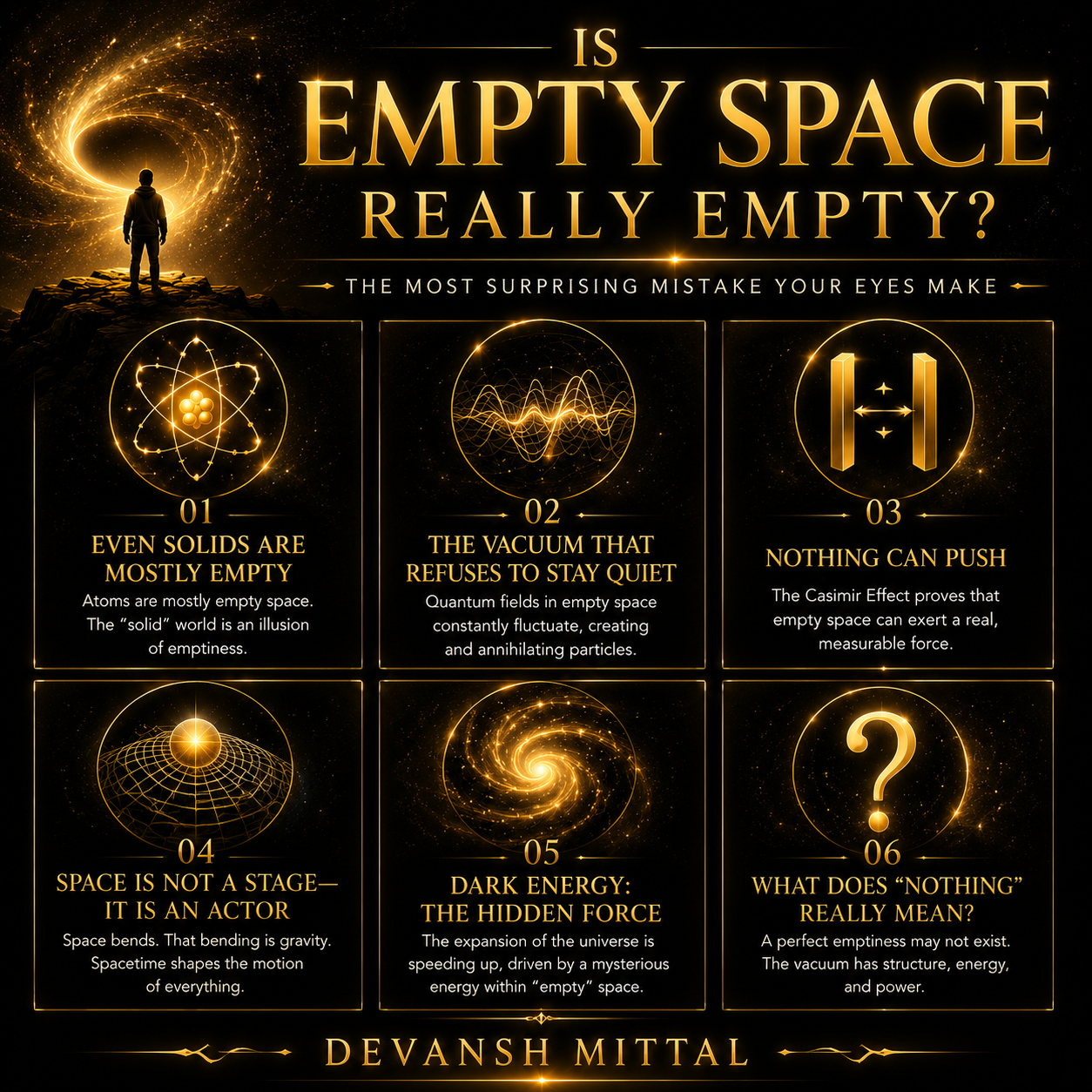
Is Empty Space Really Empty?

Standard

The Most Surprising Mistake Your Eyes Make

Look around you.

Between you and your phone, between Earth and the Moon, and even between galaxies, there appears to be nothing at all.

We call it “empty space.”

But modern physics has uncovered a remarkable truth:

Empty space may be one of the most active things in the universe.

In fact, what we casually call “nothing” is not really nothing.

It is something far stranger.


A Lesson from a Coffee Cup

Imagine placing a coffee cup on a table.

You might think the cup is made of solid matter and the air around it is empty.

Surprisingly, the cup itself is mostly empty space.

If every atom inside the cup were enlarged so that its nucleus became the size of a marble, the electrons would orbit hundreds of meters away. Almost all of the cup’s volume would be empty.

So even “solid” objects are largely made of emptiness.

But then another question appears:

What exactly fills the space between those atoms?


The Vacuum That Refuses to Stay Quiet

According to classical physics, a vacuum is simply a region with nothing inside it.

Quantum physics shattered this picture.

In the quantum world, space behaves more like a restless ocean than a silent void.

Even when all particles are removed, invisible quantum fields remain.

These fields constantly fluctuate.

Tiny particle-antiparticle pairs briefly appear and disappear.

Physicists call these events “quantum fluctuations.”

The vacuum is therefore not empty. It is alive with activity that normally remains hidden from our senses.


Nothing Can Push

This sounds impossible.

How can “nothing” exert a force?

Yet experiments show exactly that.

When two extremely smooth metal plates are placed incredibly close together in a vacuum, they experience a tiny attraction.

This phenomenon, known as the

Casimir Effect

arises because quantum fluctuations in empty space are altered between the plates.

The force has been measured experimentally.

In other words, “empty” space can physically push and pull objects.


Space Is Not a Stage—It Is an Actor

Many people imagine space as a passive background where cosmic events unfold.

Modern physics tells a different story.

Space bends around stars and planets.

That bending is what we perceive as gravity.

According to General Relativity, Earth is not being pulled through space by an invisible force. Instead, Earth moves through curved spacetime created by the Sun.

Space itself participates in the drama of the universe.

It is not merely the stage.

It is one of the actors.


The Biggest Mystery in the Cosmos

The story becomes even stranger.

Astronomers have discovered that the expansion of the universe is speeding up.

Something appears to be pushing galaxies apart faster and faster.

One possible explanation is that empty space itself contains energy.

This mysterious phenomenon is known as

Dark Energy.

Today, dark energy is thought to make up most of the cosmic energy budget.

Think about that for a moment.

The dominant ingredient of the universe may be hidden within what we call “empty” space.


What Does “Nothing” Really Mean?

The deeper physicists investigate reality, the more difficult it becomes to define nothingness.

A truly empty universe may not even be possible.

Even the vacuum possesses structure, energy, fluctuations, and physical consequences.

What appears to be a featureless void is actually a dynamic fabric woven into the workings of nature itself.


The Next Time You Look at the Sky…

On a clear night, look up at the dark space between the stars.

It may seem like the emptiest place imaginable.

Yet that darkness is not a barren void.

It is a restless quantum arena, a flexible geometric fabric, and perhaps the reservoir of the mysterious energy driving the expansion of the cosmos.

The greatest surprise of modern physics is not that the universe contains extraordinary things.

It is that what appears to be nothing may be one of the most extraordinary things of all.

Why Black Holes Bend Light?

Standard

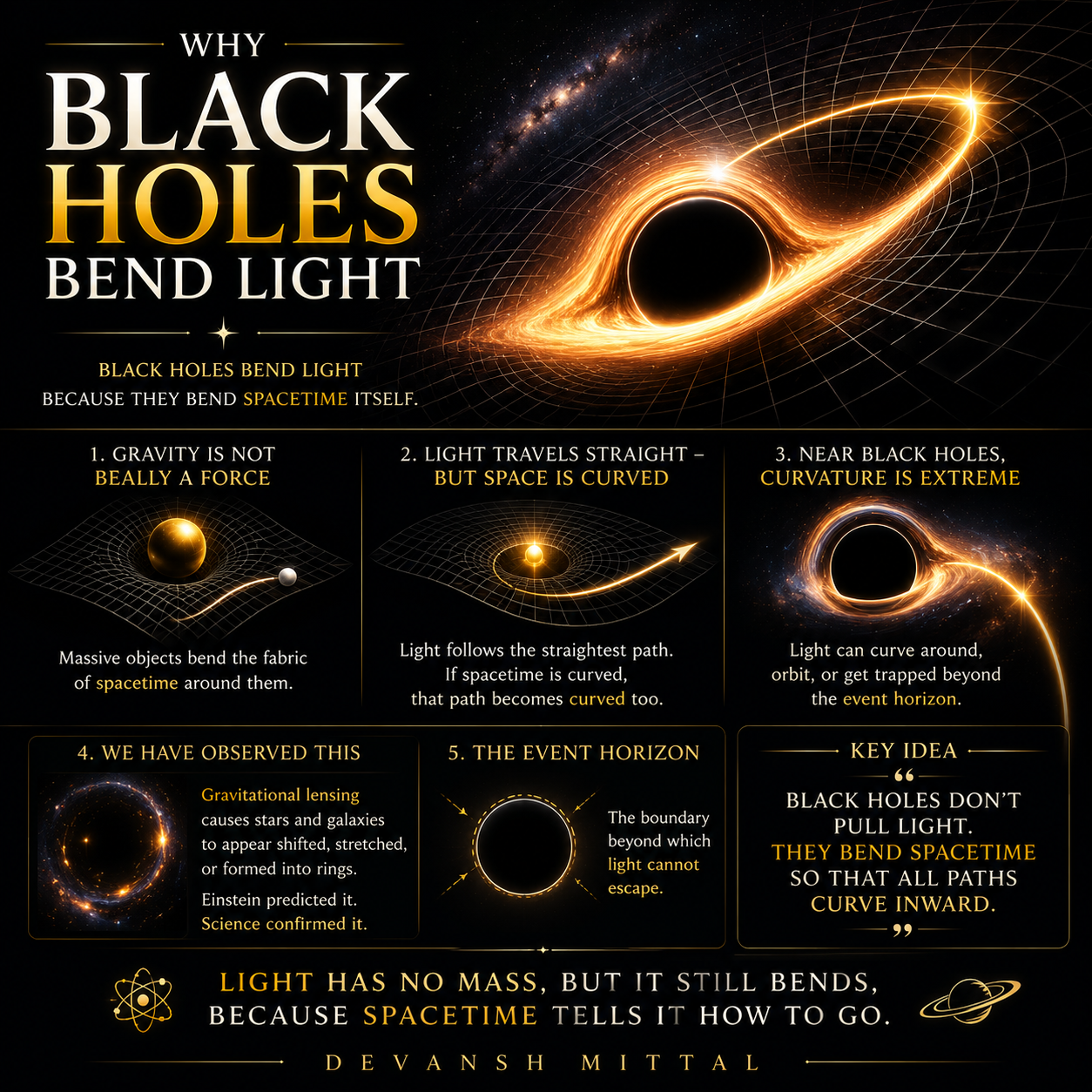
Why Black Holes Bend Light

The Strange Prediction of Gravity

We usually think gravity pulls only on things that have mass.

A falling apple has mass.
A planet has mass.
You have mass.

But light has no mass.

So why does light bend near a black hole?

This question confused scientists for centuries — until Einstein completely changed our understanding of gravity.


Gravity Is Not Really a Force

According to Isaac Newton, gravity is a force between masses.

But Einstein introduced a much deeper idea.

He said gravity is actually the bending of space and time itself.

Imagine placing a heavy bowling ball on a stretched rubber sheet. The sheet bends around the ball. If you roll a marble nearby, the marble curves toward the bowling ball — not because the ball is “pulling” it directly, but because the surface itself is curved.

Einstein proposed that space behaves in a similar way.

Massive objects bend the fabric of spacetime around them.


Light Always Travels Straight — But Space Is Curved

This is the key idea students often miss:

Light always tries to move in the straightest possible path.

But if space itself is curved, then the “straight path” also becomes curved.

Imagine walking straight on the curved surface of Earth. Even though you feel you are moving straight, your path curves around the planet.

Similarly, near a black hole, spacetime becomes extremely curved. So light follows that curvature.

As a result, light bends.


Why Black Holes Bend Light So Strongly

A black hole contains an enormous amount of mass compressed into an incredibly tiny region.

This creates extreme spacetime curvature.

Near the black hole, the bending becomes so intense that light can:

  • curve around the black hole,
  • orbit it temporarily,
  • or even become trapped forever.

The boundary beyond which light cannot escape is called the event horizon.

Once light crosses this boundary, escaping becomes impossible.

That is why black holes appear black.


We Have Actually Observed This

This is not just theory.

Scientists have observed stars appearing in shifted positions because their light bends around massive objects. This phenomenon is called gravitational lensing.

Sometimes a distant galaxy even appears stretched into rings or arcs because its light bends around another massive galaxy lying in front of it.

Einstein predicted this long before telescopes could observe it.

Later, experiments proved him correct.


The Deep Idea

Black holes do not “grab” light like a vacuum cleaner.

Instead, they bend spacetime so dramatically that every possible path light can take curves inward.

In other words:

Black holes bend light because they bend spacetime itself.

Why Light Bends Instead of Traveling Straight?

Standard

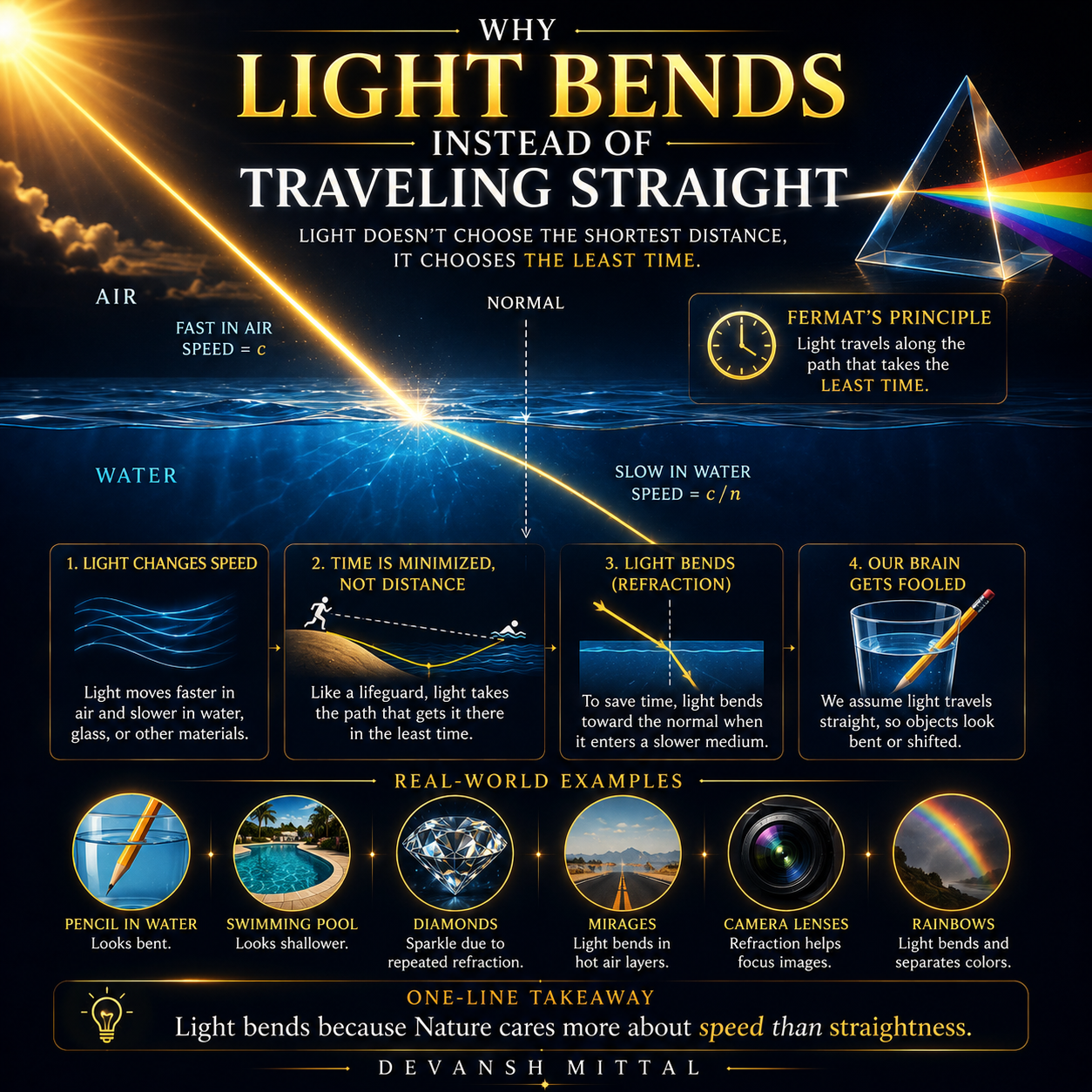
Why Light Bends Instead of Traveling Straight

The Strange Behavior of Light

We usually imagine light traveling in straight lines. Laser beams, sunlight, and torchlight all appear perfectly straight.

But then we observe strange things:

  • a pencil appears bent in water,
  • swimming pools look shallower,
  • diamonds sparkle intensely,
  • roads on hot days look wet.

Why does light bend at all when a straight path seems simpler?

The answer reveals one of the deepest ideas in Physics.


Light Minimizes Time, Not Distance

Most people assume Nature always chooses the shortest path.

But light does something far more surprising:

It chooses the path that takes the least time.

This idea is the key to understanding refraction.


The Lifeguard Analogy

Imagine a lifeguard rescuing a swimmer far away in the water.

Humans run much faster on sand than they swim in water. So the fastest route is usually not a straight line.

A smarter strategy is:

  • run longer on sand,
  • then enter the water later.

The path becomes bent because the goal is to minimize time, not distance.

Light behaves in an astonishingly similar way.


Refraction: Why Light Bends

Light travels extremely fast in air but slows down in materials like water, glass, and diamond.

When light moves from one medium to another, its speed changes. Whenever speed changes, the path bends.

This bending of light is called refraction.

When light enters a slower medium like water, it bends toward the normal because that path reduces the total travel time.


Fermat’s Principle

The French physicist Pierre de Fermat expressed this idea beautifully:

Light travels along the path that takes the least time.

Not the shortest distance.
The least time.

From this single principle, scientists can derive the laws of reflection and refraction.


Everyday Examples of Refraction

Pencil in Water

Light bends as it leaves water and enters air. Your brain assumes light traveled straight, so the pencil appears bent.

Diamonds

Diamonds slow light dramatically. Light repeatedly bends and reflects inside them, creating intense sparkle and shimmering colors.

Mirages

On hot roads, layers of hot air change the speed of light gradually. Light curves upward, creating the illusion of water on the road.


A Beautiful Lesson from Nature

Nature often behaves differently from human intuition.

We think in terms of:

  • straight lines,
  • shortest distance,
  • direct paths.

But Nature often optimizes something deeper:

  • efficiency,
  • time,
  • and elegant physical laws.

Light bends because the bent path is actually faster.

That is one of the most beautiful ideas in Physics.


One-Line Takeaway

Light bends because Nature cares more about time than straightness.

We Cannot Prove the Laws of Physics!

Standard

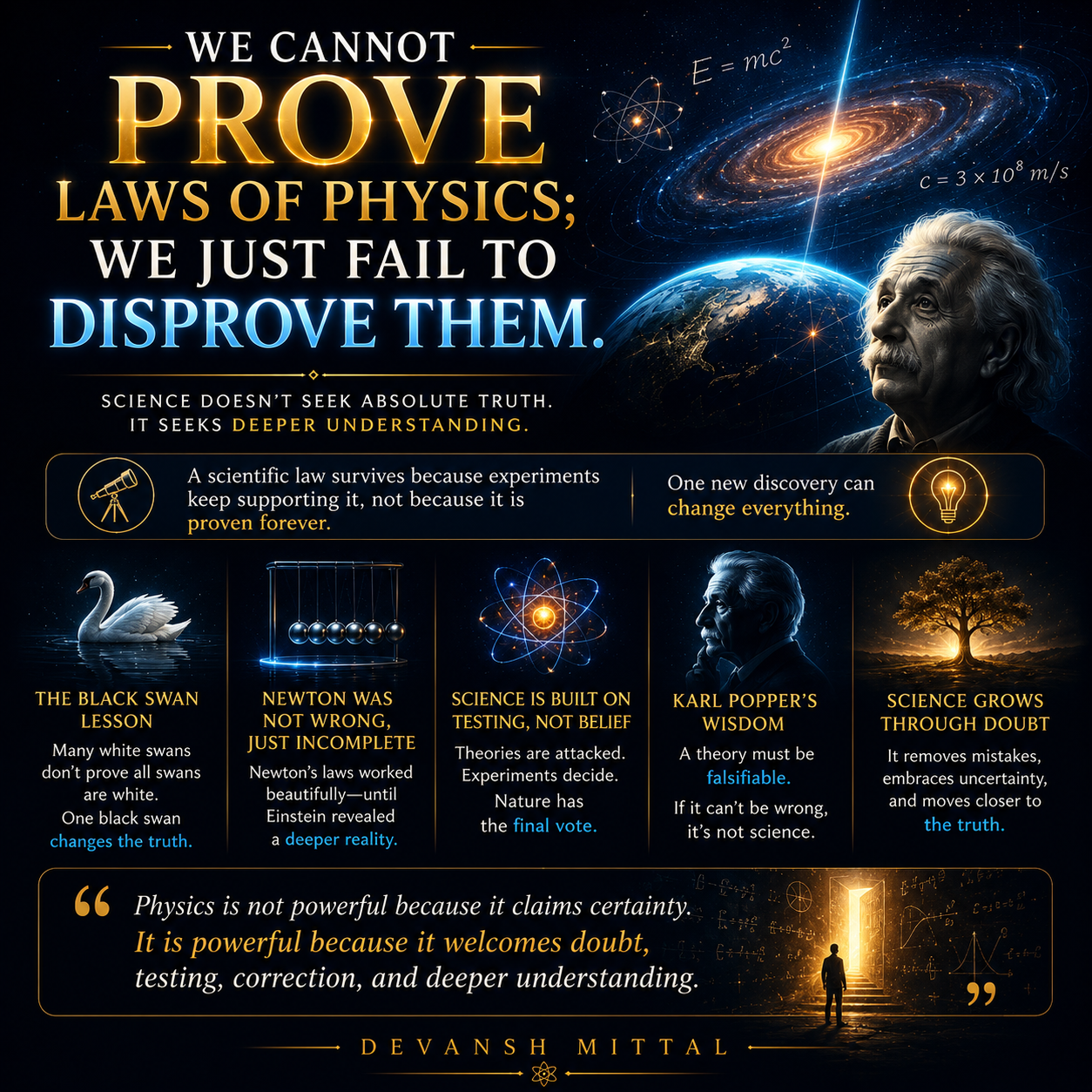
We Cannot Prove Laws of Physics; We Just Fail to Disprove Them

Most students grow up believing that the laws of physics are absolute truths.

We are taught that:

  • Newton’s laws are true,
  • gravity is true,
  • conservation of energy is true,
  • and the speed of light is constant.

But modern science reveals something far deeper and more humbling:

Physics does not truly “prove” its laws.

Instead, physics keeps testing them again and again — and so far, we have simply failed to disprove them.

This idea is one of the most profound insights in science.


Why This Idea Feels Strange

In mathematics, things can be proven permanently.

For example:

2 + 2 = 4

Once proven logically, it remains true forever within mathematics.

But physics is different.

Physics studies the real universe, and the universe must be observed experimentally.

No matter how many times an experiment succeeds, there is always a possibility — however tiny — that a future experiment may reveal something new.

This means:

No physical law is beyond questioning.

And that is exactly what makes science powerful.


Science Is Built on Testing, Not Blind Belief

A scientific law survives because it repeatedly passes experimental tests.

But passing tests is not the same as being “absolutely proven.”

Imagine this situation:

Suppose someone says:

“All swans are white.”

You observe:

  • 10 white swans,
  • 100 white swans,
  • 10,000 white swans.

Does this prove that all swans are white?

No.

Because finding just one black swan destroys the claim completely.

Physics works in a very similar way.

A law may survive millions of successful experiments, but a single contradictory observation can force scientists to rethink the theory.


Newton’s Laws Once Seemed Perfect

For centuries, Newton’s laws explained:

  • falling apples,
  • planetary motion,
  • cannonballs,
  • machines,
  • and motion on Earth.

People thought Newton had discovered the final laws of Nature.

Then Einstein arrived.

Einstein showed that Newton’s laws are not exactly correct at:

  • extremely high speeds,
  • very strong gravity,
  • and cosmic scales.

Newton was not “wrong” in ordinary situations.

But Newton’s laws were incomplete.

This is one of the greatest lessons in science:

Even the most successful theories can later become approximations of deeper truths.


The Speed of Light and Modern Physics

Today, Einstein’s relativity has passed enormous numbers of experiments.

GPS satellites work correctly only because relativistic corrections are included.

Modern particle accelerators confirm relativity repeatedly.

Yet scientists still do not claim that relativity is “perfectly proven forever.”

Why?

Because future discoveries may reveal an even deeper theory.

In fact, physicists are actively searching for theories beyond Einstein’s relativity.

Science always remains open to correction.


Why Science Is Different from Belief Systems

In many belief systems, questioning is discouraged.

But in science, questioning is essential.

A scientific theory becomes stronger precisely because scientists constantly try to break it.

Physicists do not worship theories.

They attack them with experiments.

A theory survives only if Nature refuses to disprove it.

This creates an extraordinary system of self-correction.


The Philosophy of Karl Popper

One of the most influential philosophers of science, Karl Popper, explained this beautifully.

According to Popper:

A scientific theory must be falsifiable.

This means the theory must make predictions that could, in principle, be proven wrong.

For example:

“This pen will fall downward if released.”

This is scientific because it can be tested.

But if someone makes a claim that can never be tested or disproven, it does not belong to science.

Science progresses because theories are vulnerable to failure.


Why This Makes Science Powerful

At first, this idea may sound weak.

If science cannot “prove” laws permanently, does that make science uncertain?

Actually, the opposite is true.

Science becomes powerful precisely because it allows correction.

Imagine two systems:

System 1:

  • never changes,
  • never questions itself.

System 2:

  • constantly tests itself,
  • removes mistakes,
  • improves continuously.

Which system becomes more reliable over time?

Obviously, the second one.

Science advances because it accepts the possibility of being wrong.

That intellectual honesty is one of humanity’s greatest achievements.


Real-World Examples

Example 1: Newton vs Einstein

Newton’s gravity worked extremely well for centuries.

But tiny errors in Mercury’s orbit could not be explained completely.

Einstein’s General Relativity explained those discrepancies beautifully.

The old theory survived for a long time — until better measurements exposed its limitations.


Example 2: Classical Physics vs Quantum Mechanics

Classical physics once seemed complete.

Then scientists discovered:

  • atoms,
  • electrons,
  • quantum effects,
  • wave-particle duality.

The old theories failed at microscopic scales.

Quantum mechanics emerged as a deeper framework.

Again, science corrected itself.


Example 3: Medical Science

Even medicine evolves this way.

Treatments once considered correct are sometimes abandoned after better evidence appears.

Science does not hide mistakes.

Science improves by discovering them.


A Deep Lesson About Truth

Science teaches us humility.

The universe is enormously complex.

Our theories are not perfect copies of reality.

They are models that approximate reality increasingly well.

Some models are extraordinarily successful.

But science never claims absolute finality.

This mindset is one of the reasons science progresses so rapidly.


The Beauty of Scientific Thinking

The statement:

“We cannot prove laws of physics; we just fail to disprove them.”

may initially sound unsettling.

But it actually captures the beauty of science.

Science is not a collection of unquestionable truths.

Science is a living process of exploration.

Every experiment is a question asked to Nature.

And Nature always has the final vote.


Final Thoughts

Physics is not powerful because it claims certainty.

Physics is powerful because it welcomes doubt, testing, correction, and deeper understanding.

Every law of physics survives only because:

  • experiments continue to support it,
  • observations continue to agree with it,
  • and Nature has not yet disproved it.

That is not weakness.

That is intellectual courage.

And perhaps this is the deepest lesson science teaches humanity:

True knowledge does not fear questioning.

It grows because of it.

— Devansh Mittal

Why Electricity Travels Almost At the Speed of Light, even though Electrons Drift Very Slowly in Wires?

Standard

Why Electricity Travels Almost at the Speed of Light

The Surprising Truth About Electric Fields and Electromagnetic Waves

When you switch on a light bulb, it glows almost instantly.

When you press the power button on your computer, electrical signals race through billions of circuits in a tiny fraction of a second.

But here is the surprising part:

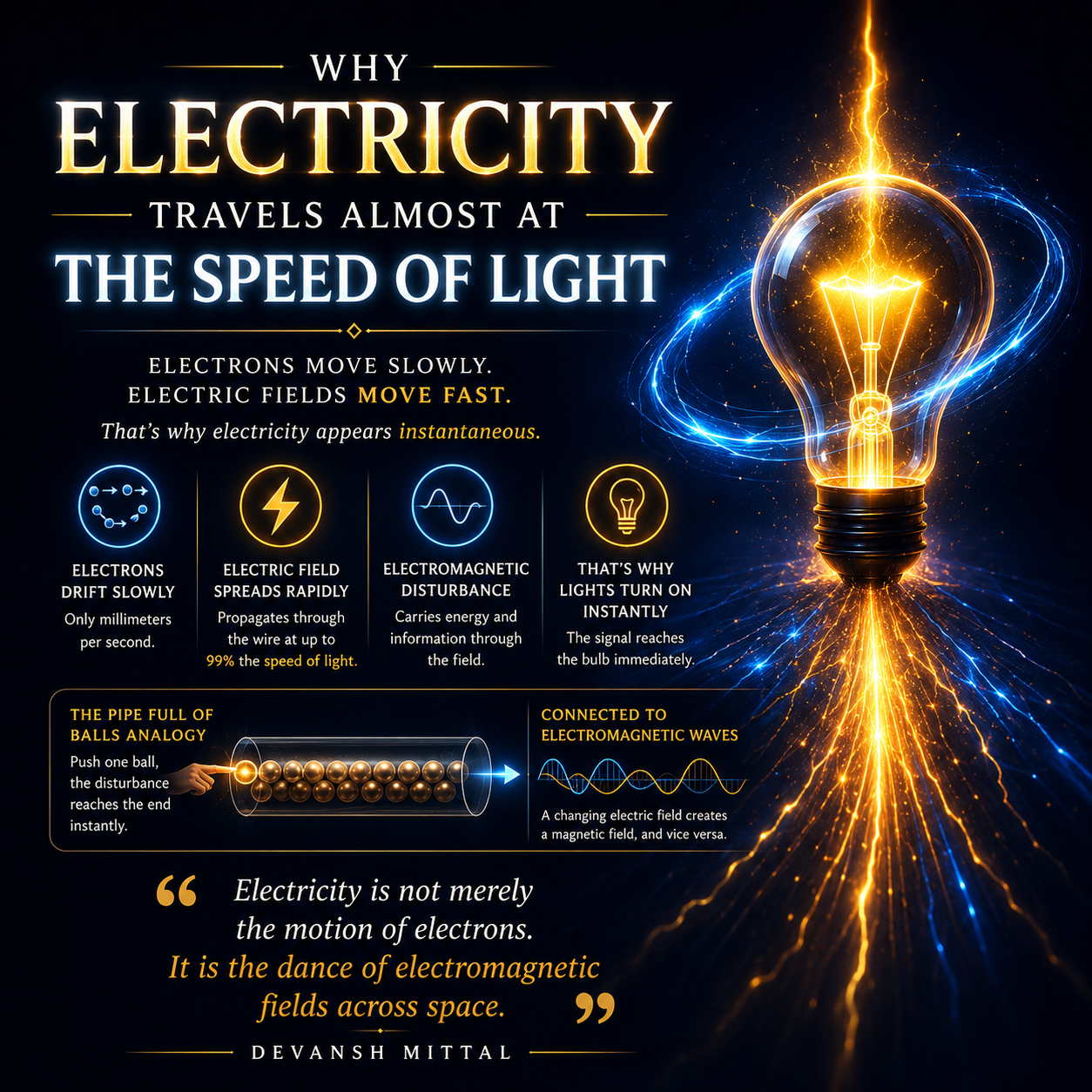
The electrons inside the wire actually move very slowly.

In many household wires, electrons drift at only a few millimeters per second — slower than a crawling ant.

So how can electricity seem to travel almost at the speed of light?

The answer reveals one of the deepest ideas in Physics:

Electricity is not mainly about electrons traveling rapidly through wires. It is about electric fields and electromagnetic disturbances propagating through space.


The Common Misconception

Most students imagine electricity like water flowing through a pipe:

  • electrons are like water molecules,
  • the wire is the pipe,
  • and electricity means electrons rushing rapidly from one end to another.

This picture is only partly correct.

The electrons themselves move slowly.

What moves rapidly is the electromagnetic signal.


Drift Velocity: The Slow Motion of Electrons

Metal wires already contain countless free electrons even before the circuit is switched on.

When a battery is connected, these electrons begin drifting in one direction. This average motion is called drift velocity.

Surprisingly, this drift velocity is extremely small.

An individual electron may take minutes or even hours to move a short distance through a wire.

Yet the bulb glows almost instantly.

Clearly, something else must be happening.


A Simple Analogy

Imagine a long pipe completely filled with tightly packed balls.

If you push one ball at one end, the ball at the opposite end moves almost immediately.

But the same ball did not travel across the pipe. Instead, the disturbance traveled rapidly through the system.

Electricity behaves similarly.

The electrons already exist throughout the wire. When an electric field is established, electrons everywhere begin responding almost simultaneously.


The Real Hero: The Electric Field

The moment you connect a battery, an electric field is created inside and around the wire.

An electric field exerts force on charges and pushes electrons throughout the circuit.

The important point is this:

The electric field propagates extremely rapidly — close to the speed of light.

So the fast behavior of electricity is mainly due to the rapid propagation of the electric field, not because electrons themselves are moving extremely fast.


Electricity Is a Field Phenomenon

This is one of the great conceptual shifts in modern Physics.

Electricity is not merely the motion of particles.

It is fundamentally a phenomenon of fields.

Electric and magnetic fields carry:

  • energy,
  • momentum,
  • and information.

The electrons simply respond locally to these fields.


Electromagnetic Waves and Maxwell

A changing electric field creates a magnetic field.

A changing magnetic field creates an electric field.

This beautiful interplay allows electromagnetic disturbances to propagate through space as electromagnetic waves.

This revolutionary idea was discovered by James Clerk Maxwell.

Maxwell realized that light itself is an electromagnetic wave.

That means:

  • radio waves,
  • microwaves,
  • visible light,
  • X-rays,

are all forms of the same electromagnetic phenomenon.

Electrical signals in wires are deeply connected to this same physics.


Real-World Examples

Switching On a Light

When you press a switch:

  • the electric field spreads rapidly through the circuit,
  • electrons everywhere begin responding,
  • the bulb glows almost instantly.

The electrons inside the bulb do not come all the way from the battery.


Internet and Communication

Modern communication depends on fast electromagnetic propagation through:

  • cables,
  • fiber optics,
  • antennas,
  • and satellites.

Without electromagnetic waves, the modern digital world would not exist.


Final Takeaway

The next time you switch on a light, remember:

  • the electrons themselves move slowly,
  • but the electric field spreads through the circuit extremely rapidly,
  • carrying energy and information almost at the speed of light.

Electricity is not merely the movement of electrons.

It is the dance of electromagnetic fields across space.

Why Time Slows Down at High Speeds?

Standard

Why Time Slows Down at High Speeds

Imagine traveling in a spaceship moving close to the speed of light. Inside the spaceship, everything would feel completely normal. Your heartbeat, thoughts, and even your watch would work exactly as usual.

But for someone watching from Earth, something strange would happen:

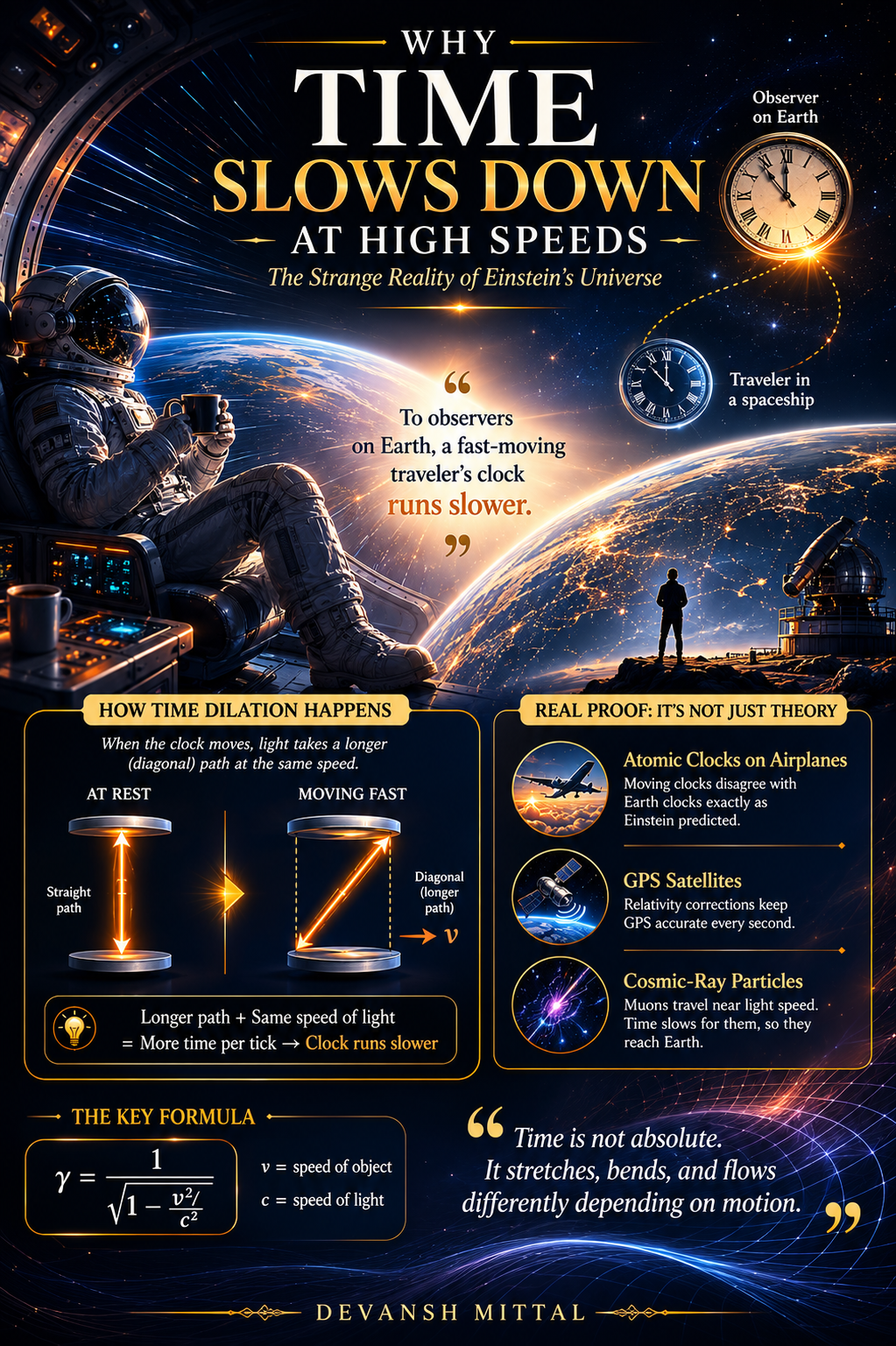
Your clock would appear to run slower.

This phenomenon is called time dilation, and it is one of the most fascinating predictions of Albert Einstein’s Special Theory of Relativity.


The Big Problem Einstein Solved

Before Einstein, scientists believed that time was absolute. They thought time flowed at the same rate for everyone everywhere in the universe.

But experiments with light created a huge problem.

Scientists discovered that the speed of light is always constant:

c ≈ 3 × 10⁸ m/s

Normally, speeds add together. For example, if you throw a ball forward inside a moving train, a person standing outside sees the ball moving faster than you do.

But light behaves differently.

Even if you move toward a beam of light at extremely high speed, you still measure light traveling at exactly the same speed.

Einstein realized that if the speed of light never changes, then space and time themselves must change.


Understanding Time Dilation Intuitively

To understand this idea, imagine a special clock made using light.

Suppose light bounces between two mirrors. Every bounce acts like one “tick” of the clock.

When the clock is at rest, the light moves straight up and down.

But if the clock moves sideways at very high speed, the light must travel diagonally to keep up with the moving clock.

The important point is:

  • The diagonal path is longer.
  • The speed of light cannot change.

So the light takes more time to complete one tick.

As a result, the moving clock runs slower.

This is the basic reason why time slows down at high speeds.


Space and Time Are Connected

Einstein showed that space and time are not separate things. They are connected together in something called spacetime.

The faster an object moves through space, the slower it moves through time.

At everyday speeds, this effect is extremely tiny, so we do not notice it. But near the speed of light, the effect becomes very large.

The mathematical expression for time dilation is:

Δt = γΔt₀

where

γ = 1 / √(1 − v²/c²)

As the speed v gets closer to the speed of light c, the value of γ increases greatly, meaning time slows down more and more.


The Twin Paradox

One famous example of time dilation is the Twin Paradox.

Imagine two twins:

  • One stays on Earth.
  • The other travels in a fast spaceship and later returns.

When they meet again, the traveling twin is younger.

Why?

Because less time passed for the twin moving at very high speed.

This may sound unbelievable, but it is a real prediction of physics.


Is Time Dilation Real?

Yes. Time dilation has been experimentally confirmed many times.

1. Atomic Clocks

Scientists placed highly accurate atomic clocks on airplanes. After the flights, the moving clocks showed slightly less time than clocks on Earth — exactly as Einstein predicted.

2. GPS Satellites

GPS satellites move very fast around Earth. Their clocks run differently because of relativity.

If scientists ignored time dilation, GPS systems would quickly become inaccurate.

3. Fast-Moving Particles

Particles called muons are created high in Earth’s atmosphere. They should decay before reaching the ground, but because they move near the speed of light, time slows down for them, allowing many to survive longer.


Why Nothing Can Travel Faster Than Light

As an object moves faster and faster, slowing time requires more and more energy.

Reaching the speed of light would require infinite energy, which is impossible.

That is why no object with mass can reach or exceed the speed of light.


Final Thoughts

Time dilation teaches us something extraordinary:

Time is not the same for everyone.

It depends on motion.

At normal speeds, the effect is tiny. But near the speed of light, time itself slows down dramatically.

Einstein’s theory completely changed our understanding of the universe. Today, relativity is not just a scientific idea — it is part of real-world technology such as GPS and particle physics experiments.

The universe is far stranger and more beautiful than our everyday experience suggests.