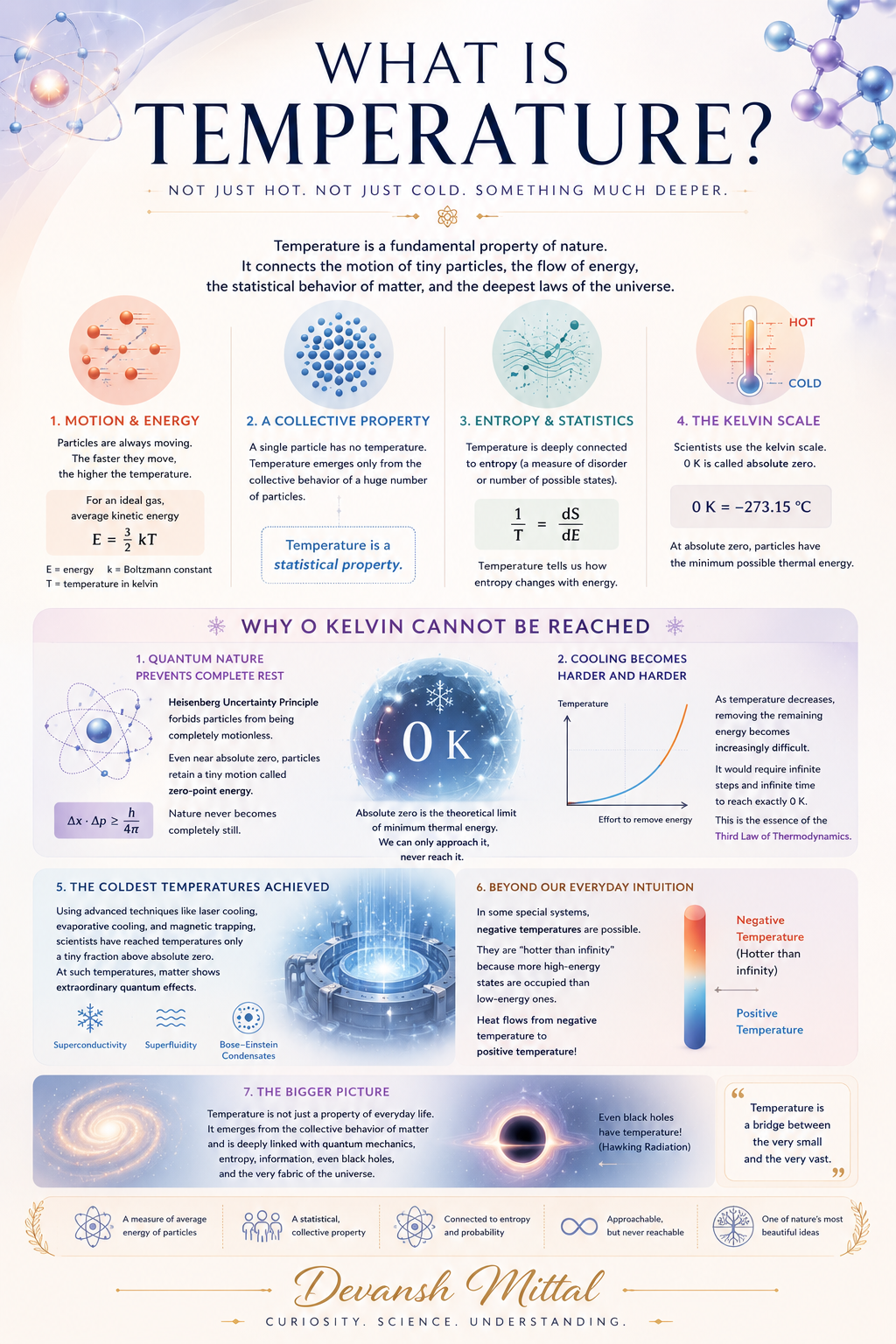
What Is Temperature?
A Modern Understanding of Temperature
Temperature is something we experience every day. We say that tea is hot, ice is cold, and the weather is warm or cool. But in physics, temperature is much deeper than just the feeling of “hotness” or “coldness.”
Modern science tells us that temperature is related to the motion and energy of tiny particles such as atoms and molecules.
Temperature and Particle Motion
All matter is made of particles that are always moving.
- In hot objects, particles move faster.
- In cold objects, particles move slower.
For an ideal gas, the average kinetic energy of particles is:
E = (3/2) × k × T
where:
- E = average kinetic energy
- k = Boltzmann constant
- T = temperature in kelvin
This means temperature is connected to the average energy of random particle motion.
Temperature Is a Collective Property
A single molecule does not have a temperature.
Temperature appears only when a very large number of particles are considered together.
So, temperature is a “collective” or “statistical” property of matter.
Temperature and Entropy
Modern physics also connects temperature with a very important idea called entropy.
Entropy measures the amount of disorder or the number of possible microscopic arrangements inside a system.
- Higher temperature generally means particles can arrange themselves in more possible ways.
- Lower temperature means fewer possible arrangements.
The deep thermodynamic relation is:
1/T = dS/dE
where:
- T = temperature
- S = entropy
- E = energy
This equation shows that temperature is deeply connected to how energy and disorder are related in Nature.
The Kelvin Scale and Absolute Zero
Scientists use the kelvin scale for temperature.
- 0 K is called absolute zero.
- 0 K = −273.15°C
At absolute zero, particles have the minimum possible thermal energy.
Why Zero Kelvin Cannot Be Reached
According to modern physics, reaching exactly 0 K is impossible.
There are two major reasons.
1. Heisenberg’s Uncertainty Principle
Quantum mechanics tells us that particles can never become perfectly motionless.
According to the Heisenberg Uncertainty Principle:
Δx × Δp ≥ h/(4π)
where:
- Δx = uncertainty in position
- Δp = uncertainty in momentum
- h = Planck’s constant
This means we cannot know both the exact position and exact momentum of a particle at the same time.
If a particle became completely motionless at 0 K, its momentum would become exactly zero, which would violate quantum mechanics.
Therefore, even near absolute zero, particles still possess a tiny unavoidable motion called:
Zero-point energy
So Nature never becomes completely still.
2. Cooling Becomes Harder and Harder
As temperature decreases:
- particles lose energy,
- but removing the remaining energy becomes increasingly difficult.
Scientists can get extremely close to 0 K, but they can never reach it exactly.
This idea is part of the Third Law of Thermodynamics.
The Coldest Temperatures Ever Created
Using advanced techniques like laser cooling, scientists have cooled matter to temperatures only a tiny fraction above absolute zero.
At such temperatures, strange quantum effects appear, including:
- superconductivity,
- superfluidity,
- Bose–Einstein condensates.
These states help scientists study the quantum world.
Modern Understanding of Temperature
Today, physicists understand temperature as:
- a measure of the average energy of particles,
- a statistical property of many particles together,
- a quantity deeply connected with entropy,
- and a concept linked with quantum mechanics.
Temperature is therefore not just about “hot” and “cold.”
It is one of the fundamental ideas that helps us understand the microscopic behavior of matter and the deeper laws of the universe.
 The Intuitive Physicist