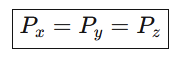
Pressure is Isotopic: It Has No Preferred Direction

Standard

Understanding Why Pressure in a Fluid is Isotropic

There are ideas in physics that are merely equations, and then there are ideas that quietly reveal how nature itself thinks. The isotropy of pressure in a fluid belongs to the second category.

It is one of those profound truths that appears deceptively simple:

At a given point inside a stationary fluid, pressure acts equally in all directions.

At first glance, this statement feels obvious. Yet the deeper one thinks about it, the more astonishing it becomes. Why should nature choose equality of pressure in every direction? Why should water in a lake, air in a room, or blood in an artery not “prefer” one direction over another?

The answer lies not in memorizing a law, but in understanding the very meaning of equilibrium.

This article is an intuitive exploration of why pressure in a fluid must be isotropic.


What Exactly Is Pressure?

Before discussing isotropy, we must first understand pressure itself.

Pressure is not a force.

It is the distribution of force over an area.

If you press a finger gently against a table, the force is small. If you press a needle with the same force, the effect becomes much stronger because the force is concentrated over a much smaller area.

Pressure measures this concentration.

But in fluids, pressure acquires a remarkable character: it does not belong to a single direction.

Unlike solids, fluids cannot sustain permanent shear stress. They continuously rearrange themselves. They flow. They adapt. They yield.

And that changes everything.


Solids Resist Shape Change. Fluids Do Not.

Imagine pushing sideways on a block of wood.

The block resists deformation because solids possess rigidity. Their molecules are locked into relatively fixed positions.

Now imagine pushing sideways on water.

Water does not preserve shape under sideways stress. It simply flows.

This is the defining distinction between solids and fluids:

  • Solids can sustain shear forces.
  • Fluids cannot sustain shear forces in static equilibrium.

This single idea is the entire foundation of isotropic pressure.


The Thought Experiment That Reveals the Truth

Let us mentally isolate an extremely tiny portion of fluid deep inside a liquid at rest.

Imagine this tiny element as a miniature triangular wedge suspended within the fluid.

Image

Pressure acts on every surface surrounding this tiny element.

Now suppose pressure were greater in one direction than another.

What would happen?

The larger pressure would produce a greater force on one side of the element. Since the opposing side would exert a smaller force, the tiny fluid element would experience a net sideways turning effect or distortion.

But fluids cannot remain at rest under shear deformation.

They would immediately begin to flow.

And yet the fluid is assumed to be stationary.

Therefore:

If the fluid is truly in equilibrium, no direction can be privileged over another.

The pressure must balance perfectly in every orientation.

Hence pressure becomes isotropic.


Nature Hates Unbalanced Shear in Fluids

This is the deepest intuitive insight.

A stationary fluid can tolerate:

  • compression,
  • weight,
  • normal pushing forces,

but it cannot tolerate continuous unbalanced tangential stress.

If unequal directional pressures existed, they would generate internal shearing tendencies. The fluid would no longer remain static.

Equilibrium itself demands isotropy.

In other words:

Pressure becomes equal in all directions because any inequality would destroy the state of rest.


Why Pressure Acts Perpendicular to Surfaces

Another beautiful consequence emerges naturally.

Since fluids cannot sustain tangential stress in equilibrium, the force exerted by a fluid on any surface must act perpendicular to that surface.

That perpendicular force per unit area is pressure.

This is why:

  • water pushes normally on dam walls,
  • air presses normally against a balloon,
  • blood pushes outward against artery walls.

Fluids never “pull sideways” in static equilibrium.

They only press inward or outward normally.


A Simple Everyday Observation

Consider an underwater diver.

The water presses:

  • on the top of the head,
  • on the sides of the body,
  • underneath the feet,
  • against the chest from every direction.

If pressure were directional, the diver would constantly experience twisting or sideways distortion.

Instead, the pressure surrounds uniformly.

Nature itself demonstrates isotropy continuously.


Pascal’s Principle: A Grand Consequence of Isotropy

The isotropy of pressure leads directly to one of the most powerful principles in engineering:

Pascal’s Principle

A change in pressure applied to an enclosed fluid is transmitted equally and undiminished throughout the fluid.

Hydraulic lifts, braking systems, industrial presses, and countless machines exist because pressure has no preferred direction.

A tiny force applied at one point can emerge as a gigantic force elsewhere simply because fluids transmit pressure isotropically.


Microscopic Interpretation: Molecular Motion

Even at the molecular level, isotropy makes profound sense.

Fluid molecules move randomly in all directions.

At equilibrium:

  • there is no preferred direction of molecular motion,
  • no directional bias in collisions,
  • no privileged orientation.

As molecules strike a tiny imaginary surface from every side equally, the resulting pressure naturally becomes direction-independent.

The macroscopic law of isotropic pressure is therefore a reflection of microscopic randomness and symmetry.


A Subtle but Important Clarification

Pressure in a static fluid is isotropic at a point.

This does not mean pressure is the same everywhere in the fluid.

For example:

  • pressure increases with depth in water,
  • atmospheric pressure decreases with altitude.

The magnitude of pressure may vary from point to point.

But at any single point:

pressure acts equally in all directions.

This distinction is extremely important.


The Philosophical Beauty of the Idea

Physics often reveals that symmetry is not merely aesthetic — it is necessary.

The isotropy of pressure is not an arbitrary property imposed upon fluids. It is a logical consequence of equilibrium itself.

A fluid at rest cannot allow directional imbalance internally. The moment such imbalance appears, motion begins and equilibrium is destroyed.

Thus isotropy is nature’s way of preserving stillness.


Final Conclusion

Pressure in a stationary fluid is isotropic because fluids cannot sustain shear stress in equilibrium.

If pressure were unequal in different directions at a point:

  • unbalanced tangential forces would arise,
  • the fluid element would deform,
  • motion would begin,
  • and the fluid would cease to remain at rest.

Therefore, equilibrium itself demands that pressure at a point in a fluid act equally in all directions.

This profound principle explains:

  • hydrostatic behavior,
  • Pascal’s law,
  • fluid equilibrium,
  • and much of fluid mechanics itself.

In the end, isotropic pressure is not merely a chapter in physics.

It is symmetry expressing itself through matter in its most fluid form.

Leave a comment