What Is Temperature?
Temperature is one of the most familiar quantities in physics, yet its true meaning is remarkably profound.
At the microscopic level, temperature measures the average random kinetic energy of particles in a system. In simpler terms:
The faster the particles move randomly, the higher the temperature.
In gases, particles move freely in all directions. In solids, atoms vibrate about fixed positions. As thermal motion increases, temperature rises.
Thus, temperature is fundamentally connected to microscopic motion.
What Happens When Temperature Decreases?
When a body cools:
- particle motion decreases,
- vibrations become weaker,
- and the average kinetic energy reduces.
This naturally leads to an important question:
Can particle motion become completely zero?
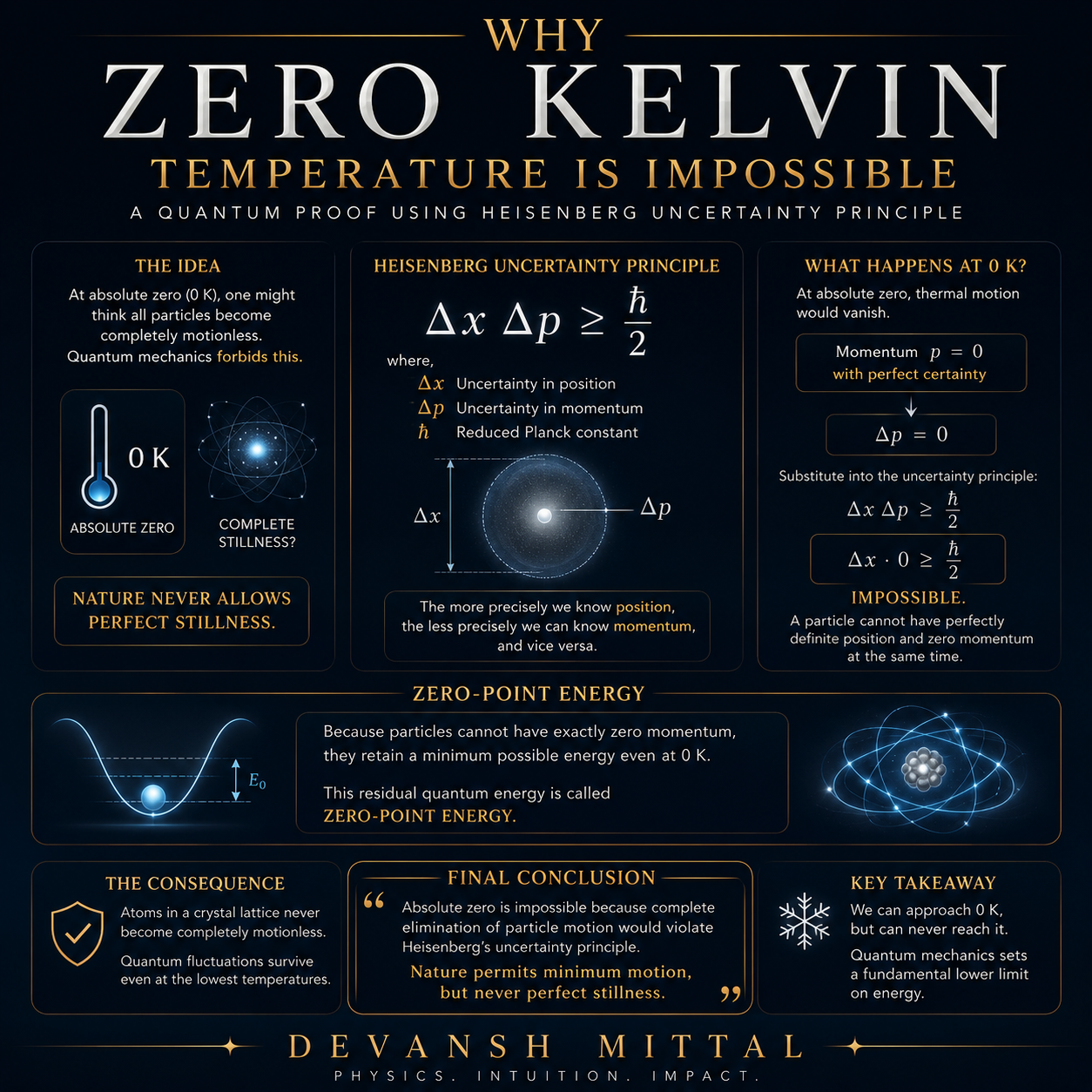
If that were possible, the system would reach the lowest possible temperature: 0 K, called absolute zero.
Classically, one might imagine that at 0 K all particles become perfectly motionless.
Quantum mechanics, however, forbids this possibility.
Heisenberg’s Uncertainty Principle
One of the foundational principles of quantum mechanics is Heisenberg’s uncertainty principle:
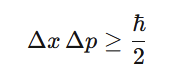
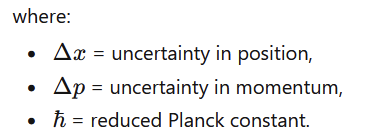
This principle states that a particle cannot simultaneously possess:
- perfectly definite position,
- and perfectly definite momentum.
This is not a limitation of measurement instruments. It is a fundamental law of nature.
Why Absolute Zero Is Impossible
Suppose a particle inside a solid reaches absolute zero.
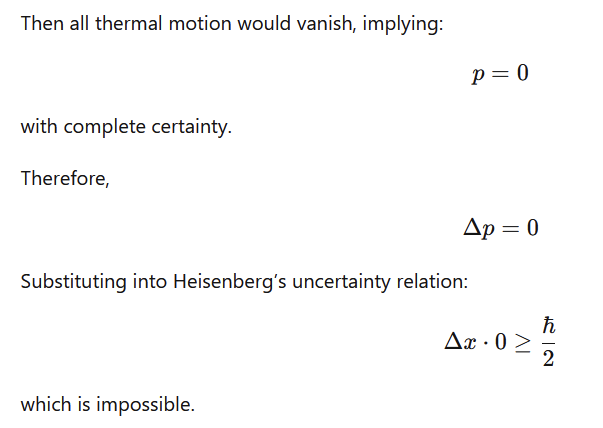
Hence a particle cannot simultaneously have:
- zero momentum,
- and a definite position inside matter.
Some residual momentum uncertainty must always remain.
As a result, particles retain a minimum unavoidable motion even at extremely low temperatures.
This residual energy is called zero-point energy.
Zero-Point Energy
Even near 0 K:
- atoms in a crystal continue to vibrate slightly,
- electrons retain quantum motion,
- and complete stillness never occurs.
Nature permits minimum motion, but never perfect stillness.
Thus:
Absolute zero can be approached indefinitely, but never perfectly reached.
Final Conclusion
Temperature is a measure of microscopic random motion. As temperature decreases, this motion reduces, but quantum mechanics prevents it from becoming exactly zero.
Heisenberg’s uncertainty principle ensures that particles can never possess both perfectly definite position and zero momentum simultaneously.
Therefore:
0 K is Fundamentally Unattainable.
Absolute zero is not merely technologically difficult — it is forbidden by the quantum structure of nature itself.
 The Intuitive Physicist