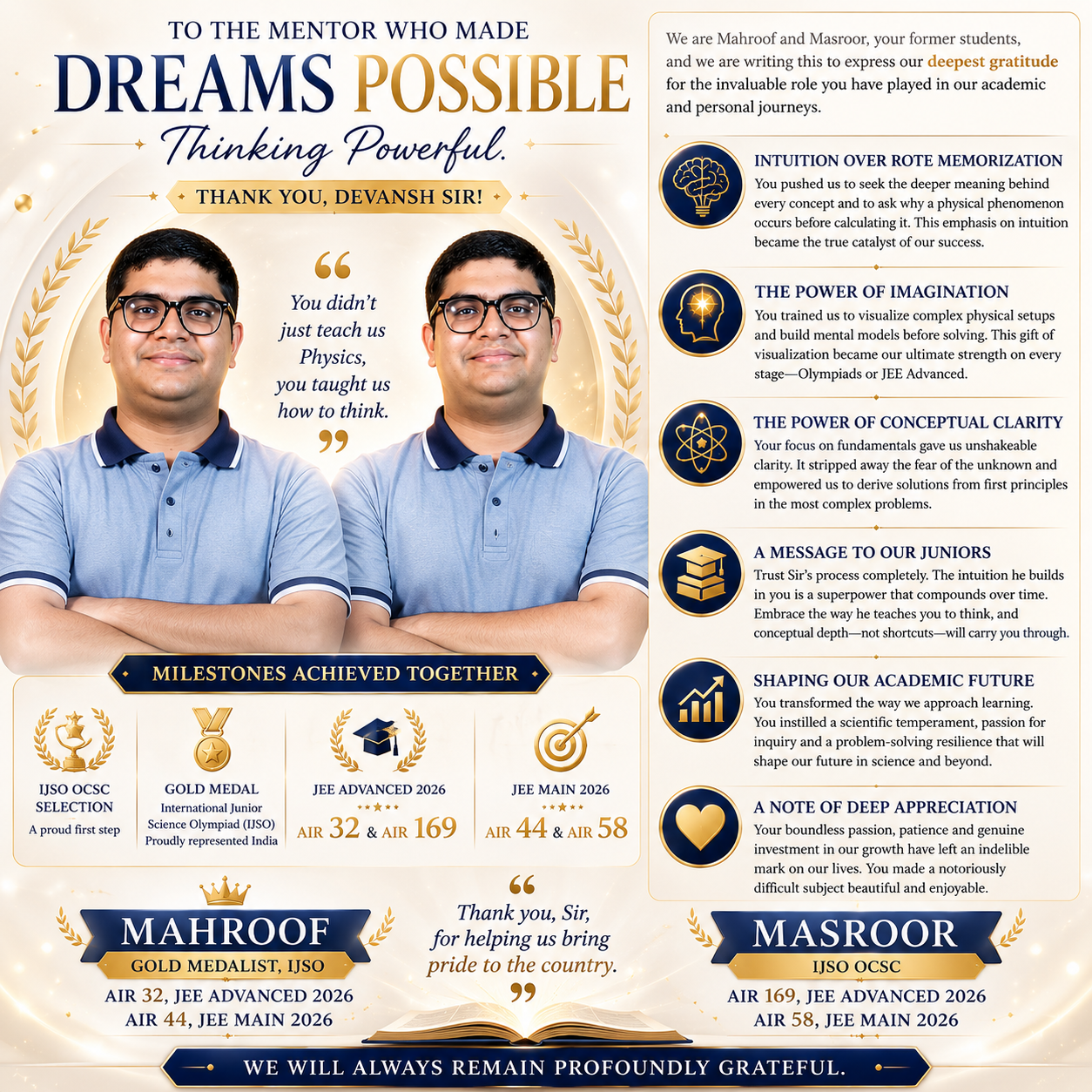
This testimonial comes from two extraordinary brothers, Mahroof and Masroor, whose journeys reflect the power of deep conceptual learning and disciplined thinking. Under my mentorship, Mahroof went on to win a Gold Medal at the International Junior Science Olympiad (IJSO) and secure AIR 32 in JEE Advanced 2026 and AIR 44 in JEE Main 2026, while Masroor achieved AIR 169 in JEE Advanced 2026 and AIR 58 in JEE Main 2026 after qualifying for the IJSO OCSC. In this heartfelt message, they share how intuition, imagination, and conceptual clarity shaped their success and express their sincere gratitude for the role my teaching played in their academic journey.
Respected Devansh Sir,
We are Mahroof and Masroor, your former students, and we are writing this to express our deepest gratitude for the invaluable role you have played in our academic and personal journeys.
Looking back at our milestones, we realize that the foundation of our success was laid entirely under your mentorship.
With your guidance, we were privileged to achieve milestones we once thought were distant dreams:
- IJSO Orientation-Cum-Selection Camp (OCSC) Selection
- Representing India and winning a Gold Medal for the nation at the International Junior Science Olympiad (IJSO)
- AIR 32 & AIR 169 in JEE Advanced 2026
- AIR 44 & AIR 58 in JEE Main 2026
While these ranks and medals are a testament to hard work, the true catalyst was the way you taught us to think.
What set your classes apart was a relentless emphasis on INTUITION OVER ROTE MEMORIZATION.
You constantly pushed us to seek the deeper meaning behind every concept, urging us to ask WHY a physical phenomenon occurs before figuring out how to calculate it.
YOUR UNIQUE APPROACH
You taught us the power of imagination. You trained us to visualize complex physical setups and build mental models before touching a pen to paper.
This gift of visualization became our ultimate strength, giving us the confidence to break down completely unfamiliar problems, whether we were competing on an international Olympiad stage or tackling the toughest questions in JEE Advanced.
THE POWER OF CONCEPTUAL CLARITY
In a competitive landscape where many rely on pattern recognition and formula shortcuts, your focus on absolute conceptual clarity became our greatest competitive advantage.
By ensuring our fundamentals were unshakeable, you stripped away the fear of the unknown. When faced with highly complex, multi-concept problems in JEE Advanced and the Olympiads—questions designed to break standard formulas—our strong conceptual foundation allowed us to derive solutions from first principles.
You didn’t just teach us Physics; you gave us the ultimate toolkit to conquer any high-stakes examination.
A MESSAGE TO OUR JUNIORS
To our juniors who are currently learning under Devansh Sir, our biggest advice is to trust his process completely.
In the beginning, focusing deeply on concepts and visualization might feel slower than just memorizing a formula to get a quick answer. But commit to it anyway.
The intuition Sir builds in you is a superpower that compounds over time. When the syllabus expands and the problems get tougher, it is this conceptual depth—not shortcuts—that will carry you through.
Listen to his insights, ask the “WHYS”, and embrace the way he teaches you to think.
SHAPING OUR ACADEMIC FUTURE
Your impact on us goes far beyond these examinations.
You didn’t just prepare us for a test; you genuinely transformed the way we approach learning itself. By instilling a rigorous scientific temperament and a passion for deep inquiry, you have permanently shaped our future academic paths.
The analytical mindset and problem-solving resilience we developed in your classroom are the very tools we will carry forward into our higher education and future careers in science and technology.
A NOTE OF DEEP APPRECIATION
Sir, we feel incredibly fortunate to have been mentored by an educator of your caliber.
Your boundless passion for Physics, your patience, and your genuine investment in our growth have left an indelible mark on our lives. You made a notoriously difficult subject beautiful and enjoyable.
Thank you for your tireless guidance, your unwavering belief in our potential, and for helping us bring pride to the country.
WE WILL ALWAYS REMAIN PROFOUNDLY GRATEFUL TO YOU.
WITH SINCERE RESPECT AND GRATITUDE,
MAHROOF
Gold Medalist, IJSO
AIR 32, JEE Advanced 2026 | AIR 44, JEE Main 2026
MASROOR
IJSO OCSC
AIR 169, JEE Advanced 2026 | AIR 58, JEE Main 2026
 The Intuitive Physicist