The Introduction
Every year, thousands of ambitious students dream of studying at Stanford, MIT, Harvard, Cambridge, and other world-leading universities. But very few understand what it actually takes to build the kind of academic and personal profile that stands out at that level.
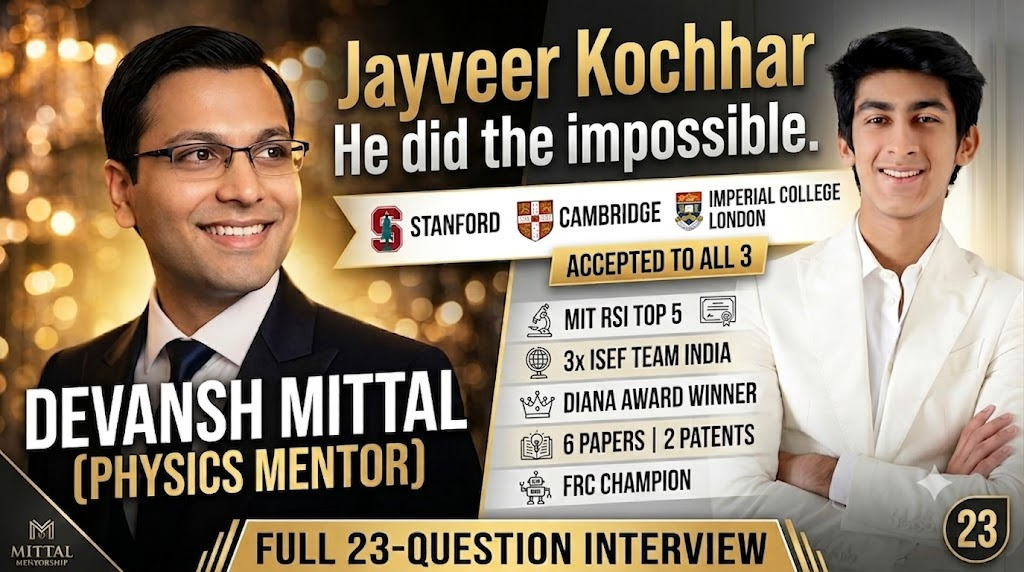
In this exclusive interview, Devansh Mittal speaks with his student Jayveer Kochhar, who has been accepted to Stanford University, Class of 2030, where he intends to pursue Applied Mathematics and Computer Science. Jayveer’s journey is exceptional: he was selected for MIT’s Research Science Institute, received a Top 5 Written Research Paper Award there, represented Team India at Regeneron ISEF for three consecutive years, published six research papers in platforms such as IEEE and Springer, developed two patents, contributed to award-winning robotics teams, earned The Diana Award for social impact, and achieved perfect 5/5 scores in multiple AP Physics exams.
Across 23 thoughtful questions, Jayveer shares the real story behind his admission: how he discovered his interests, built depth in applied mathematics, pursued research and robotics, balanced academics with high-level competitions, handled pressure, chose meaningful opportunities, and developed the strategic mindset required for elite university admissions. This interview is not merely about getting into Stanford. It is a practical roadmap for students who want to build intellectual depth, authentic impact, and a profile worthy of the world’s best universities.
The Conversation
BLOCK 1 – The Dream
Q1: Congratulations on your admission — take us back to the moment you found out. What did that feel like, and who was the first person you called?
When I received my acceptance from Stanford, I was not at home — I was in Bangalore attending a training camp for the International Science and Engineering Fair (ISEF). The admissions decisions are released at US time, which meant it was 5:30 AM in India. I had set an alarm on my phone, woke up, checked the portal, and saw that I had been admitted to Stanford.
The first people I called were my parents, to share the news with them, because they have been an integral part of my journey. After that, I told a few close friends, slept for another three to four hours, and then woke up and texted my mentors and teachers to thank them for their support.
Q2: When did you first truly decide, that a place like Stanford is your goal?
Although I was not entirely certain that Stanford would be my final destination, I knew from around Grade 9 that I wanted to target a top US university, and I began preparing with that goal in mind ever since. The specific decision to apply early to Stanford was made around August or September of Grade 12 (2025), approximately three to four months before the early application deadline.
BLOCK 2 – Building the Foundation
Q3: Could you share your entire journey with me? I would love to understand everything you did — from the time you first dreamed of getting into Stanford until the day you were admitted. Specifically, I’d like to know: which exams you appeared for; what activities, projects, or achievements you pursued; which decisions and efforts had the greatest impact on your admission; which things, in hindsight, were not particularly impactful; and any lessons you learned or things you wish you had done differently. A chronological account of your journey would be incredibly helpful.
Even before Grade 8, I was always more inclined toward academics. I would participate in competitions such as the AMC (American Mathematics Competitions) and NMTC (National Mathematics Talent Contest) for math. At that stage, it was purely out of curiosity rather than any specific college goal. I also did basic robotics using Lego kits and learned Scratch coding.
Things really accelerated toward the end of Grade 8 and the start of Grade 9. That is when I first got involved in FTC (First Tech Challenge), a global robotics competition. This is where I picked up a lot of my coding skills. Combined with some coding classes I took, I learned programming fundamentals. I participated in FTC for two years, competing in both Indian Nationals and traveling to Australia to represent India.
My entire robotics journey culminated in 2025 when I was participating in the First Robotics Competition (FRC). My team became the first Indian team to ever win a Regional — this was in Istanbul, Turkey. After that, we also represented India at the World Championships in Texas, USA. Robotics has been one major pillar of my journey.
The other major pillar has been exams and Olympiads. Throughout Grades 9 to 12, I have been participating in the Sir Isaac Newton exam, NSEP (the National Standard Examination in Physics, which is India’s qualifier for the International Physics Olympiad), IOQM (the qualifier for the International Mathematical Olympiad), and the AMC. I would advise that there are many Olympiads available, but if one truly cares about going down the path of reaching the Indian team, one should focus on the national-level qualifiers like NSEP or IOQM. Many other Olympiads may not be as useful or prestigious, even though they call themselves Olympiads.
In terms of research projects and activities: my research journey began in Grade 8, when I started my first project under my mentor. It was related to human breathing and how external sensors can be used to track respiratory patterns. That project marked the beginning of a very important journey for me, because it led to my participation in the qualifying fairs for ISEF (International Science and Engineering Fair). ISEF is the world’s largest and most prestigious high school STEM science fair. Only 20 projects are selected to represent India — making selection almost comparable to making a national Olympiad team. The first step is the IRIS National Science Fair.
I started participating in IRIS in Grade 9. In Grades 10, 11, and 12 — all three years — I qualified to represent India at ISEF and won awards in multiple years. That research, which started in Grades 8 and 9, was incredibly important for me, because it led me to write six research papers. Writing these papers helped me realize my true interests, as I explored different fields: three of my papers were in biomedical engineering (developing working prototypes), for which I received a utility patent. My other projects were more theoretical — for example, developing algorithms and computer vision techniques for motion tracking, or classifying stars using astrophysics and machine learning.
Beyond research, other components that strengthened my application included social service (I donated my respiratory diagnostic prototypes to public hospitals), leadership (I served as Head Boy of my school), and sport (I have practiced Taekwondo since the age of three and competed at an international level).
As for things that were not particularly impactful in hindsight: participating in random, minor competitions that lack real prestige or recognition does not add much value. The key lesson I learned is that depth matters far more than breadth — committing deeply to one area and building a sustained track record is what makes a real difference.
Q4: What specific habits and study strategies you followed to achieve this goal?
One challenge I have always faced — and still work on to this day — is organization and time management. Staying organized is extremely beneficial when you are balancing academics, research, competitions, and applications.
In terms of study strategy, I believe it is important not to study blindly for hours. Many students study continuously without evaluating their progress, which is inefficient. My approach has always been to focus on problem-solving first. If I encountered a question I could not solve, I would go back to the theory, revise that specific concept, and then return to the problems. This reverse-revision method — solving first, then learning theory as needed — worked exceptionally well for me.
BLOCK 3 – Building a World-Class Profile
Q5: Which exams, Olympiads, research projects or extracurricular activities had the greatest impact?
Because US universities evaluate profiles holistically, every component plays a role. However, certain achievements had an outsized impact on my application:
First, the MIT Research Science Institute (RSI). RSI is a six-week program at MIT where you are assigned a research mentor and work alongside real PhD students in a laboratory. It is extremely competitive — only three to four students from India are selected each year. Getting into RSI signals to US universities that you are truly ready for the next level of academic work.
Second, the International Science and Engineering Fair (ISEF). Representing Team India at ISEF for three consecutive years (2023, 2024, and 2025) and winning awards was a significant component. Training for the Olympiad is a major time commitment, and I chose a slightly different path by focusing on ISEF. US universities value sustained participation in ISEF highly.
Third, the Diana Award. This is a social service award given by the British Royal Family. I received it for using my respiratory diagnostic prototypes for public benefit — I donated several devices to public hospitals where they could be used for patient care. I believe this signaled to the universities that I was applying my skills and patents to do good for others, which also had a significant impact.
While reaching the national team for the International Mathematical Olympiad (IMO) or International Physics Olympiad (IPhO) is also extremely prestigious and would make a huge impact, I chose a different path. Students should weigh their options carefully and choose between the Olympiad route and the research/science fair route based on their strengths and interests.
Q6: Rank the following by importance and explain why: Academics, Olympiads, SAT/AP, Research, Essays, Leadership, Recommendation Letters, Interviews, extracurricular activities.
The ranking depends entirely on whether you are applying to the UK or the US, because the two systems are fundamentally different.
For UK universities, the process is far more straightforward and heavily academic. Extracurricular activities, leadership, and research are given almost no importance. The ranking is: (1) School Academics and Grades — this is the primary baseline; (2) University Entrance Exams — the ESAT, TMUA, or PAT, depending on your subject; (3) Technical Interview — this is a purely technical, physics-and-math-based problem-solving interview; (4) Recommendation Letters; (5) Personal Statement/Essays. Everything else is essentially irrelevant in the UK system.
For US universities, the process is holistic. The ranking is: (1) Academics, SAT, and AP Exams combined — these serve as the threshold baseline; without strong scores, your application may not even be reviewed; (2) Extracurricular Activities, Olympiads, Research, and Leadership — I would group all of these together as the second most important layer, as they are what differentiate you from other academically strong applicants; (3) Essays and Recommendation Letters — these are crucial for presenting your personality, character, and the human being behind the achievements; (4) Admissions Interviews — these do not make a significant difference for US admissions.
Q7: Given the goal in our context, what opportunities do Indian students have and they most commonly miss?
One major opportunity that many Indian students miss is participation in science fairs. Science fairs are a big deal for US admissions, yet most students preparing for competitive examinations like JEE are not even aware they exist. For example, submitting your research projects to IRIS (the Indian national science fair) is a significant opportunity that I feel more students should take advantage of. IRIS is the qualifier for ISEF, and making it to ISEF is comparable in prestige to representing India at an Olympiad.
Apart from IRIS and ISEF, there are other research competitions such as the S.T. Yau High School Science Award (where initial submissions are online and finals are held in Hong Kong and China) and the Genius Olympiad. These are all research paper competitions that provide excellent platforms to showcase scientific work.
Robotics is another commonly missed opportunity. To start an FTC (First Tech Challenge) team, you essentially need only seven or eight dedicated people. Through competitive robotics, students learn not just engineering and coding, but also fundraising, project management, manufacturing skills, and teamwork — all of which are extremely valuable for a university application. These are skills that standard school curricula simply do not teach.
BLOCK 4 – The Admission Journey
Q8: What do you think ultimately earned you admission?
I believe what ultimately earned me my admission was perseverance — not any single award or exam score. Because the US admissions process is holistic, it is impossible to credit any one achievement. What mattered most was the fact that I persevered through doing so many things simultaneously, through many tough times with enormous workloads, and I continued to deliver results. If you can genuinely push through those challenges, you will earn a strong admission.
Q9: What did your application primarily focus on?
I applied for Applied Mathematics as my first-preference major, with Computer Science as my second preference, and I will likely pursue both at Stanford as a double major.
Although my projects span very different domains — biomedical engineering, computer vision, astrophysics, physics — one thing that is common throughout all of them is the application of advanced mathematics. I do not mean basic math like solving a quadratic equation; I mean university-level applied mathematics: Fourier space analysis, complex error propagation, stochastic calculus, and even quaternions (four-dimensional numbers used in computer graphics generation).
My entire application was built around the narrative that I am someone who applies mathematical knowledge to solve real-world problems across different disciplines. When your application weaves all your experiences into a coherent personal story, it leaves a lasting impression.
Q10: What role did essays, recommendations and interviews play?
Essays are extremely important because, while it is one thing to present a list of awards, universities genuinely want to see what kind of person you are. Your essays must be unique and deeply personal — they cannot be generic. Essays are what bring your application to life.
Recommendation letters are also important, though not as critical as essays. They provide external validation of your character and academic ability from people who know you well.
For US admissions, the interview does not matter much, to be honest. However, for UK admissions, it is the exact opposite. In the UK, the interview is the final and most decisive stage — it consists entirely of technical questions in physics and mathematics, and you must perform well to receive an offer. So for the UK, interviews are the most important component, while for the US, essays hold that position.
Q11: What misconceptions about admissions should students stop believing?
There are several significant misconceptions that students and parents need to stop believing:
First, people must understand that US admissions are holistic. The admissions committee is not looking at any one specific thing — they evaluate your entire application in the context of where you are from. It is not the case that winning one Olympiad guarantees admission. Your application must be well-rounded.
Second, many families refrain from applying to US universities because they believe it is too expensive or that there are not enough scholarships. This is simply not true. Many top universities — including MIT and Harvard — are need-blind, which means that if you are admitted and cannot afford the fees, they will cover whatever financial need you demonstrate. Students should never hold back from applying simply because they assume it will be too expensive.
Third, there is a common belief that students only apply abroad because the Indian system is too hard for them. This is also incorrect. The US admissions process is genuinely very tough, particularly for Indian passport holders. For example, while approximately 25 people from India may be admitted to Stanford in a given year, about 10 of them would hold US passports. That means only around 15 actual Indian-passport students are admitted. The numbers are extremely low, and the competition is fierce.
BLOCK 5 – Challenges & Mindset
Q12: What was the toughest phase of your journey? How did you handle pressure, setbacks and self-doubt?
I had two particularly tough periods during my journey.
The first was during my Grade 10 board exams. My board exams coincided with traveling to Los Angeles for ISEF. It was a very challenging time because I was simultaneously preparing for my board exams and for ISEF, and I had to travel internationally. I actually had to give my board exams during the competition — in between judging sessions, I would sit and write my papers. Just two months after ISEF, I also traveled to Australia for the First Tech Challenge. There was an enormous amount of work happening at once, along with ongoing preparation for physics classes and other commitments.
The second tough period was during the second term of Grade 11. I had to travel to Turkey in March for the FRC Regional, to the US in April for the FRC World Championships, and to Columbus, Ohio in May for ISEF. Since I study in the IB Diploma Programme, my Grade 11 second-term examinations were critically important — these are the exams based on which teachers assign predicted grades, and those predicted grades are sent to US universities (because the final IB exams happen in May, after admissions decisions). All of this was happening at the same time.
To handle the pressure and setbacks, it is important to stay focused on your goal. You have to accept that these challenges will happen, and if you want to achieve your goal, you simply have to push through them. Everyone has different coping mechanisms, but for me personally, it was a matter of telling myself: whatever the problem is, I will deal with it, because I want to achieve my goal of getting into a top university.
Q13: What role did your family, mentors and friends play?
My family was absolutely essential. My mother has been one of my greatest supporters. None of this would have been possible without her, because she helped me stay organized, find teachers, discover new opportunities, and manage the entire process. Although she herself is not a STEM student and never studied math or physics, she always tried her best to help in every way she could. Both my parents have been truly supportive throughout the entire journey.
Mentors are also an incredibly important part — not only for your admission, but for who you become as a person. They shape many of your beliefs, because as a young student, these are the people who are teaching you and influencing your development. For mentors, I would say that Devansh Mittal Sir is the best physics teacher I’ve ever had — his classes were essential in helping me develop a strong foundation in physics and in learning how to apply it wherever I needed to. My robotics mentor was also instrumental throughout my journey.
Friends are always there to support you through everything. Sometimes you need a lighthearted conversation and a chance to relax, and friends provide that essential balance.
BLOCK 6 – The Roadmap
Q14: Design an ideal roadmap for a student aspiring for global universities?
I will describe an ideal roadmap for a STEM student. For US universities, it is important to be involved in some form of research work — you do not need to write six research papers; even one or two is helpful. At the same time, you need to cover all aspects of your application: play a sport, do some social service, and perhaps take on a leadership role. These are all secondary components.
The most critical step is to choose one area where you want to demonstrate depth. For me, that was applied mathematics — I did all my work in that area. If someone is interested in chemistry, for example, they should do all their projects in chemistry, participate in chemistry competitions, and show that they are uniquely accomplished in that field. Aim for achievements that other people could not easily replicate — whether that is through Olympiads, research competitions, or patents.
In summary: apart from the baseline activities like social service and leadership, the ideal roadmap is to pick one area and excel in it at the highest possible level.
Q15: What should students focus on in Classes 8, 9, 10, 11 and 12?
Apart from the application itself, the most important thing students should focus on is developing a strong conceptual base. I am able to carry out the research projects I do today only because I have a strong conceptual foundation in math, physics, and coding.
When you have a strong base, and you then go and apply your knowledge in a robotics competition or a research project, you gain enormously more benefit than someone who jumps straight into projects without understanding the fundamentals. Furthermore, even if a student manages to gain admission to a top US university purely based on achievements but without a solid conceptual base, they will lag behind once they reach university.
Therefore, throughout your school years, in whichever subjects you wish to pursue, you should be learning the underlying theory deeply and well. Strong academics and deep conceptual understanding should be the non-negotiable foundation upon which everything else is built.
Q16: What books, websites, YouTube channels and mentors would you recommend?
For physics, I used the standard H.C. Verma textbooks (Concepts of Physics). I also had Irodov (Problems in General Physics) at home, though I used it selectively for a few specific problems.
For math, I strongly recommend the website Art of Problem Solving (AoPS). It is an outstanding resource because it covers every topic you would ever need for Olympiad math, with questions organized by topic and difficulty. The platform also tracks every question you solve, allows you to review past problems, and includes actual past-paper questions from various Olympiads. For math preparation, it is probably the best resource available.
For coding and machine learning, I primarily used YouTube. There are excellent channels for learning Python, TensorFlow, and machine learning concepts. GitHub is another invaluable resource — you can study other people’s code repositories and learn from their implementations.
In terms of general academic YouTube channels, I watch Veritasium and 3Blue1Brown — the latter is probably my favourite YouTube channel for developing mathematical intuition.
For mentors: Devansh Mittal Sir is the best physics teacher I have ever had. His classes have been quite essential to me, actually developing a strong base in physics and applying it wherever I needed to. For robotics, I attended classes at Omotech, which were excellent. Having the right mentors early on saves months of trial and error.
Q17: How should students balance school, extracurricular activities, Olympiads, JEE (if applicable) with international admissions?
If you are not preparing for JEE, then school should always be your first priority, because academics are the most important component. Without strong academics, you will not secure your admission. Extracurricular activities form the second layer — they are built on top of the academic foundation. If you are preparing for JEE, the same principle applies: JEE should be your first priority because it is the exam that secures your admission to Indian institutions.
For your secondary focus, you should choose between Olympiads and project-based extracurriculars depending on your working style. Olympiads require a very specific skill set — you sit down for three hours and solve written problems under pressure. That may not be everyone’s style. Some students prefer working over multiple days to solve larger, more complex problems that span multiple subjects. If that describes you, then research, patents, and science fairs may be the better path.
Olympiads are extremely prestigious, but they are not for everyone. And if you choose not to pursue Olympiads, there are many other ways to demonstrate excellence for the US application process. The key is to not try to do everything simultaneously — pick your path and commit to it.
BLOCK 7 – Legacy & Rapid Fire
Q18: One habit every successful student should develop.
Not giving up. That is the most important thing. You should always persevere through the challenges life throws at you — whether it is a difficult question, a stressful exam season, or any personal setback. Perseverance is non-negotiable.
Q19: One mistake every student should avoid.
Losing focus and being inconsistent. You cannot study physics intensively for six months and then abandon it for the next six months — that is not how learning works; you would forget everything. You have to be consistent. While it is not always possible to maintain a perfectly fixed schedule throughout the year, you must try your best to maintain consistency in your efforts.
Q20: One opportunity students should pursue early.
No student should be held back by their school curriculum. This was instrumental for me. If you feel the school curriculum is too easy or basic, start learning higher-level material immediately — move on to the next level. If school physics feels too easy, begin studying Olympiad-level physics. This is true for any subject, not just physics.
You should always be pushing yourself and learning at a higher level. For example, I am currently pursuing mathematics at Stanford, and this summer I have been studying material for courses I will likely take in my second year of university. You should never be satisfied with your current level and think “this is good enough.” Always keep learning the higher-level material.
Q21: One myth about Ivy League admissions.
That they are objective. They are not. The US admissions process is not completely random, but there is a genuine element of randomness involved. For example, I was admitted to Stanford, but I did not get into several other top universities — including Harvard and Princeton. It is not 100% guaranteed that a great profile with no glaring weakness will get you into every school. You will get into some top university — that is true — but not necessarily the one you expect. The process contains randomness, and it is perfectly fine to not get into the highest-ranked school.
Q22: One piece of advice for parents.
It is important to push your children from an early age and encourage them to take up high-level challenges. But at the same time, you must listen to what your child has to say. If your child wants to study chemistry, do not force them to do math — that does not make sense. Support your child’s genuine interests and push them to take those interests further. Help them pursue what they truly want to do, and encourage them to do it at the highest level possible.
Q23: Your message for students dreaming of studying at the world’s best universities.
Work smart. Especially if you want to get into a good US university, just blindly working hard is not the correct approach. You have to be strategic — evaluate what is going to benefit you, what will appear on your application, and work accordingly. Work backwards: look at your final goal, and then determine what you need to do to achieve it.
Second, understand the college admissions process for the US. Understand where you should apply early, where you should apply in the regular round — these are critically important strategic decisions. Be strategic, not just hard-working. Hard work is obviously important, but to secure a strong admission, it is equally important to have a well-thought-out strategy.
Devansh Sir’s 10 Insights for Future Ivy League and Global University Aspirants
1. Stop trying to build an application. Start building a serious intellectual life.
Jayveer’s Stanford acceptance was not the result of last-minute profile building. It was the outcome of years spent exploring mathematics, physics, coding, robotics, research, and real-world problem-solving. Elite universities can usually distinguish between students who collect achievements and students who genuinely live their interests.
2. The strongest profile is not the longest profile. It is the most coherent one.
Jayveer’s work covered biomedical engineering, computer vision, astrophysics, machine learning, physics, robotics, and patents. Yet the common thread was applied mathematics. Future applicants should not chase random activities. They should build a clear intellectual story that connects their choices, projects, and ambitions.
3. Research is one of the most powerful ways to prove readiness for top universities.
Programs and platforms such as MIT RSI, ISEF, IRIS, and serious independent research projects allow students to show originality, persistence, technical maturity, and the ability to work beyond the school curriculum. For STEM aspirants, meaningful research can become a defining differentiator.
4. Olympiads are prestigious, but they are not the only path to excellence.
Jayveer makes an important distinction: Olympiads such as NSEP, IOQM, IMO, and IPhO are highly valuable, but they suit a particular kind of learner. Students who are not naturally aligned with Olympiad-style timed problem-solving can still demonstrate excellence through research, robotics, engineering projects, social impact, and advanced academic work.
5. Do not let the school curriculum become the ceiling of your ambition.
One of Jayveer’s strongest messages is that students should move beyond school-level learning when they are ready. If school Physics feels basic, explore Olympiad Physics. If school Mathematics feels easy, study advanced mathematics. The students who reach the highest levels usually start learning beyond the syllabus much earlier than others.
6. For US admissions, essays reveal the person behind the achievements.
Awards and scores show what a student has done, but essays explain who the student is. Jayveer emphasizes that strong essays must be personal, specific, and authentic. A generic essay weakens even a strong profile, while a thoughtful essay can connect achievements into a memorable human story.
7. UK and US admissions are completely different games.
Jayveer’s ranking of application components is extremely important. UK universities prioritize academics, subject entrance tests, and technical interviews. US universities look more holistically at academics, research, extracurricular depth, essays, recommendations, and context. Students must prepare for the system they are actually applying to, not rely on vague global-admission advice.
8. Financial fear should not stop serious students from applying abroad.
Many Indian students avoid applying to top US universities because they assume the cost is impossible. Jayveer points out that several leading universities offer strong financial aid, and some are need-blind for international applicants. Students should research financial aid carefully before ruling themselves out.
9. Perseverance is more valuable than a perfect journey.
Jayveer faced periods where board exams, ISEF, robotics travel, IB predicted grades, research, and regular academics overlapped intensely. His lesson is simple: ambitious paths will contain difficult phases. The students who succeed are not those who avoid pressure, but those who continue working through it with clarity and purpose.
10. Work backwards from the dream, then work smart every day.
Jayveer’s final advice is not just to work hard, but to work strategically. Understand your target universities, know what they value, choose opportunities carefully, decide where to apply early, and build your profile intentionally. Hard work matters, but direction multiplies effort. Without strategy, even sincere effort can be wasted.
Final Thought
The central lesson from Jayveer Kochhar’s journey is clear: elite university admissions are not won by shortcuts, generic activities, or a checklist mentality. They are earned through deep learning, authentic curiosity, meaningful work, strong mentorship, perseverance, and intelligent strategy. Students who begin early, think clearly, and build depth in what they truly care about give themselves the best chance of standing out in the most competitive admissions processes in the world.
 The Intuitive Physicist