Tag Archives: philosophy

When the Straight Line Is Not the Fastest Path

Standard

When the Straight Line Is Not the Fastest Path

A Beautiful Idea from Physics

We often hear the statement:

“The shortest distance between two points is a straight line.”

In geometry, this is absolutely correct.

But physics teaches us something deeper:

The shortest path is not always the fastest path.

Sometimes a slightly longer curved path can take less time than a straight-line path.

At first this sounds impossible, but Nature gives many beautiful examples of this idea.


Distance and Time Are Not the Same Thing

Suppose you want to travel from one place to another.

Your travel time depends on two things:

  • the distance traveled,
  • and your speed during the journey.

Mathematically:

Time = Distance / Speed

This means that even if a path is longer, it can still take less time if you move faster along it.

This simple idea is the key to understanding the entire article.


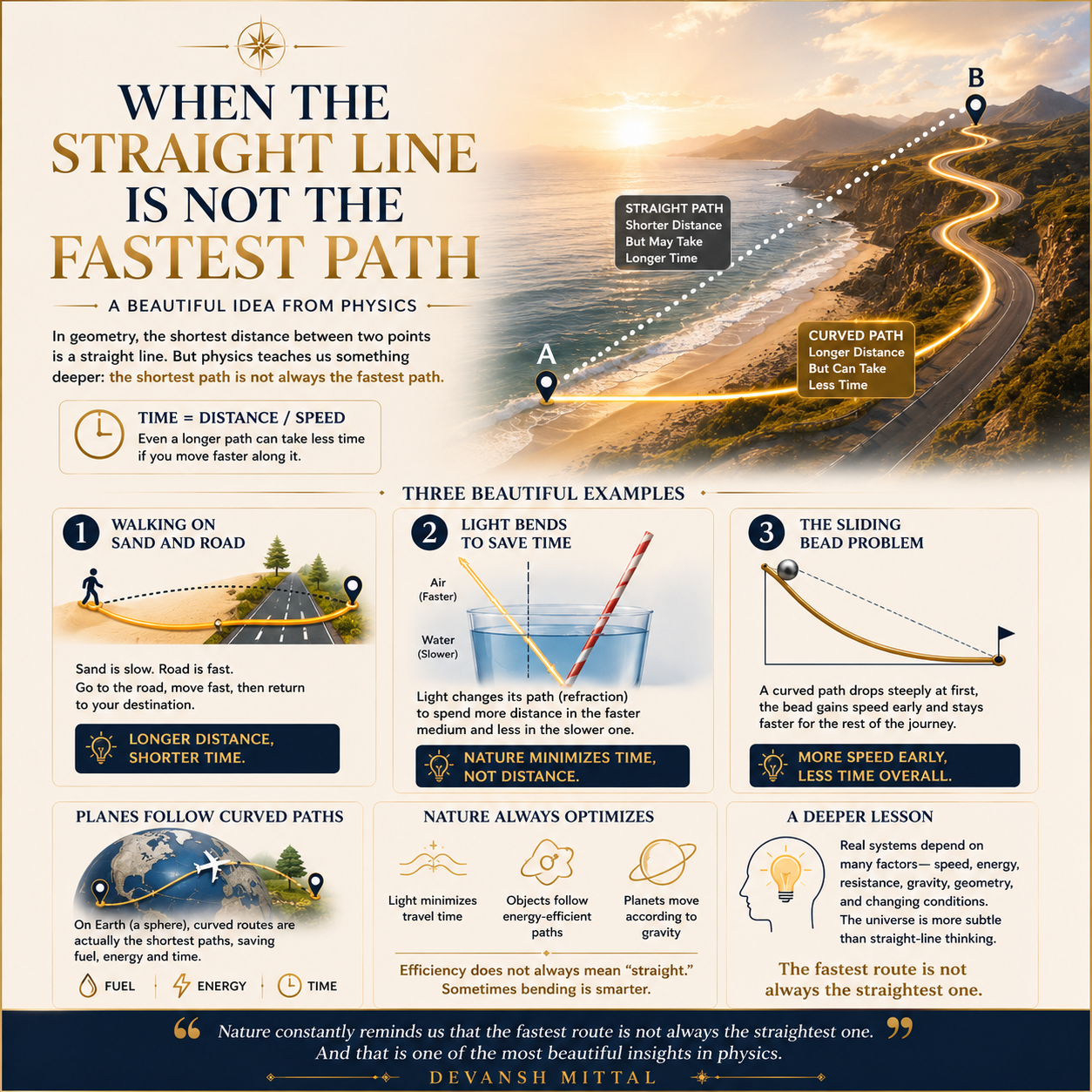
Example 1: Walking on Sand and Road

Imagine you are standing on a beach.

  • Walking on sand is slow.
  • Walking on a road is much faster.

Now suppose your destination lies far away along the beach.

Should you walk directly toward it in a straight line through sand?

Not always.

A faster strategy may be:

  • first move toward the road,
  • travel quickly along the road,
  • then return toward the destination.

Even though the total distance becomes larger, the total time can become smaller because most of the motion happens on the faster surface.

So:

Shortest distance ≠ shortest time.


Example 2: Light Does Not Always Travel in Straight Lines

Light usually travels in straight lines in air.

But when light enters water or glass, it bends.

This phenomenon is called:

Refraction

Why does light bend?

Because light travels slower in water than in air.

To save time, light changes its path so that it spends more distance in the faster medium.

This is why a straw placed in water appears bent.

Nature is not trying to minimize distance.
Nature is trying to minimize time.


Example 3: The Sliding Bead Problem

This is one of the most famous problems in physics.

Imagine a bead sliding under gravity from one point to another.

Which path will take the least time?

Most people naturally think:

“A straight line.”

But surprisingly, this is wrong.

A curved path can actually be faster.

Why?

Because the curved path drops steeply at first, allowing the bead to gain speed quickly due to gravity.

After gaining large speed early, the bead continues moving rapidly for the rest of the journey.

So although the curved path is longer, the higher speed makes the total time smaller.

This is one of the most beautiful ideas in physics.


Why Curved Paths Can Be Faster

There are two competing effects:

Straight Path

  • shorter distance,
  • but slower speed gain.

Curved Path

  • longer distance,
  • but faster speed gain.

Sometimes the increase in speed is more important than the extra distance.

That is why the curved path wins.


Airplanes Also Follow Curved Paths

When airplanes travel long distances on Earth, their routes often appear curved on maps.

But Earth is spherical, not flat.

The curved-looking route is actually the shortest path on a sphere.

This path helps save:

  • fuel,
  • energy,
  • and travel time.

Again, Nature and engineering often prefer optimal paths rather than visually straight ones.


Nature Always Tries to Optimize

Many laws of physics are based on optimization principles.

For example:

  • light tries to minimize travel time,
  • objects move in ways that reduce energy,
  • planets follow paths determined by gravity.

Physics repeatedly shows that Nature is extremely efficient.

But efficiency does not always mean “straight.”

Sometimes:

  • bending is faster,
  • curved motion is smarter,
  • and indirect paths become optimal.

A Deeper Lesson

This idea teaches us something important beyond physics.

Our intuition often focuses only on distance.

But in real systems, many factors matter:

  • speed,
  • energy,
  • resistance,
  • gravity,
  • geometry,
  • and changing conditions.

The universe is more intelligent and subtle than simple straight-line thinking.


Final Thoughts

The statement:

“The shortest distance between two points is a straight line”

is true in geometry.

But physics asks a deeper question:

“What path takes the least time?”

And the answer is often very different.

Light bends.
Objects curve.
Airplanes follow arcs.
Sliding beads move faster on curved tracks.

Nature constantly reminds us that the fastest route is not always the straightest one.

And that is one of the most beautiful insights in physics.
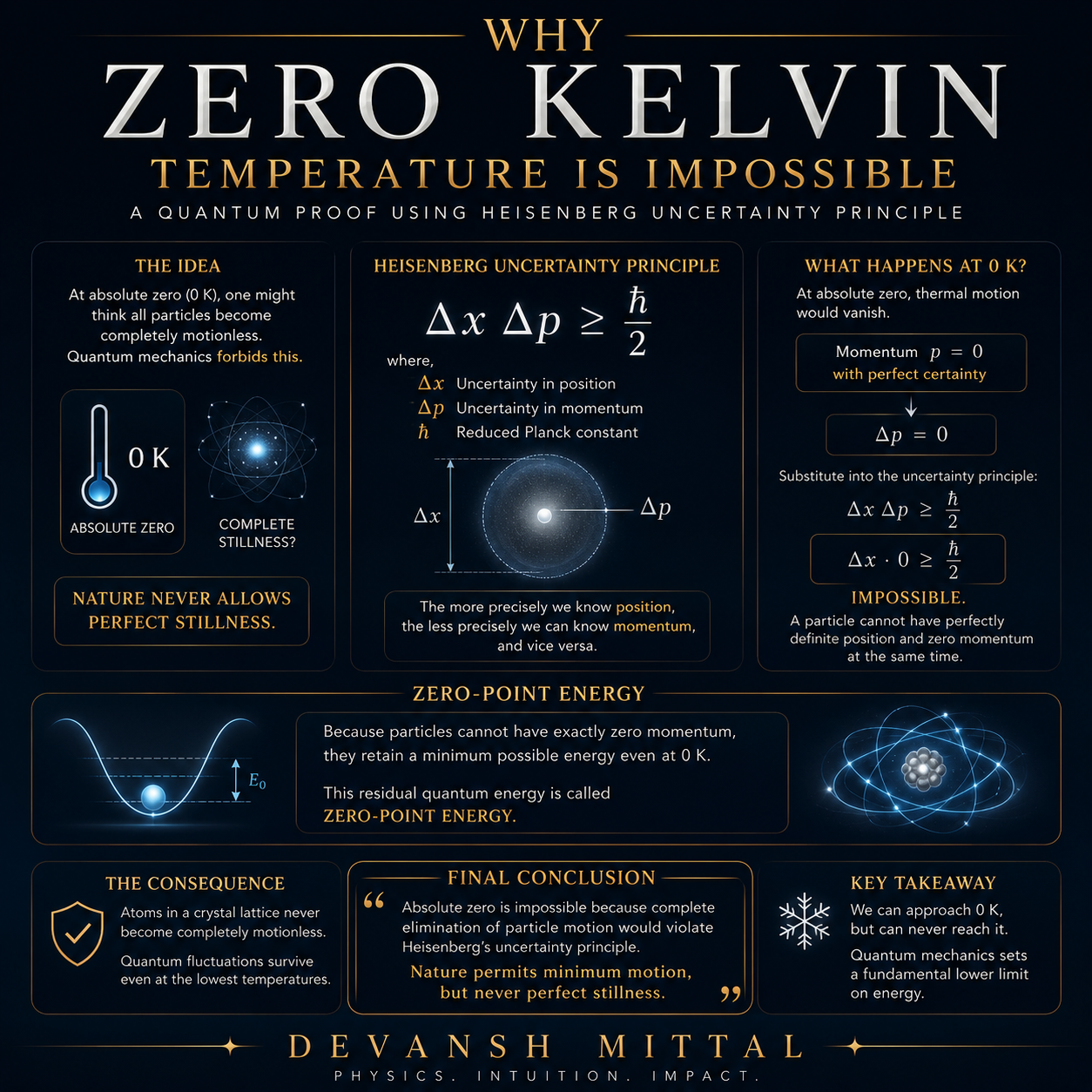
Temperature, Entropy and Quantum Mechanics: Why Zero Kelvin is Not Possible?

Standard

What Is Temperature?

A Modern Understanding of Temperature

Temperature is something we experience every day. We say that tea is hot, ice is cold, and the weather is warm or cool. But in physics, temperature is much deeper than just the feeling of “hotness” or “coldness.”

Modern science tells us that temperature is related to the motion and energy of tiny particles such as atoms and molecules.


Temperature and Particle Motion

All matter is made of particles that are always moving.

  • In hot objects, particles move faster.
  • In cold objects, particles move slower.

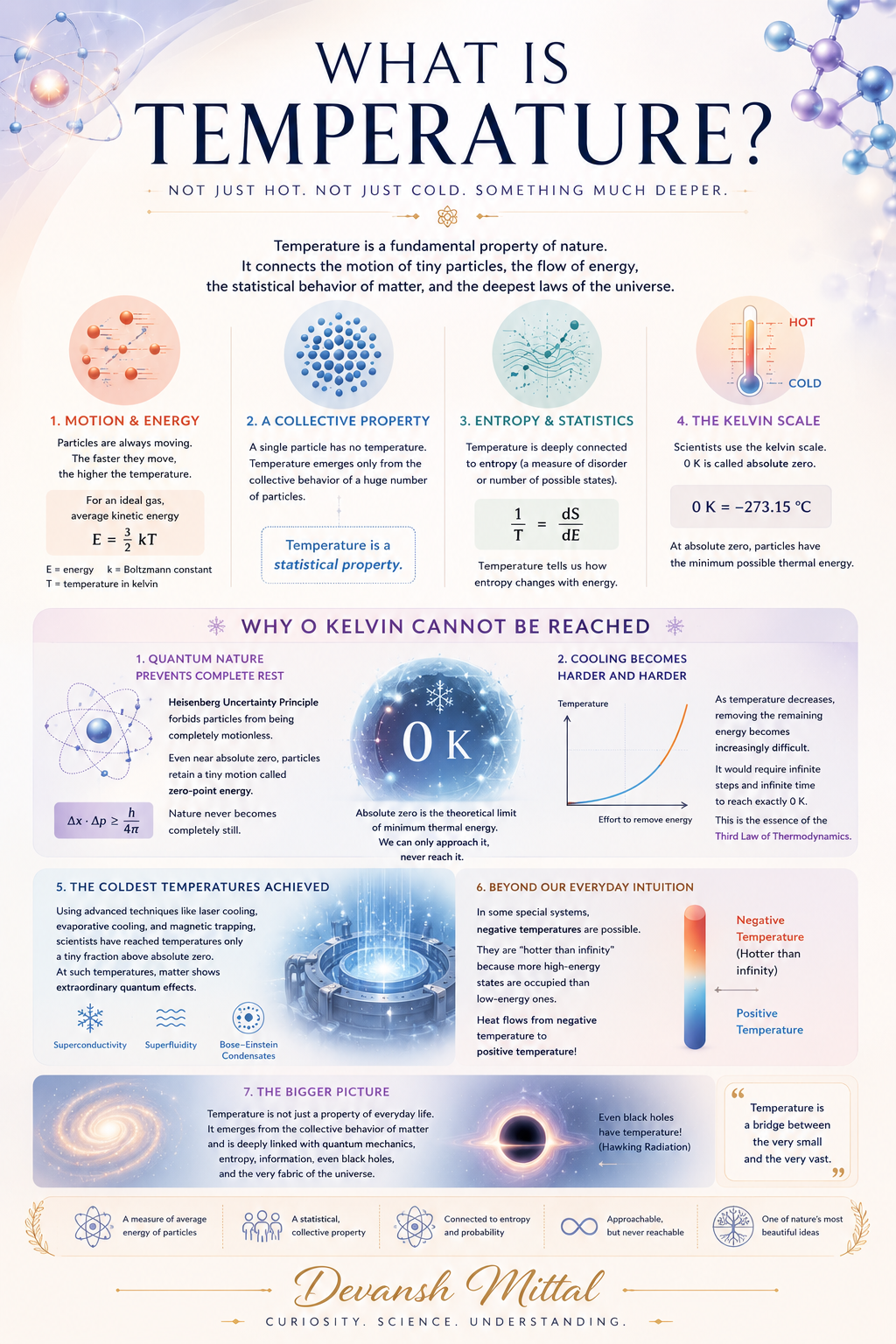
For an ideal gas, the average kinetic energy of particles is:

E = (3/2) × k × T

where:

  • E = average kinetic energy
  • k = Boltzmann constant
  • T = temperature in kelvin

This means temperature is connected to the average energy of random particle motion.


Temperature Is a Collective Property

A single molecule does not have a temperature.

Temperature appears only when a very large number of particles are considered together.

So, temperature is a “collective” or “statistical” property of matter.


Temperature and Entropy

Modern physics also connects temperature with a very important idea called entropy.

Entropy measures the amount of disorder or the number of possible microscopic arrangements inside a system.

  • Higher temperature generally means particles can arrange themselves in more possible ways.
  • Lower temperature means fewer possible arrangements.

The deep thermodynamic relation is:

1/T = dS/dE

where:

  • T = temperature
  • S = entropy
  • E = energy

This equation shows that temperature is deeply connected to how energy and disorder are related in Nature.


The Kelvin Scale and Absolute Zero

Scientists use the kelvin scale for temperature.

  • 0 K is called absolute zero.
  • 0 K = −273.15°C

At absolute zero, particles have the minimum possible thermal energy.


Why Zero Kelvin Cannot Be Reached

According to modern physics, reaching exactly 0 K is impossible.

There are two major reasons.


1. Heisenberg’s Uncertainty Principle

Quantum mechanics tells us that particles can never become perfectly motionless.

According to the Heisenberg Uncertainty Principle:

Δx × Δp ≥ h/(4π)

where:

  • Δx = uncertainty in position
  • Δp = uncertainty in momentum
  • h = Planck’s constant

This means we cannot know both the exact position and exact momentum of a particle at the same time.

If a particle became completely motionless at 0 K, its momentum would become exactly zero, which would violate quantum mechanics.

Therefore, even near absolute zero, particles still possess a tiny unavoidable motion called:

Zero-point energy

So Nature never becomes completely still.


2. Cooling Becomes Harder and Harder

As temperature decreases:

  • particles lose energy,
  • but removing the remaining energy becomes increasingly difficult.

Scientists can get extremely close to 0 K, but they can never reach it exactly.

This idea is part of the Third Law of Thermodynamics.


The Coldest Temperatures Ever Created

Using advanced techniques like laser cooling, scientists have cooled matter to temperatures only a tiny fraction above absolute zero.

At such temperatures, strange quantum effects appear, including:

  • superconductivity,
  • superfluidity,
  • Bose–Einstein condensates.

These states help scientists study the quantum world.


Modern Understanding of Temperature

Today, physicists understand temperature as:

  • a measure of the average energy of particles,
  • a statistical property of many particles together,
  • a quantity deeply connected with entropy,
  • and a concept linked with quantum mechanics.

Temperature is therefore not just about “hot” and “cold.”
It is one of the fundamental ideas that helps us understand the microscopic behavior of matter and the deeper laws of the universe.

What is Temperature? and Why Absolute Zero is not possible?

Standard

What Is Temperature?

Temperature is one of the most familiar quantities in physics, yet its true meaning is remarkably profound.

At the microscopic level, temperature measures the average random kinetic energy of particles in a system. In simpler terms:

The faster the particles move randomly, the higher the temperature.

In gases, particles move freely in all directions. In solids, atoms vibrate about fixed positions. As thermal motion increases, temperature rises.

Thus, temperature is fundamentally connected to microscopic motion.


What Happens When Temperature Decreases?

When a body cools:

  • particle motion decreases,
  • vibrations become weaker,
  • and the average kinetic energy reduces.

This naturally leads to an important question:

Can particle motion become completely zero?

If that were possible, the system would reach the lowest possible temperature: 0 K, called absolute zero.

Classically, one might imagine that at 0 K all particles become perfectly motionless.

Quantum mechanics, however, forbids this possibility.


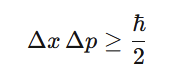
Heisenberg’s Uncertainty Principle

One of the foundational principles of quantum mechanics is Heisenberg’s uncertainty principle:

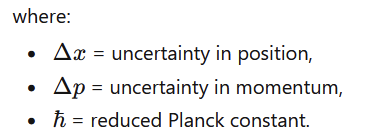
This principle states that a particle cannot simultaneously possess:

  • perfectly definite position,
  • and perfectly definite momentum.

This is not a limitation of measurement instruments. It is a fundamental law of nature.


Why Absolute Zero Is Impossible

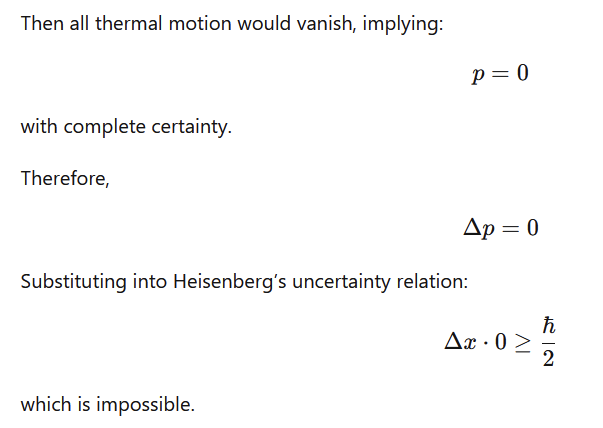
Suppose a particle inside a solid reaches absolute zero.

Hence a particle cannot simultaneously have:

  • zero momentum,
  • and a definite position inside matter.

Some residual momentum uncertainty must always remain.

As a result, particles retain a minimum unavoidable motion even at extremely low temperatures.

This residual energy is called zero-point energy.


Zero-Point Energy

Even near 0 K:

  • atoms in a crystal continue to vibrate slightly,
  • electrons retain quantum motion,
  • and complete stillness never occurs.

Nature permits minimum motion, but never perfect stillness.

Thus:

Absolute zero can be approached indefinitely, but never perfectly reached.


Final Conclusion

Temperature is a measure of microscopic random motion. As temperature decreases, this motion reduces, but quantum mechanics prevents it from becoming exactly zero.

Heisenberg’s uncertainty principle ensures that particles can never possess both perfectly definite position and zero momentum simultaneously.

Therefore:

0 K is Fundamentally Unattainable.

Absolute zero is not merely technologically difficult — it is forbidden by the quantum structure of nature itself.

Pressure is Isotopic: It Has No Preferred Direction

Standard

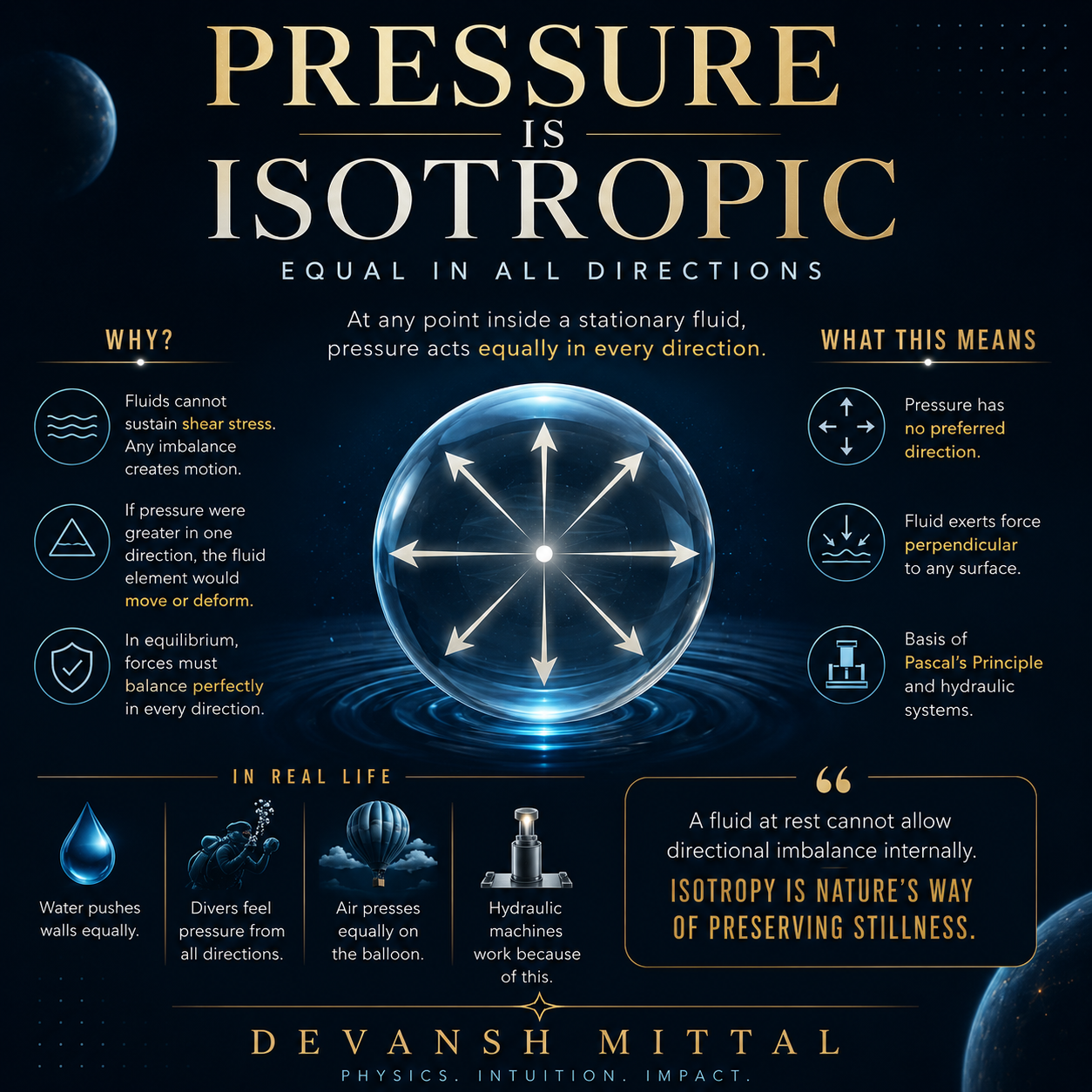
Pressure Is Isotropic

Why Pressure in a Fluid Acts Equally in All Directions

One of the most fundamental results in fluid mechanics is:

At a given point inside a stationary fluid, pressure acts equally in all directions.

This property is called the isotropy of pressure.

At first glance, the statement appears intuitive. Yet it emerges from a deep physical requirement: a fluid at rest cannot sustain shear stress.


The Core Physical Idea

Unlike solids, fluids cannot resist continuous tangential deformation. If unequal directional stresses existed at a point inside a stationary fluid, the fluid element would experience a net turning or shearing effect.

The element would then deform and begin to flow.

But a stationary fluid, by definition, is in equilibrium.

Therefore:

No directional imbalance can exist inside a fluid at rest.

Pressure must therefore act equally in every direction.


The Conceptual Proof

Consider an extremely small fluid element inside a liquid at rest.

Suppose pressure along one direction were greater than pressure along another direction.

The larger pressure would produce a greater force on one face of the element, generating an unbalanced shear tendency. Since fluids cannot sustain shear stress in static equilibrium, motion would immediately begin.

This contradicts the assumption that the fluid is stationary.

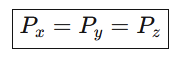
Hence the only possible equilibrium condition is:

Thus, pressure at a point in a static fluid is isotropic.


An Important Consequence

Because pressure has no preferred direction:

  • fluids exert force perpendicular to surfaces,
  • Pascal’s law becomes possible,
  • and hydraulic systems function efficiently.

From ocean depths to hydraulic lifts, isotropic pressure governs the behavior of fluids everywhere.


Final Conclusion

Pressure in a stationary fluid is isotropic because any directional inequality in pressure would create shear forces and destroy equilibrium. Nature preserves stillness inside fluids by ensuring perfect directional balance.

“Section 375” Will Just WoW You!

Standard

“We are not in the business of Justice, We are in the business of Law” says Akshaye Khanna in “Section 375”. This statement will reiterate in your mind a lot of times after having watched this “Astounding” movie!

This is one of the best “Intellectually Invigorating” movies I watched on Courtroom Portrayal in Indian Cinema. The earlier one I relished was Shahid (Rajkumar Rao) along with some others.

This film has Richa Chadha and Akshaye Khanna cast as lawyers. While Richa Chadha represents the victim Anjali Vasudev Dangle who is played by Meera Chopra, Akshaye Khanna represents the accused Rohan Ravi Khurana who is played by Rahul Bhat. Anjali works as an assistant costume designer with film director Rohan Ravi and accuses him of raping her. This is where the film starts. Akshaye Khanna chooses to advocate the accused, Rohan Ravi Khurana.

Director, Ajay Bahl, through this movie, is trying to draw viewers’ attention towards the difference between “Justice” and “Law”. Movie sets out its theme in the starting itself when Akshaye Khanna in a speech to Law students says “Justice is the goal, Law is just a tool to get there”. He, in spite of being a Lawyer himself and giving a speech to Law students, says, “One should not fall in love with the Law. Law is a Jealous Mistress, it requires a prolonged courtship and may finally disappoint you in the end”.

Akshaye Khanna is shown as a mature lawyer in the movie, who is aware of harsh realities in the Law and who knows that the Law may not always deliver justice. Richa Chaddha, on the other hand, is shown as a new enthusiastic lawyer who wishes to ensure justice with the Law as a tool, only destined to realize by the end of the movie that Law and Justice are not synonymous.

Director, in this movie, in a very balanced and amazing way, is able to show various inconsistencies and limitations in the current Law system and successfully able to draw the attention of the viewers, the various pressures Law system faces from the society and in the course of which, may fail to deliver the Justice. The Law system is there to uphold the law, but in the end, whether the Justice is ensured, is questionable!

Radical Subject, Superb Direction, Marvelous Dialogues with Magnificent Delivery, and Awesome Acting. One of the Incredible dialogues still echoing in my mind is “The Law is a fact, Justice is abstract”. Another one is “Will is more important than the Consent”.

This is not a family entertainer, as was evident from just 10 of us (I and some others I do not know about) watching the movie in the entire theater. If you like Intellectual Stimulation, If you are interested in the theme of the movie or if you like to watch some good directed and well-acted movies, then I would highly recommend it to you.

My rating — 4/5.