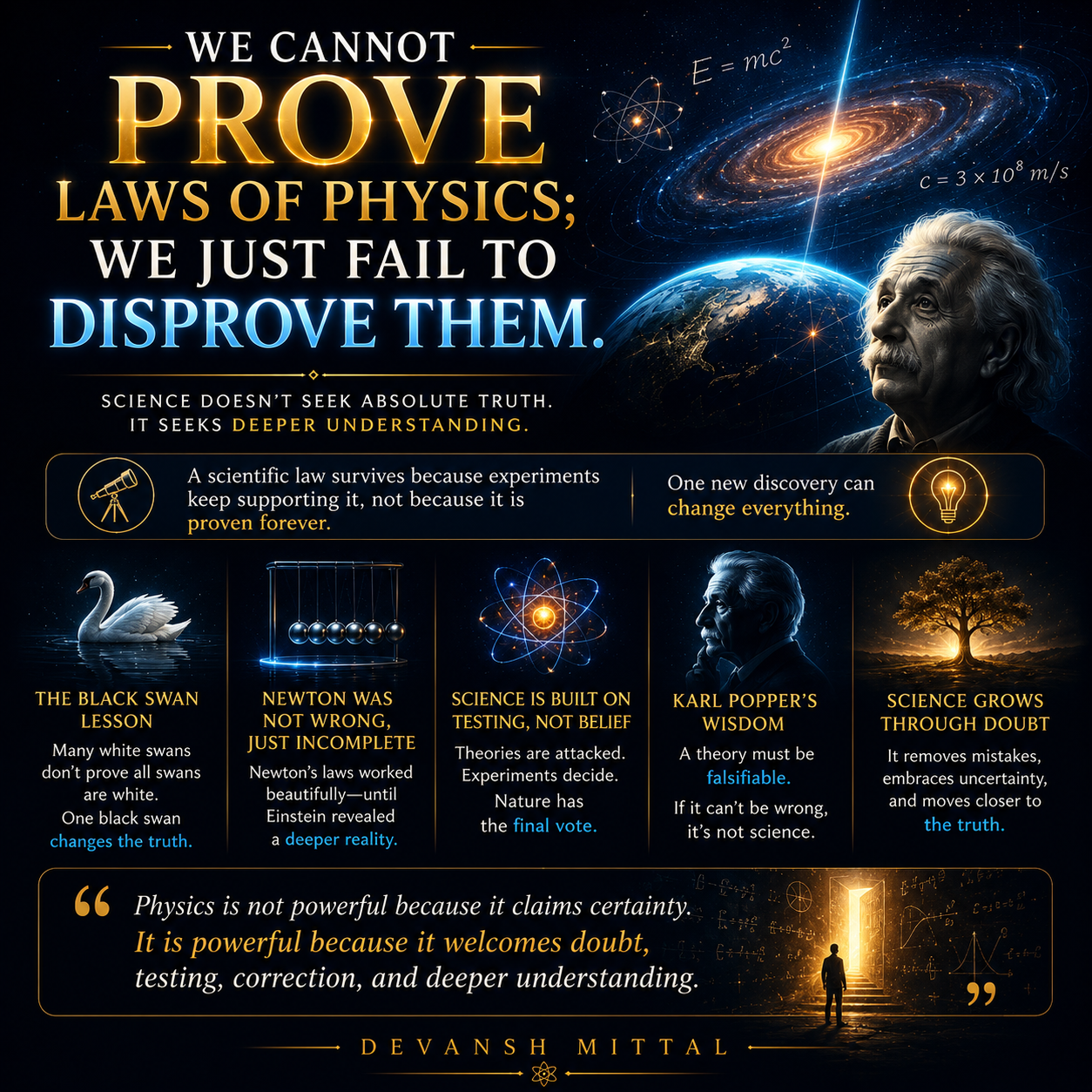
We Cannot Prove Laws of Physics; We Just Fail to Disprove Them
Most students grow up believing that the laws of physics are absolute truths.
We are taught that:
- Newton’s laws are true,
- gravity is true,
- conservation of energy is true,
- and the speed of light is constant.
But modern science reveals something far deeper and more humbling:
Physics does not truly “prove” its laws.
Instead, physics keeps testing them again and again — and so far, we have simply failed to disprove them.
This idea is one of the most profound insights in science.
Why This Idea Feels Strange
In mathematics, things can be proven permanently.
For example:
2 + 2 = 4
Once proven logically, it remains true forever within mathematics.
But physics is different.
Physics studies the real universe, and the universe must be observed experimentally.
No matter how many times an experiment succeeds, there is always a possibility — however tiny — that a future experiment may reveal something new.
This means:
No physical law is beyond questioning.
And that is exactly what makes science powerful.
Science Is Built on Testing, Not Blind Belief
A scientific law survives because it repeatedly passes experimental tests.
But passing tests is not the same as being “absolutely proven.”
Imagine this situation:
Suppose someone says:
“All swans are white.”
You observe:
- 10 white swans,
- 100 white swans,
- 10,000 white swans.
Does this prove that all swans are white?
No.
Because finding just one black swan destroys the claim completely.
Physics works in a very similar way.
A law may survive millions of successful experiments, but a single contradictory observation can force scientists to rethink the theory.
Newton’s Laws Once Seemed Perfect
For centuries, Newton’s laws explained:
- falling apples,
- planetary motion,
- cannonballs,
- machines,
- and motion on Earth.
People thought Newton had discovered the final laws of Nature.
Then Einstein arrived.
Einstein showed that Newton’s laws are not exactly correct at:
- extremely high speeds,
- very strong gravity,
- and cosmic scales.
Newton was not “wrong” in ordinary situations.
But Newton’s laws were incomplete.
This is one of the greatest lessons in science:
Even the most successful theories can later become approximations of deeper truths.
The Speed of Light and Modern Physics
Today, Einstein’s relativity has passed enormous numbers of experiments.
GPS satellites work correctly only because relativistic corrections are included.
Modern particle accelerators confirm relativity repeatedly.
Yet scientists still do not claim that relativity is “perfectly proven forever.”
Why?
Because future discoveries may reveal an even deeper theory.
In fact, physicists are actively searching for theories beyond Einstein’s relativity.
Science always remains open to correction.
Why Science Is Different from Belief Systems
In many belief systems, questioning is discouraged.
But in science, questioning is essential.
A scientific theory becomes stronger precisely because scientists constantly try to break it.
Physicists do not worship theories.
They attack them with experiments.
A theory survives only if Nature refuses to disprove it.
This creates an extraordinary system of self-correction.
The Philosophy of Karl Popper
One of the most influential philosophers of science, Karl Popper, explained this beautifully.
According to Popper:
A scientific theory must be falsifiable.
This means the theory must make predictions that could, in principle, be proven wrong.
For example:
“This pen will fall downward if released.”
This is scientific because it can be tested.
But if someone makes a claim that can never be tested or disproven, it does not belong to science.
Science progresses because theories are vulnerable to failure.
Why This Makes Science Powerful
At first, this idea may sound weak.
If science cannot “prove” laws permanently, does that make science uncertain?
Actually, the opposite is true.
Science becomes powerful precisely because it allows correction.
Imagine two systems:
System 1:
- never changes,
- never questions itself.
System 2:
- constantly tests itself,
- removes mistakes,
- improves continuously.
Which system becomes more reliable over time?
Obviously, the second one.
Science advances because it accepts the possibility of being wrong.
That intellectual honesty is one of humanity’s greatest achievements.
Real-World Examples
Example 1: Newton vs Einstein
Newton’s gravity worked extremely well for centuries.
But tiny errors in Mercury’s orbit could not be explained completely.
Einstein’s General Relativity explained those discrepancies beautifully.
The old theory survived for a long time — until better measurements exposed its limitations.
Example 2: Classical Physics vs Quantum Mechanics
Classical physics once seemed complete.
Then scientists discovered:
- atoms,
- electrons,
- quantum effects,
- wave-particle duality.
The old theories failed at microscopic scales.
Quantum mechanics emerged as a deeper framework.
Again, science corrected itself.
Example 3: Medical Science
Even medicine evolves this way.
Treatments once considered correct are sometimes abandoned after better evidence appears.
Science does not hide mistakes.
Science improves by discovering them.
A Deep Lesson About Truth
Science teaches us humility.
The universe is enormously complex.
Our theories are not perfect copies of reality.
They are models that approximate reality increasingly well.
Some models are extraordinarily successful.
But science never claims absolute finality.
This mindset is one of the reasons science progresses so rapidly.
The Beauty of Scientific Thinking
The statement:
“We cannot prove laws of physics; we just fail to disprove them.”
may initially sound unsettling.
But it actually captures the beauty of science.
Science is not a collection of unquestionable truths.
Science is a living process of exploration.
Every experiment is a question asked to Nature.
And Nature always has the final vote.
Final Thoughts
Physics is not powerful because it claims certainty.
Physics is powerful because it welcomes doubt, testing, correction, and deeper understanding.
Every law of physics survives only because:
- experiments continue to support it,
- observations continue to agree with it,
- and Nature has not yet disproved it.
That is not weakness.
That is intellectual courage.
And perhaps this is the deepest lesson science teaches humanity:
True knowledge does not fear questioning.
It grows because of it.
— Devansh Mittal
 The Intuitive Physicist