Tag Archives: Science

Why Electricity Travels Almost At the Speed of Light, even though Electrons Drift Very Slowly in Wires?

Standard

Why Electricity Travels Almost at the Speed of Light

The Surprising Truth About Electric Fields and Electromagnetic Waves

When you switch on a light bulb, it glows almost instantly.

When you press the power button on your computer, electrical signals race through billions of circuits in a tiny fraction of a second.

But here is the surprising part:

The electrons inside the wire actually move very slowly.

In many household wires, electrons drift at only a few millimeters per second — slower than a crawling ant.

So how can electricity seem to travel almost at the speed of light?

The answer reveals one of the deepest ideas in Physics:

Electricity is not mainly about electrons traveling rapidly through wires. It is about electric fields and electromagnetic disturbances propagating through space.


The Common Misconception

Most students imagine electricity like water flowing through a pipe:

  • electrons are like water molecules,
  • the wire is the pipe,
  • and electricity means electrons rushing rapidly from one end to another.

This picture is only partly correct.

The electrons themselves move slowly.

What moves rapidly is the electromagnetic signal.


Drift Velocity: The Slow Motion of Electrons

Metal wires already contain countless free electrons even before the circuit is switched on.

When a battery is connected, these electrons begin drifting in one direction. This average motion is called drift velocity.

Surprisingly, this drift velocity is extremely small.

An individual electron may take minutes or even hours to move a short distance through a wire.

Yet the bulb glows almost instantly.

Clearly, something else must be happening.


A Simple Analogy

Imagine a long pipe completely filled with tightly packed balls.

If you push one ball at one end, the ball at the opposite end moves almost immediately.

But the same ball did not travel across the pipe. Instead, the disturbance traveled rapidly through the system.

Electricity behaves similarly.

The electrons already exist throughout the wire. When an electric field is established, electrons everywhere begin responding almost simultaneously.


The Real Hero: The Electric Field

The moment you connect a battery, an electric field is created inside and around the wire.

An electric field exerts force on charges and pushes electrons throughout the circuit.

The important point is this:

The electric field propagates extremely rapidly — close to the speed of light.

So the fast behavior of electricity is mainly due to the rapid propagation of the electric field, not because electrons themselves are moving extremely fast.


Electricity Is a Field Phenomenon

This is one of the great conceptual shifts in modern Physics.

Electricity is not merely the motion of particles.

It is fundamentally a phenomenon of fields.

Electric and magnetic fields carry:

  • energy,
  • momentum,
  • and information.

The electrons simply respond locally to these fields.


Electromagnetic Waves and Maxwell

A changing electric field creates a magnetic field.

A changing magnetic field creates an electric field.

This beautiful interplay allows electromagnetic disturbances to propagate through space as electromagnetic waves.

This revolutionary idea was discovered by James Clerk Maxwell.

Maxwell realized that light itself is an electromagnetic wave.

That means:

  • radio waves,
  • microwaves,
  • visible light,
  • X-rays,

are all forms of the same electromagnetic phenomenon.

Electrical signals in wires are deeply connected to this same physics.


Real-World Examples

Switching On a Light

When you press a switch:

  • the electric field spreads rapidly through the circuit,
  • electrons everywhere begin responding,
  • the bulb glows almost instantly.

The electrons inside the bulb do not come all the way from the battery.


Internet and Communication

Modern communication depends on fast electromagnetic propagation through:

  • cables,
  • fiber optics,
  • antennas,
  • and satellites.

Without electromagnetic waves, the modern digital world would not exist.


Final Takeaway

The next time you switch on a light, remember:

  • the electrons themselves move slowly,
  • but the electric field spreads through the circuit extremely rapidly,
  • carrying energy and information almost at the speed of light.

Electricity is not merely the movement of electrons.

It is the dance of electromagnetic fields across space.

The Making of an IJSO Gold Medalist: Aadish Jain’s Words of Gratitude

Standard

Some achievements are measured by ranks and medals. Others are measured by the depth of understanding, discipline, and intellectual growth developed along the journey.

Aadish Jain’s remarkable journey — from beginning Physics with uncertainty to representing India at the International Junior Science Olympiad (IJSO) 2025 and winning a Gold Medal for the country — is a story of curiosity, perseverance, and genuine conceptual learning.

What makes his testimonial especially meaningful to me is not merely the achievement itself, but the values it reflects: independent thinking, strong intuition, intellectual honesty, and the courage to deeply struggle with difficult ideas instead of relying on shortcuts.

His words beautifully capture the teaching philosophy I have always believed in — that Physics should not merely be memorized, but truly understood.

I am immensely proud of Aadish and deeply grateful to have been a part of his extraordinary journey.


Respected Devansh Sir,

Winning a Gold Medal for India at the International Junior Science Olympiad (IJSO) 2025 after being selected among the six students chosen to represent the country has been one of the proudest achievements of my life. This journey, which began with my qualification in the Indian National Junior Science Olympiad (INJSO) 2025 and continued through the OCSC camp, would not have been possible without your invaluable guidance and mentorship.

As I look back on this entire experience, I realize how deeply your teaching transformed my understanding of Physics and shaped my overall way of thinking.

When I first joined your online classes in June last year, Physics was not particularly my strongest subject. However, as the course progressed, I gradually developed not only conceptual clarity, but also a genuine fascination for the subject. The intuitive manner in which you explained concepts made Physics feel intellectually beautiful rather than intimidating.

What truly makes your teaching extraordinary is your emphasis on genuine understanding instead of superficial problem-solving. While many teachers focus mainly on shortcuts, memorization, and formula-based approaches, you consistently encouraged us to think independently, struggle honestly with problems, and derive equations ourselves. You taught us that developing the correct method and depth of thought is far more important than merely arriving at an answer.

That philosophy had a tremendous impact on me.

Your classes trained me to think analytically, build strong intuition, and approach difficult problems with confidence and patience. Over time, this way of learning became one of the greatest strengths in my Olympiad preparation and played a major role throughout my INJSO, OCSC, and IJSO journey.

Beyond academics, your philosophical insights on discipline, consistency, learning strategy, and personal growth were equally inspiring. They helped me develop a far more mature and focused mindset toward both studies and life.

I sincerely believe that the strong conceptual foundation and scientific temperament I developed under your mentorship became one of the most important reasons behind my success.

Thank you once again, Sir, for your constant encouragement, extraordinary guidance, and for inspiring students to truly understand Physics instead of merely studying it. I will always remain deeply grateful for your support and hope to continue learning from your wisdom in the years to come.

With deepest respect and gratitude,
Aadish Jain

Why Time Slows Down at High Speeds?

Standard

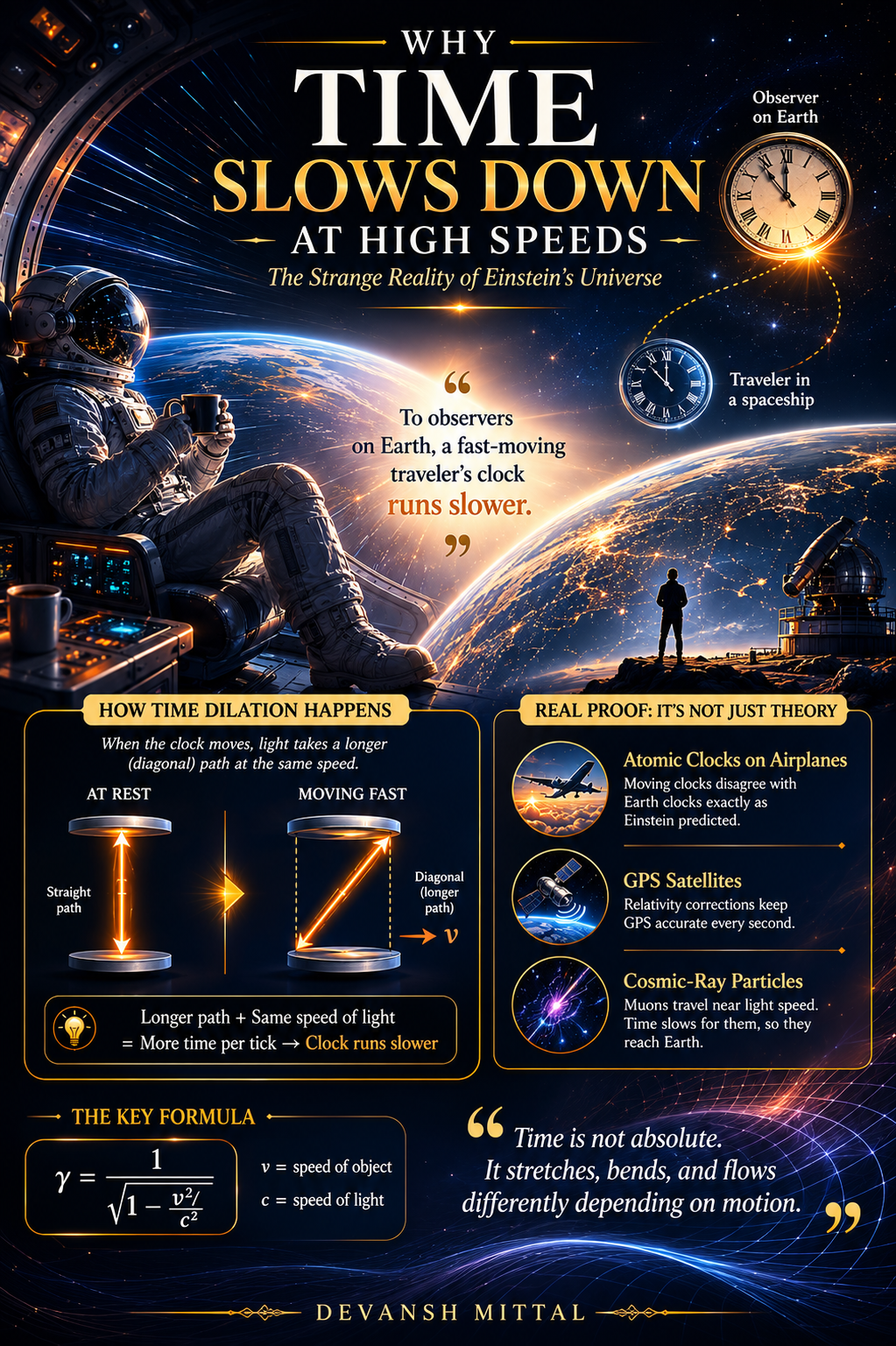
Why Time Slows Down at High Speeds

Imagine traveling in a spaceship moving close to the speed of light. Inside the spaceship, everything would feel completely normal. Your heartbeat, thoughts, and even your watch would work exactly as usual.

But for someone watching from Earth, something strange would happen:

Your clock would appear to run slower.

This phenomenon is called time dilation, and it is one of the most fascinating predictions of Albert Einstein’s Special Theory of Relativity.


The Big Problem Einstein Solved

Before Einstein, scientists believed that time was absolute. They thought time flowed at the same rate for everyone everywhere in the universe.

But experiments with light created a huge problem.

Scientists discovered that the speed of light is always constant:

c ≈ 3 × 10⁸ m/s

Normally, speeds add together. For example, if you throw a ball forward inside a moving train, a person standing outside sees the ball moving faster than you do.

But light behaves differently.

Even if you move toward a beam of light at extremely high speed, you still measure light traveling at exactly the same speed.

Einstein realized that if the speed of light never changes, then space and time themselves must change.


Understanding Time Dilation Intuitively

To understand this idea, imagine a special clock made using light.

Suppose light bounces between two mirrors. Every bounce acts like one “tick” of the clock.

When the clock is at rest, the light moves straight up and down.

But if the clock moves sideways at very high speed, the light must travel diagonally to keep up with the moving clock.

The important point is:

  • The diagonal path is longer.
  • The speed of light cannot change.

So the light takes more time to complete one tick.

As a result, the moving clock runs slower.

This is the basic reason why time slows down at high speeds.


Space and Time Are Connected

Einstein showed that space and time are not separate things. They are connected together in something called spacetime.

The faster an object moves through space, the slower it moves through time.

At everyday speeds, this effect is extremely tiny, so we do not notice it. But near the speed of light, the effect becomes very large.

The mathematical expression for time dilation is:

Δt = γΔt₀

where

γ = 1 / √(1 − v²/c²)

As the speed v gets closer to the speed of light c, the value of γ increases greatly, meaning time slows down more and more.


The Twin Paradox

One famous example of time dilation is the Twin Paradox.

Imagine two twins:

  • One stays on Earth.
  • The other travels in a fast spaceship and later returns.

When they meet again, the traveling twin is younger.

Why?

Because less time passed for the twin moving at very high speed.

This may sound unbelievable, but it is a real prediction of physics.


Is Time Dilation Real?

Yes. Time dilation has been experimentally confirmed many times.

1. Atomic Clocks

Scientists placed highly accurate atomic clocks on airplanes. After the flights, the moving clocks showed slightly less time than clocks on Earth — exactly as Einstein predicted.

2. GPS Satellites

GPS satellites move very fast around Earth. Their clocks run differently because of relativity.

If scientists ignored time dilation, GPS systems would quickly become inaccurate.

3. Fast-Moving Particles

Particles called muons are created high in Earth’s atmosphere. They should decay before reaching the ground, but because they move near the speed of light, time slows down for them, allowing many to survive longer.


Why Nothing Can Travel Faster Than Light

As an object moves faster and faster, slowing time requires more and more energy.

Reaching the speed of light would require infinite energy, which is impossible.

That is why no object with mass can reach or exceed the speed of light.


Final Thoughts

Time dilation teaches us something extraordinary:

Time is not the same for everyone.

It depends on motion.

At normal speeds, the effect is tiny. But near the speed of light, time itself slows down dramatically.

Einstein’s theory completely changed our understanding of the universe. Today, relativity is not just a scientific idea — it is part of real-world technology such as GPS and particle physics experiments.

The universe is far stranger and more beautiful than our everyday experience suggests.

When the Straight Line Is Not the Fastest Path

Standard

When the Straight Line Is Not the Fastest Path

A Beautiful Idea from Physics

We often hear the statement:

“The shortest distance between two points is a straight line.”

In geometry, this is absolutely correct.

But physics teaches us something deeper:

The shortest path is not always the fastest path.

Sometimes a slightly longer curved path can take less time than a straight-line path.

At first this sounds impossible, but Nature gives many beautiful examples of this idea.


Distance and Time Are Not the Same Thing

Suppose you want to travel from one place to another.

Your travel time depends on two things:

  • the distance traveled,
  • and your speed during the journey.

Mathematically:

Time = Distance / Speed

This means that even if a path is longer, it can still take less time if you move faster along it.

This simple idea is the key to understanding the entire article.


Example 1: Walking on Sand and Road

Imagine you are standing on a beach.

  • Walking on sand is slow.
  • Walking on a road is much faster.

Now suppose your destination lies far away along the beach.

Should you walk directly toward it in a straight line through sand?

Not always.

A faster strategy may be:

  • first move toward the road,
  • travel quickly along the road,
  • then return toward the destination.

Even though the total distance becomes larger, the total time can become smaller because most of the motion happens on the faster surface.

So:

Shortest distance ≠ shortest time.


Example 2: Light Does Not Always Travel in Straight Lines

Light usually travels in straight lines in air.

But when light enters water or glass, it bends.

This phenomenon is called:

Refraction

Why does light bend?

Because light travels slower in water than in air.

To save time, light changes its path so that it spends more distance in the faster medium.

This is why a straw placed in water appears bent.

Nature is not trying to minimize distance.
Nature is trying to minimize time.


Example 3: The Sliding Bead Problem

This is one of the most famous problems in physics.

Imagine a bead sliding under gravity from one point to another.

Which path will take the least time?

Most people naturally think:

“A straight line.”

But surprisingly, this is wrong.

A curved path can actually be faster.

Why?

Because the curved path drops steeply at first, allowing the bead to gain speed quickly due to gravity.

After gaining large speed early, the bead continues moving rapidly for the rest of the journey.

So although the curved path is longer, the higher speed makes the total time smaller.

This is one of the most beautiful ideas in physics.


Why Curved Paths Can Be Faster

There are two competing effects:

Straight Path

  • shorter distance,
  • but slower speed gain.

Curved Path

  • longer distance,
  • but faster speed gain.

Sometimes the increase in speed is more important than the extra distance.

That is why the curved path wins.


Airplanes Also Follow Curved Paths

When airplanes travel long distances on Earth, their routes often appear curved on maps.

But Earth is spherical, not flat.

The curved-looking route is actually the shortest path on a sphere.

This path helps save:

  • fuel,
  • energy,
  • and travel time.

Again, Nature and engineering often prefer optimal paths rather than visually straight ones.


Nature Always Tries to Optimize

Many laws of physics are based on optimization principles.

For example:

  • light tries to minimize travel time,
  • objects move in ways that reduce energy,
  • planets follow paths determined by gravity.

Physics repeatedly shows that Nature is extremely efficient.

But efficiency does not always mean “straight.”

Sometimes:

  • bending is faster,
  • curved motion is smarter,
  • and indirect paths become optimal.

A Deeper Lesson

This idea teaches us something important beyond physics.

Our intuition often focuses only on distance.

But in real systems, many factors matter:

  • speed,
  • energy,
  • resistance,
  • gravity,
  • geometry,
  • and changing conditions.

The universe is more intelligent and subtle than simple straight-line thinking.


Final Thoughts

The statement:

“The shortest distance between two points is a straight line”

is true in geometry.

But physics asks a deeper question:

“What path takes the least time?”

And the answer is often very different.

Light bends.
Objects curve.
Airplanes follow arcs.
Sliding beads move faster on curved tracks.

Nature constantly reminds us that the fastest route is not always the straightest one.

And that is one of the most beautiful insights in physics.

Temperature, Entropy and Quantum Mechanics: Why Zero Kelvin is Not Possible?

Standard

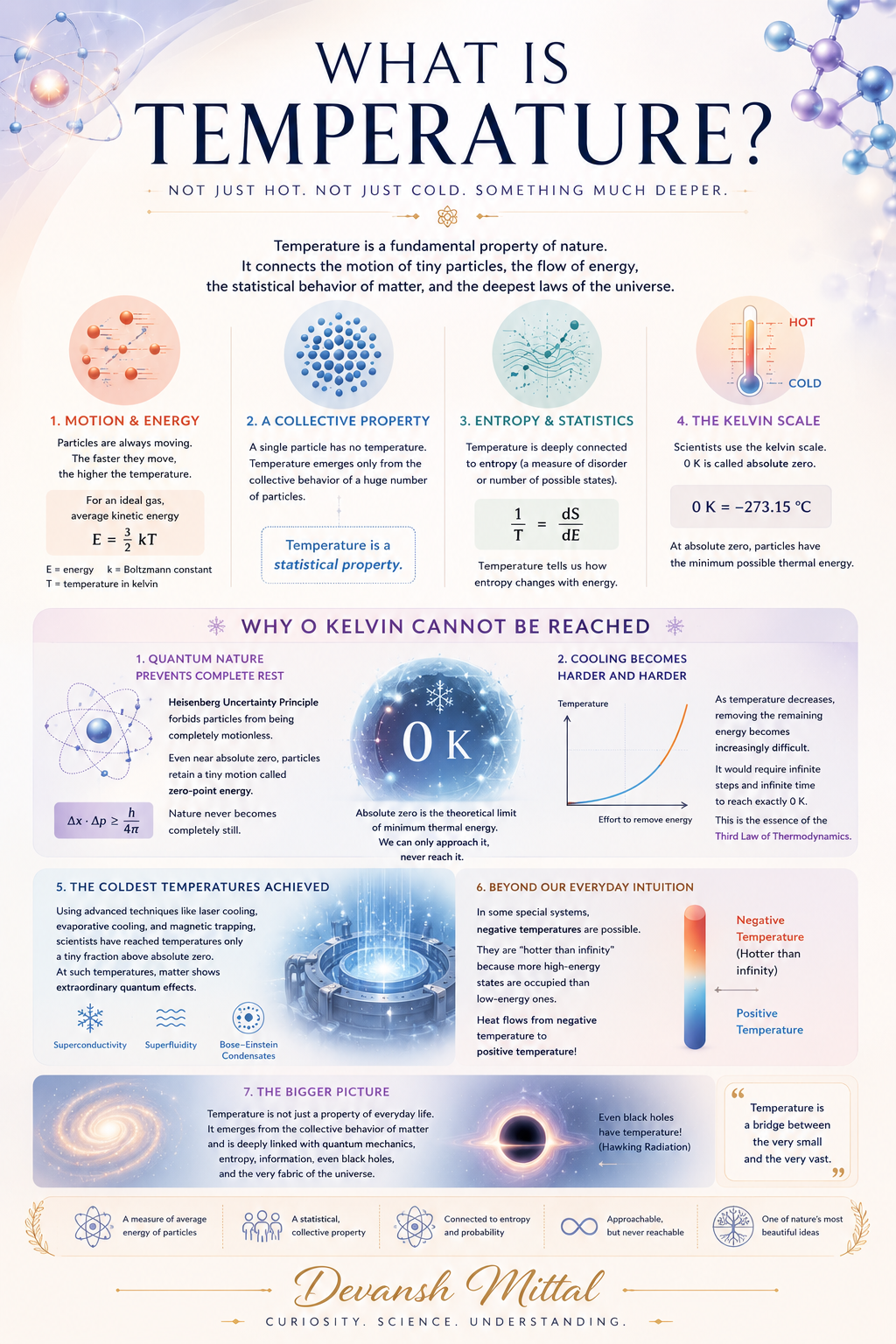
What Is Temperature?

A Modern Understanding of Temperature

Temperature is something we experience every day. We say that tea is hot, ice is cold, and the weather is warm or cool. But in physics, temperature is much deeper than just the feeling of “hotness” or “coldness.”

Modern science tells us that temperature is related to the motion and energy of tiny particles such as atoms and molecules.


Temperature and Particle Motion

All matter is made of particles that are always moving.

  • In hot objects, particles move faster.
  • In cold objects, particles move slower.

For an ideal gas, the average kinetic energy of particles is:

E = (3/2) × k × T

where:

  • E = average kinetic energy
  • k = Boltzmann constant
  • T = temperature in kelvin

This means temperature is connected to the average energy of random particle motion.


Temperature Is a Collective Property

A single molecule does not have a temperature.

Temperature appears only when a very large number of particles are considered together.

So, temperature is a “collective” or “statistical” property of matter.


Temperature and Entropy

Modern physics also connects temperature with a very important idea called entropy.

Entropy measures the amount of disorder or the number of possible microscopic arrangements inside a system.

  • Higher temperature generally means particles can arrange themselves in more possible ways.
  • Lower temperature means fewer possible arrangements.

The deep thermodynamic relation is:

1/T = dS/dE

where:

  • T = temperature
  • S = entropy
  • E = energy

This equation shows that temperature is deeply connected to how energy and disorder are related in Nature.


The Kelvin Scale and Absolute Zero

Scientists use the kelvin scale for temperature.

  • 0 K is called absolute zero.
  • 0 K = −273.15°C

At absolute zero, particles have the minimum possible thermal energy.


Why Zero Kelvin Cannot Be Reached

According to modern physics, reaching exactly 0 K is impossible.

There are two major reasons.


1. Heisenberg’s Uncertainty Principle

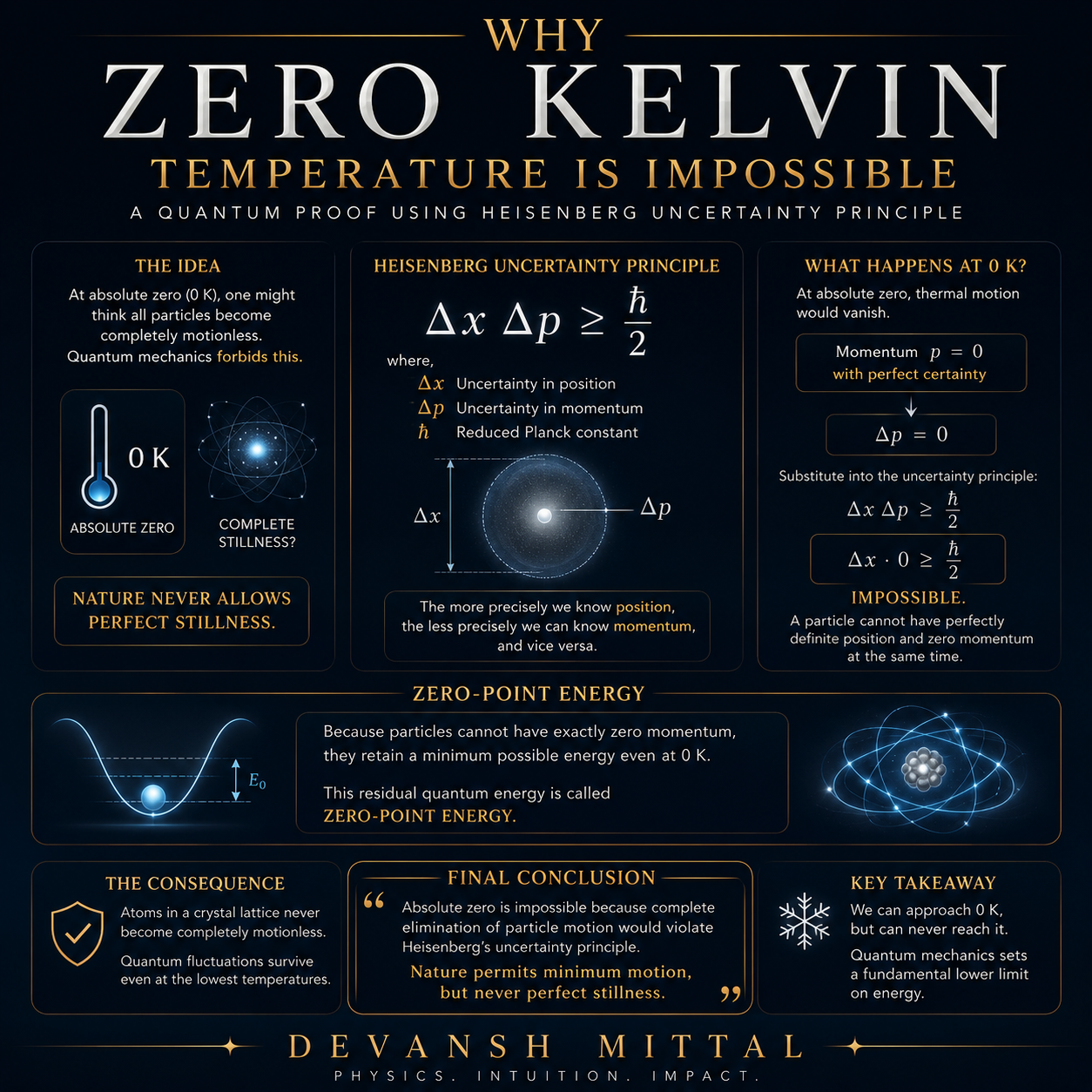
Quantum mechanics tells us that particles can never become perfectly motionless.

According to the Heisenberg Uncertainty Principle:

Δx × Δp ≥ h/(4π)

where:

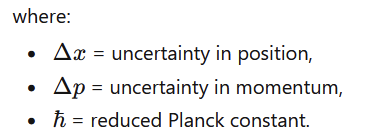
  • Δx = uncertainty in position
  • Δp = uncertainty in momentum
  • h = Planck’s constant

This means we cannot know both the exact position and exact momentum of a particle at the same time.

If a particle became completely motionless at 0 K, its momentum would become exactly zero, which would violate quantum mechanics.

Therefore, even near absolute zero, particles still possess a tiny unavoidable motion called:

Zero-point energy

So Nature never becomes completely still.


2. Cooling Becomes Harder and Harder

As temperature decreases:

  • particles lose energy,
  • but removing the remaining energy becomes increasingly difficult.

Scientists can get extremely close to 0 K, but they can never reach it exactly.

This idea is part of the Third Law of Thermodynamics.


The Coldest Temperatures Ever Created

Using advanced techniques like laser cooling, scientists have cooled matter to temperatures only a tiny fraction above absolute zero.

At such temperatures, strange quantum effects appear, including:

  • superconductivity,
  • superfluidity,
  • Bose–Einstein condensates.

These states help scientists study the quantum world.


Modern Understanding of Temperature

Today, physicists understand temperature as:

  • a measure of the average energy of particles,
  • a statistical property of many particles together,
  • a quantity deeply connected with entropy,
  • and a concept linked with quantum mechanics.

Temperature is therefore not just about “hot” and “cold.”
It is one of the fundamental ideas that helps us understand the microscopic behavior of matter and the deeper laws of the universe.

What is Temperature? and Why Absolute Zero is not possible?

Standard

What Is Temperature?

Temperature is one of the most familiar quantities in physics, yet its true meaning is remarkably profound.

At the microscopic level, temperature measures the average random kinetic energy of particles in a system. In simpler terms:

The faster the particles move randomly, the higher the temperature.

In gases, particles move freely in all directions. In solids, atoms vibrate about fixed positions. As thermal motion increases, temperature rises.

Thus, temperature is fundamentally connected to microscopic motion.


What Happens When Temperature Decreases?

When a body cools:

  • particle motion decreases,
  • vibrations become weaker,
  • and the average kinetic energy reduces.

This naturally leads to an important question:

Can particle motion become completely zero?

If that were possible, the system would reach the lowest possible temperature: 0 K, called absolute zero.

Classically, one might imagine that at 0 K all particles become perfectly motionless.

Quantum mechanics, however, forbids this possibility.


Heisenberg’s Uncertainty Principle

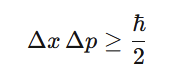
One of the foundational principles of quantum mechanics is Heisenberg’s uncertainty principle:

This principle states that a particle cannot simultaneously possess:

  • perfectly definite position,
  • and perfectly definite momentum.

This is not a limitation of measurement instruments. It is a fundamental law of nature.


Why Absolute Zero Is Impossible

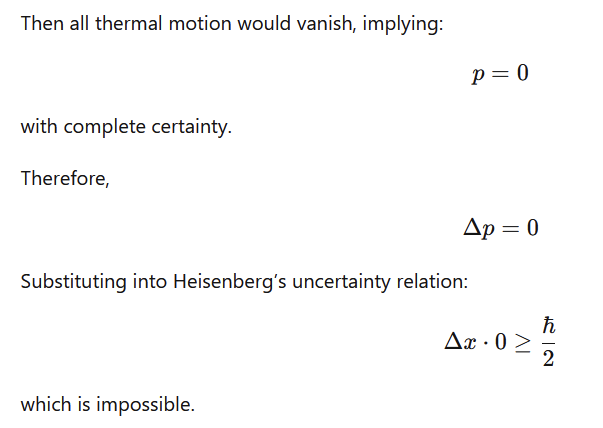
Suppose a particle inside a solid reaches absolute zero.

Hence a particle cannot simultaneously have:

  • zero momentum,
  • and a definite position inside matter.

Some residual momentum uncertainty must always remain.

As a result, particles retain a minimum unavoidable motion even at extremely low temperatures.

This residual energy is called zero-point energy.


Zero-Point Energy

Even near 0 K:

  • atoms in a crystal continue to vibrate slightly,
  • electrons retain quantum motion,
  • and complete stillness never occurs.

Nature permits minimum motion, but never perfect stillness.

Thus:

Absolute zero can be approached indefinitely, but never perfectly reached.


Final Conclusion

Temperature is a measure of microscopic random motion. As temperature decreases, this motion reduces, but quantum mechanics prevents it from becoming exactly zero.

Heisenberg’s uncertainty principle ensures that particles can never possess both perfectly definite position and zero momentum simultaneously.

Therefore:

0 K is Fundamentally Unattainable.

Absolute zero is not merely technologically difficult — it is forbidden by the quantum structure of nature itself.

The Mindset Behind IIT JEE Advanced AIR 56, IJSO Gold, and World Rank 10 in SIN: Vasu Vijay’s Extraordinary Journey

Standard

Very few academic journeys reflect excellence across so many of the world’s most prestigious examinations and Olympiads at such a young age. From securing an extraordinary AIR 56 in IIT-JEE Advanced, to winning a Gold Medal with International Rank 8 at the International Junior Science Olympiad (IJSO) 2022 in Bogotá, Colombia, to achieving International Rank 10 along with Distinction in the prestigious Sir Isaac Newton (SIN) Exam conducted by the University of Waterloo, Vasu Vijay’s accomplishments stand as a remarkable testament to intellectual depth, discipline, and conceptual mastery.

What makes his story especially meaningful to me, however, is not merely the scale of these achievements, but the transformation behind them.

As Vasu himself shares in this testimonial, there was a time when Physics felt difficult and unintuitive to him. Over the years, through a learning approach centered around intuition, conceptual understanding, analytical thinking, and scientific imagination, he gradually developed not only mastery over the subject, but also a genuine love for it.

His words beautifully reflect a philosophy I have always believed in deeply — that true excellence in Physics does not emerge from memorizing formulas or mechanically solving thousands of problems, but from learning how to think clearly, understand concepts fundamentally, and approach challenges with calmness and intelligence.

One of the most touching parts of Vasu’s testimonial is his gratitude toward the way he was taught to approach both Physics and examinations themselves — not with fear or pressure, but with curiosity, strategy, and confidence. To know that this mindset contributed meaningfully to his Olympiad journey, his international success, and his IIT-JEE performance is profoundly fulfilling as a teacher.

Vasu’s journey is not merely a story of ranks and medals. It is a story of transformation — from confusion to clarity, from hesitation to confidence, and from learning formulas to truly understanding the beauty of Physics.

I feel immensely proud to have been part of his journey and deeply grateful for the sincerity and warmth with which he has expressed his appreciation.


Respected Devansh Sir,

I remember that at the beginning of Class 9, Physics was the subject I struggled with the most. Even the basic concepts often felt unclear to me, and I never really enjoyed studying the subject. However, the way you taught Physics completely changed how I viewed it. Your emphasis on intuition and conceptual understanding helped me develop genuine interest in the subject.

What impacted me the most was that your teaching was never limited to memorizing formulas or blindly applying methods. Instead, you always encouraged us to understand the idea behind every concept and every question. Because of this, whenever I now encounter a Physics problem, my first instinct is to understand the concept deeply before attempting to solve it. The questions discussed in class were themselves more than sufficient to develop a strong understanding, without the need to solve hundreds of questions from multiple books.

Apart from academics, your guidance regarding examination pressure and mindset also helped me immensely. I still remember your idea of treating an exam like a puzzle, where the objective is to optimize marks, calmly and intelligently. That approach proved to be extremely effective for me and positively influenced my performance in every major examination thereafter.

This way of learning and approaching Physics helped me throughout my entire Junior Science Olympiad journey, from NSEJS and INJSO to the OCSC selection camp at HBCSE, eventually culminating in a Gold Medal and an International Rank 8 in IJSO 2022 held in Bogotá, Colombia. The same approach and mindset later continued to help me in other examinations as well, including JEE Advanced, where I secured AIR 56, and the Sir Isaac Newton (SIN) Exam, where I secured an International Rank 10 along with a Distinction.

I will always remain grateful to you not just for teaching Physics so beautifully, but also for changing the way I approach learning and problem solving as a whole. Thank you for making Physics so intuitive and enjoyable for me!

Vasu Vijay

Pressure is Isotopic: It Has No Preferred Direction

Standard

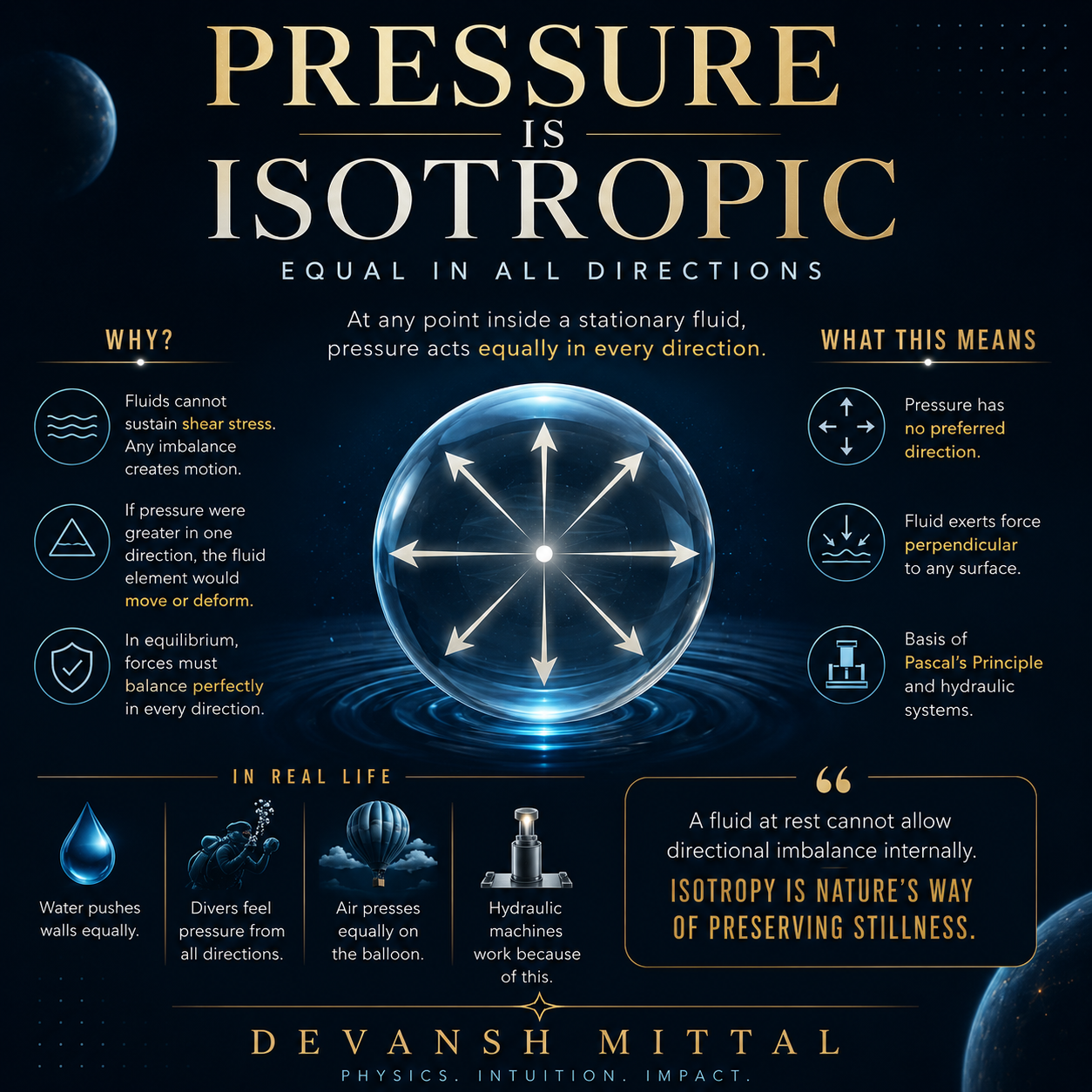
Pressure Is Isotropic

Why Pressure in a Fluid Acts Equally in All Directions

One of the most fundamental results in fluid mechanics is:

At a given point inside a stationary fluid, pressure acts equally in all directions.

This property is called the isotropy of pressure.

At first glance, the statement appears intuitive. Yet it emerges from a deep physical requirement: a fluid at rest cannot sustain shear stress.


The Core Physical Idea

Unlike solids, fluids cannot resist continuous tangential deformation. If unequal directional stresses existed at a point inside a stationary fluid, the fluid element would experience a net turning or shearing effect.

The element would then deform and begin to flow.

But a stationary fluid, by definition, is in equilibrium.

Therefore:

No directional imbalance can exist inside a fluid at rest.

Pressure must therefore act equally in every direction.


The Conceptual Proof

Consider an extremely small fluid element inside a liquid at rest.

Suppose pressure along one direction were greater than pressure along another direction.

The larger pressure would produce a greater force on one face of the element, generating an unbalanced shear tendency. Since fluids cannot sustain shear stress in static equilibrium, motion would immediately begin.

This contradicts the assumption that the fluid is stationary.

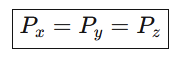
Hence the only possible equilibrium condition is:

Thus, pressure at a point in a static fluid is isotropic.


An Important Consequence

Because pressure has no preferred direction:

  • fluids exert force perpendicular to surfaces,
  • Pascal’s law becomes possible,
  • and hydraulic systems function efficiently.

From ocean depths to hydraulic lifts, isotropic pressure governs the behavior of fluids everywhere.


Final Conclusion

Pressure in a stationary fluid is isotropic because any directional inequality in pressure would create shear forces and destroy equilibrium. Nature preserves stillness inside fluids by ensuring perfect directional balance.

The Bell-Shaped Curve: A Common Pattern in Nature…

Standard

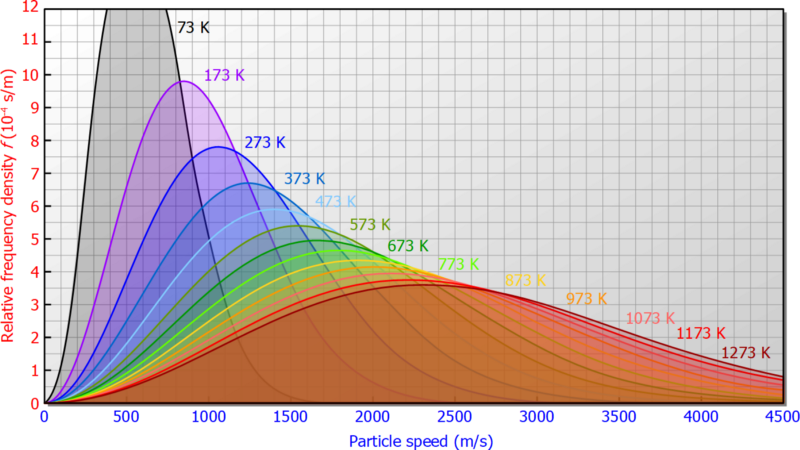
Following is Maxwell’s Distribution of Velocity Curve, in Kinetic Theory of Gases.

1*A2YXBk8eYVOKi5FMFKn13A

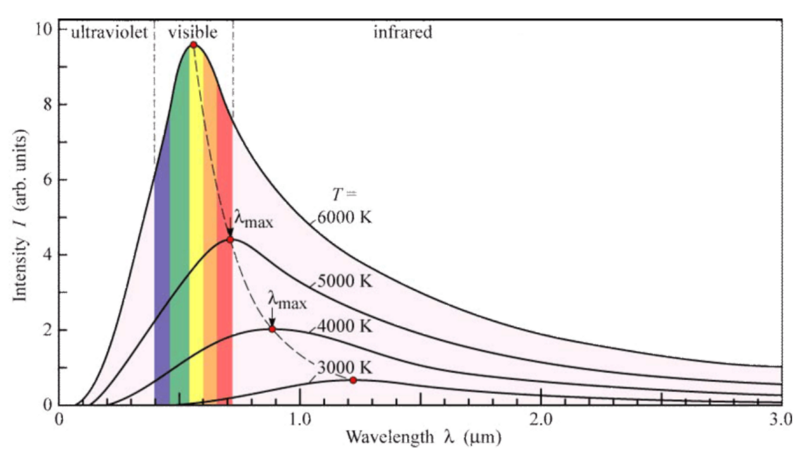
Following is the Wein’s Displacement Law, in Thermal Radiations.

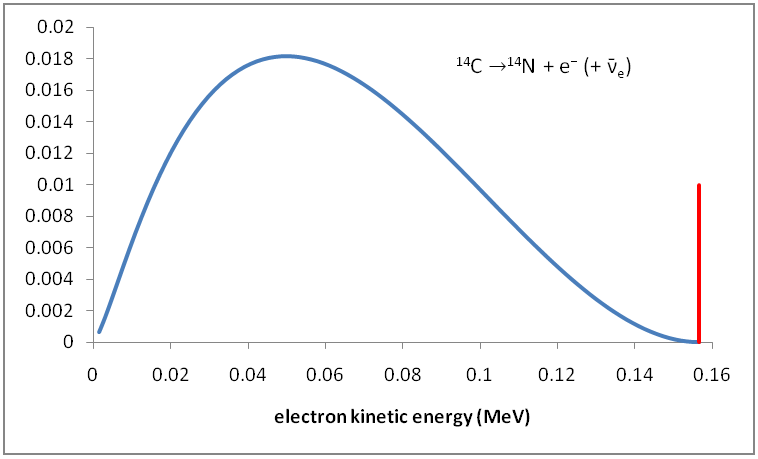
Following is the Distribution of Kinetic Energy of Beta Particles in Radioactive Decays.

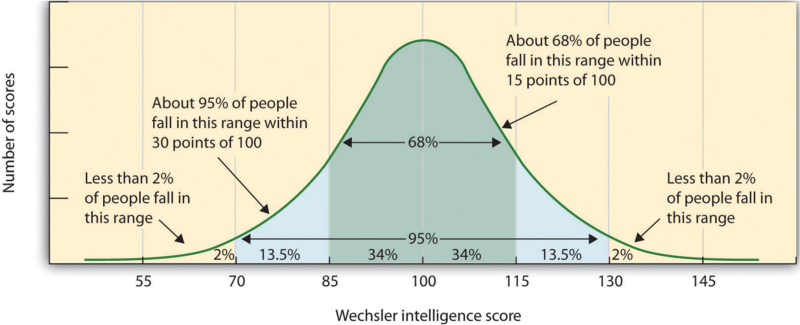
Following is the distribution of Intelligence among people in general.

Following is the distribution of Salaries in various countries among people.

Do you notice a pattern here?

All of them are Bell-Shaped curves. All the graphs shown above come from completely different fields of studies and still, they share a similar distribution pattern. Isn’t it strange and amazing? Doesn’t that point to some hidden mysteries of nature?

The bell-shaped curve is a common feature of nature and psychology. In statistics it is called a “Normal Distribution” and it is given a lot of importance in statistics and probabilistic distributions.

What is a Normal Distribution in Statistics?

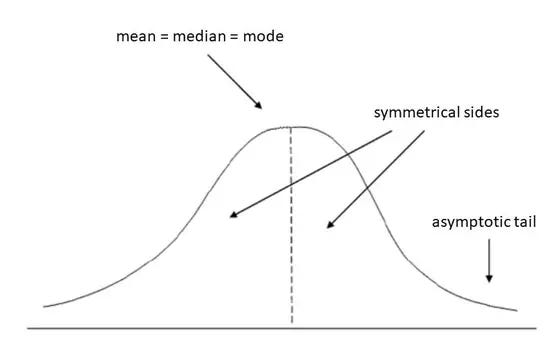
A normal distribution has a bell-shaped curve and is symmetrical around its center, so the right side of the center is a mirror image of the left side.

Most of the continuous data values in a normal distribution tend to cluster around the mean, and the further a value is from the mean, the less likely it is to occur. The tails are asymptotic, which means that they approach but never quite meet the horizon (i.e. x-axis).

For a perfectly normal distribution the mean, median and mode will be the same value, visually represented by the peak of the curve.

The normal distribution is often called the bell curve because the graph of its probability density looks like a bell. It is also known as called Gaussian distribution, after the German mathematician Carl Gauss who first described it.

Why is the normal distribution important?

The bell-shaped curve is a common feature of nature and psychology

The normal distribution is the most important probability distribution in statistics because many continuous data in nature and psychology displays this bell-shaped curve when compiled and graphed.

For example, if we randomly sampled 100 individuals we would expect to see a normal distribution frequency curve for many continuous variables, such as IQ, height, weight and blood pressure.

Parametric significance tests require a normal distribution of the samples’ data points. The most powerful (parametric) statistical tests used by psychologists require data to be normally distributed. If the data does not resemble a bell curve researchers may have to use a less powerful type of statistical test, called non-parametric statistics.

The normal distribution is so important in statistics that statisticians have written down books and have developed several theorems on just this single idea! One of the epitome of such theorems is Central Limit Theorem, which summarizes the idea discussed so far.

Later, I posted the same question on Physics Stack Exchange too, to receive more knowledge on the subject and yes it resulted positively. Following is the conversation.

https://physics.stackexchange.com/questions/521843/why-most-distribution-curves-are-bell-shaped-is-there-any-physical-law-that-lea

Further Readings and explorations.
1. The Normal Distribution: Crash Course Statistics #19
2. What is a Normal Distribution in Statistics?
3. Why is Normal Distribution Bell Shaped?
4. The Normal Distribution and the 68–95–99.7 Rule (5.2)
5. Why do airlines sell too many tickets? — Nina Klietsch


Perpetual Motion Machines — Why They Don’t Work?

Standard

Around 1159 A.D., a mathematician called Bhaskara the Learned sketched a design for a wheel containing curved reservoirs of mercury. He reasoned that as the wheels spun, the mercury would flow to the bottom of each reservoir, leaving one side of the wheel perpetually heavier than the other. The imbalance would keep the wheel turning forever. Bhaskara’s drawing was one of the earliest designs for a perpetual motion machine, a device that can do work indefinitely without any external energy source. Imagine a windmill that produced the breeze it needed to keep rotating. Or a lightbulb whose glow provided its own electricity. These devices have captured many inventors’ imaginations because they could transform our relationship with energy. For example, if you could build a perpetual motion machine that included humans as part of its perfectly efficient system, it could sustain life indefinitely. There’s just one problem. They don’t work.

Ideas for perpetual motion machines all violate one or more fundamental laws of thermodynamics, the branch of physics that describes the relationship between different forms of energy.

The first law of thermodynamics says that energy can’t be created or destroyed. You can’t get out more energy than you put in. That rules out a useful perpetual motion machine right away because a machine could only ever produce as much energy as it consumed. There wouldn’t be any leftover to power a car or charge a phone.

But what if you just wanted the machine to keep itself moving? Inventors have proposed plenty of ideas. None of them work.

Even if engineers could somehow design a machine that didn’t violate the first law of thermodynamics, it still wouldn’t work in the real world because of the second law of thermodynamics. The second law of thermodynamics tells us that energy tends to spread out through processes like friction. Any real machine would have moving parts or interactions with air or liquid molecules that would generate tiny amounts of friction and heat, even in a vacuum. That heat is energy escaping, and it would keep leeching out, reducing the energy available to move the system itself until the machine inevitably stopped.

Various kinds of Perpetual Motion Machines can be classified in the following categories and here we see, why they are doomed to fail given our current understanding of Science.

  • A perpetual motion machine of the first kind produces work without the input of energy. It thus violates the first law of thermodynamics: the law of conservation of energy.
  • A perpetual motion machine of the second kind is a machine which spontaneously converts thermal energy into mechanical work. When the thermal energy is equivalent to the work done, this does not violate the law of conservation of energy. However, it does violate the more subtle second law of thermodynamics (see also entropy). The signature of a perpetual motion machine of the second kind is that there is only one heat reservoir involved, which is being spontaneously cooled without involving a transfer of heat to a cooler reservoir. This conversion of heat into useful work, without any side effect, is impossible, according to the second law of thermodynamics.
  • A perpetual motion machine of the third kind is usually (but not always) defined as one that completely eliminates friction and other dissipative forces, to maintain motion forever (due to its mass inertia). Such a machine should satisfy the following 3 properties, at the least.
    The machine should not have any “rubbing” parts: Any moving part must not touch other parts. This is because of friction that would be created between the two. This friction will ultimately cause the machine to lose its energy to heat.
    The machine must be operated inside a vacuum (no air): The reason for this has to do with the reason listed in number one. Operating the machine anywhere will cause the machine to lose energy due to the friction between the moving parts and air. Although the energy lost due to air friction is very small, remember, we are talking about perpetual motion machines here, if there is a loss mechanism, eventually, the machine will still lose its energy and run down (even if it takes a long, long time).
    The machine should not produce any sound: a Sound is also a form of energy; if the machine is making any sound, that means that it is also losing energy.
    It is impossible to make such a machine, as dissipation can never be completely eliminated in a mechanical system, no matter how close a system gets to this ideal.

So far, these two laws of thermodynamics have stymied every idea for perpetual motion and the dreams of perfectly efficient energy generation they imply. Yet it’s hard to conclusively say we’ll never discover a perpetual motion machine because there’s still so much we don’t understand about the universe. Perhaps we’ll find new exotic forms of matter that’ll force us to revisit the laws of thermodynamics. Or maybe there’s a perpetual motion on tiny quantum scales. What we can be reasonably sure about is that we’ll never stop looking. For now, the one thing that seems truly perpetual is our search.

Following are some popular proposals for Perpetual Motion Machines, which may seem convincing in the first sight, but on detailed analysis, they contradict at least one of the Laws of Thermodynamics.

There are concepts and technical drafts that propose “perpetual motion”, but on closer analysis, it is revealed that they actually “consume” some sort of natural resource or latent energy, such as the phase changes of water or other fluids or small natural temperature gradients, or simply cannot sustain the indefinite operation. In general, extracting work from these devices is impossible.

Resource consuming

Some examples of such devices include:

  • The drinking bird toy functions using small ambient temperature gradients and evaporation. It runs until all water is evaporated.
  • A capillary action-based water pump functions using small ambient temperature gradients and vapor pressure differences. With the “Capillary Bowl”, it was thought that the capillary action would keep the water flowing in the tube, but since the cohesion force that draws the liquid up the tube in the first place holds the droplet from releasing into the bowl, the flow is not perpetual.
Untitled.png
  • A Crookes radiometer consists of a partial vacuum glass container with a lightweight propeller moved by (light-induced) temperature gradients.
  • Any device picking up minimal amounts of energy from the natural electromagnetic radiation around it, such as a solar-powered motor.
  • Any device powered by changes in air pressure, such as some clocks (Cox’s timepiece, Beverly Clock). The motion leeches energy from moving air which in turn gained its energy from being acted on.
  • The Atmos clock uses changes in the vapor pressure of ethyl chloride with temperature to wind the clock spring.
  • A device powered by radioactive decay from an isotope with a relatively long half-life; such a device could plausibly operate for hundreds or thousands of years.
  • The Oxford Electric Bell and Karpen Pile, driven by dry pile batteries.

Low friction

  • In flywheel energy storage, “modern flywheels can have a zero-load rundown time measurable in years”.
  • Once spun up, objects in the vacuum of space — stars, black holes, planets, moons, spin-stabilized satellites, etc. — dissipate energy very slowly, allowing them to spin for long periods. Tides on Earth are dissipating the gravitational energy of the Moon/Earth system at an average rate of about 3.75 terawatts.
  • In certain quantum-mechanical systems (such as superfluidity and superconductivity), very low friction movement is possible. However, the motion stops when the system reaches an equilibrium state (e.g. all the liquid helium arrives at the same level.) Similarly, seemingly entropy-reversing effects like superfluids climbing the walls of containers operate by ordinary capillary action.

Thought experiments

In some cases, a thought experiment appears to suggest that perpetual motion may be possible through accepted and understood physical processes. However, in all cases, a flaw has been found when all of the relevant physics is considered. Examples include:

  • Maxwell’s demon: This was originally proposed to show that the Second Law of Thermodynamics applied in the statistical sense only, by postulating a “demon” that could select energetic molecules and extract their energy. Subsequent analysis (and experiment) have shown there is no way to physically implement such a system that does not result in an overall increase in entropy.
  • Brownian ratchet: In this thought experiment, one imagines a paddle wheel connected to a ratchet. Brownian motion would cause surrounding gas molecules to strike the paddles, but the ratchet would only allow it to turn in one direction. A more thorough analysis showed that when a physical ratchet was considered at this molecular scale, Brownian motion would also affect the ratchet and cause it to randomly fail to result in no net gain. Thus, the device would not violate the Laws of thermodynamics.
  • Vacuum energy and zero-point energy: In order to explain effects such as virtual particles and the Casimir effect, many formulations of quantum physics include background energy which pervades empty space, known as vacuum or zero-point energy. The ability to harness zero-point energy for useful work is considered pseudoscience by the scientific community at large. Inventors have proposed various methods for extracting useful work from zero-point energy, but none have been found to be viable, no claims for extraction of zero-point energy have ever been validated by the scientific community, and there is no evidence that zero-point energy can be used in violation of conservation of energy.

References
1.
Why don’t perpetual motion machines ever work? — Netta Schramm
2. Science Explained: The Physics of Perpetual Motion Machines
3. Perpetual Motion.