A Question So Simple That It Shook Cosmology
Step outside on a clear night and look up at the sky. You will see thousands of stars scattered across the darkness, some shining brilliantly while others appear as faint points of light. Most of us never question why the spaces between those stars are dark. It feels completely natural. Yet this seemingly ordinary observation hides one of the most profound questions in the history of science: Why is the night sky dark at all?
At first glance, the answer appears obvious. Many people assume that the sky is dark because most of space is empty. Surprisingly, that explanation is not correct. In fact, this simple question puzzled astronomers for centuries and eventually helped reveal one of the most important discoveries about the universe itself.
The Puzzle Nobody Expected
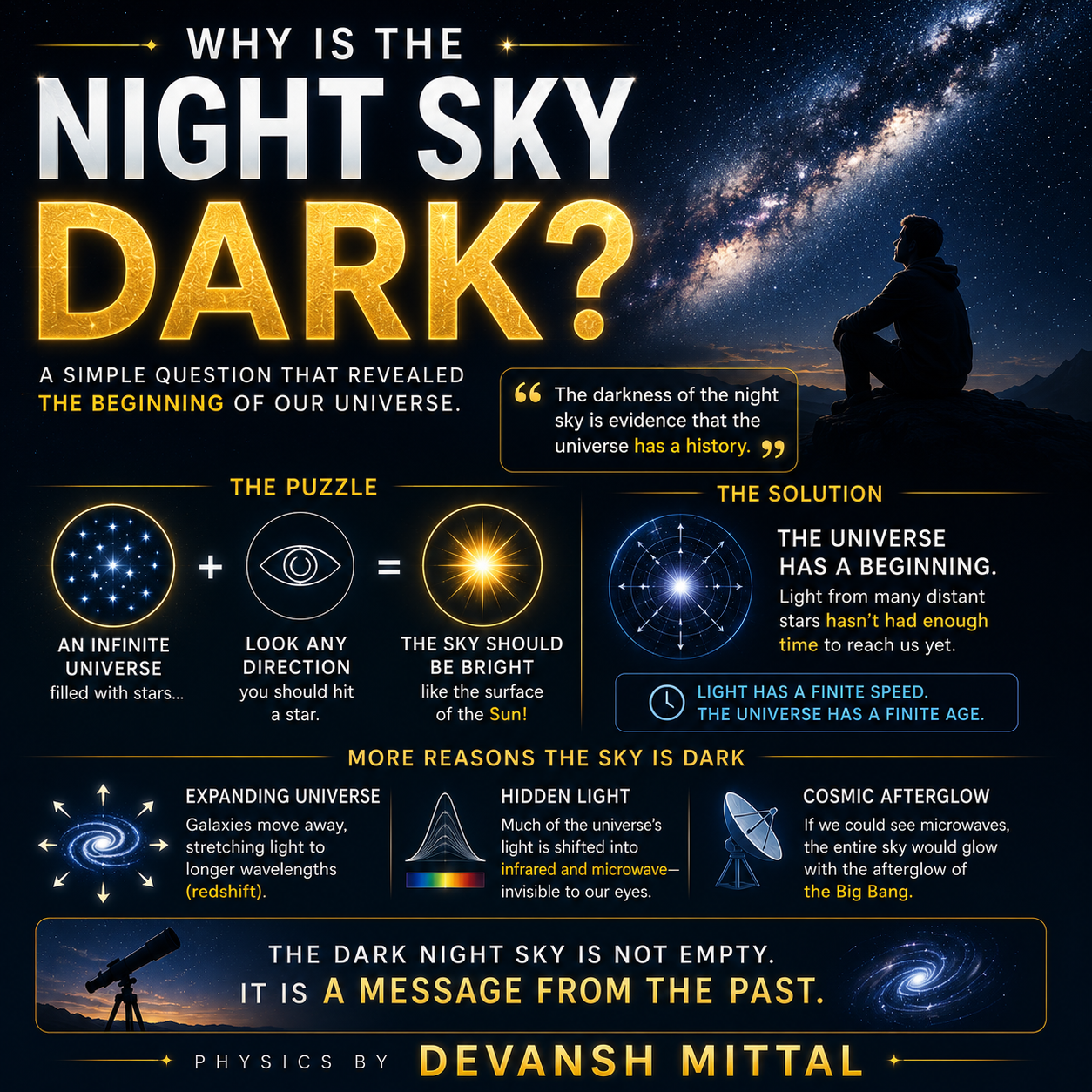
Imagine a universe that is infinitely large, filled with stars in every direction, and has existed forever. In such a universe, no matter where you looked, your line of sight would eventually end on the surface of a star. A useful analogy is a dense forest: wherever you look, your view ultimately terminates at a tree. By the same reasoning, every direction in the sky should eventually terminate at a star.
If this picture were correct, the entire night sky should glow with starlight. In fact, it should be almost as bright as the surface of the Sun. Yet the real night sky is overwhelmingly dark. This striking contradiction became known as Olbers’ Paradox, and it challenged some of the greatest scientific minds for generations.
Could Dust Be Blocking the Light?
One proposed solution was that enormous clouds of cosmic dust might be absorbing the light from distant stars before it reached Earth. At first, this idea seemed promising. However, it contains a fatal flaw. Dust that absorbs starlight cannot remain cold forever. Over time, it would heat up and begin emitting radiation of its own. Eventually, the dust would glow just as brightly as the light it absorbed, leaving the sky bright once again.
The darkness of the night sky therefore demanded a deeper explanation.
The Astonishing Solution
The breakthrough came when astronomers realized something extraordinary: the universe is not infinitely old. Instead, it had a beginning. Today, we call that beginning the Big Bang.
Because the universe has existed for only a finite amount of time, light from many distant stars and galaxies simply has not had enough time to reach us. When we gaze into the darkness of space, we are not necessarily looking into empty regions. In many directions, we are looking beyond the observable horizon of the universe, toward places whose light is still traveling toward us. The darkness of the night sky is therefore evidence that the cosmos has a finite age and a history.
Darkness as a Cosmic Message
The story becomes even more fascinating when we consider that the universe is expanding. As distant galaxies move away from us, their light becomes stretched to longer wavelengths through a process known as redshift. Over billions of years, much of the radiation produced throughout cosmic history has been shifted beyond the range of visible light into infrared and microwave wavelengths.
In other words, the universe is not truly dark. It is flooded with radiation. Our eyes simply cannot detect most of it. If human vision were sensitive to microwaves, the sky would appear to glow in every direction with the faint afterglow of the Big Bang itself.
The Next Time You Look Up
The darkness above you is not merely the absence of light; it is a source of information. It tells us that the universe has not existed forever. It tells us that light travels at a finite speed. It tells us that the cosmos is expanding and evolving with time.
Perhaps the most beautiful realization is that the dark night sky is not empty at all. It is a silent record of the universe’s origin, age, and history. Every star visible in the night sky is a reminder of the vastness of the cosmos, but the darkness between those stars may be even more profound. It is the darkness itself that reveals one of the greatest truths ever discovered: our universe had a beginning, and the night sky quietly tells that story every single night.
 The Intuitive Physicist