Introduction
What does it take to excel in NSEJS and progress towards international Olympiad success?
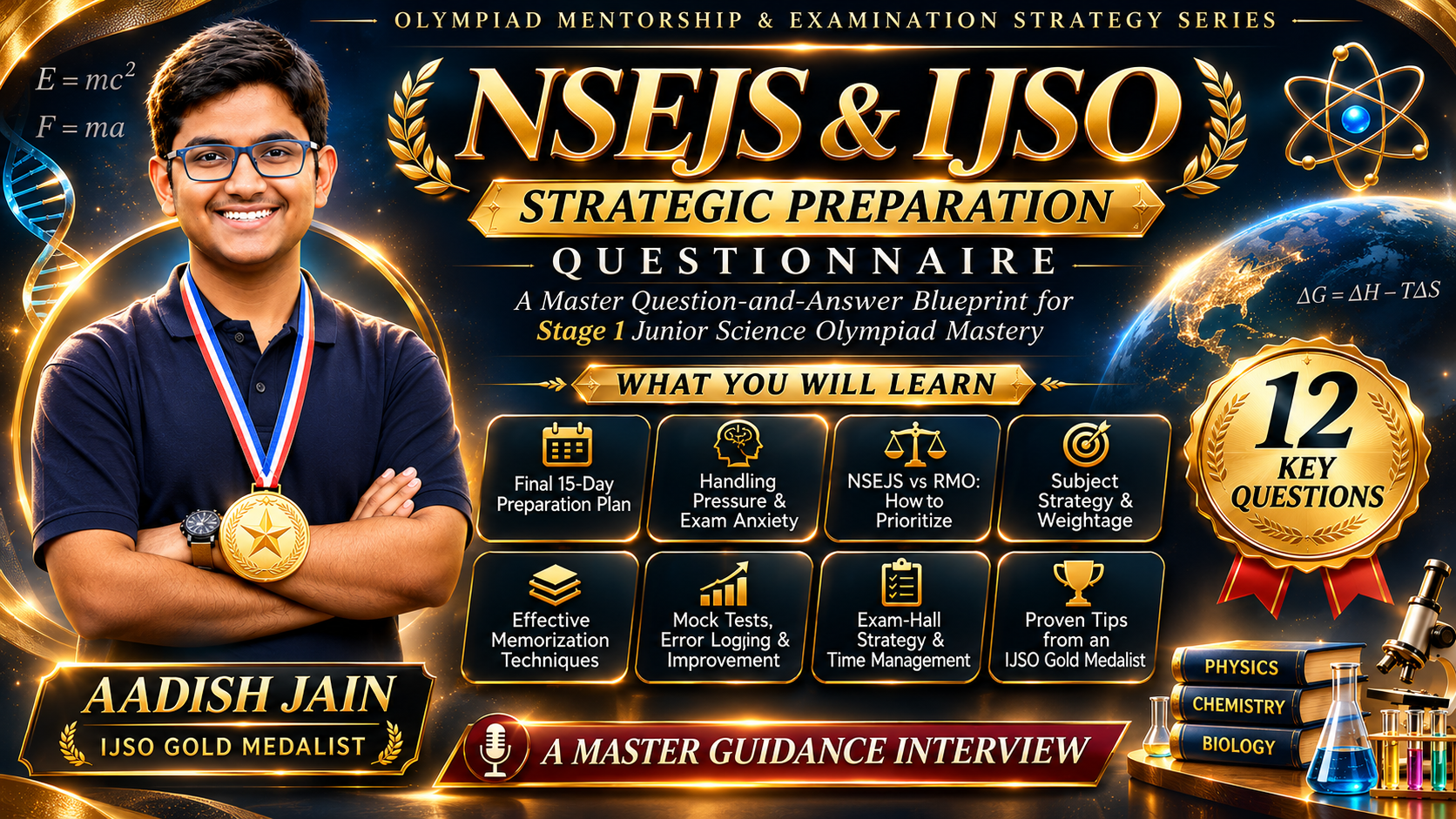
In this exclusive interview, Aadish Jain, IJSO 2025 Gold Medalist, shares his practical insights into effective preparation, subject-wise strategies, mock-test analysis, active recall, time management, and examination-hall techniques.
Through 12 carefully selected questions, we explore how to approach Physics, Chemistry and Biology, overcome exam anxiety, avoid negative marking, and maximise performance in the final stages of preparation.
A valuable preparation guide for every student aspiring to excel in NSEJS and pursue the Junior Science Olympiad journey.
The Questionnaire:
Module 1: The Final 15-Day Preparation Protocol & Psychology
Calibrating daily routine, mock test cadence, error logging, and performance expectations.
| Question 1: With approximately 15 days remaining before the NSEJS examination, what should be an aspirant’s primary focus, daily routine, and overall preparation strategy? |
Response & Guidance:
In the final 15 days, students must completely transition away from passive theory reading to active, rigorous mock testing. Reading textbooks from scratch at this juncture yields diminishing returns; all essential theoretical concepts have already been taught during the preceding academic months.
The daily regimen should revolve around solving 1 to 2 full-length, timed mock tests (or high-quality past-year papers). Aim to solve approximately 500 to 600 questions across this two-week window. This intense problem-solving routine achieves three vital objectives:
1. Active Diagnosis of Hidden Gaps: As you solve questions under exam constraints, conceptual misunderstandings and forgotten formulas immediately surface.
2. The Goldmine of Practice Errors: Making mistakes during practice is extraordinarily beneficial, provided they are addressed immediately. Maintain an ‘Error Logbook’. Every calculation slip or conceptual mistake recorded and corrected during mocks is an error permanently prevented on the actual exam day.
3. Decoupling from Mock Score Fluctuations: Do not allow lower mock scores to induce panic or demotivation. Mock difficulty fluctuates, and institutes intentionally create challenging papers. What matters is not your score today, but your ability to eliminate recurring errors before exam day.
| Question 2: How should students psychologically handle exam pressure, fear of failure, and the anxiety of not scoring at the top in mock tests? |
Response & Guidance:
Experiencing pressure is completely natural, but students must recognize that anxiety directly impairs executive cognitive function, degrades working memory, and leads to avoidable calculation errors. Anxiety never adds a single mark to your scorecard.
The most effective psychological reframe is understanding the fundamental qualification mechanics of NSEJS:
• Qualification, Not Perfection: In NSEJS, you do not need 100% marks or an all-India top rank. Your sole objective is to surpass the Merit Index (MI) / Minimum Admissible Score (MAS) to secure selection within your state’s allotted quota for Stage 2 (INJSO).
• The Clean Slate of Stage 2: Scores achieved in NSEJS do not carry forward into INJSO. Whether a student qualifies at the very top of their state or barely clears the boundary line, every qualified candidate enters Stage 2 on an entirely equal footing.
• Historical Precedent (The Boundary Qualifier): Even students who qualify on the absolute lowest boundary mark can go on to win International Gold Medals for India at IJSO, because subsequent stages test deep subjective thinking and experimental acumen rather than speed-based multiple-choice execution.
View every mistake made in mocks as a positive asset: if you complete 500 practice questions and get 100 wrong, you have uncovered and neutralized 100 potential pitfalls before walking into the examination center.
Module 2: Strategic Prioritization & Competitive Landscape
Evaluating competing Olympiad tracks, age brackets, and long-term academic dividends.
| Question 3: Many students in Grades 8, 9, and 10 face a dilemma between preparing for the Regional Mathematical Olympiad (RMO) and the Junior Science Olympiad (NSEJS). How should students strategically prioritize between these two examinations? |
Response & Guidance:
While intellectual exploration across multiple disciplines is commendable, when time is constrained, students in Class 8, 9, and 10 must make NSEJS/IJSO their absolute primary priority. This prioritization is backed by hard competitive arithmetic and empirical track records:
1. Age-Capped Peer Competition: In NSEJS/IJSO, the competitive cohort is strictly restricted to students under 15–16 years of age (Grades 8, 9, and 10). You compete exclusively against your immediate developmental peers. In stark contrast, in RMO and subsequent stages, a Class 9 or 10 student competes on the exact same paper against highly experienced Class 11 and Class 12 students.
2. Dramatically Higher Camp Selection Odds: Because the playing field in Junior Science is age-bounded, the statistical probability of qualifying through NSEJS and INJSO to reach the national Orientation-cum-Selection Camp (OCSC) is vastly higher than securing one of the few national seats for the International Mathematical Olympiad Training Camp (IMOTC).
3. Proven Foundation for Future Excellence: Empirical tracking of national competitive results reveals that in recent IIT-JEE Advanced results, 7 out of the Top 10 all-India rankers (AIR 1, 3, 4, 5, 7, 8, 10) were Junior Science OCSC alumni. Junior Science builds a comprehensive, multi-disciplinary foundation across Physics, Chemistry, and analytical scientific reasoning that directly fuels future academic dominance.
Students may sit for RMO for intellectual stimulation, but their core energy, revision hours, and practice papers in Grades 8–10 must remain anchored to NSEJS.
Module 3: Subject-Specific High-Yield Blueprints
Deconstructing syllabus weightages across Physics, Chemistry, and Biology.
| Question 4: In Physics, what is the nature of the questions asked in NSEJS, and which specific chapters represent the highest-yield investment for final revision? |
Response & Guidance:
Physics in NSEJS is characterized by significant mathematical depth, multi-step derivations, and the blending of concepts across disparate physical domains. The exam rarely tests isolated, formula-plugging questions; rather, it evaluates conceptual synthesis.
The highest-yield areas that form the core backbone of the Physics paper include:
• Class 11 Mechanics & Kinematics: Newton’s Laws of Motion (NLM), constrained motion, friction, and one/two-dimensional kinematics.
• Work, Energy & Power: Conservation of mechanical energy, work-energy theorem, and potential energy curves.
• Fluid Mechanics: Hydrostatic pressure, buoyant force, Archimedes’ principle, and continuity equations. Fluid problems are frequently blended with kinematics or harmonic motion.
• Foundational Electrodynamics & Optics: Current Electricity (complex resistor networks, Kirchhoff’s laws) and Geometric Optics (refraction, total internal reflection, thin lenses).
Strategic Directive: Allocate revision time to solving multi-concept numerical problems from these chapters. Avoid passive re-reading of theory; solve challenging problems under timed conditions.
| Question 5: How should students balance their preparation across Physical, Organic, and Inorganic Chemistry, and what specific sub-topics yield the most consistent marks? |
Response & Guidance:
Chemistry in NSEJS requires a balanced triad approach, as each branch demands a distinct cognitive strategy:
1. Organic Chemistry (Surging Importance): Over the past two to three examination cycles, IAPT has steadily elevated the weightage of Organic Chemistry, with recent papers containing approximately 8 dedicated questions. Fortunately, questions remain grounded in fundamentals rather than obscure named reactions. Prioritize IUPAC nomenclature, structural and stereoisomerism, General Organic Chemistry (inductive effects, resonance, hyperconjugation, carbocation/carbanion stability), and standard reactions of hydrocarbons.
2. Physical Chemistry (Calculation Rigor): Physical Chemistry is anchored primarily in early Class 11 concepts. Master the Mole Concept, Stoichiometry, Redox Reactions, and fundamental Electrochemistry. Chemical Equilibrium problems can occasionally become algebraically intricate, so ensure numerical accuracy in balancing and stoichiometric equivalents.
3. Inorganic Chemistry (High-Frequency Retention): Inorganic Chemistry is notoriously prone to memory decay. Rather than engaging in exhausting multi-hour cramming sessions, adopt high-frequency reviews: spend 15 to 30 minutes daily reviewing periodic trends, chemical bonding, and NCERT factual tables.
Chemistry represents the most reliable scoring stabilizer in NSEJS. Solid fundamentals in Organic and Physical Chemistry allow students to accumulate marks with minimal time expenditure.
| Question 6: Many engineering and JEE-oriented aspirants neglect or fear Biology. Why is Biology considered the ultimate competitive differentiator in NSEJS, and which selective chapters must non-medical students master? |
Response & Guidance:
Biology is universally recognized by Olympiad mentors as the ‘Game-Changer’ of NSEJS. The strategic reasons are compelling:
• The Engineering Cohort Trap: The overwhelming majority of serious NSEJS aspirants are heavily focused on mathematics, physics, and physical chemistry. Consequently, scores in Physics and Chemistry hit a plateau of cut-throat competition where almost all top students score equally well.
• The Decisive Cut-Off Cushion: Biology provides the crucial mark differential needed to surge past state Merit Index cut-offs. Every mark scored in Biology requires a fraction of the time needed to solve a complex Physics problem, carries zero mathematical calculation risk, and adds directly to the aggregate score.
For students without a deep medical background, reading entire comprehensive medical encyclopedias is counterproductive. Instead, master these four high-yielding domains:
1. Human & Animal Physiology: Circulatory, excretory, nervous, endocrine, and digestive systems. Focus on physiological mechanisms and hormone regulation.
2. Plant Physiology: Photosynthetic pathways (C3, C4 mechanisms), cellular respiration, transpiration pull, and plant growth regulators.
3. Classical Genetics: Mendelian inheritance laws, monohybrid/dihybrid crosses, sex linkage, and pedigree analysis basics.
4. Animal Behavior & Ecology: Ecological pyramids, trophic interactions, ethology basics, and environmental adaptations.
Never abandon Biology. Securing even 20 to 30 marks in Biology often represents the exact mathematical margin between qualifying and elimination.
Module 4: Cognitive Science of Memorization & Active Recall
Harnessing cognitive memory laws to master inorganic reactions, biology cycles, and physics formulas.
| Question 7: What scientifically proven memorization techniques and active recall protocols should students employ to retain vast amounts of factual information in Biology and Inorganic Chemistry without cognitive burnout? |
Response & Guidance:
Human memory operates under well-established cognitive laws. Attempting to force-cram vast factual taxonomies, reaction sheets, or biochemical pathways through brute-force, single-session intensity always results in steep forgetting curves within days.
To achieve permanent, stress-free retention, students must employ a three-tier cognitive protocol:
1. The Law of Frequency over Intensity: Long, exhausting 5-hour study blocks dedicated to a single factual subject lead to cognitive saturation and rapid decay. Instead, drastically increase the frequency of exposure. A brisk, 15-minute daily pass through your short notes, reaction summary charts, or formula sheets produces exponential gains in long-term neural consolidation compared to an occasional 4-hour marathon.
2. Active Recall via Blank-Page Retrieval: Passive reading and highlighting give students an artificial ‘illusion of competence.’ The true test of memory is retrieval. After reviewing a topic, immediately close the book and recreate the chemical reaction mechanism, biochemical pathway (e.g., Krebs cycle or Calvin cycle), or formula derivation on a blank sheet of paper strictly from memory. What you can write without looking is permanently encoded.
3. Verbal Articulation (The Protégé Effect): Explain complex concepts, physiological feedback loops, or periodic trends aloud to a study partner, sibling, or parent. Translating abstract visual data into coherent verbal speech forces the brain to reorganize knowledge hierarchically, instantly exposing hidden conceptual voids.
High frequency of contact, active paper retrieval, and verbal testing will invariably outperform passive rereading.
Module 5: Exam-Hall Tactics & Paper-Attempt Engineering
Engineering paper navigation, round-based filtering, multi-correct defense, and negative-marking control.
| Question 8: What is the recommended overall paper-attempt strategy, subject sequence, and time management protocol inside the 2-hour NSEJS examination hall? |
Response & Guidance:
Inside the examination hall, your performance is a product of knowledge multiplied by execution discipline. The ideal paper-attempt strategy follows a structured **3-Round Sweep Protocol**:
• Initial Starting Subject: Always begin with your personal stronghold (for many, this is Physics or Chemistry). Successfully solving the first 4 to 5 questions in your strongest domain triggers neurochemical momentum, reduces cortisol (stress), and settles exam-room jitters.
• Round 1 (The Speed & Confidence Sweep — First 45–50 Minutes): Rapidly traverse the single-correct questions across all three subjects. Solve strictly those direct, high-confidence questions that can be completed in under 2 minutes. Bank all accessible, low-hanging fruit immediately.
• Round 2 (Consolidation & Moderate Calculations — Next 40–45 Minutes): Return to questions that were flagged as solvable but required multi-step algebraic manipulation, balancing equations, or closer reading.
• Round 3 (Multi-Correct & Complex Problems — Final 25–30 Minutes): Dedicate focused attention to the high-stakes multi-correct section and remaining complex questions.
By segmenting the 120 minutes into distinct tactical rounds, you ensure that no simple, high-scoring question anywhere in the booklet is left unread or unattempted due to time exhaustion.
| Question 9: What should a student do if their favorite or strongest subject turns out to be unexpectedly brutal or complicated in that year’s examination paper? |
Response & Guidance:
One of the most dangerous traps for top students is the ‘Ego Trap.’ When an aspirant who has solved advanced university-level problems in their favorite subject encounters an exceptionally challenging question in that subject, they often refuse to let go, spending 8 to 10 precious minutes attempting to force a solution.
The professional tactical directive is unequivocal:
• Leave Your Ego at the Door: An examination paper does not care about your emotional attachment to a subject. An elementary mark earned in Biology carries the exact same numerical weight as a mark wrestled from an agonizing 10-minute Physics problem.
• Dynamic Subject Switching: If you discover during the first 10 minutes that your primary subject is brutally difficult, immediately pivot! Switch smoothly to Chemistry or Biology, accumulate all direct, scoring points, and secure your baseline score.
• Recognize Universal Difficulty: If a section is genuinely difficult, it is difficult for every candidate across the country. The Merit Index will drop accordingly. Never allow one tough section to ruin your composure across the rest of the paper.
| Question 10: How should students tackle the high-stakes Multi-Correct (One or More than One Option Correct) section in NSEJS to maximize scoring while avoiding severe marking penalties? |
Response & Guidance:
In NSEJS, Part B (Multi-Correct Questions) carries immense mathematical leverage: typically awarding +6 marks if all correct options are selected, but 0 marks (or negative penalties) if even a single incorrect option is chosen or an option is missed. With approximately 12 questions totaling 72 marks, this section can single-handedly propel a candidate into national selection.
To navigate this high-risk, high-reward section, adopt these strict guidelines:
1. Treat Every Option as an Independent True/False Proposition: Never rush into choosing familiar-looking options. Evaluate Option A, Option B, Option C, and Option D as four distinct, standalone conceptual statements.
2. Rigorous Option Elimination: Actively seek counterexamples or dimensional inconsistencies to decisively falsify incorrect options before validating the remaining choices.
3. Zero Speculative Guessing: Because partial marking is either non-existent or heavily penalized, speculative guesswork in multi-correct questions is statistically destructive. Only commit to multi-option selections when your theoretical or mathematical justification is completely airtight.
4. Strategic Placement in Exam Timeline: Attempt multi-correct questions only after securing your baseline qualifying score from the single-correct sections.
| Question 11: What concrete guidelines should students follow to eliminate negative marking and enforce strict question-skipping discipline during the exam? |
Response & Guidance:
In competitive Olympiads, what you choose *not* to solve is just as vital as what you solve. Time is the most inelastic resource in a 120-minute examination.
Enforce these three non-negotiable rules:
• The 120-Second Rule: When you read a problem, if a clear conceptual roadmap to the solution does not crystallize within 90 to 120 seconds, flag the question and move on immediately. Sinking 6 minutes into a single stubborn problem effectively robs you of attempting three easy problems located later in the paper.
• Eliminate Blind Guesswork: In single-correct questions (+3 / -1), blind guessing incurs a negative expected value. Only consider attempting a calculated guess if you have definitively eliminated at least two options through rigorous scientific reasoning.
• Protect Your Net Aggregate: Remember that avoiding a -1 penalty is functionally equivalent to scoring an additional mark elsewhere. Conserving marks through disciplined skipping is what elevates boundary students into comfortable qualifiers.
Module 6: Exam-Day Mindset & Psychological Composure
Maintaining calm, handling test-center logistics, and sustaining peak mental flow.
| Question 12: On the day of the examination, what mental rituals and psychological coping strategies ensure that students stay calm, handle unforeseen logistical friction, and perform at their absolute peak? |
Response & Guidance:
On the final examination morning, academic preparation gives way to psychological state management. Peak cognitive performance requires deliberate mental anchoring:
1. The ‘Just Another Mock’ Psychological Framing: Do not build the examination up into a life-altering ordeal. Consciously frame the test as simply ‘Mock Test #25’—identical in duration, structure, and challenge to the dozens of practice papers you have already dismantled in previous weeks.
2. Neutralizing Center Friction: Unforeseen logistics can happen at external centers—such as delays in distributing rough sheets, strict invigilator instructions, or ambient noise. Pre-program your mind to expect minor imperfections. External logistics are completely outside your circle of control; your focus, breathing, and question-selection discipline are 100% within your control.
3. The 30-Second Breathing Reset: If at any point during the exam you encounter two consecutive unfamiliar questions and feel anxiety rising (elevated heart rate, racing thoughts), immediately put your pen down, close your eyes, take three deep diaphragmatic breaths, and remind yourself: ‘The paper is tough, which means the cut-off is low. My job is simply to find the next solvable question.’
Trust the months of rigorous training, execute your round-based strategy with calm precision, and allow your preparation to shine.
Master Strategy Synthesis & Action Checklist
Quick-reference compilation of core rules across all 12 questions.
| Strategic Domain | Non-Negotiable Executive Directive |
| Daily Practice Cadence | Complete 1 full mock test every 1–2 days under strict 2-hour timed conditions; solve 500–600 questions across the final 15 days. |
| Error Logging | Maintain a physical ‘Error Logbook’. Analyze every calculation and conceptual slip immediately; review every morning. |
| Biology Allocation | Dedicate 30–45 minutes daily to high-yield Physiology, Genetics, and Ecology. View Biology as your cut-off insurance policy. |
| Inorganic Chemistry Retention | Execute high-frequency, rapid 15-minute daily reviews of NCERT tables and trends rather than occasional multi-hour cramming blocks. |
| Paper Sweep Protocol | Enforce the 3-Round Strategy. Round 1: Solve only <2 min direct questions. If stuck past 120 seconds, skip instantly. |
| Multi-Correct Execution | Treat each option as an independent True/False statement. Employ strict option elimination; zero blind guessing. |

