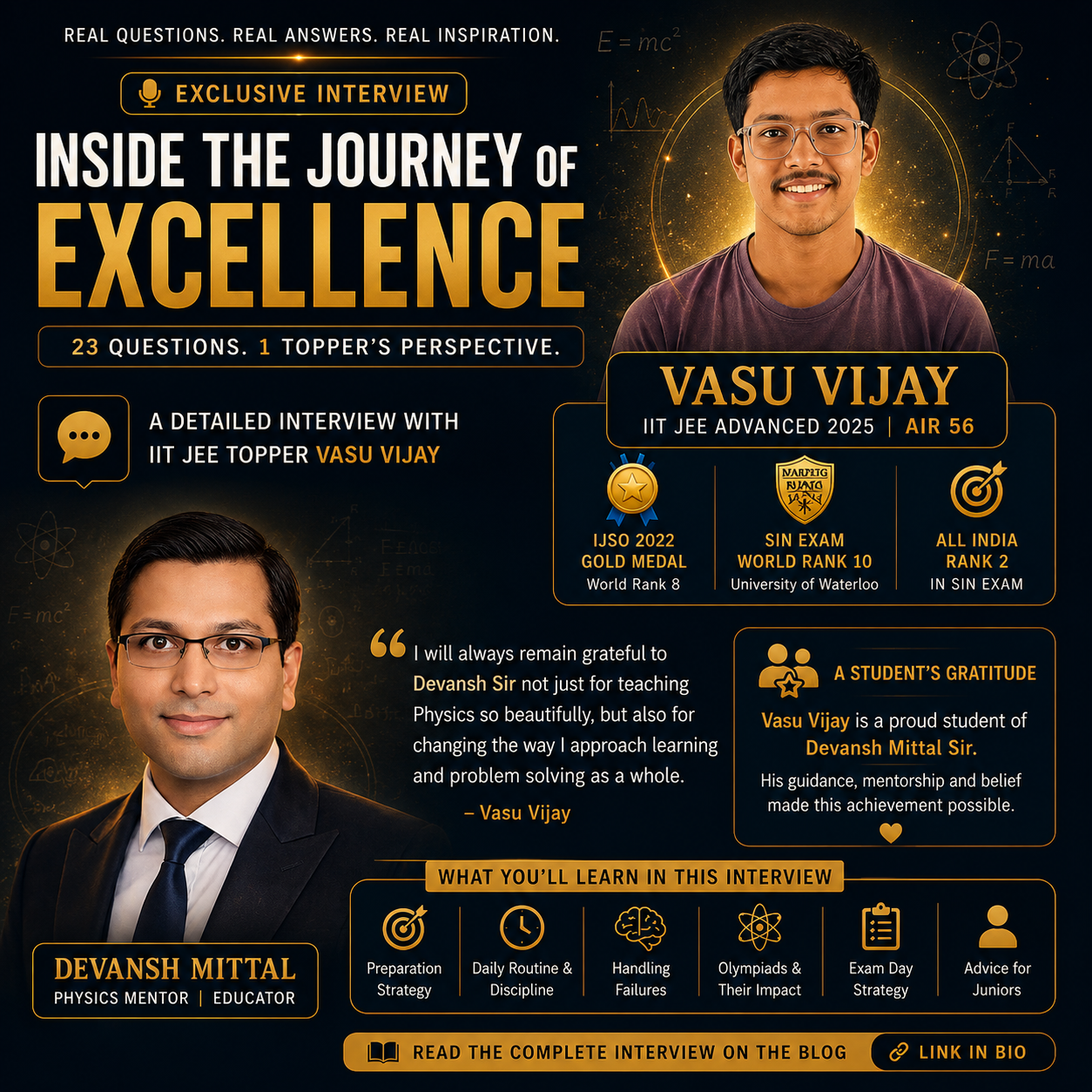
23 thoughtful questions on JEE preparation, Olympiads, discipline, setbacks, mentorship, exam strategy, and the habits that shape exceptional achievement.
Phase 1: The Journey Begins
Question 1: The Result Moment
Walk us through the exact moment you (and your parents) saw that you secured a top All India Rank. What was that feeling like?
Response 1:
It was early in the morning, around 6 A.M., when I checked the result. Seeing my rank was an incredibly happy and satisfying moment. When I shared the news with my family, they were overjoyed. It was a moment of celebration and relief for all of us after years of hard work.
Question 2: The Catalyst
When did you officially start your JEE preparation? Was getting into an IIT always your ultimate dream, or did the realization happen later?
Response 2:
I started preparing seriously for JEE during Classes 10 to 12. The idea of getting into an IIT had been in my mind for a few years before that, so it was a goal I had been working towards for quite some time.
Question 3: Identifying the Path
How did you figure out your true academic interest? At what point did you decide to pursue engineering over medical or commerce?
Response 3:
The decision developed gradually. I was always interested in building things, solving problems, and understanding how systems work. Engineering felt like the natural path because it combined creativity, innovation, and problem-solving.
Question 4: The Olympiad Edge
You have represented India in international Olympiads. How important are these exams (like IJSO, NSEP) in building the foundation for JEE?
Response 4:
Preparing seriously for Olympiads like IJSO helps build strong fundamentals, develops problem-solving skills, and teaches you how to learn effectively. These skills become extremely valuable later during JEE preparation.
Preparing for NSEP is a good idea if you are preparing for IIT, because the syllabus for both is very similar.
However, as you move on to the higher stages beyond NSEP towards IPhO, the Olympiad syllabus starts deviating from the IIT path. I would recommend my juniors to take NSEP very seriously, but not necessarily the higher stages of the Physics Olympiad if they do not wish to compromise their IIT preparation.
If they believe they can manage both the Olympiad and IIT, then they can continue with all the stages of IPhO.
Similar are my views towards the Chemistry Olympiad.
Phase 2: Academic Architecture & Blueprint
Question 5: The Daily Routine
What did your daily routine look like? Did you follow a rigid timetable (by the hour) or a flexible, target-based approach?
Response 5:
I mainly focused on completing my daily goals. Rather than following a rigid timetable, I preferred a target-based approach where the priority was getting important work done consistently. I always tried to study 6-8 hours daily, apart from my classes which used to consume around 5-6 hours of time. On a holiday, I used to study a minimum of 10 hours.
Question 6: Sleep & Cycles
How many hours of sleep did you prioritize? Did you prefer studying late at night or early in the morning?
Response 6:
I generally preferred studying a little later at night, but I always tried to get at least 6–7 hours of sleep. Adequate sleep was important for maintaining concentration and productivity.
Question 7: Subject Allocation
How did you balance Physics, Chemistry, and Math? Did you allocate equal time to all, or base it entirely on your weak points?
Response 7:
In the beginning, I gave roughly equal attention to all three subjects. During revision, however, I adjusted my time according to my needs, spending more time on weaker subjects or topics that required additional work.
Question 8: The Material Trap
Did you rely strictly on your coaching modules, or did you use multiple reference books (like H.C. Verma)? Is it better to solve one book three times or three books once?
Response 8:
For concept-building, solving the same high-quality material multiple times is usually sufficient. It also saves time because you can focus on strengthening weak areas rather than repeatedly solving questions you are already comfortable with.
In my opinion, you should follow the material provided in your coaching institute and the material which your teachers recommend. That is generally sufficient.
However, if you feel bored or want additional practice, exploring new books can provide fresh problem formulations based on similar concepts. But more is not always better, hunting for new books all the time is also not a good idea.
Question 9: Study Material
Which material did you use for IJSO and what material did you use for IIT?
Response 9:
For Physics during IJSO preparation, I mainly used H.C. Verma and Past Year Questions. In other subjects I primarily used class notes and Past Year Questions of NSEJS and INJSO.
For IIT-JEE, I relied primarily on coaching material. In physics, in addition I used H.C. Verma and selected topics from I.E. Irodov. In the other subjects, my primary focus remained on coaching material. If at all I followed any other resources, they were only the ones suggested by my teachers to me. My recommendation is, just follow your coaching material and your teachers.
Question 10: Biology and IJSO
Being an IIT aspirant, how was your attitude towards Biology during IJSO preparation?
Response 10:
One thing I enjoyed about IJSO Biology was that it was highly application-oriented and logical. Because of that, I found it interesting and engaging rather than something that had to be memorized. Since I was in Class 9 at the time, I also had sufficient time to balance it with future JEE preparation.
Question 11: IOQM and IMO
Should students focus on IOQM if their future goal is IIT?
Response 11:
I think this depends largely on personal interest. Attempting IOQM can be a good way to stay connected with mathematical thinking. However, the skills and syllabus required for higher-level Olympiad mathematics are quite different from JEE, so it is not necessary for every IIT aspirant.
Question 12: School and Coaching
How did you manage the time with both school and coaching?
Response 12:
I was enrolled in a dummy school, so managing regular school commitments was not a challenge for me.
Question 13: Sports and Recreation
Did you only study during those preparation years or did you also spend time in sports, workouts, and other recreational activities?
Response 13:
I practiced yoga in the mornings during my JEE preparation. Apart from that, I occasionally watched television, but most of my time was focused on academics.
Phase 3: Psychology, Adversities & Mindset
Question 14: Tackling Failure
What were your best and worst scores in mock tests? How did you mentally recover from a disastrous test score?
Response 14:
My best score was around 330 out of 360, while my lowest was around 190. Whenever I performed poorly, I carefully analysed where I had lost marks and why. I also discussed both the academic and psychological aspects of the situation with my teachers. At the end of the day, a mock test is only a tool for improvement, not a final judgment.
Question 15: The “Silly Mistakes” Protocol
Almost every student loses ranks to silly mistakes. Did you maintain a “mistake notebook,” and how did you actively minimize these errors?
Response 15:
Instead of maintaining a separate notebook, I marked questions directly in my hard copies and categorised them according to the type of mistake and its underlying cause. I would carefully review these questions the day after the exam and focus on preventing similar errors in the future.
Question 16: Conquering Fear
Was there a specific topic (like Thermodynamics or Fluids) that terrified you? How did you overcome it?
Response 16:
Topics such as parts of Rigid Body Dynamics and Fluid Dynamics were initially difficult because building intuition for them took time. Some concepts were also quite dense. Rather than fearing them, I accepted that they would require more effort and invested additional time in understanding them properly.
Question 17: Digital Distractions
How did you handle smartphones and social media? Did you cut them off completely, or use them in moderation?
Response 17:
I used my phone normally, but primarily for communication through WhatsApp. I did not spend significant time on social media platforms, which helped me stay focused without feeling completely disconnected.
Question 18: The “Burnout” Days
What did you do on days when you were completely exhausted and absolutely did not want to study?
Response 18:
If I felt genuinely tired, I would take a short nap or play a game for a while before returning to work. Since I lived at home, burnout was not a major issue for me, but I always tried to listen to my body when I needed a break.
Phase 4: The Ecosystem (Family, Mentors & Peers)
Question 19: The Peer Group
How important is a highly competitive friend circle in cracking JEE? Did you do group studies or doubt-solving with friends?
Response 19:
Discussing doubts and brainstorming with friends helped me develop a much deeper understanding of concepts. It also provided a useful reality check regarding my preparation. At the same time, it is important not to feel intimidated by what others are doing. What matters most is how effectively you are using your own time and opportunities.
Question 20: The Mentors
Were you ever hesitant to ask doubts in a class full of brilliant students? How did your bond with your teachers help you beyond academics?
Response 20:
Yes, I did feel hesitant in some classes initially. However, overcoming that hesitation and asking doubts is extremely valuable. Building a strong relationship with teachers helps not only academically but also in developing confidence, perspective, and better decision-making throughout the preparation journey.
Phase 5: The Exam Day & The Aftermath
Question 21: The Exam Strategy
Did you have a pre-decided sequence for attempting the paper (e.g., Chemistry, then Physics, then Math), or did you adapt based on the paper’s difficulty?
Response 21:
I always adapted my strategy according to the paper. My priority was to identify and solve the easier questions first, secure those marks, and then return to the more challenging questions later.
Question 22: Exam Temperament
Were you nervous on the actual day of the exam, or did giving continuous mock tests eliminate the “exam fear”?
Response 22:
By the time the actual exam arrived, I had very little exam anxiety. Regular mock tests had helped me build familiarity with the exam environment and develop the confidence needed to perform calmly under pressure.
Once I started attempting my actual IIT exam, it felt like a regular mock test only to me.
Phase 6: Unplugged & Rapid Fire
Question 23: The Ultimate Advice
What is your final, defining piece of advice for the millions of juniors who want to be in your shoes next year?
Response 23:
Build strong relationships with your teachers, focus deeply on conceptual understanding, surround yourself with a positive and motivated peer group, and make sure you have a healthy way to manage stress. These factors may seem simple, but over time they can make a tremendous difference in both your preparation and your final outcome.
 The Intuitive Physicist