
Pressure Is Isotropic
Why Pressure in a Fluid Acts Equally in All Directions
One of the most fundamental results in fluid mechanics is:
At a given point inside a stationary fluid, pressure acts equally in all directions.
This property is called the isotropy of pressure.
At first glance, the statement appears intuitive. Yet it emerges from a deep physical requirement: a fluid at rest cannot sustain shear stress.
The Core Physical Idea
Unlike solids, fluids cannot resist continuous tangential deformation. If unequal directional stresses existed at a point inside a stationary fluid, the fluid element would experience a net turning or shearing effect.
The element would then deform and begin to flow.
But a stationary fluid, by definition, is in equilibrium.
Therefore:
No directional imbalance can exist inside a fluid at rest.
Pressure must therefore act equally in every direction.
The Conceptual Proof
Consider an extremely small fluid element inside a liquid at rest.
Suppose pressure along one direction were greater than pressure along another direction.
The larger pressure would produce a greater force on one face of the element, generating an unbalanced shear tendency. Since fluids cannot sustain shear stress in static equilibrium, motion would immediately begin.
This contradicts the assumption that the fluid is stationary.
Hence the only possible equilibrium condition is:
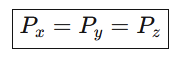
Thus, pressure at a point in a static fluid is isotropic.
An Important Consequence
Because pressure has no preferred direction:
- fluids exert force perpendicular to surfaces,
- Pascal’s law becomes possible,
- and hydraulic systems function efficiently.
From ocean depths to hydraulic lifts, isotropic pressure governs the behavior of fluids everywhere.
Final Conclusion
Pressure in a stationary fluid is isotropic because any directional inequality in pressure would create shear forces and destroy equilibrium. Nature preserves stillness inside fluids by ensuring perfect directional balance.