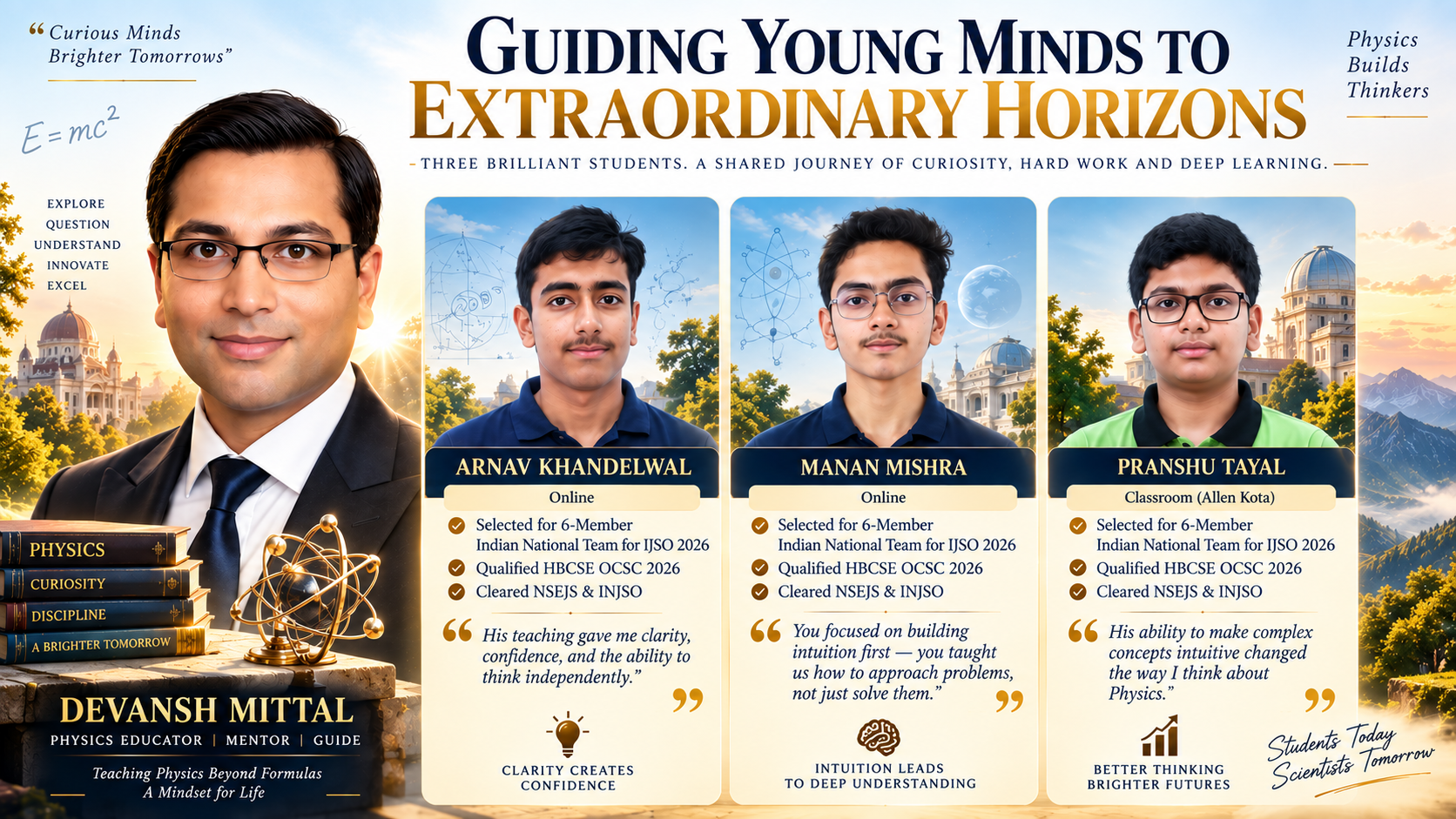
The true measure of a teacher’s impact is often best expressed through the words of the students themselves. These three testimonials come from Manan Mishra, Pranshu Tayal, and Arnav Khandelwal, each of whom achieved significant success in the Junior Science Olympiad journey under my mentorship. Manan, Arnav and Pranshu were selected for the six-member Indian National Team for IJSO 2026, after clearing NSEJS, INJSO.
What makes their words especially meaningful to me is the consistency in what they experienced: learning Physics through intuition rather than memorization, developing the ability to visualize physical phenomena, connecting concepts across different areas, and gaining the confidence to tackle unfamiliar problems. Their testimonials are, ultimately, a reflection of a teaching philosophy centred not merely on preparing students for examinations, but on teaching them how to think.
Testimonial: Manan Mishra (Online Batch)
1. Title:From a “Wall of Formulas” to the Indian IJSO Team: Manan Mishra’s Journey of Intuitive Physics
2. Student’s Name: Manan Mishra (Online Batch)
3. Achievements:
Selected for the 6-Member Indian National Team for IJSO 2026 (Stage 3 HBCSE OCSC Qualifier)
Qualified HBCSE Orientation-Cum-Selection Camp (OCSC) 2026 for Junior Science
Cleared National Standard Examination in Junior Science (NSEJS) & Indian National Junior Science Olympiad (INJSO)
Mentored by Devansh Sir through the Intensive Online Physics Course
Context & Background: Manan Mishra joined Devansh Sir’s online physics course at a time when physics felt like an intimidating “wall of formulas.” Through Devansh Sir’s focus on first-principles intuition, predictive qualitative reasoning (“what do you expect to happen?”), and interdisciplinary synthesis across mechanics, heat, and optics, Manan transformed his analytical thinking to conquer unfamiliar multi-concept problems, ultimately securing his selection for the Indian National Team for IJSO 2026.
4. What They Said About Devansh Sir:
“When I started, physics problems felt like a wall of formulas. Your course completely changed that. You focused on building intuition first — you made sure we understood WHY something happens before jumping to equations. That shift helped me tackle unfamiliar problems in the selection rounds with confidence instead of panic. You didn’t just teach physics — you taught us how to approach it.”
Respected Devansh Sir,
I am Manan. I was your student in the physics course, and I’m writing to thank you for the role you played in helping me get selected for the Indian team for IJSO 2026.
When I started, physics problems felt like a wall of formulas. Your course completely changed that. You focused on building intuition first — you made sure we understood why something happens before jumping to equations. That shift helped me tackle unfamiliar problems in the selection rounds with confidence instead of panic.
I really liked how the course went beyond textbooks. The problem sets were designed to make us think, not just plug-and-chug, and the way you linked concepts across mechanics, heat, and optics gave me a connected picture of physics. The regular doubt discussions meant I never had to leave a question half-understood.
Your mentorship was the best part. You didn’t just teach physics — you taught us how to approach it. Your habit of asking “what do you expect to happen here?” before solving trained me to trust my reasoning. That mindset was crucial during the IJSO selection camps.
The final IJSO exam is in December, and I feel ready because of the foundation you gave me. I’m genuinely grateful for your guidance, Sir.
Thank you very much! Best regards, Manan Mishra Selected for Indian National Team, IJSO 2026 | HBCSE OCSC Qualifier
Key Methodological Insights & Takeaways:
Intuition Before Equations: Prioritizing physical reality and understanding the qualitative “why” before algebraic formulation eliminated examination panic and unlocked spontaneous problem solving.
Cross-Domain Concept Synthesis: Linking fundamental concepts across mechanics, thermal physics, and optics replaced isolated formulas with a coherent, unified picture of physics.
Predictive Reasoning Pedagogy: Devansh Sir’s signature habit of asking “what do you expect to happen here?” trained students to trust their scientific instincts during high-stakes national camps.
Testimonial: Pranshu Tayal (Allen Kota Offline)
1. Title:Learning to Think Like a Physicist: Pranshu Tayal’s Path to OCSC Selection & Representing India at IJSO 2026
2. Student’s Name: Pranshu Tayal (Allen Kota Offline)
3. Achievements:
Selected for the 6-Member Indian National Team for IJSO 2026 (Stage 3 HBCSE OCSC Qualifier)
Qualified HBCSE Orientation-Cum-Selection Camp (OCSC) 2026 for Junior Science
Cleared National Standard Examination in Junior Science (NSEJS) & Indian National Junior Science Olympiad (INJSO)
Classroom Physics Student at Allen Career Institute, Kota under Devansh Sir
Context & Background: Studying physics under Devansh Sir’s direct offline mentorship at Allen Kota, Pranshu Tayal developed the rare and transformative ability to “truly think like a physicist.” Devansh Sir’s uncompromising emphasis on conceptual depth and intuitive reasoning provided the exact bedrock Pranshu needed to master challenging Olympiad concepts, conquer NSEJS and INJSO, and earn selection to represent India on the international stage at IJSO 2026.
4. What They Said About Devansh Sir:
“Your teaching has gone far beyond helping me solve problems. Through your emphasis on conceptual clarity and intuitive understanding, you taught me how to truly think like a physicist. Many of the important and challenging concepts that I learned from you played a crucial role… ultimately leading to my selection for OCSC and the opportunity to represent India at the International Junior Science Olympiad.”
Respected Sir,
I am Pranshu Tayal, a student of Allen Kota, and I have had the privilege of learning Physics under your guidance.
Your teaching has gone far beyond helping me solve problems. Through your emphasis on conceptual clarity and intuitive understanding, you taught me how to truly think like a physicist. Many of the important and challenging concepts that I learned from you played a crucial role in my preparation for NSEJS and INJSO, ultimately leading to my selection for OCSC and the opportunity to represent India at the International Junior Science Olympiad (IJSO).
This achievement would not have been possible without your guidance, mentorship, and the strong foundation that you helped me build. The ability to understand Physics deeply and intuitively has been one of the most valuable lessons I have gained from being your student.
I sincerely thank you for your dedication, encouragement, and the knowledge you have shared with me. I hope that many more students who learn from you achieve great success and continue to benefit from your exceptional teaching and mentorship.
Thank you so much, Sir. Pranshu Tayal Selected for Indian National Team, IJSO 2026 | Allen Kota | HBCSE OCSC Qualifier
Key Methodological Insights & Takeaways:
Thinking Like a Physicist: Moving beyond formulaic problem solving into profound physical inquiry, enabling effortless navigation of non-standard Olympiad challenges.
Bedrock Conceptual Grounding: Solidifying foundational laws in mechanics and modern physics early on eliminated the need for rote memorization across multi-stage national examinations.
High-Touch Kota Classroom Culture: Direct offline mentorship, personalized conceptual rigor, and continuous encouragement created an environment where ambitious goals translated into national selection.
Testimonial: Arnav Khandelwal (Offline Batch)
1. Title:Developing Scientific Persistence & Deep Reasoning: Arnav Khandelwal on Reaching the OCSC 2026 Selection Camp
Selected for HBCSE Orientation-Cum-Selection Camp (OCSC) 2026 for Junior Science (Stage 3 IJSO)
Cleared National Standard Examination in Junior Science (NSEJS) & Indian National Junior Science Olympiad (INJSO)
Rapid 3-Month Conceptual Evolution from Class 9 Foundation to National Olympiad Finalist
Offline Mentee under Devansh Sir
Context & Background: Joining Devansh Sir’s specialized INJSO and OCSC intensive preparation in Class 9, Arnav Khandelwal experienced a rapid and profound shift in his scientific approach. Devansh Sir’s emphasis on tackling challenging, non-routine problems through persistence and physical intuition rather than pure calculation propelled Arnav to the third and final national stage of IJSO.
4. What They Said About Devansh Sir:
“The two to three months I spent in this course completely changed the way I approached physics. What I appreciated most was that the course focused not only on theory but also on challenging problems that required deep thinking and persistence… Sir also encouraged us to understand the intuition behind physical concepts rather than relying only on mathematical calculations.”
Respected Devansh Sir,
My name is Arnav Khandelwal, and I was in Class 9 when I joined this course to prepare for INJSO and later for OCSC. The two to three months I spent in this course completely changed the way I approached physics.
What I appreciated most was that the course focused not only on theory but also on challenging problems that required deep thinking and persistence. Through these problems, I developed better reasoning and problem-solving skills. Sir also encouraged us to understand the intuition behind physical concepts rather than relying only on mathematical calculations, which proved extremely useful during competitive examinations.
Overall, this course was much more than exam preparation. It helped me develop a genuine interest in physics and played an important role in kickstarting my journey toward the final stage of IJSO preparation. I will always remain grateful to Devansh Sir for his guidance, support, and inspiring way of teaching.
Rapid Conceptual Rewiring: Demonstrating that 2–3 months of intuition-first instruction can fundamentally transform a student’s problem-solving paradigm from calculation-heavy to insight-driven.
Intellectual Persistence with Challenging Problems: Cultivating cognitive stamina and deductive reasoning by grappling with multifaceted Olympiad problems without premature solution lookups.
Igniting Lifelong Scientific Curiosity: Transforming competitive examination preparation into a captivating intellectual journey that inspires long-term academic excellence.
Every year, thousands of talented students dream of studying at universities like Stanford, MIT, Harvard, and Cambridge. Yet only a small number receive that life-changing acceptance. What truly distinguishes these students? Is it perfect grades, extraordinary test scores, or something much deeper?
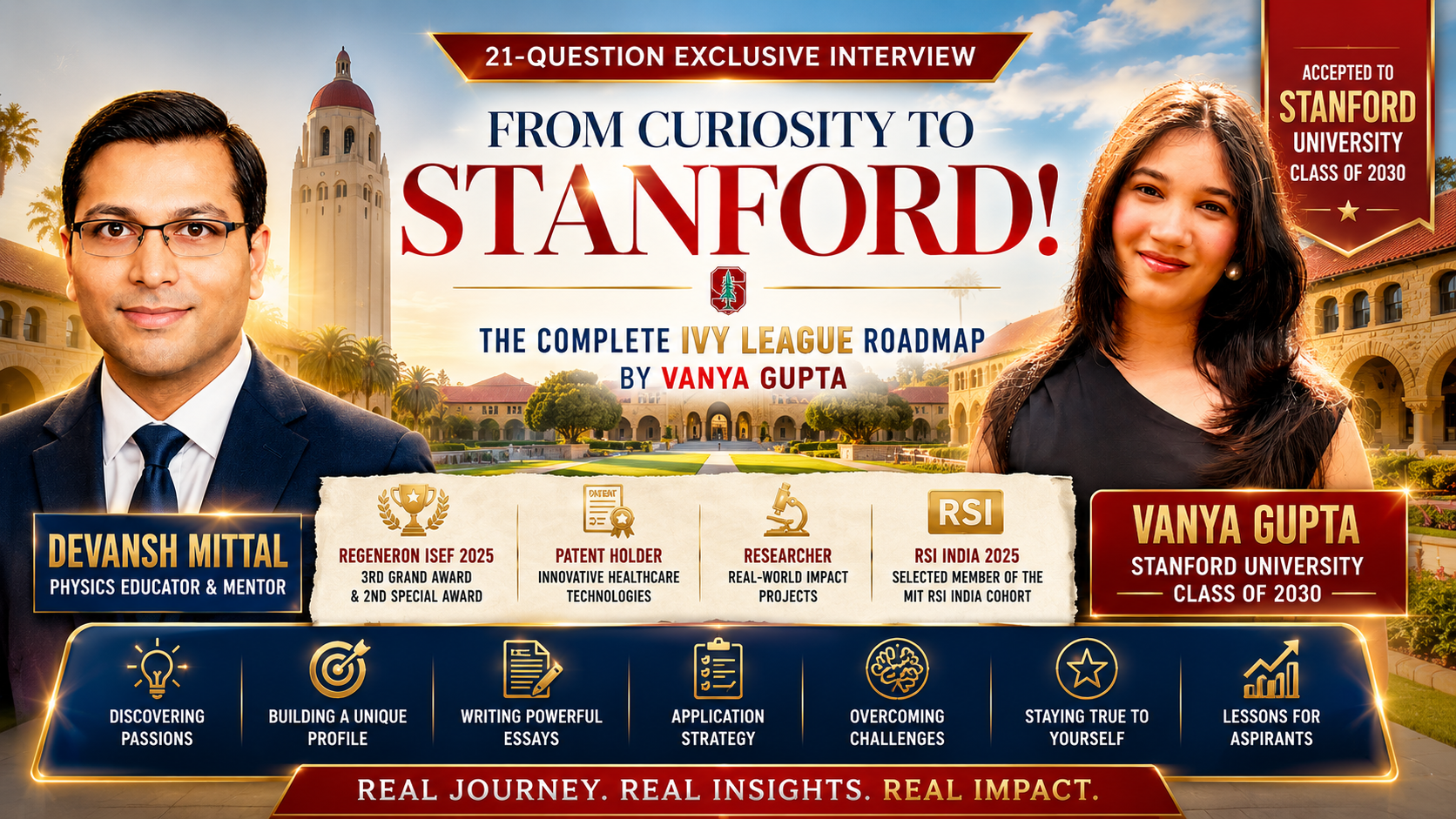
In this exclusive interview, I speak with Vanya Gupta, who recently earned admission to Stanford University (Class of 2030). Beyond her Stanford acceptance, Vanya has built an exceptional profile through award-winning scientific research, international recognition at Regeneron ISEF 2025, innovative patents, community impact, leadership initiatives, and years of sustained intellectual curiosity. Her journey demonstrates that admission to the world’s best universities is not about checking boxes—it is about becoming a person capable of creating meaningful impact.
Across 21 carefully curated questions, Vanya shares the complete roadmap behind her journey: how she discovered her interests, built an authentic profile, pursued original research, wrote compelling essays, balanced academics with extracurricular activities, handled setbacks, and ultimately earned admission to one of the world’s most selective universities.
Whether your dream is Stanford, MIT, Harvard, Cambridge, Oxford, Imperial College London, or any other leading global institution, this interview offers invaluable lessons on building not just a successful application, but a meaningful life.
The Conversation:
Q1: Congratulations for your admission — so take us back to the moment you found out about your Stanford acceptance, how did that feel like, and who was the first person you share it with?
A: Honestly, it didn’t feel real at all at first. I had replayed that moment in my head so many times that when I finally opened the decision letter, I just froze. I stared at the screen for a few seconds because I couldn’t process it. The first thing I saw was just the confetti, and then five minutes later, after it sank in, I read the acceptance letter. The first people I told were my parents and my brother because they had been part of every late night, every competition rejection, and every crazy idea. At that moment, it felt less like ‘I got in’ and more like ‘we got here together’ because they had been such an integral part of the journey. The entire feeling was a mix of excitement and gratitude. Reflecting on it, I realized how many people had believed in me before I fully believed in myself, and that this wasn’t an individual journey but a very collective one.
Q2: When did you first truly decide, that a place like Stanford is your goal?
A: My goal to study in the US became pretty clear around Grade 9. As for Stanford specifically, it had actually been my dream school since the 5th or 6th grade because I was obsessed with the campus and its environment. But in Grade 9, I started learning about its culture, values, and how much the university values engineering, entrepreneurship, research, design, and interdisciplinary decisions. What attracted me the most was that Stanford is an environment where building something new and scaling it is encouraged rather than being treated as unusual.
Q3: Could you share your entire journey with me? I would love to understand everything you did—from the time you first dreamed of getting into Stanford until the day you were admitted. Specifically, I’d like to know: Which exams you appeared for, what activities, projects, or achievements you pursued, which decisions and efforts had the greatest impact on your admission, which things, in hindsight, were not particularly impactful, and any lessons you learned or things you wish you had done differently. A chronological account of your journey would be incredibly helpful.
A: My journey started around Grade 6 or 7. Initially, it was nothing specific or dedicated like ‘I want to go to university, that’s why I’m doing this.’ At that point, I had no clue. It just started off with curiosity. I explored everything from programming to robotics, mathematics, physics, and chemistry.
In Grade 9, I committed to long-term work. I spent several years pursuing robotics, trying to understand it—though it’s a huge field, so I probably only know 30% to 40% of it. I also continued practicing Mallakhamb, an Indian traditional yoga sport that I’ve been doing since I was 10 years old. It is just a genuine passion and hobby for me. Around the same time, I started teaching STEM to underserved students at local NGOs and schools. Instead of simply absorbing existing knowledge, I began asking research questions.
The biggest turning point was in Grade 10 and 11, when I started conducting original research, presenting my projects internationally, winning medals, founding a STEM initiative, and working with professors. More than thinking about competitions, I switched my focus to solving real problems because I enjoyed it, rather than just collecting awards and certificates.
Grade 12 was not about adding new activities, projects, or awards. It was about improving what was already built, strengthening my essays, publishing my research, and compiling my application. The application phase is about presenting a cohesive story—finding the link between my five or six years of work and putting it into one small application.
In terms of exams, I took my school’s IGCSE and A-level exams, prepared for and appeared in basic Olympiads, and took the SAT and IELTS.
For activities and projects, I had four or five main ones. One was a cognitive science project trying to measure the cognitive ability of underserved students without depending on literacy or factors acquired by more privileged students. Another project mapped the skills of factory and shop floor workers to appropriate jobs to boost their wages and empower their livelihoods. I also patented a seizure identification wristwatch for toddlers that records vitals and alerts guardians before a seizure occurs. Additionally, I developed a gamified, sensory-adaptive cognitive impairment screening tool for geriatrics, which won grand and special awards at Regeneron ISEF 2025.
As for what had the greatest impact versus what didn’t: random competitions done just to look good on the application were not impactful, and I didn’t even list them. The biggest contributors were my research publications, leadership demonstrated through my activities, long-term community impact, essays (common app and supplements), and recommendations. If I could do one thing differently, I would have started writing essays and reflecting earlier. Curating a meaningful story isn’t something you can do in three or four months; it’s something collected over the years.
Q4: What specific habits and study strategies you followed to achieve this goal?
A: Consistency was key for me. I didn’t set a goal of working a specific number of hours, but I made sure that whenever I studied, I was completely focused. Multitasking and distractions were avoided. Even if I sat at my desk for only 20 minutes on some days and 8 hours on others, showing up consistently made a huge impact. Reflection was also crucial. I regularly sat down and asked myself: ‘Am I actually enjoying this, or am I doing it just for the sake of it? What is genuinely exciting me, and what have I learned?’ These questions saved me from wasting hours on things I wasn’t passionate about. Focus comes with passion; if you enjoy something, you naturally stay focused.
Q5: Which exams, Olympiads, research projects or extracurricular activities had the greatest impact?
A: In order of importance, the things that had the greatest impact on my goal were independent research projects, long-term community impact initiatives, leadership roles, school academic records (IGCSE/A-levels), and standardized test scores like the SAT.
Q6: Rank the following by importance and explain why: Academics, Olympiads, SAT/AP, Research, Essays, Leadership, Recommendation Letters, Interviews, extracurricular activities.
A: Here is my ranking and explanation of the various components, ordered from the most fundamental baseline requirements to the differentiating elements:
1. Academics (5/5) & SAT (5/5) [The Non-Negotiable Foundation]: These are threshold requirements. You need top-tier school grades and a strong SAT score to get your application reviewed. Top universities receive applications from top students worldwide, so academic excellence is the basic entry requirement. Standardized test scores have been reinstated by almost all Ivy League and top US universities, making the SAT extremely important.
2. Essays (5/5) [The Differentiator]: Essays are the most critical part of the application because they showcase your personality, voice, and authenticity. Your grades and activities list show what you have done, but your essays demonstrate who you are as a person.
3. Research Papers (5/5) [Intellectual Depth]: Independent research is highly impactful because it demonstrates deep passion, intellectual curiosity, and the ability to solve complex, real-world problems. It shows you want to go beyond classroom boundaries.
4. Extracurricular Activities (4/5) & Leadership (4/5) [Personality & Impact]: Extracurricular activities show who you are outside of coursework, while leadership roles demonstrate social and people skills. You cannot just sit and study all day; you need to show how you engage with others and create impact.
5. Recommendation Letters (4/5) [Credibility]: LORs are very important because they provide third-party credibility. They verify your claims and hours of work, adding depth to your file from the perspective of trusted teachers and mentors.
6. AP Exams & Subject Olympiads [Additional Tracks]: AP exams are useful if you use them to explore subjects outside your school stream (e.g., taking a psychology AP if you are a science student) to show breadth. Taking them in the same subjects you study in school (like physics/chemistry in A-levels) is redundant. International Olympiads (representing Team India) are extremely important (5/5) but represent just one path; you can achieve the same impact through research.
7. Interviews [Complementary]: Interviews complement the application by providing a personal dimension to verify your interest and communication skills.
*My top five most impactful components (excluding the non-negotiable academics/SAT baseline) are: Essays, Leadership, Extracurricular activities, Research, and Recommendation Letters.*
Q7: What story did your application tell?
A: My application told a story of breaking barriers and pursuing niche, unique things. It showed that I identify overlooked problems, understand them deeply, and build human-centered solutions that connect with people in real life. It connected my technical research skills with my community leadership and service, showing that my work is driven by empathy and curiosity rather than a desire to collect credentials.
Q8: What role did essays, recommendations and interviews play?
A: These three components provide the human dimension and credibility to your application:
– **Essays** are the voice of the application. They explain the ‘why’ behind everything you do and demonstrate your authenticity, self-reflection, and character.
– **Recommendations** provide third-party validation and credibility. They assure admission officers that your achievements and community hours are genuine and that your mentors have high trust in your abilities.
– **Interviews** serve as a conversational verification, helping universities see your personality, communication style, and genuine fit for the campus culture beyond written words.
Q9: What misconceptions about admissions should students stop believing?
A: The biggest misconception is that admissions are about perfection. It’s not about being the most perfect student; it’s about being the most authentic one. Another common myth is that you need a checklist of trendy achievements—like starting 10 companies or launching multiple startups—to get in. You should focus on doing a few very meaningful, deep, and consistent things over several years rather than trying to do everything for the sake of your resume.
Q10: What was the toughest phase of your journey?
A: The toughest phase was definitely during Grade 11 and 12, when I had to balance school exams, SAT preparation, research deadlines, and college applications simultaneously. There’s a saying that ‘nothing can happen in 10 years, but 10 years can happen in a week.’ That was very true for me during weeks when everything hit priority status at the same time, and I had to learn how to manage competing deadlines.
Q11: How did you handle pressure, setbacks and self-doubt?
A: I had two main ways of handling setbacks and pressure. First, I separated the outcome from the effort. Rejections and redirections hurt, but that doesn’t mean the work you’ve done is meaningless; one setback cannot change the value of your entire journey. Second, I leaned heavily on my support system—my parents, my brother, my teachers, and my friends. I would go to them, admit that I couldn’t handle everything at the moment, and talk things through. Sometimes they gave me solutions, and other times I found the solutions myself just by talking to them.
Q12: What role did your family, mentors and friends play?
A: Each group played an equally important role in keeping me balanced and supported:
– **My family** gave me the freedom to explore. My parents never restricted me; they always supported my ideas and encouraged me to study and think to my heart’s content.
– **My mentors** provided resources and academic support, but more importantly, they challenged me. They didn’t just hand me the answers—they asked questions until I figured out the solutions myself, which completely shaped my thinking.
– **My friends** kept me sane. They reminded me that there is a life outside of awards and applications, and they were always there when I needed a mental break.
Q13: What should students focus on from grade 8 – 12 for this goal?
A: Based on my journey, here is a structured roadmap for students preparing for top global universities:
– **Grade 8 & 9 [Exploration & Core Habits]**: Focus on exploration and curiosity. Learn programming, robotics, math, or whatever science subjects excite you. This is also the time to establish a solid physical or creative hobby (like my Mallakhamb practice) and begin volunteering at local NGOs. Establish consistency in your study habits.
– **Grade 10 & 11 [Committed Focus & Independent Projects]**: Narrow down your interest areas and commit to long-term projects. Instead of just studying, start asking research questions and conducting independent research. Seek out mentors or professors in your field. Shift your focus from winning random competitions to solving real, human-centered problems.
– **Grade 12 [Refining & Storytelling]**: Focus on executing and finishing your projects, writing and publishing your research papers, and preparing your college applications. Dedicate ample time to reflecting on your journey and writing your common app and supplemental essays. Your main task here is finding the thread that connects your five years of work into a cohesive story.
Q14: What books, websites, YouTube channels and mentors would you recommend?
A: I recommend the following resources based on what helped me:
– **Websites**: Khan Academy for academic learning, MIT OpenCourseWare for advanced science concepts, and arXiv for reading scientific research papers.
– **YouTube Channels**: Veritasium and 3Blue1Brown for intuitive physics and math concepts, along with self-help videos on time management, productivity, and prioritization.
– **Books**: *Atomic Habits* (one of my favorites for building systems), *Deep Work* for focused study habits, *Mindset* by Carol Dweck, and books addressing the global impact of AI.
Q15: How should students balance school, extracurricular activities, Olympiads, JEE (if applicable) with international admissions?
A: The key is focus and prioritization: do not try to excel at five completely unrelated things. In my opinion, you should structure your time around a clear framework: have one deep academic focus, one major extracurricular/community initiative, one physical activity, and one creative hobby. Not everything has to be done for the sake of applications. Most importantly, build a reliable support system and lean on them whenever the pressure becomes too high.
Q16: One habit every successful student should develop.
A: Reflection. You must regularly sit down with yourself and honestly think about whether you enjoy what you are doing, what you are learning, and what genuinely excites you, rather than just executing tasks blindly.
Q17: One mistake every student should avoid.
A: Doing things just for the sake of doing them. Don’t build a resume or join clubs just because you think you have to; focus on building your actual skills and personal growth.
Q18: One opportunity students should pursue early.
A: Research. Pursuing independent research early is incredibly valuable—not because it looks impressive, but because it teaches you the vital skill of how to ask meaningful questions.
Q19: One myth about Ivy League admissions.
A: That there is a secret formula or a specific template of an admitted student. There isn’t. Every admitted student looks completely different. What they all share is authenticity, sustained impact, and long-term consistency.
Q20: One piece of advice for parents.
A: Support your child’s exploration instead of trying to direct, restrict, or force a particular academic decision. The strongest college applications are born from genuine curiosity and passion, which can only thrive under support rather than pressure.
Q21: Your message for students dreaming of studying at the world’s best universities.
A: Don’t spend your middle and high school years trying to become the student you think universities want to accept. Instead, spend those years trying to become someone you value and respect. The ultimate goal is not to receive an acceptance letter; the goal is to become the kind of person who will thrive at a place like Stanford regardless of whether you get accepted or not. If you focus on that growth, your application will naturally become a genuine reflection of your journey rather than a curated performance.
Devansh Sir’s 10 Key Takeaways For Future Ivy League Aspirants:
1. Stanford Doesn’t Admit Perfect Students — It Admits Authentic Ones.
The biggest misconception in Ivy League admissions is that you need a flawless, ‘tick-every-box’ profile. Vanya shatters this myth with a single insight: “It’s not about being the most perfect student; it’s about being the most authentic one.” Admissions committees are not looking for the student who did the most things; they are looking for the student who meant what they did. Stop curating a performance and start living a story worth telling. Authenticity is not a soft skill — it is the single hardest thing to fake and the single most powerful thing to possess.
2. Your Application Is Not a Résumé — It Is a Narrative.
Most students treat college applications like a list of accomplishments. Vanya treated hers like a story. Her application told the narrative of someone who ‘identifies overlooked problems, understands them deeply, and builds human-centred solutions.’ Every activity, every research project, and every essay pointed back to one coherent thread. If your activities cannot be connected by a single sentence that explains who you are, you don’t have an application — you have a spreadsheet. Start with the story you want to tell, not the awards you want to list.
3. Essays Are the Admission — Everything Else Is the Screening.
Vanya rates essays 5 out of 5 — the single most critical differentiator. “Your grades and activities list show what you have done, but your essays demonstrate who you are as a person.” Grades and test scores get your file reviewed; essays get you admitted. Yet most students spend 80% of their time on test preparation and 20% on essays — exactly backwards. The best essays are not written in three months during application season; they are reflections collected over years. Start journaling, reflecting, and understanding yourself today.
4. The ‘Resume-Padding’ Strategy Is Dead — Depth Wins, Not Breadth.
Vanya explicitly states that random competitions done ‘just to look good on the application’ were not impactful — and she did not even list them. Instead, she committed to four or five deep, multi-year projects that solved real problems: a patented wristwatch for seizure detection in toddlers, a cognitive screening tool for the elderly, and a skills-mapping project for factory workers. The era of joining 15 clubs and winning 30 certificates is over. One transformative project that changes someone’s life will always outweigh a hundred participation certificates that changed nothing.
5. Research Is Not About Looking Impressive — It’s About Learning to Ask Questions.
When asked what opportunity students should pursue early, Vanya’s answer was immediate: research. But her reason is counterintuitive. She does not recommend research because it looks good on an application — she recommends it because “it teaches you the vital skill of how to ask meaningful questions.” Most students are trained to answer questions. The ones who get into Stanford are the ones who learn to ask them. The ability to identify problems that nobody else sees is more valuable than the ability to solve problems that everyone already knows about.
6. Grade 12 Is Too Late to Start Building — It’s Only for Storytelling.
Vanya’s most strategic insight is her timeline. Grade 12 was not about adding new activities or winning more awards. It was entirely dedicated to ‘improving what was already built, strengthening essays, publishing research, and compiling the application.’ If you are starting your extracurriculars in Grade 11 or 12, you have already lost the long game. The students who win Stanford admissions in Grade 12 are the ones who started building in Grade 8. By the time you write your Common App essay, you should be curating five years of work — not scrambling to create it.
7. There Is No Secret Formula — and That’s the Best News You’ll Ever Hear.
“There is no secret formula or a specific template of an admitted student. There isn’t. Every admitted student looks completely different.” This is both the most terrifying and the most liberating truth about Ivy League admissions. There is no template to copy, no formula to hack, and no consultant who holds the ‘secret code.’ What every admitted student shares is authenticity, sustained impact, and long-term consistency. The implication is profound: the most strategic thing you can do is stop being strategic and start being genuine.
Vanya didn’t set a goal of working a specific number of hours. Instead, she made sure that whenever she studied, she was completely focused. ‘Even if I sat at my desk for only 20 minutes on some days and 8 hours on others, showing up consistently made a huge impact.’ The cult of ‘hours studied’ is misleading. What matters is the quality of attention, not the quantity of time. Build a system of showing up every single day — even if it’s just for twenty minutes — and you will outperform every student who brags about pulling all-nighters but checks their phone every five minutes.
9. Parents: Support Exploration, Don’t Direct It — The Best Applications Are Born from Freedom.
Vanya’s advice for parents is blunt and transformative: “Support your child’s exploration instead of trying to direct, restrict, or force a particular academic decision.” The strongest applications come from students who were given the freedom to follow their curiosity — not students who were handed a checklist of activities by anxious parents. Vanya’s own family gave her the space to explore everything from robotics to Mallakhamb to cognitive science, trusting that depth would emerge from exploration. The paradox of Ivy League admissions is this: the more you try to engineer your child’s application, the less authentic — and therefore less competitive — it becomes.
10. Don’t Become the Student Universities Want — Become Someone You Respect.
Vanya’s final message is the most powerful sentence in this entire interview: “Don’t spend your middle and high school years trying to become the student you think universities want to accept. Instead, spend those years trying to become someone you value and respect.” This single idea, if truly internalized, would render every ‘how to get into Stanford’ guide obsolete. The goal is not an acceptance letter. The goal is to become the kind of person who will thrive at a place like Stanford — regardless of whether you get accepted. If you focus on that growth, your application will naturally become a genuine reflection of your journey rather than a curated performance. That is not just admissions advice. That is life advice.