Tag Archives: technology

From Olympiad Success to AIR 7 in JEE Advanced: Arnav Gautam’s Gratitude Towards Devansh Sir

Standard

Introduction

Among the many students I have had the privilege of teaching, Arnav Gautam stands out as one of the most accomplished. In 2026, he secured AIR 7 in JEE Advanced and AIR 5 in JEE Main, achievements that place him among the very top students in the country. His journey, however, extends far beyond JEE. Over the years, he qualified prestigious examinations including NSEJS, INJSO, NSEP, INPhO, INChO, and INAO, and attended the OCSC camps for both Junior Science and Physics Olympiads.

What makes Arnav’s testimonial especially meaningful to me is not merely the extraordinary list of achievements, but his reflection on the deeper aspects of learning. In the words that follow, he shares how an emphasis on conceptual understanding, intuition, visualization, and independent thinking helped shape his approach to Physics and problem-solving. He also speaks about the role that mentorship, personal guidance, and scientific thinking played throughout his academic journey.

I am delighted to share Arnav’s thoughts and experiences in his own words. His journey is a powerful reminder that lasting success is built not only on hard work, but also on a strong foundation of understanding and a genuine love for learning.


Respected Devansh Sir,

I am Arnav Gautam. I was your student in the IJSO batches earlier.

This year, I secured AIR 7 in JEE Advanced 2026 and AIR 5 in JEE Main 2026. Along the way, I also qualified NSEJS, INJSO, NSEP, INPhO, INChO, and INAO multiple times, and attended the OCSC camps for both Junior Science and Physics Olympiads.

I would like to sincerely thank you for the role you played in this journey.

One thing that always made your classes different was your emphasis on understanding rather than memorization. You never encouraged us to blindly apply formulas. Instead, you taught us to think deeply about concepts, build intuition, and visualize physical phenomena. This approach completely changed the way I looked at Physics.

Your classes not only strengthened my problem-solving abilities but also developed the confidence to tackle unfamiliar and challenging questions. Whether it was preparing for Olympiads or JEE, the strong conceptual foundation built in your classes helped me immensely.

I am also grateful for the effort and personal attention you invested in your students. Your guidance, suggestions, and constant encouragement motivated me throughout my preparation. The problem-solving mindset and scientific way of thinking that I learned from you have benefited me far beyond examinations.

Looking back, I realize that many of my achievements would not have been possible without the foundation you helped me build. Thank you for inspiring me to genuinely enjoy Physics and for always pushing me to think independently.

I will always remain grateful for your mentorship and support.

Best regards,

Arnav Gautam
AIR 7, JEE Advanced 2026
AIR 5, JEE Main 2026
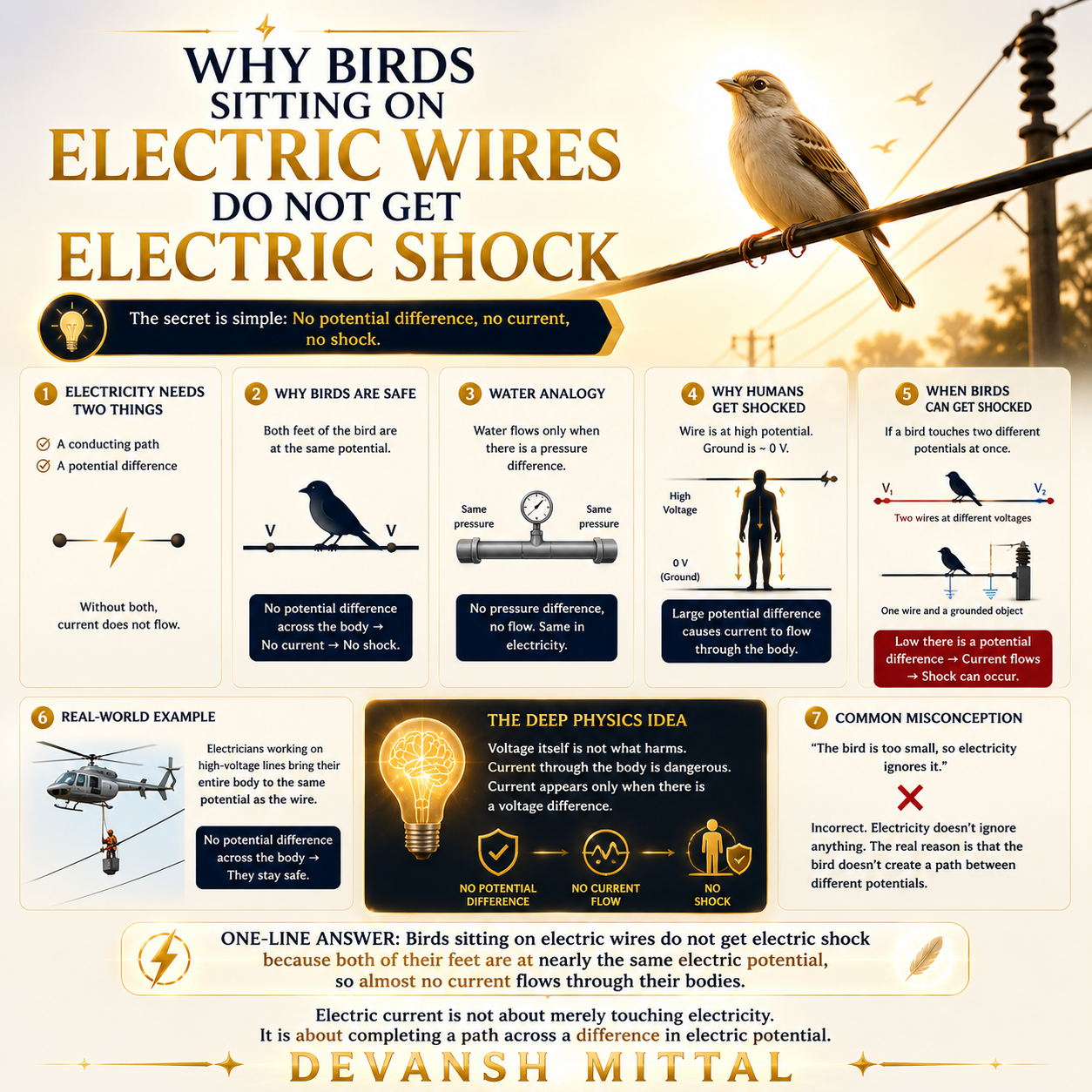
Why Birds Sitting on Electric Wires Do Not Get Electric Shock?

Standard

A Mystery We See Every Day

Have you ever looked at electric wires on the roadside and wondered:

“How can birds sit on high-voltage wires without getting electrocuted?”

After all, we humans are warned constantly about the dangers of electricity. Touching a live wire can be deadly.

Yet tiny birds sit peacefully on electric lines every single day.

Are birds somehow immune to electricity?

Not at all.

The real answer reveals one of the most important ideas in electricity — electric current flows only when there is a difference in electric potential.

And once you understand this idea deeply, many electrical phenomena suddenly become intuitive.


Electricity Does Not Flow Just Because a Wire is “Live”

This is the biggest misconception students usually have.

Many people think:

“If a wire contains electricity, touching it automatically gives a shock.”

But that is not how electricity works.

Electric current flows only when there is:

  1. A conducting path, and
  2. A potential difference between two points.

Without both conditions, current does not flow through the body.

A bird sitting on a single wire usually touches only one point of the electrical system.

That changes everything.


The Real Reason Birds Stay Safe

When a bird sits on one wire:

  • Both of its feet are almost at the same electric potential.
  • Therefore, there is almost no potential difference across its body.
  • Since current depends on potential difference, almost no current flows through the bird.

And without significant current through the body, there is no electric shock.

The bird is simply becoming part of the wire at the same voltage.


An Easy Water Analogy

Imagine water flowing through pipes.

Water flows only when there is a pressure difference.

If both ends of a pipe section are at the same pressure, water does not move through that section.

Electric current behaves similarly.

Here:

  • I = current
  • V = potential difference
  • R = resistance

If the voltage difference across the bird is nearly zero, the current is also nearly zero.

This is the key idea.


Then Why Do Humans Get Shocked?

Suppose a person touches a live wire while standing on the ground.

Now two parts of the body are at very different potentials:

  • The wire may be at thousands of volts.
  • The ground is approximately zero volts.

This creates a large potential difference across the body.

Electric current now finds a path:

Wire → Body → Ground

And dangerous current flows through the person.

That is an electric shock.


Why Birds Must Be Careful Too

Birds are safe only under specific conditions.

They can still get electrocuted if they simultaneously touch:

  • Two wires at different voltages, or
  • One wire and a grounded object like a metal pole.

Now there is a voltage difference across the bird’s body.

Current flows through the bird.

And the result can be fatal.

This is why large birds with wide wingspans are more vulnerable near power lines.


A Powerful Real-World Example

Electricians working on high-voltage transmission lines sometimes use helicopters and special suits.

Surprisingly, they can safely touch wires carrying hundreds of thousands of volts.

How?

Because their entire body is brought to the same electric potential as the wire before contact.

Again, the secret is not “low voltage.”

The secret is:

No significant potential difference across the body.

This is exactly the same principle that protects birds.


The Deep Physics Idea

Students often memorize formulas in electricity without understanding the physical meaning.

But this example teaches a profound lesson:

Voltage itself is not what harms living beings.

Current through the body is what becomes dangerous.

And current appears only when there is a voltage difference that drives charges through the body.

That is why:

  • Birds survive on wires,
  • Electricians use insulation and grounding carefully,
  • And electrical safety rules focus on preventing current paths.

A Common Misconception

People often say:

“The bird is too small, so electricity ignores it.”

This is incorrect.

Electricity does not “choose” to avoid the bird.

The real reason is that the bird does not provide a useful path between different potentials.

Physics is governed by electric fields, resistance, and potential differences — not by intention.


The One-Line Answer

Birds sitting on electric wires do not get electric shock because both of their feet are at nearly the same electric potential, so almost no current flows through their bodies.


Final Thought

The next time you see birds resting calmly on power lines, remember:

They are demonstrating one of the deepest principles of electricity in nature.

Electric current is not about merely touching electricity.

It is about completing a path across a difference in electric potential.

And that simple idea powers everything from mobile chargers to giant electrical grids.