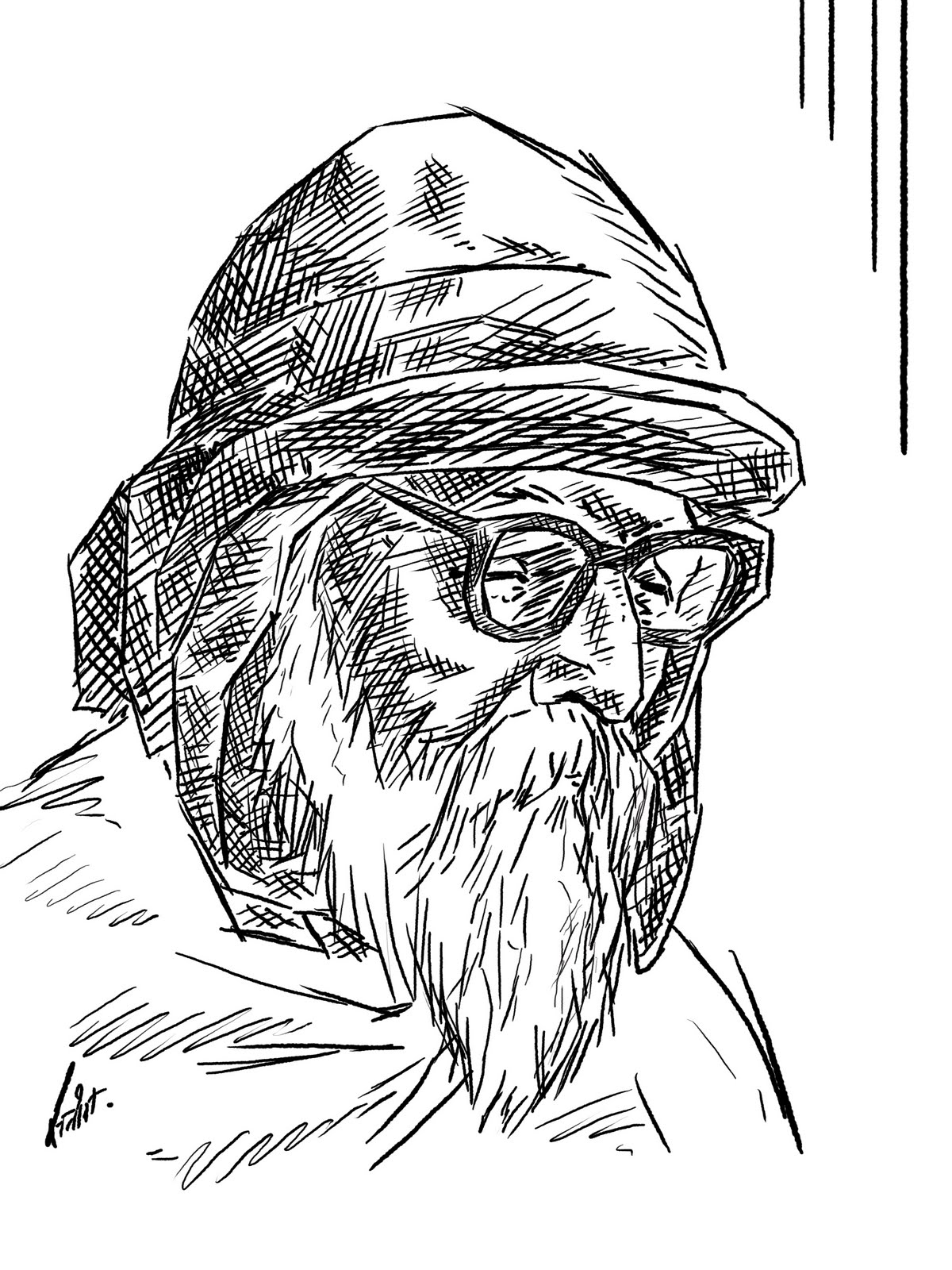
I AM A MAN who belongs to another world than this, one that may seem very strange. For I claim that I am moved by love, that I feel it all the time. I do not deal in opinions, but only in thought, in which there can be give and take. Thought is not walled in or tied down, it can be shared with people of goodwill; we can take their ideas and offer them ours, and in this way thought grows and spreads. This has always been my experience and therefore I do not accept any kind of label for myself. It is open to anyone whatever to explain his ideas to me and convince me, and anyone is free to make my ideas his own in the same way.
There is nothing so powerful as love and thought–no institution, no government, no ism, no scripture, and no weapon. I hold that these – love and thought, are the only sources of power. You should nor expect me therefore to have any fixed opinions, only ideas. I am a man who changes every moment. Anyone can make me his slave by putting his ideas vigorously before me and convincing me that they are right. But no one, however hard he tries, can get me to accept his authority without first convincing me of the soundness of his thought.
I am just one individual; I wear no label, I am not a member of any institution, I have nothing to do with political parties. I do however keep in affectionate contact with the organizations for constructive work. I was born a Brahmin, but I cut myself off from my caste when I cut off my shikha.’ Some people call me a Hindu, but I have made such a repeated study of the Koran and the Bible that my Hinduism has been washed off. People like what I say because my work is rooted in compassion, love and thought. I have ideas, but no permanently settled views. In fact I am so unreliable that I do not hesitate to express one view today and another tomorrow. I am not the same today as I was yesterday. I think differently every moment and go on changing all the time.
All are my kinsfolk and I theirs. It is not in my heart to love some more and others less. In the Life of the Prophet Muhammad it is related how once, speaking about Abu Bakr, he said: ‘I could love him more than anyone, if it were not forbidden to love one more than another.’ That is to say, God forbids us to love one more than another. The same is true for me. I cannot make any differences between individuals.
I once saw a portrait of Louis Pasteur, and below it these words: ‘I do not want to know your religion or your views, but only what your troubles are. I want to help you to get rid of them.’ Those who do that are discharging their duty as human beings, and that is what I am trying to do.
I don’t take any step without going deeply into the matter and getting at the root of it. I have spent thirty years of my life in solitary thought, while at the same time giving what service I could. I wished to make my life one of service, but it has been one of reflection-reflection about the changes which must come in society, and how the roots of those changes must be purified. I am quite clear now about my basic thought, and I am not afraid of any problem. No matter what it is, no matter how big, it seems small to me, for I am bigger than the problem. However big it may be it is after all a human problem, and it can be solved by human intelligence.
During the course of my work, both in Ashrams and outside them, I have aimed at finding out how difficulties of every kind in the life of a society, and in the life of the individual, may he overcome by non-violence. That is my chief task; that is why I went to Telangana, If I had avoided that work I should have broken my pledge to strive for non-violence and Shanti Sena.
The things that happened in this country immediately after we got independence had dimmed the hope of non-violence. Forces of violence showed themselves in India in great strength. After Gandhiji passed away I was therefore trying to discover how a non-violent social order might be built.
By nature I am inclined to use the methods of Lord Mahavira, but what I actually did was more on the lines of Lord Buddha. The two are not opposed. It was not Mahavira’s way to take up a practical problem or propagate an idea. Wherever he went he would talk to individuals, understand the outlook of whoever was before him, and show each one how to find satisfaction in Life. If someone believed in a particular scripture he would use that as the basis of his teaching; if another had no faith in any book, he would make suggestions without reference to a book. In this way he shared his thought from a middle ground. The Lord Buddha on the other hand took up social problems and actively spread the idea of non-violence.
Another question is whether one should have recourse to outward forms in order to propagate an idea. There is always a danger that the outward forms may usurp the foremost place, and that the inward spiritual thing, the idea for whose sake the forms are used, may be overshadowed and become secondary. On the other hand, without such outward embodiment thought is not focused. Goodwill spreads invisibly, but ideas need to take concrete shape, otherwise ordinary people are not attracted. So there is a risk both in using the outward framework and in not using it; there is also good to be had in both ways.
I certainly used the problem of land as my framework, but my basic aim is to teach and commend the idea ~of unity and com- passion. In choosing this framework I used my intelligence, but my thinking always went beyond the framework, and I longed many times to keep to my own real nature. Still, I did not give up the outward form, so I have been working on a synthesis of the way of Lord Mahavira and that of Lord Buddha.
In whatever has seemed to me to be worth doing in life, I have received the greatest help (apart from the scriptures) from three people–Shankara, Jnanadeva and Gandhi. As for Gandhiji, I not only studied his ideas and writings, I lived in his company, and spent my whole time, in my youth, in the various forms of service which he started. His presence, his ideas, and the opportunity to put them into practice–I had the benefit of all three. In other words I lived under the wing of a great man, and he gave me a very great gift for which I am grateful. So did the first Shankaracharya. He helped me chiefly in overcoming the philosophical doubts which naturally arise in any reasoning mind, and I shall always remain in his debt in the world of thought. As for the gift I have received from Saint Jnanadeva, I have no words to describe it. He has shaped my thought, entered my heart, guided my action; besides all this, as I believe, he has touched my body also. His influence has been great and many-sided. I am by nature wry harsh, a lump of rough shapeless rock. Shankaracharya made the rock strong, Gandhiji chiselled it and gave it a form, but the mighty task of piercing the rock and releasing the springs of water below, and so endowing my life and heart with sweetness–that was the work of Saint Jnanadeva.
When I think of myself, of who I am, and of the good fortune that has come my way, I recall a lot of favourable outward circumstances. I certainly had very special parents, as people recognize. My brothers too have a quality of their own. I have had a guide on my way who by universal acclaim is a Mahatma. I have had dear friends, and all of them without exception have won the affection of the people. I have had students of whom I myself have become enamoured. What a great heap of good fortune. In addition, because I know a number of languages, I have had and still have opportunity to taste the nectar of thought of many saints and men of religion. That too, so one may reflect, is a piece of great good fortune. Yet all this pales into insignificance beside the greatest good fortune of all, which is mine and yours and everyone’s-that we are all members, portions, limbs of God, waves in that Ocean. Our greatest good fortune is that we abide within God; once we feel that, we are free.
—
Vinoba Bhave (Ahimsa Ki Talaash)
 The Intuitive Physicist
Really Inspiring for all of us especially for people who want to go in search of the path of knowledge…..he rightly tells about how a real follower of truth will behave….
Thanks, keep reading 🙂
Reading it from past 3 days .. too difficult but interesting, for layman like me, I have to read it a 100 times to understand it.
You may also like to read the Hindi version of it, which is the original version also. It is the preface of the book called “Ahimsa Ki Talaash”. Try to read it. It is amazing 🙂
Keep reading and commenting 🙂
This was on my reading list from sometime. I think it is time i read it. Nice post 🙂