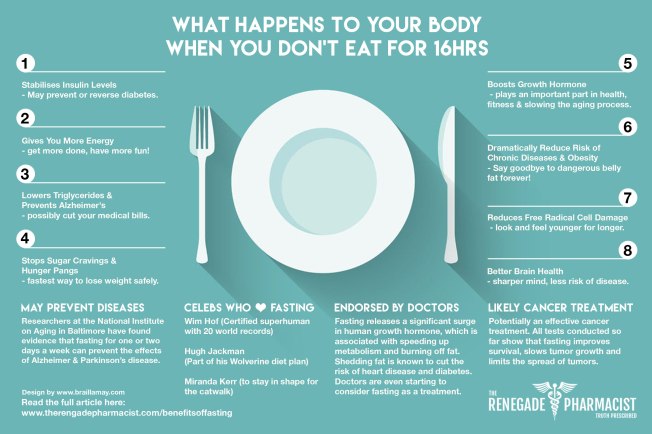
Fasting is the willing abstinence or reduction from some or all food, drink, or both, for a period of time. Following are some amazing benefits of fasting. Before dwelling into this article, you may like to read my previous article on “Science of Fasting: Autophagy”.
1. Fasting is an excellent tool for weight loss.
There have been studies that support fasting as an excellent tool for weight loss. One 2015 study found that alternate day fasting trimmed body weight by up to 7 percent and slashed body fat by up to 12 pounds. (1)
Another study, this one out of the University of Southern California, discovered that when 71 adults were placed on a five-day fast (eating between 750 and 1,100 calories a day) once every three months, they lost an average of 6 pounds, reduced inflammation levels and their waistlines and lost total body fat without sacrificing muscle mass. (2) If you want to lose weight and lose belly fat, fasting even irregularly could be the key.
2. Fasting promotes the secretion of human growth hormone and hence slows down the aging process.
Human growth hormone, or HGH, is naturally produced by the body, but remains active in the bloodstream for just a few minutes. It’s been effectively used to treat obesity and help build muscle mass, important for burning fat. HGH also helps increase muscle strength, which can help improve your workouts, too. Combine these together and you have an effective fat-burning machine on your hands.
A common way biochemists define aging is as “the slow accumulation of dysfunctional proteins and organelles in our cells” – which leads eventually to cell dysfunction and/or death.
Owing largely to the stimulation of autophagy, fasting can reverse this process, stimulating cells to “clean house”, preventing the dysfunction that can lead to disease (including cancer).
While not yet proven in humans, early studies in rats seem to link intermittent fasting with increased longevity. One study found that intermittent fasting decreased body weight and increased the life span in rats (6). Another found that a group of mice who fasted intermittently actually lived longer than the control group, although they were heavier than the non-fasting mice. (7) Of course, it’s not clear that the same results would happen in humans, but the signs are encouraging.
3. Fasting is great for Improving Blood Sugar and for normalizing insulin sensitivity.
When you eat, carbohydrates are broken down into glucose (sugar) in your bloodstream. A hormone called insulin is responsible for transporting the glucose out of the bloodstream and into the cells where it can be used up as energy.
When your body gets too many carbs and sugar, it can become insulin resistant, which often paves the way for a host of chronic diseases, including type-2 diabetes. If you don’t want to go down this route, it’s critical to keep your body sensitive to insulin. Fasting is an effective way to do this.
A study published in the World Journal of Diabetes found that intermittent fasting in adults with type-2 diabetes improved key markers for those individuals, including their body weight and glucose levels. (3) And another study found that intermittent fasting was as effective as caloric restrictions in reducing visceral fat mass, fasting insulin and insulin resistance. (4) If you’re struggling with pre-diabetes or insulin sensitivity, intermittent fasting can help normalize things.
Insulin doesn’t always work effectively when you have diabetes, which can result in high blood sugar levels coupled with symptoms like fatigue, thirst and frequent urination.
Some studies have found that intermittent fasting benefits your blood sugar levels by keeping them well-regulated and preventing spikes and crashes.
In one study, participants with diabetes fasted an average of 16 hours daily for two weeks. Not only did intermittent fasting cause weight loss and a decrease in caloric intake, but it also helped significantly reduce blood sugar levels. (6)
Another study showed that fasting decreased blood sugar by 12 percent and also lowered insulin levels by nearly 53 percent. Preventing a build-up of insulin allows it to work more efficiently and keeps your body sensitive to its effects. (7)
You may like to read following two articles in this regard:
– 8 People Reversed Their Type 2 Diabetes Doing This One Thing.
– Successful reversal of type 2 diabetes inspired by Dr. Jason Fung
4. Fasting can Keeps Your Heart Healthy and lower Triglyceride levels.
When you consume too much bad cholesterol, your triglyceride levels may shoot up, increasing your risk of heart disease. Intermittent fasting actually lowers those bad cholesterol levels, decreasing triglycerides in the process. (5) Another interesting thing to note is that fasting doesn’t affect the levels of good cholesterol in the body.
One of the most impressive intermittent fasting benefits is its favorable effect on heart health. Studies show that intermittent fasting improves your heart health by lowering certain heart disease risk factors.
In one study, fasting was shown to influence several components of heart health. It increased good HDL cholesterol and decreased both bad LDL cholesterol and triglyceride levels. (8)
One animal study in the Journal of Nutritional Biochemistry showed that intermittent fasting caused an increase in levels of adiponectin. (9) Adiponectin is a protein involved in the metabolism of fat and sugar that may be protective against heart disease and heart attacks. (10)
In fact, in one study, rats who fasted every other day were nearly 66 percent more likely to survive a heart attack than those on a normal diet. (11)
5. Reduces Inflammation
Inflammation is a normal immune response to injury. Chronic inflammation, on the other hand, can lead to chronic disease. Some research has even linked inflammation to conditions like heart disease, diabetes, obesity and cancer. (12)
A study published in Nutrition Research followed 50 individuals observing Ramadan and showed that they had decreased levels of some inflammatory markers during Ramadan fasting. (13) Another study in 2015 found that a longer duration of nighttime fasting was associated with a decrease in markers of inflammation. (14) In the journal Rejuvenation Research, alternate-day fasting helped reduce markers of oxidative stress. (15)
While more research is needed, these studies provide promising evidence showing that fasting may help reduce inflammation and fight off chronic disease.
6. Protects Your Brain
In addition to keeping your heart healthy and warding off disease, some studies have indicated that intermittent fasting protects the health of your brain.
One animal study showed that intermittent fasting helps enhance cognitive function and protect against changes in memory and learning function compared to a control group. (16) Another animal study found that intermittent fasting protects the brains of mice by influencing certain proteins involved in brain aging. (17)
Additionally, the anti-inflammatory effects of intermittent fasting may also help slow the progression of neurodegenerative disorders like Alzheimer’s disease. (18)
Some also say that fasting promotes autophagy, or “self-eating,” which is our normal bodily process of cellular renewal — a process that is supposedly aided by fasting, though more scientific evidence is needed until this is certain.
7. Cancer Prevention/Treatment
Talk to most anyone involved in research around calorie restriction or fasting and they’ll tell you these are tragically underused tools in the cancer cell treatment toolkit.
Fasting has been shown to comparable in efficacy to chemotherapy in delaying the growth of certain types of tumors. Think about that: fasting is comparable in efficacy to the unbelievably toxic chemical soup that works by (hopefully) killing cancerous cells ever-so-slightly faster than it kills the recipient. Why is this not more used in oncology?
At minimum, a fasting protocol should be used in addition to chemotherapy, as it has been shown to preferentially protect non-cancerous cells from chemo drugs.
8. Decreases Hunger
Leptin, also known as the satiety hormone, is a hormone produced by the fat cells that helps signal when it’s time to stop eating. Your leptin levels drop when you’re hungry and increase when you’re feeling full.
Because leptin is produced in the fat cells, those who are overweight or obese tend to have higher amounts of leptin circulating in the body. However, too much leptin floating around can cause leptin resistance, which makes it harder for it to effectively turn off hunger cues.
One study with 80 participants measured leptin levels during intermittent fasting and found that levels were lower at night during the fasting period.
Lower levels of leptin could translate to less leptin resistance, less hunger and potentially even more weight loss.
9. Fasting can normalize ghrelin levels.
What is ghrelin? It is actually also known as the hunger hormone, because it is responsible for telling your body that it is hungry. Dieting and really restrictive eating can actually increase ghrelin production, which will leave you feeling hungrier. But when you fast, though you might struggle in the first few days, you’re actually normalizing ghrelin levels.
Eventually, you won’t feel hungry just because it’s your usual meal time. Instead, your body will become more adept in discerning when it actually needs food.
10. Fasting may be good for athletes.
Fasting has been found to have positive effects on body mass as well as other health markers in professional athletes. This is because, as previously mentioned, fasting can effectively shed excess fat, while optimizing muscle growth, because of HGH production. Traditionally, athletes are advised to consume high-quality protein half hour after finishing their workouts (post-workout nutrition) to simultaneously build muscle and reduce fat. Fasting is advised for training days, while eating is encouraged on game days.
Following is an amazing lecture by Dr. Berg on what happens inside the body when we fast. A must watch.
References
 Tribulations of A Fledgling Mind