There are oysters that live at the bottom of the ocean. A little bit of the light we enjoy up here is able to reach down there somehow. But the oysters have no chance to see the blue ocean; for them the blue ocean doesn’t exist. We human beings are walking on the planet. When we look up we see the constellations, the stars, the moon, the blue sky, and when we look down we see the blue ocean. We consider ourselves to be much superior to the oysters, and we have the impression that we see everything and hear everything. But in fact, we are a kind of oyster. We have access only to a very limited zone of suchness.
Our perception of something tends to be based on the ground of our precious experiences. We have experienced something in the past and we compare it with what we encounter in the present moment and we feel that we recognize it. We paint the information with the colors we already have inside us. That’s why most of the time we don’t have the direct access to the reality.
Often it is our own knowledge that is the biggest obstacle to us touching suchness. That is why its very important to learn how to release our own views. Knowledge is the obstacle to knowledge. If you are dogmatic in your way of thinking it is very difficult to receive new insights, to conceive of new theories and understanding about the world. The Buddha said, “Please consider my teaching to be a raft helping you to the other shore”. What you need is a raft to cross the river in order to go to the other shore. You don’t need a raft to worship, to carry on your shoulders and to be proud that you are possessing the truth.
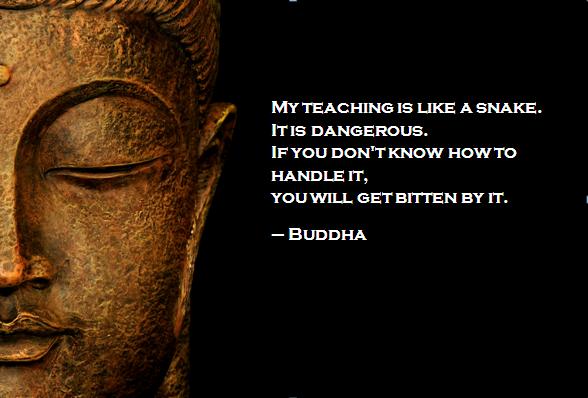
The Buddha said, “Even the Dharma has to be thrown away, not to mention the non-Dharma”. Sometimes he went further. He said that, “My teaching is like a snake. It is dangerous. If you don’t know how to handle it, you will get bitten by it.”
One day in a meeting, a Zen master said this: “Dear friends, I am allergic to the word ‘Buddha.’ You know, he is a Zen master, and he talks about the Buddha like that. “Every time I am forced to utter the word ‘Buddha’ I have to go to the river and rinse my mouth three times.” And many people were confused, because he was a Buddhist teacher. He was supposed to praise the Buddha. Fortunately there was one person who understood in the crowd. She stood up and said, “Dear teacher, every time I hear you pronouncing the word ‘Buddha’, I have to go to the river and wash my ears three times.” This is a Buddhist example of a good teacher and a good student!
References:
- Buddha Mind, Buddha Body — Thich Nhat Hanh (Book)
See Also:
 The Intuitive Physicist
I am not able to understand the last paragraph…can you explain what it is trying to say. Is it that its telling us to leave the “word” which is just information and go towards the real “meaning” which will lead to real knowledge.
I’m not sure if I understood the last paragraph completely, though I agree with the theme (and the title) of the topic. I’ve also arrived at the same conclusion but in the domain of scientific knowledge. Every scientific discovery/fact/theory makes it more difficult for the unknowns to be discovered, because as it has been seen that the new facts are often discovered at the cost of the so-called established facts. If you don’t doubt and are not willing to give up the established facts, it is very less likely that you will discover the new ones, the more refined ones!
@Sarfaraz:
Great! I am glad to see your comment. You are right in saying that our previous knowledge hinders our new observations. This concept in Science is known as “Theory Ladenness of Observation”. Read following articles to explore more into this idea:
Click to access Theory_Laden.pdf
The Theory Ladenness of Observation and the Theory-Ladenness of the Rest of the Scientific Process — William F. Brewer, Department of Psychology, University of Illinois at Urbana-Champaign.
@Sarfaraz and Pratibha:
There are several things hidden in the last paragraph.
1. Meaning is more important than the word.
2. Repeating the word again and again may give one and others the impression that one knows the meaning as well, which may not be the case. But if one assumes that one knows the meaning without really knowing the meaning then such knowledge is like a snake. It is dangerous. It keeps biting you. When one assumes that one knows without knowing then he also wants others to accept that he knows and then starts all the domination and violence. Hence is the danger.
So there is a need to rinse your mouth and ears when words starts giving you the impression that you know without really knowing it 🙂
I hope you got the meaning now 🙂
Pingback: Set the Beliefs Right! | Tribulations of A Fledgling Mind