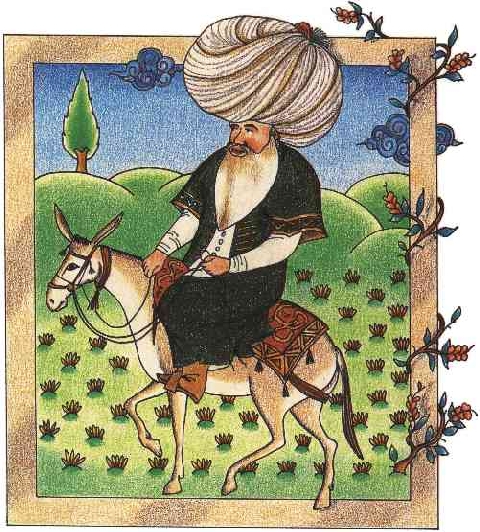
The philosophers, logicians and doctors of law were drawn up at court to examine Mulla Nasrudin. This was a serious case, because he had admitted going from village to village saying: ”The so-called wise men are ignorant, irresolute and confused.” He was charged with undermining the security of the state.
”You may speak first,” said the King.
”Have paper and pens brought,” said the Mulla.
Paper and pens were brought.
”Give some to each of the first seven savants.”
They were distributed.
”Have them write separately an answer to this question:
’What is bread?’”
This was done. The papers were handed to the King, who read them out:
The first said: ”Bread is a food.”
The second: ”It is flour and water.”
The third: ”A gift of God.”
The fourth: ”Baked dough.”
The fifth: ”Changeable, according to how you mean ’bread’.”
The sixth: ”A nutritious substance.”
The seventh: ”Nobody really knows.”
”When they decide what bread is,” said Nasruddin, ”It will be possible for them to decide other things.
For example, whether I am right or wrong. Can you entrust matters of assessment and judgement to people like this? Is it or is it not strange that they cannot agree about something which they eat each day, and yet are unanimous that I am a heretic?”
Yes, that is the situation of your so-called philosophers, theologians, doctors of law: the learned people. They are parrots. They have not even known themselves yet – what else can they know? They are not even acquainted with themselves – how can they be acquainted with others? They have not unraveled the mystery that they are.


Mulla Nasrudin, spreading wisdom in most surprising ways! 🙂 Thanks for sharing this story !! 🙂 🙂
Thanks for the comments Vrikmace 🙂
Keep reading and commenting.
its naive to dismiss or ridicule the experts. as a student, you cant afford the attitude. moreover in few years time, you yourself would be considered an expert in human values.
in your story, each expert gave a dimension of bread. the bread exists in multiple dimensions, in multiple contexts. as a student, you need to understand all the dimensions.
Thanks for the comments Anonymous 🙂
Well, what I have written can also be considered as one of the “important” dimensions of experts. It should also be kept in mind when dealing/learning with the experts, even as a student. As a student if I am not aware of this dimension then I may also become an “expert”, which at least I do not intend to become 🙂
Apart from above, I wish to add, in life when one has to take concrete decisions, in which “One Conclusion/Belief/Assumption” has to be taken in order to move ahead. If these different dimensions from experts help me in moving head with confidence in life, then it is well and good, but if it makes me more confused and uncertain in my daily life then it is not acceptable. Or if one keeps knowledge and life separate and then do these discussions for the sake of knowing different dimensions then it is one’s own choice. I must mention that it is not my choice.
Finally, I feel as an student I should also appreciate the dimension which I have put in the post, while appreciating the dimensions in which savants talk. I feel I am able to do it.
Thanks,
Devansh
The takeaway for me in the story is that, “There are always differing opinions, they may not all be wrong. So do not ever dismiss something just because it diverges from your perspective of things.”
However, there are sometimes “opinions” which are just that.
Thanks for your comment Kartik 🙂
What you said is also right. There are some more take away for me.
1. Different perspectives may facilitate learning as well as confusion. One should be aware of this aspect of knowing several dimensions.
2. Without knowing myself I cannot know others.
3. In life one has to take concrete decisions in which perspective may hinder one’s confidence to move ahead. One wants confidence, which comes from knowing the reality. Knowing different perspective may also create an illusion as if there is no reality and only the perspectives exist.
4. It also shows the kind of discussions generally happen in philosophy and humanities departments in various colleges.
5. Somewhere we have reduced knowledge as just an intellectual exercise than a thing to make life and world more happy. Intellectual exercise doesn’t help one in living a life, it only gives a mere intellectual arrogance of “knowing”.
Devansh
Well, if arrogance makes you happy, why not? 🙂
@plumenator: Then go ahead and enjoy! 🙂
Mulla Nasruddin ji .. glad to see this new technique of expressing things .. I must appreciate your attempt by a story … keep up the spirit …
I would suggest you to read some short stories of birbal etc .. and how they have been written non-controversially, yet conveying the point they want to convey …
All the best ..
Also I have one suggestion for you (free advise!) .. try creating a blog/website anonymously .. people have already some judgement about you .. so while looking at you from that purdah .. they might discard even some things they like .. try it doing anonymously .. and you can try seeing if the responses are different there ..
Thanks for the comment Bhaiyya 🙂
Your suggestions are good.
There are curtains of both the kinds. Some read the post because it is written by Devansh, some discard it because it is written by Devansh 🙂
This is life 😐
With Regards,
Devansh
Good post Devansh.
Another (perhaps orthogonal) thought related to this issue. A lot of people spend their lives trying to learn the rules and do things according to the so-called “system”.
Like, let’s say how to check-in at the airport. Having this information is pretty useless because it’s less universal and very time bound. Maybe 100 years from now, we wont have airports and our cars themselves will fly. Instead they should concentrate on more meaningful things, which are universally true.
Someone gave an example of Birbal. Creations like Birbal or Panchtantra or Chanakya or Rahim’s writings or Kabeer’s doha are relevant even today because they deal with such universally applicable topics.
Devansh,
I disagree with you here. I think, you’ve set up a very good example of a straw man argument in the form of the following question:
>> is it not strange that they cannot agree about something which they eat each day, and yet are unanimous that I am a heretic?
I don’t think their answers disagree on something which they eat everyday. You understood them incorrectly. 🙂
I’m sure the guy who said “bread is a food” would agree with the guy who said “it is flour and water”. He would also agree with the other guy who instead said “it is a nutritious substance”, or the guy who said “its a gift from God” (assuming he believes in God).
I mean each of them can easily see that others’s answer don’t necessarily contradict his answer. Each of the answers provides different level of description: “bread is a food” is a higher level description while “it is a flour and water” and “it is a nutritious substance” are lower level descriptions of “bread”.
Apart from that, the context of a question also matters. For example, “bread is a noun. it consists of 2 vowels and 3 consonants; it spells as B-R-E-A-D” is also a valid answer :D. In fact, this answer would particularly be relevant if the question was asked by an English teacher in a classroom.
Hope you got my point. 🙂
—-
By the way, what is straw man argument?
Answer : http://en.wikipedia.org/wiki/Straw_man
Thanks a lot for the comment Sarfaraz 🙂
Now I see a philosopher talking 🙂 I am glad to your beautiful comment. Kindly keep reading and commenting 🙂
I feel I got your point and I am in agreement with your argument. What I wish to add is, in life to take daily life decisions we need to have concrete decisions in order to move ahead. This post also shows the general tendency of a savant that he is a bunch of opinions and he takes pleasure into this opinions themselves and these opinions have no connection with his daily life. What I mean is, knowledge when is being used just for the sake of intellectual exercise then it is of no use. Knowledge is to be used in daily life.
It is also true that the different opinions as made by 7 seven savants are not in contradiction with each other, in this case, but in many cases they are also in contradiction. They sometimes makes things unnecessarily complicated, which is not required.
It also shows the kind of general discussions happen in between savants, in which just a debate happens and comes out no concrete result in the end, which doesn’t lead to any relation with the daily life. It brings a separation between knowledge and daily life. These two things are not separate, they are for each other.
A very enlightening article indeed. Since the time immemorial, great thinkers, philosophers and scientists have been laughed at and ridiculed by the society.
Thanks Ashwin for the comment 🙂
Kindly keep reading and commenting 🙂
Sure!
Nice!